Essay
Your Brain Isn’t Built for Meetings. Here’s How AI Fixes That.
Dr. Jerry A. Smith · November 5, 2025 · 14 min read
Author note: I’ve spent the past two years building real-time AI transcription systems and studying their cognitive effects. This isn’t a product pitch — it’s an analysis of what happens when we offload cognitive work to machines, based on neuroscience research and direct observation.
Listen to the article on Apple Podcasts
Listen to the article on Soundcloud
You’re 20 minutes into a strategy meeting. The VP is talking about Q2 priorities. You’re trying to listen while simultaneously typing notes, glancing at Slack, monitoring the clock, and formulating your response for when they ask your opinion.
Your laptop has 14 tabs open. Your brain has 14 thoughts competing for attention.
You’re doing everything at once — which means you’re doing nothing well.
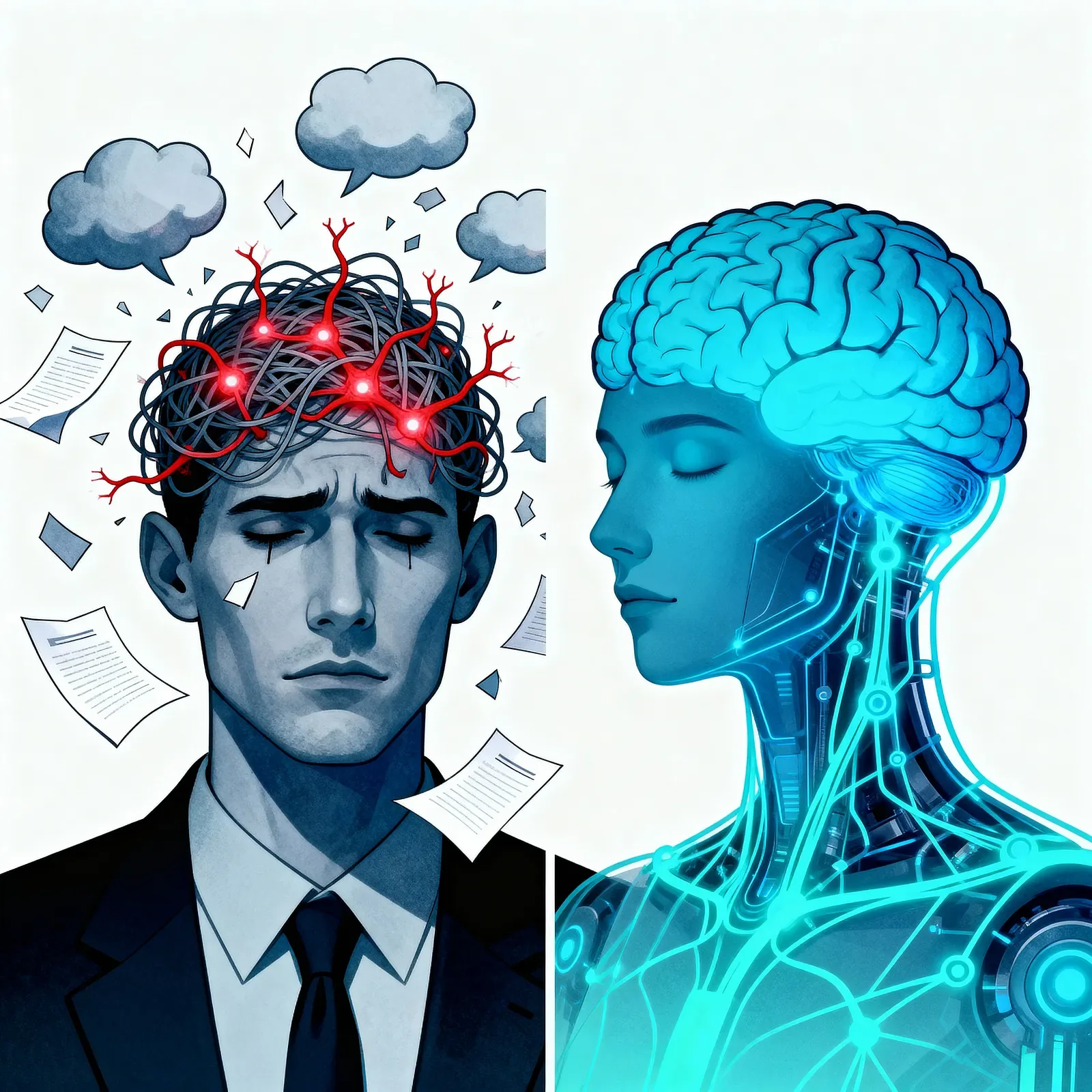
Here’s what your brain is actually experiencing: cognitive overload. Not because you’re bad at meetings. Because meetings are neurologically impossible.
But here’s the fascinating part: new AI systems are fundamentally changing how our brains work during conversations. Not by making us smarter — by making us less stupid.
Your Brain Can Hold About 4 Things at Once. Meetings Demand 12.
Let’s start with an uncomfortable truth: your working memory has hard limits.
Cognitive scientist Nelson Cowan’s research indicates that human working memory can hold approximately 4 ± 1 chunks of information at any given moment. That’s it. Not 10. Not 20. Four.
Now look at what meetings actually demand:
- Listening and comprehending what’s being said
- Formulating your response
- Taking notes
- Remembering the earlier context
- Monitoring who’s talking and for how long
- Tracking action items
- Watching the time
- Reading social cues
- Staying present
That’s not four things. That’s 12. You’re running at 300% capacity.
Imagine your brain is a juggler. Four balls? No problem. But meetings hand you 12 balls and expect you to juggle while also riding a unicycle and solving math problems.
This isn’t a personal failing. It’s a design flaw. Your brain evolved for hunter-gatherer tribes of 50 people, not Zoom calls with 12 stakeholders discussing API architecture.
Writing It Down Doesn’t Mean You’re Learning It
Here’s where it gets worse. You think note-taking solves the problem, right? Capture everything, review later, you’re good.
Wrong.
Research by Pam Mueller and Daniel Oppenheimer at Princeton found something startling: students who took more detailed notes actually remembered less. Not more. Less.
Why? Because note-taking uses transcription mode, not encoding mode.
Your fingers are typing. Your brain isn’t processing. You’re creating a document you’ll probably never read about a conversation you won’t remember.
Studies on note-taking and memory indicate that retention declines significantly over time. Kenneth Kiewra’s review of note-taking research found that without active review and encoding strategies, detailed information fades rapidly — with the sharpest decline in the first 48 hours.
Let’s do the math: If you spend 20 hours per week in meetings and retain a fraction of the information, you’re wasting substantial cognitive effort every single week.
You’re spending half your work week in a state of neurological overload that guarantees poor encoding.
The Hidden Costs You Can’t See
The memory loss is bad enough. However, cognitive overload creates three additional problems that are even more severe.
You Can’t Think Strategically Under Load
Daniel Kahneman’s research on thinking systems shows that strategic reasoning requires System 2 thinking — slow, deliberate, analytical. But System 2 needs cognitive space to operate.
When your working memory is maxed out, you default to System 1: fast, automatic, shortcut-driven thinking.
Translation: Strategic decisions made during cognitively overloaded meetings are systematically compromised. Your best thinking never happens because there’s no room for it.
Whitney et al.’s research on decision-making under cognitive load demonstrates that working memory constraints lead to increased reliance on heuristics and heightened susceptibility to framing effects.
You Have Zero Self-Awareness
Here’s an uncomfortable experiment: Estimate what percentage of the meeting time you spoke in your last team discussion.
Got a number? You’re probably wrong.
Research on metacognitive accuracy shows that people consistently overestimate their listening and underestimate their speaking time. The Dunning-Kruger effect applies to communication: those who need the most feedback are often the least aware of their own need for it.
Even worse: Your voice betrays your mental state in ways you can’t consciously monitor. Research on vocal expression of emotion (Scherer et al., 2003) shows that pitch variance increases with stress and emotional arousal. Studies on speaking rate and cognitive load (Bone et al., 2014) demonstrate that temporal features of speech correlate with internal states — but you literally cannot hear these changes in yourself while you’re talking.
You think you’re listening well. You might be dominating the conversation. And no one will tell you.
Knowledge Evaporates Into Organizational Amnesia
Without proper encoding, institutional knowledge disappears. Teams re-litigate the same decisions endlessly.
The cycle looks like this:
- Discuss an issue
- Make a decision
- Forget the context
- Six weeks later: “Wait, why did we decide that again?”
- Discuss the same issue again
Research on transactive memory systems (Lewis & Herndon, 2011) shows that organizational knowledge depends on shared encoding and retrieval. When people forget decisions, the entire system breaks down.
This isn’t just annoying. It’s expensive. Atlassian research estimates that $37 billion is lost annually to unproductive meetings — much of it from this exact problem.
What Happens When AI Takes Over the Grunt Work
Here’s the experiment: What if you stopped taking notes entirely?
What if an AI transcribed everything, identified decisions, tracked action items, and analyzed group dynamics — all in real-time while you just… participated?
This is where the research gets interesting. And where we need to think carefully about both benefits and costs.
Benefit #1: Working Memory Liberation
The Promise
When AI handles transcription, the cognitive load reduction should be substantial. In theory, you reclaim the working memory capacity previously allocated to note-taking.
Early observational data suggest this happens. Users of real-time transcription systems report subjective increases in presence and strategic thinking. One executive described it this way: “For the first time in years, I was actually listening. Not performing listening while secretly taking notes. Actually hearing what people said.”
Instead of documenting the meeting, you’re present in it.
The Problem: Attention Fragmentation
But monitoring AI outputs during conversation creates a second attention channel. You’re simultaneously:
- Listening to the speaker
- Reading AI-generated summaries
- Checking if the transcription is accurate
- Glancing at speaking time metrics
This isn’t cognitive offloading. It’s cognitive doubling.
Research on dual-task interference (Piolat et al., 2005) indicates that dividing attention between related tasks impairs both tasks. The cost might be smaller than manual note-taking, but it’s not zero.
The question: Does freed working memory get reallocated to higher-order thinking, or does it just create space for distraction? Should feedback be asynchronous (post-meeting) rather than real-time?
This needs rigorous empirical validation. We need controlled studies comparing decision quality, strategic insight generation, and memory retention with and without AI assistance during active conversation.
Benefit #2: Metacognitive Feedback
The Promise
Real-time feedback on speaking time, vocal features, and participation patterns creates something unprecedented: data-driven self-awareness.
Imagine seeing your speaking time as a percentage of the total conversation. Or monitoring your vocal stress markers — pitch variance, speaking rate, pause frequency — as they happen.
The feedback loop is immediate: Awareness → Adjustment → Better behavior.
One executive I observed saw that he dominated supposedly “collaborative” meetings. His behavior changed dramatically.
The Problem: Performative Anxiety
But does this improve group dynamics or create performative anxiety?
Another user reported feeling “watched” and less willing to speak spontaneously. She described constantly monitoring her metrics: “Am I talking too much? Not enough? Is my pitch variance showing stress?”
The technology creates awareness. Whether that awareness improves outcomes depends on context, personality, and implementation.
There’s also a deeper question about authenticity. When you’re monitoring your own communication metrics in real-time, are you being more authentic (correcting unconscious biases) or less authentic (performing for the algorithm)?
Research on self-monitoring and spontaneity (from social psychology) suggests a trade-off: increased self-awareness often disrupts the natural flow of communication. High self-monitors are better at adapting their behavior but may appear less genuine.
The question: Can we design feedback systems that improve behavior without inducing self-consciousness? Should metrics be visible only to the individual, or shared with the group? Should feedback be continuous or intermittent?
Benefit #3: Institutional Memory
The Promise
AI creates a queryable record of all meetings. “When did we decide to prioritize feature X?” → Instant answer with full context.
This solves the re-litigation problem. No more “I thought we agreed on Y.” No more onboarding where new hires reconstruct decisions from cryptic Slack threads.
Knowledge doesn’t evaporate. It accumulates.
The Problem: Privacy, Permanence, and Power
But permanent recording creates serious risks.
The Privacy Problem
Everything you say is captured. That data lives somewhere. Who owns it? Who can access it? Can it be subpoenaed? Used for performance reviews? Sold to third parties?
The technology is value-neutral. The implementation isn’t.
In a high-trust environment with clear consent and data governance, AI transcription could be liberating. In a low-trust environment with surveillance culture, it’s dystopian.
Technical mitigations exist:
- End-to-end encryption (only participants have decryption keys)
- Ephemeral transcripts (auto-delete after 30 days unless explicitly saved)
- Selective recording (only capture segments users explicitly tag)
- Local processing (transcription happens on-device, never sent to cloud)
- Anonymization (speaker labels removed, only content preserved)
Policy frameworks are also essential:
- Explicit opt-in consent (not opt-out or assumed)
- Individual data ownership (each participant controls their own contributions)
- Right to deletion (remove your contributions from shared transcript)
- Usage restrictions (transcript cannot be used for performance evaluation without separate consent)
- Third-party audit (independent review of data handling practices)
But these protections only work if implemented. Many commercial systems prioritize convenience over privacy. The EU’s GDPR provides some guardrails. The US essentially doesn’t.
The Context Collapse Problem
A decision made in one context gets cited in another where it doesn’t apply. “But the transcript from Q2 planning shows we agreed to X” becomes a weapon when X was conditional on circumstances that changed.
Perfect memory is literal. Human memory is interpretive. We remember the gist, the emotional tone, the conditional nature of decisions. Transcripts preserve words but lose context.
The Permanence Anxiety Problem
If everything is recorded forever, do people self-censor? Do they avoid necessary but uncomfortable conversations? Do they speak in careful, lawyerly language rather than thinking out loud?
There’s value in ephemerality. In knowing that not every word will be preserved and scrutinized. In the freedom to brainstorm, speculate, and revise without creating a permanent record.
The question: How do we get the benefits of institutional memory without the chilling effects of permanent surveillance? Can we design systems with graduated permanence — some things remembered, while others are forgotten?
Benefit #4: Extended Cognition
The Promise
In 1998, philosophers Andy Clark and David Chalmers proposed the Extended Mind Hypothesis, which posits that external tools become part of cognition when they’re reliably integrated into our thought processes.
Their example: Is Otto’s notebook (where he writes everything due to memory loss) part of his memory? If it functions like memory — always accessible, automatically consulted, trusted — then yes, it IS his memory.
AI transcription meets those criteria:
- Always accessible during and after meetings
- Automatically invoked (no manual activation)
- Potentially trusted as much as biological memory
Your memory isn’t just in your skull anymore. It’s distributed across your biology and your AI assistant.
This creates something researchers call “emergent intelligence” — capabilities that emerge from human-AI collaboration that neither human nor AI possesses alone.
The Problem: Cognitive Atrophy and Dependency
However, the Extended Mind Hypothesis is a subject of controversy. And the risks are real.
The “Use It or Lose It” Problem
If AI always remembers for us, do we lose the ability to remember for ourselves?
The answer from neuroscience is: yes. Memory is strengthened through retrieval practice. When we stop practicing retrieval (because AI provides instant answers), those neural pathways weaken.
The Google effect research by Betsy Sparrow et al. (2011) demonstrates this: knowing information is accessible reduces our drive to remember it. We externalize memory to the internet, losing the ability to retrieve it without it.
But we’ve been externalizing memory for millennia. Writing didn’t destroy oral memory — it changed what we memorize. We stopped memorizing epic poems and started memorizing concepts and relationships.
The question: What kinds of memory should remain biological, and what can we safely externalize? Where’s the line between helpful augmentation and harmful dependency?
We should remember that a decision was made and where to find it, but externalize the precise details. We should encode emotional context and strategic rationale, but offload the tactical specifics.
We need research on differential memory externalization — which cognitive functions benefit from augmentation and which atrophy dangerously.
The Autonomy Problem
Mark Rowlands argues in The New Science of the Mind that extended cognition changes the nature of thinking itself. We’re not just using tools more efficiently. We’re becoming different kinds of cognitive agents.
Is that good? It depends on what we value.
If we value efficiency and accuracy, extended cognition is clearly beneficial. But if we value autonomy — the ability to think independently without external supports — then dependency on AI is concerning.
When the AI system goes down, are you cognitively impaired? If your company switches platforms and you lose access to years of meeting transcripts, have you lost part of your memory?
The question: How do we maintain cognitive autonomy while benefiting from augmentation? Can we design systems that enhance capacity without creating dependency?
The Inequality Problem: Cognitive Class Systems
Here’s a concern that rarely gets discussed: cognitive augmentation is expensive.
High-quality AI transcription, real-time analysis, and seamless integration aren’t free. Enterprise systems can cost thousands of dollars per user per year. Individuals pay hundreds for consumer versions that lack sophisticated features.
Who gets access?
Historical Parallels
We’ve seen this pattern before:
- Literacy: For centuries, only elites could read. Literacy was a massive cognitive advantage. Universal education democratized it.
- Computing: In the 1980s, computer literacy was a class marker. Public investment in computer labs and internet access helped close the gap.
- Smartphones: Initially luxury items, now nearly universal (though digital divide persists).
Each technology followed an S-curve: early adopters paid premium prices, costs declined, and access broadened. However, there’s always a lag — a period during which those with access gain compounding advantages.
Cognitive augmentation follows this pattern. Today, it’s senior executives and well-funded teams. Tomorrow, it might be universal. But today’s gap matters.
Compounding Advantages
Those with AI assistance:
- Make better decisions faster (less cognitive load)
- Retain more institutional knowledge (perfect memory)
- Develop better communication skills (metacognitive feedback)
- Build more strategic thinking capacity (freed working memory)
Those without:
- Continue operating at cognitive overload
- Lose decisions to organizational amnesia
- Lack data-driven feedback on behavior
- Use working memory for transcription instead of synthesis
Over time, this creates a cognitive class system. Those with augmentation pull ahead. Those without fall further behind. The gap widens.
Interventions
How do we prevent this?
Policy options:
- Public investment: Government-funded cognitive augmentation for schools, libraries, and the public sector
- Open source: Development of free, privacy-respecting alternatives to commercial systems
- Regulation: Mandate that AI tools meet accessibility standards and offer subsidized tiers
- Workplace equity: Companies that deploy AI systems must provide them universally, not just to executives
Technical options:
- Lightweight implementations: Browser extensions and mobile apps that work without expensive infrastructure
- Cooperative ownership: User-owned platforms where costs are shared, not extracted
- Tiered functionality: Basic cognitive offloading free, advanced analytics paid
This isn’t just about fairness. It’s about collective intelligence. When only 10% of the population has cognitive augmentation, we underutilize 90% of human potential. When it’s universal, we raise the baseline for everyone.
The question: Will we treat cognitive augmentation as a luxury good or a public utility? The answer will determine whether it reduces inequality or amplifies it.
What We’re Really Talking About
This isn’t about productivity hacks. It’s about fundamental questions:
What is cognition when it’s distributed across biological and artificial systems?
What is memory when it’s externalized and permanent?
What is a meeting when every word is captured, every decision tracked, every social dynamic quantified?
Andy Clark’s "Natural-Born Cyborgs" argues that humans have always been tool-users who integrate technology into their cognition. We’ve never been purely biological thinkers. From language to writing to smartphones, we’ve constantly extended our minds.
AI transcription is the next step in that evolution. Not a revolution — a continuation.
But continuation doesn’t mean inevitability. We get to choose how to integrate these tools. We get to decide which cognitive functions to augment and which to preserve in their biological form.
The research is clear: meetings exceed cognitive capacity. Note-taking impairs encoding. Memory fades. Self-awareness is limited.
AI can address all of these problems. But it introduces new ones: attention fragmentation, cognitive atrophy, privacy erosion, performative anxiety, and inequality.
The question isn’t whether to use AI. It’s about using it wisely.
Where We Go From Here
We need more research, not from vendors selling products, but from cognitive scientists studying actual outcomes.
We need:
- Controlled studies comparing decision quality with and without AI assistance
- Longitudinal research on memory retention in augmented vs. non-augmented workers
- Attention studies measuring cognitive load during real-time vs. post-meeting review
- Social research on group dynamics when meetings are recorded and analyzed
- Policy frameworks for ethical implementation and data governance
- Equity research on access patterns and interventions to prevent cognitive class systems
We also need humility. The Extended Mind Hypothesis is compelling, but it’s not settled science. The benefits of cognitive offloading are real, but so are the risks.
Your brain wasn’t built for modern meetings. That’s true.
AI can help. That’s also true.
However, the future we’re building depends on the choices we make now: Will we design these systems for human flourishing or corporate exploitation? For universal access or elite advantage? For autonomy or dependency? For privacy or surveillance?
The technology is here. The cognitive revolution has begun. What matters now is: What kind of cyborgs do we want to become?
References & Further Reading
- Bone, D., Lee, C. C., & Narayanan, S. (2014). Robust unsupervised arousal rating. IEEE Transactions on Affective Computing
- Clark, A. (2003). Natural-born cyborgs: Minds, technologies, and the future of human intelligence
- Clark, A., & Chalmers, D. (1998). The extended mind. Analysis
- Cowan, N. (2001). The magical number 4 in short-term memory. Behavioral and Brain Sciences
- Kahneman, D. (2011). Thinking, Fast and Slow
- Kiewra, K. A. (1989). A review of note-taking: The encoding-storage paradigm and beyond. Educational Psychology Review
- Lewis, K., & Herndon, B. (2011). Transactive memory systems. Organization Science
- Mueller, P. A., & Oppenheimer, D. M. (2014). The pen is mightier than the keyboard. Psychological Science
- Piolat, A., Olive, T., & Kellogg, R. T. (2005). Cognitive effort during note taking. Applied Cognitive Psychology
- Rowlands, M. (2010). The New Science of the Mind: From Extended Mind to Embodied Phenomenology
- Scherer, K. R., Johnstone, T., & Klasmeyer, G. (2003). Vocal expression of emotion. Handbook of Affective Sciences
- Sparrow, B., Liu, J., & Wegner, D. M. (2011). Google effects on memory. Science
- Whitney, P., Rinehart, C. A., & Hinson, J. M. (2008). Framing effects under cognitive load. Psychonomic Bulletin & Review