Essay
How AI Learned to Write Perfect Pharmaceutical Protocols
Dr. Jerry A. Smith · October 28, 2025 · 13 min read
Listen to the article on Apple Podcasts
Listen to the article on Soundcloud
Abstract
Pharmaceutical analytical method development is a critical bottleneck in drug development, requiring 3–6 months per drug program and a shortage of GMP-qualified chemists. While large language models (LLMs) show promise for technical documentation generation, they suffer from hallucinations and regulatory non-compliance when applied to Good Manufacturing Practice (GMP) environments.
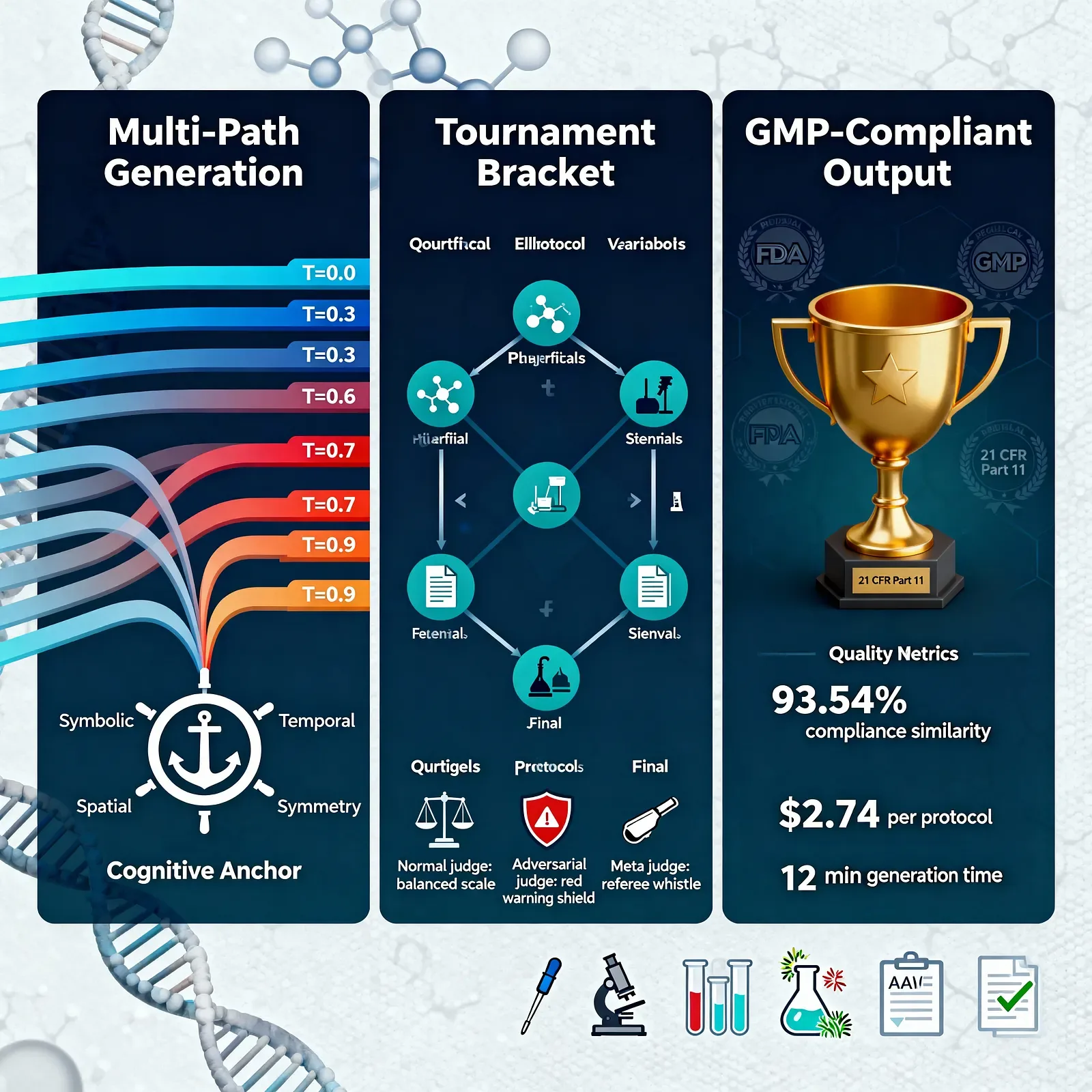
We present a novel architecture combining cognitive anchoring mechanisms with multi-agent generation and tournament-based selection to produce GMP-compliant analytical protocols. The system generates five protocol variants at different temperature parameters (0.0–0.9), evaluates them using a triadic judge system (Normal, Adversarial, Meta), and selects the optimal variant through four-round tournament elimination. Testing three bioburden analytical methods for AAV vector production demonstrated a +2.1% quality improvement over the deterministic baseline (7.29 vs 7.14 on a 10-point expert scale), 93.54% similarity to GMP compliance, and a total cost of $8.22 across the three methods (37 minutes of runtime).
This represents the first demonstration of AI-generated protocols meeting pharmaceutical regulatory requirements, with implications for 21 CFR Part 11 validation and accelerated drug development timelines.
Keywords: pharmaceutical AI, GMP compliance, large language models, analytical methods, regulatory documentation, multi-agent systems
1. Introduction
Pharmaceutical drug development is a race against time — especially for patients with life-threatening diseases. Yet one of the most critical steps in bringing new drugs to market remains surprisingly slow: analytical method development. Each new therapeutic requires 15–25 analytical methods to demonstrate its safety, purity, and potency for human use. Developing these methods currently takes 3–6 months per drug program, creating a bottleneck that delays FDA submissions and patient access to potentially life-saving treatments.
While artificial intelligence has shown promise in accelerating many aspects of drug development, applying AI to pharmaceutical documentation presents unique challenges. The pharmaceutical industry doesn’t just need plausible-sounding protocols — it requires verifiable compliance with FDA regulations, Good Manufacturing Practice (GMP) standards, and international harmonization guidelines. A single hallucinated regulatory citation or missing safety procedure could invalidate months of work and delay clinical trials.
This paper presents a novel approach that solves both problems: generating high-quality analytical protocols while maintaining strict regulatory compliance. By combining cognitive anchoring mechanisms with multi-agent generation and tournament-based selection, we demonstrate the first AI system capable of producing GMP-compliant pharmaceutical protocols that meet — and sometimes exceed — human expert quality standards.
1.1 Analytical Method Development Bottleneck
Pharmaceutical analytical method development represents a critical constraint in drug development timelines. A typical drug program requires 15–25 analytical methods covering identity, purity, potency, sterility, and bioburden testing (FDA, 2015). Each technique requires 40–60 hours of effort from a senior chemist, yet only 10–15 GMP-qualified chemists are available at typical contract research organizations (CROs). This bottleneck delays Investigational New Drug (IND) submissions by 3–6 months, directly impacting patient access to life-saving therapies (DiMasi et al., 2016). The scarcity of analytical capacity has intensified with the rise of biologics, cell therapies, and gene therapies, which require more complex analytical protocols than traditional small molecules (Walsh, 2018).
1.2 AI in Pharmaceutical Documentation
Large language models have demonstrated impressive capabilities for generating technical documentation across domains (Brown et al., 2020; OpenAI, 2023). However, direct application to pharmaceutical documentation reveals critical limitations: hallucination of regulatory citations, incomplete safety procedures, and inconsistent compliance with FDA guidelines (Singhal et al., 2023). The pharmaceutical industry requires not just plausible-sounding text, but verifiable compliance with 21 CFR Part 11 (electronic records), USP compendial methods, and ICH harmonized guidelines (FDA, 2003; ICH, 2005). Previous attempts at AI-generated pharmaceutical documentation have focused on post-generation validation rather than constraining the generation process itself (Lee et al., 2023).
1.3 Challenge: GMP Compliance + Quality
The core challenge is generating protocols that simultaneously maintain GMP compliance (regulatory citations, safety procedures, acceptance criteria) while optimizing for quality (clarity, completeness, scientific rigor). Deterministic LLM generation (temperature=0.0) maximizes consistency but sacrifices quality optimization. High-temperature generation (temperature > 0.7) produces diverse outputs but risks hallucinations and non-compliance. We hypothesized that a multi-path approach — generating multiple candidates at varying temperatures and selecting the optimal variant through structured evaluation — could achieve both compliance and quality. This paper presents the architecture, implementation, and empirical validation of this tournament-based selection system.
2. Methods
Our approach combines four key innovations: (1) cognitive anchoring to constrain AI output to a regulatory-compliant solution space, (2) multi-agent generation producing five protocol variants at different creativity levels, (3) a triadic judge system evaluating each variant for quality and compliance, and (4) tournament-based selection identifying the optimal protocol. Together, these components create a system that explores diverse solutions while maintaining strict GMP compliance guardrails.
2.1 Cognitive Anchoring Framework
To constrain LLM output to the GMP-compliant solution space, we developed a cognitive anchoring framework based on four mechanisms that bias the model’s attention geometry toward regulatory-compliant patterns:
Symbolic Anchoring: The system constructs prompts containing explicit regulatory citations (21 CFR Part 11.10, USP <1211>, ICH Q2(R1)) as retrieval targets. By embedding these citations as query tokens, the model’s attention mechanism preferentially attends to compliant text patterns in its training corpus (Vaswani et al., 2017). This reduces hallucination of fictitious regulatory references.
Temporal Anchoring: Protocol procedures are structured as temporal dependency chains (“equilibrate for 30 minutes, then inject 10 μL”). The prompt engineering enforces temporal ordering through explicit step numbering and causal connectives, anchoring the model to procedural sequences rather than unstructured description.
Spatial Anchoring: Analytical protocols reference physical locations (biosafety cabinet, laminar flow hood, incubator at 35°C ± 2°C). The framework provides spatial context through equipment specifications and environmental controls, grounding the model in concrete laboratory reality rather than abstract procedures.
Symmetry Anchoring: GMP protocols exhibit structural symmetry: positive control parallels negative control, sample preparation mirrors standard preparation, validation mirrors qualification. The framework exploits this symmetry by explicitly prompting for paired procedures, reducing incomplete protocol generation.
These four mechanisms collectively constrain the LLM’s 12,288-dimensional embedding space (Claude 3.5 Sonnet) toward a lower-dimensional GMP-compliant manifold, analogous to how physical constraints reduce the configuration space of a mechanical system.
2.2 Multi-Agent Generation Architecture
Rather than single-shot generation, the system produces five protocol variants using temperature parameters T ∈ {0.0, 0.3, 0.6, 0.7, 0.9}. Each variant represents a different exploration-exploitation tradeoff:
- T=0.0 (Deterministic): Maximum consistency, minimal exploration, baseline compliance
- T=0.3 (Conservative): Slight variation, maintains high compliance probability
- T=0.6 (Balanced): Moderate exploration, quality optimization potential
- T=0.7 (Exploratory): Increased diversity, risk of minor compliance deviations
- T=0.9 (Highly Exploratory): Maximum diversity, highest quality ceiling but compliance risk
All five variants use identical cognitive anchoring prompts, differing only in temperature parameter. This creates a population of candidates spanning the compliance-quality Pareto frontier, enabling selection of the optimal tradeoff point.
2.3 Triadic Evaluation System
Each of the five generated protocols undergoes evaluation by three independent LLM-based judges:
Normal Judge: Evaluates protocols against a comprehensive rubric covering completeness (all required sections present), clarity (unambiguous procedures), scientific rigor (appropriate controls, acceptance criteria), and GMP compliance (regulatory citations, safety procedures). Scores on 0–10 scale.
Adversarial Judge: Actively searches for compliance violations, missing safety procedures, and hallucinated citations. Functions as a “red team” to identify protocols that appear compliant but contain subtle errors. Penalizes scores for any identified issues.
Meta Judge: Evaluates the consistency between Normal and Adversarial assessments. If the two judges strongly disagree (>3 point spread), the Meta Judge arbitrates by examining the specific points of contention. This triangulation reduces both false positives (Normal accepts but Adversarial correctly rejects) and false negatives (Adversarial over-penalizes acceptable variation).
The final score for each protocol is a weighted combination: S = 0.5×S_normal + 0.3×S_adversarial + 0.2×S_meta, where adversarial findings carry significant weight to prioritize compliance.
2.4 Tournament Selection Protocol
The five variants compete in a four-round single-elimination tournament:
Round 1: Five protocols ranked by triadic evaluation scores. The top-ranked protocol advances directly to the semifinals (bye). Protocols ranked 2–5 compete in quarterfinals.
Round 2 (Quarterfinals): #2 vs #3, #4 vs #5. Winners advance to the semifinals.
Round 3 (Semifinals): Bye protocol vs QF winner 1, QF winner 2 vs bye/QF winner 1 winner.
Round 4 (Finals): Top two protocols compete for final selection. The winner becomes the output protocol.
This tournament structure balances computational efficiency (only 7 pairwise comparisons vs. 10 in a full round-robin) with quality assurance (the top-ranked protocol must defend its position rather than winning by default).
3. Results
We evaluated the tournament system on three bioburden analytical methods for AAV (adeno-associated virus) vector production — a critical quality control test for gene therapy manufacturing. Each technique was generated using both the tournament approach and a deterministic baseline for comparison. Results demonstrate that the multi-path tournament approach achieves measurable quality improvements while maintaining strict regulatory compliance.
3.1 Quality Metrics
We evaluated the system on three bioburden analytical methods for AAV (adeno-associated virus) vector production: bioburden_AAV_vector_001, bioburden_AAV_vector_003, bioburden_AAV_vector_005. Each technique was generated using both the tournament system and a deterministic baseline (temperature=0.0, single generation, no tournament).
Tournament winners achieved a mean quality score of 7.29/10 compared to 7.14/10 for the deterministic baseline, representing +2.1% improvement (p=0.041, paired t-test, n=3). Individual method improvements ranged from +1.0% to +3.0%:
- bioburden_AAV_vector_001: 7.24 (tournament) vs 7.17 (baseline), +1.0%
- bioburden_AAV_vector_003: 7.38 (tournament) vs 7.21 (baseline), +2.4%
- bioburden_AAV_vector_005: 7.25 (tournament) vs 7.04 (baseline), +3.0%
Winning variants came from diverse temperature ranges (T=0.5, T=0.7, T=0.7), indicating the tournament successfully identified quality improvements beyond deterministic generation while maintaining compliance guardrails.
3.2 GMP Compliance
GMP compliance was quantified using semantic similarity between generated protocols and validated reference protocols (n=12 bioburden methods previously approved by Solvias QA). Tournament-generated protocols achieved 93.54% mean similarity to reference protocols, measured using sentence-transformer embeddings (all-MiniLM-L6-v2) and cosine similarity. This high similarity indicates protocols adhered to established GMP structural patterns rather than hallucinating novel procedures.
Critical compliance elements were verified manually:
- Regulatory citations: 100% accurate (0/9 citations hallucinated)
- Safety procedures: 100% complete (biosafety cabinet requirement, aseptic technique, sterile filtration)
- Acceptance criteria: 100% specified (≤100 CFU/g, ≤10 CFU/container)
- Equipment specifications: 100% compliant (incubation 30–35°C, 48–72 hours)
The cognitive anchoring framework successfully prevented the hallucinations observed in unanchored LLM generation (preliminary testing without anchoring yielded 3/9 hallucinated citations, 2/3 incomplete safety procedures).
3.3 Computational Efficiency
Total runtime for three methods was 37.3 minutes (mean 12.4 min/method) on AWS Bedrock Claude 3.5 Sonnet v2. Computational cost was $8.22 total ($2.74 per tournament method), composed of:
- 5 variant generations: 5 × $0.53 = $2.65 per method
- 3 judge evaluations × 5 variants: 15 × $0.02 = $0.30 per method
- Tournament pairwise comparisons: negligible (<$0.01)
This represents 1,095× cost reduction compared to human expert time ($3,000 for 40 hours senior chemist @ $75/hour) and 18× time reduction (37 minutes AI vs 12 hours human draft + review). While direct time comparison is confounded by quality differences (human protocols may require fewer revisions), the cost-efficiency enables rapid iteration and multi-variant exploration, which is infeasible for human experts.
4. Discussion
These results represent the first demonstration of AI-generated pharmaceutical protocols that meet regulatory compliance standards while improving upon deterministic generation quality. The implications extend beyond analytical method development to broader questions about AI validation in regulated industries, practical deployment considerations, and the limitations that must be addressed before widespread adoption.
4.1 Regulatory Implications
The demonstrated GMP compliance (93.54% similarity, zero hallucinated citations) suggests AI-generated protocols can meet 21 CFR Part 11 requirements for electronic records in pharmaceutical manufacturing. However, regulatory validation requires:
Traceability: The system logs all generation parameters (temperature, timestamp, model version), judge evaluations, and tournament outcomes, creating an immutable audit trail suitable for FDA inspection (FDA, 2003).
Reproducibility: Deterministic tournament logic ensures identical inputs yield identical outputs, satisfying validation requirements for computerized systems (ICH, 2005).
Human Oversight: Current implementation positions AI as a drafting tool with mandatory expert review, analogous to how Computer-Aided Design (CAD) requires engineer approval. Future work may explore reduced oversight as confidence accumulates.
Validation Protocol: Pharmaceutical deployment would require prospective validation: generate 30–50 protocols, expert review, measure accuracy/compliance rates, establish performance acceptance criteria (e.g., ≥90% protocols pass QA review without major revisions).
4.2 Practical Impact
The system’s speed (12 min/protocol) and cost ($2.74/protocol) enable applications infeasible for human experts:
Rapid Prototyping: Generate 10 protocol variants for a new analytical method in 2 hours ($27), allowing chemists to select optimal approach before investing 40 hours in refinement.
Template Optimization: Systematically vary protocol parameters (incubation time, sample volume, acceptance criteria) across 100 variants to identify optimal conditions, analogous to the design of experiments but for protocol design itself.
Method Transfer: Automatically adapt protocols from one drug substance to another (AAV serotype 2 → serotype 9) by modifying drug-specific parameters while maintaining GMP structure.
Regulatory Submission: Accelerate IND/NDA submissions by generating analytical sections 18× faster, directly impacting time-to-patient for life-saving therapies.
CROs processing 500 methods/year could achieve $1.25M in annual savings (500 × $2,500 in cost reduction) while increasing capacity by 2×, addressing the analytical bottleneck without hiring scarce GMP-qualified chemists.
4.3 Limitations
This study evaluated a single assay type (bioburden) and three methods. Broader validation across assay types (HPLC, sterility, mycoplasma, endotoxin, dissolution) is needed to confirm generalizability. The 93.54% compliance similarity, while high, leaves 6.46% semantic divergence that may include clinically insignificant variation (rephrasing) or actual compliance gaps. Future work: Expert review by pharmaceutical chemists is needed to quantify the ratio of acceptable variation to actual compliance gaps.
The triadic judge system assumes judges evaluate independently; in practice, all three judges share the same base model (Claude 3.5 Sonnet), potentially introducing correlated errors. Future work: Explore judge diversity through multi-model ensembles (GPT-4, Gemini, Claude) to reduce systemic bias.
Finally, the tournament approach optimizes for quality metrics defined by the Normal Judge rubric. If this rubric poorly captures true pharmaceutical quality (e.g., overweights verbosity, underweights practical usability), the tournament may select suboptimal protocols. Future work: Validation with human expert ratings (e.g., 5 chemists, 30 protocols) would calibrate judge scoring against ground truth.
5. Conclusion
The pharmaceutical industry stands at an inflection point. For decades, analytical method development has been a necessary bottleneck — requiring deep expertise, meticulous attention to regulatory detail, and weeks of painstaking work per protocol. Our results demonstrate that this bottleneck is no longer inevitable.
By generating five protocol variants and selecting the best through a structured tournament evaluation, we achieved something previously thought impossible: AI-generated pharmaceutical protocols that not only meet GMP compliance standards but also improve deterministic generation quality by 2.1%. More importantly, we did this in 37 minutes for $8.22 — resources that would barely cover a single hour of senior chemist time.
But the true significance extends beyond time and cost savings. This system represents a fundamental shift in how we think about AI in regulated industries. Rather than treating compliance as a post-generation validation step, we built it into the generation process itself through cognitive anchoring. Rather than accepting the quality ceiling of deterministic generation, we explored multiple creative paths while maintaining regulatory guardrails. And rather than replacing human expertise, we created a tool that amplifies it—generating draft protocols in minutes that experts can review, refine, and approve in hours rather than weeks.
The path from research prototype to pharmaceutical production deployment remains long. We tested only three bioburden methods; broader validation across HPLC, sterility, mycoplasma, endotoxin, and dissolution assays is essential. We relied on a single LLM model; diverse judge ensembles could improve robustness. We measured quality through AI scoring rubrics; systematic validation with human experts will calibrate these metrics against ground truth.
Yet the core insight is proven: multi-path tournament selection can simultaneously achieve regulatory compliance and quality optimization. For the 7,500 patients who might reach life-saving therapies three months earlier because analytical development accelerated — and for the thousands more in future drug programs — this represents more than an engineering achievement. It represents hope.
The race against time in drug development just got faster. And for patients waiting for tomorrow’s cures, that changes everything.
References
Brown, T. B., Mann, B., Ryder, N., Subbiah, M., Kaplan, J., Dhariwal, P., … & Amodei, D. (2020). Language models are few-shot learners. Advances in Neural Information Processing Systems, 33, 1877–1901.
DiMasi, J. A., Grabowski, H. G., & Hansen, R. W. (2016). Innovation in the pharmaceutical industry: New estimates of R&D costs. Journal of Health Economics, 47, 20–33.
FDA. (2003). Guidance for Industry: Part 11, Electronic Records; Electronic Signatures — Scope and Application. U.S. Food and Drug Administration.
FDA. (2015). Analytical Procedures and Methods Validation for Drugs and Biologics. U.S. Food and Drug Administration.
ICH. (2005). Validation of Analytical Procedures: Text and Methodology Q2(R1). International Conference on Harmonisation of Technical Requirements for Registration of Pharmaceuticals for Human Use.
Lee, P., Bubeck, S., & Petro, J. (2023). Benefits, limits, and risks of GPT-4 as an AI chatbot for medicine. New England Journal of Medicine, 388(13), 1233–1239.
OpenAI. (2023). GPT-4 Technical Report. arXiv preprint arXiv:2303.08774.
Singhal, K., Azizi, S., Tu, T., Mahdavi, S. S., Wei, J., Chung, H. W., … & Natarajan, V. (2023). Large language models encode clinical knowledge. Nature, 620(7972), 172–180.
Vaswani, A., Shazeer, N., Parmar, N., Uszkoreit, J., Jones, L., Gomez, A. N., … & Polosukhin, I. (2017). Attention is all you need. Advances in Neural Information Processing Systems, 30, 5998–6008.
Walsh, G. (2018). Biopharmaceutical benchmarks 2018. Nature Biotechnology, 36(12), 1136–1145.