Essay
Your AI Might Be Thinking in 17 Dimensions. You’re Only Using 2.
Dr. Jerry A. Smith · November 7, 2025 · 22 min read

Note: This article presents a working hypothesis and research agenda, not empirically validated claims.
Listen to the article on Apple Podcasts
Listen to the article on Soundcloud
The Dimensional Bottleneck
Every time you ask AI to “think step-by-step,” you may be collapsing multiple dimensions of reasoning into a single line. Right now, you’re forcing your AI to think like a human. That’s exactly the problem.
We all do it. “Let’s approach this systematically.” “Walk me through your reasoning.” “Break this down step-by-step.” Chain-of-thought prompting has become second nature — because it works. AI performs better when we ask it to show its work, just like we learned in school.
But here’s what we don’t talk about: that step-by-step reasoning isn’t how the AI’s internal representations work. It’s a translation layer. The AI’s native processing happens in high-dimensional embedding spaces — hundreds or thousands of dimensions in the representation. When we force sequential explanation, we’re asking it to flatten all that complexity onto a single line of text.
It’s like trying to convey a sculpture by describing it one word at a time over the phone. You can do it. But you lose almost everything.
What if the best way to work with AI isn’t to make it think like us, but to learn how to collaborate with something that thinks fundamentally differently?
The Stakes
This matters right now because we’re at an inflection point. AI systems are increasingly capable, but our interaction paradigms were designed for interpretability, not performance. We built these constraints when we needed to understand what AI was doing. Now, as problems get more complex — strategy, design, research, innovation — the dimensional bottleneck may be costing us.
This article proposes a conceptual framework and research agenda. I’m not claiming to have proven these ideas empirically — I’m suggesting they’re worth investigating. The dimensional analysis is a working model, not an established science. What I am confident about: we need to rethink how we collaborate with AI systems, and dimensionality may provide a useful lens for that rethinking.
Every time you force step-by-step reasoning on a multi-constraint optimization problem, you might be making the AI process consider sequentially what could happen simultaneously. You’re compressing high-dimensional understanding into linear text. You’re potentially discarding solution paths that don’t fit the sequential narrative.
Early adopters who figure out better collaboration frameworks will unlock capabilities others can’t access. This isn’t theoretical. It’s happening now, in the problems you’re working on today.
Let me show you what I mean.
The Problem Revealed
Here’s what this could look like in practice — imagine this scenario:
You’re designing a product positioning strategy for a new AI tool targeting both technical buyers and executive decision-makers. You turn to your AI assistant for help.
With chain-of-thought, you prompt: “Think step-by-step about product positioning strategy.”
The AI responds:
Step 1: Identify target audiences → Engineers and executives
Step 2: Determine key value propositions → Technical capability and business ROI
Step 3: Craft messaging → Technical specs for engineers, business outcomes for executives
Step 4: Choose channels → Technical blogs and business publications
It’s logical. It’s clear. And it’s limited. The AI treated each consideration sequentially. First audience, then value props, then messaging, then channels. But a real positioning strategy requires simultaneous consideration of at least:
- Technical credibility (engineers must believe it works)
- Executive appeal (business value must be clear)
- Brand consistency (with your other products)
- Market differentiation (versus competitors)
- Pricing psychology (value perception matters)
- Implementation complexity (affects adoption rates)
- Timing and market readiness (is the market mature?)
- Regulatory considerations (especially for AI products)
- Organizational change implications (training, workflow shifts)
- Long-term scalability (future roadmap alignment)
These aren’t sequential steps — they’re orthogonal dimensions that all interact. When your technical credibility affects your pricing, psychology affects your executive appeal, affects your differentiation strategy… You can’t optimize them one at a time.
Chain-of-thought forces the AI to present its reasoning sequentially, even though its internal representations exist in spaces with hundreds or thousands of dimensions and might be processing many of these considerations in parallel. We’re forcing it to project all that complexity onto a single line of step-by-step text.
What gets lost? Solutions that emerge from unexpected interactions between dimensions. Trade-offs that become visible only when viewing multiple dimensions at once. Optimization paths that don’t follow linear logic.
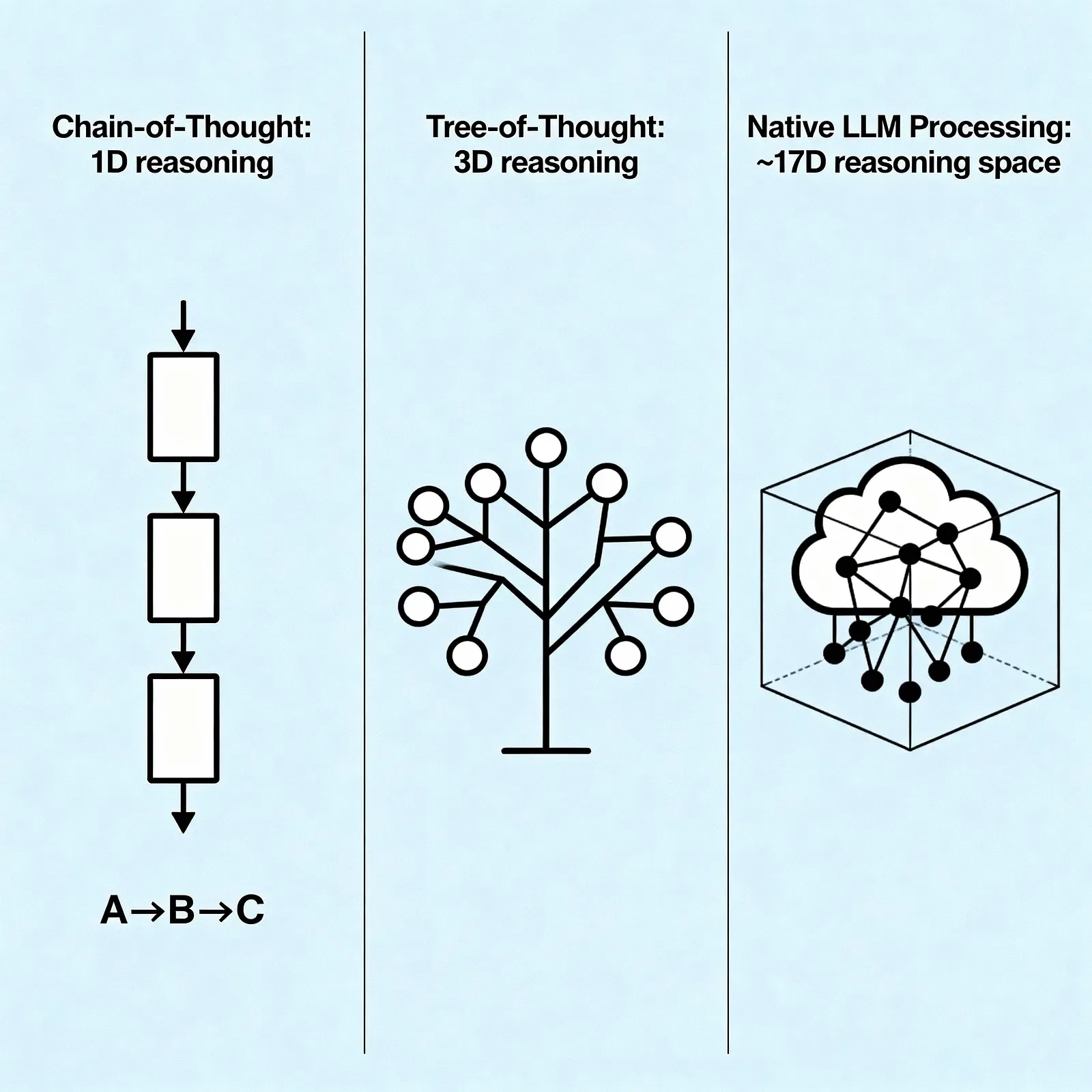
The Dimensional Framework
What do I mean by “17 dimensions”? And why is this more than a metaphor?
1D: Serial Thinking (Chain-of-Thought)
One consideration at a time. A→B→C. This is how we talk, how we write, how we explain ourselves to others. Chain-of-thought mimics human verbal reasoning. It’s linear — and that’s both its strength and limitation.
3D: Parallel Branching (Tree-of-Thought)
Multiple paths are explored simultaneously. At each junction, you split: try this approach, try that approach. It’s better — you can explore alternatives. But you’re still constrained to discrete branches in a hierarchical structure. You’ve added dimensions, but you’re still far from the AI’s native representational capacity.
~17D: Native Multi-Dimensional Processing
This is where it gets interesting — and where I propose we need to think differently.
Why approximately 17 dimensions? This is a working hypothesis, not a fact. Here’s the reasoning:
LLMs operate on embeddings with 300–1,500 raw dimensions — that’s an implementation detail. But not all of those dimensions are functionally independent. Through interpretability research, we can identify distinct functional dimensions — independent cognitive operations that might be happening simultaneously.
Based on preliminary analysis of attention mechanisms in transformers (Elhage et al., Anthropic), studies of conceptual space geometry (Gärdenfors), and information-theoretic constraints on human working memory, I hypothesize that the number of truly independent reasoning dimensions could be on the order of 15–20.
I use “~17D” as an illustrative working model. The exact number is less important than the principle: AI reasoning may operate across many more dimensions than the 1–3 dimensions we force it into through our prompting strategies. This is a conceptual framework to investigate, not a proven measurement.
Think of each dimension as an independent reasoning modality. Not sequential steps, but parallel considerations:
Core Cognitive Dimensions (~17 proposed):
- Semantic similarity and conceptual distance
- Temporal ordering and causality
- Analogical structural mapping
- Modal reasoning (possibility, necessity, counterfactuals)
- Uncertainty quantification and confidence
- Abstraction level and scope
- Perspective and framing
- Affective valence and emotional tone
- Pragmatic context and communicative intent
- Compositional structure and part-whole relationships
- Relational roles and binding (what relates to what)
- Category membership and boundary conditions
- Process dynamics and state transitions
- Normative and evaluative dimensions
- Constraint satisfaction and optimization
- Meta-cognitive monitoring (reasoning about reasoning)
- Contextual relevance and salience
Each may operate with some degree of independence. Each can inform the others. When you force sequential consideration, you might be artificially serializing processes that could happen in parallel.
This mirrors what we observe in human cognition. Your brain doesn’t think “first semantics, then causality, then emotion.” All those processes happen simultaneously in distributed neural networks. Multiple cognitive systems operate in parallel, their outputs integrated into a coherent understanding.
We built AI systems that work similarly — distributed representations, parallel processing, multi-dimensional embeddings. Then we taught them to explain themselves sequentially, and assumed that’s how they should think.
Inside a transformer’s attention mechanism, multiple attention heads process different relational patterns simultaneously. One head might capture semantic relationships, while another captures syntactic structure, and another tracks discourse coherence. This is parallel high-dimensional processing.
Technical note on embedding geometry: Standard transformer models (GPT, Claude, etc.) use Euclidean embedding spaces. While research has explored whether hyperbolic or other non-Euclidean geometries might better capture hierarchical semantic relationships (Nickel & Kiela, 2017), these remain experimental approaches rather than standard practice in production systems. The multi-dimensional processing I’m describing operates within conventional Euclidean embedding spaces — what matters is the dimensionality and parallel processing capacity, not the specific geometric properties.
Chain-of-thought collapses all of that into: “Step 1… Step 2… Step 3…”

Why We Constrain AI
Before I go further, let me be clear: chain-of-thought prompting isn’t wrong. It’s been hugely successful. There are good reasons we do it this way.
When Wei et al. introduced chain-of-thought prompting in 2022, it was a breakthrough. Asking AI to “think step-by-step” dramatically improved performance on complex reasoning tasks. Why?
Three key benefits:
1. Human Oversight: We can read the steps, verify the logic, and catch errors. Critical for high-stakes applications.
2. Debugging: When AI fails, step-by-step reasoning shows us where. Essential for improvement.
3. Trust: Seeing the “thought process” helps humans trust the output. Psychological and practical importance.
These aren’t small considerations. In applications like medical diagnosis, financial analysis, and legal reasoning, you absolutely need interpretability. “The AI gave this answer, but we can’t explain how” is often unacceptable.
But here’s what we’re trading away: computational efficiency and native processing capability.
It’s like requiring a calculator to show all its work in base-10 arithmetic, even though it computes in binary internally. You get interpretability. You lose efficiency. For simple problems, who cares? For complex problems with many interacting constraints, the cost may grow substantially.
The current paradigm makes a specific choice:
Prioritize human interpretability of PROCESS over computational efficiency of EXPLORATION.
I’m proposing we reconsider:
Prioritize computational efficiency of EXPLORATION with human interpretability of OUTCOMES.
Think about how you collaborate with human domain experts. You don’t require them to narrate every cognitive step as they think. You specify the problem, set constraints, and evaluate outcomes. You trust their expertise while validating their conclusions.
What if we engaged AI similarly?
Current paradigm: Human as supervisor, AI as intern following instructions
- “Show your work at every step.”
- “Think the way I think”
- “Explain in terms I understand immediately.”
Proposed paradigm: Human and AI as collaborators with complementary strengths
- “Here’s the problem space and constraints.”
- “Explore using your native capabilities”
- “Show me the solution landscape and let’s evaluate together.”
Not replacing interpretability — redefining where it happens.
What’s Lost in Translation
Let me illustrate with another thought experiment — imagine this situation:
You’re a neuroscientist. You’ve got unexpected experimental results — neurons firing in a pattern that doesn’t match existing theories. You need hypotheses that might explain it.
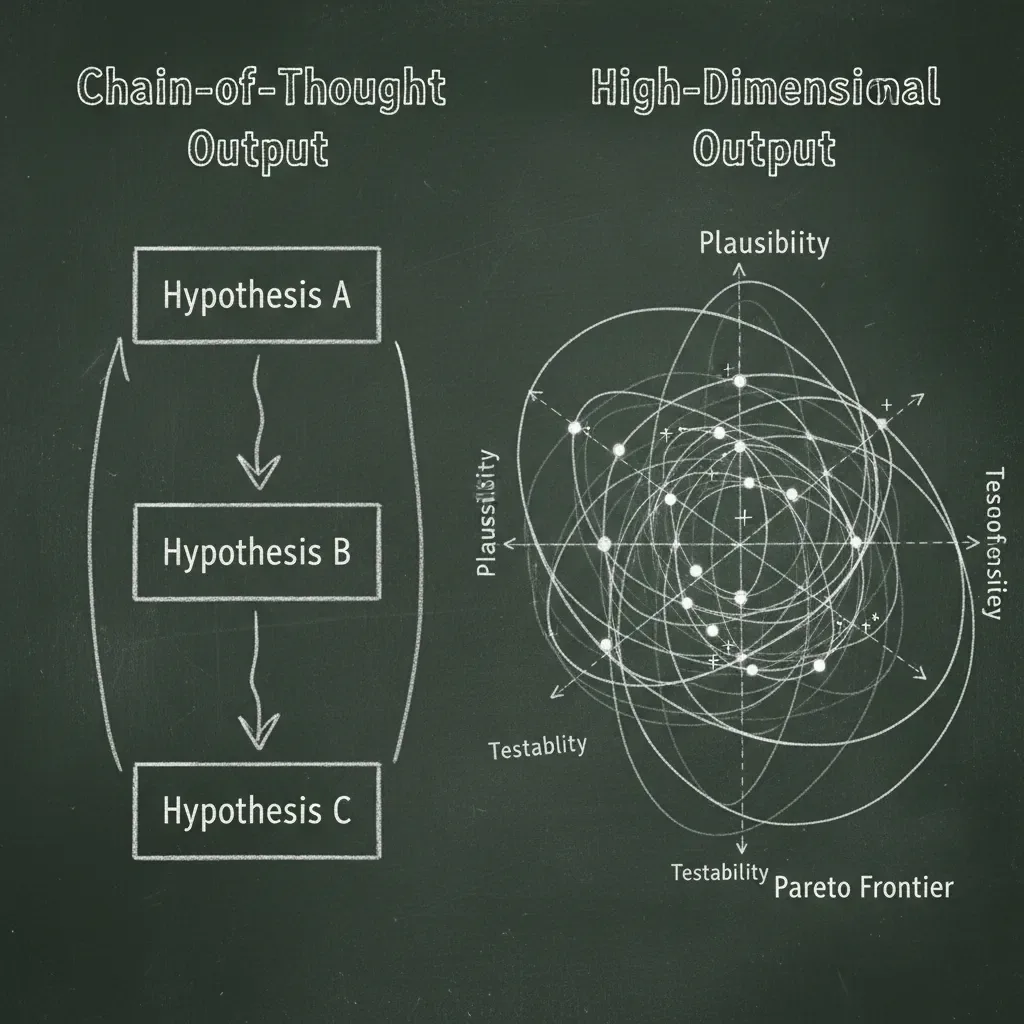
Chain-of-Thought Approach:
Prompt: "Think step-by-step about possible explanations."
AI Output:
Step 1: Review existing theories → Theory A suggests X mechanism
Step 2: Check if theory applies → Theory A doesn't explain the timing
Step 3: Consider alternative → Theory B suggests Y mechanism
Step 4: Evaluate fit → Theory B partially explains it
Step 5: Generate novel hypothesis → Maybe mechanism Z...
What you get: a linear exploration of hypothesis space. The AI evaluates one possibility at a time. It’s thorough, it’s readable, and it’s fundamentally sequential.
Higher-Dimensional Approach:
Now imagine the AI simultaneously considering:
- Biological plausibility (mechanism must be possible)
- Parsimony (simpler explanations preferred)
- Consistency with existing data (must not contradict known facts)
- Testability (must be experimentally verifiable)
- Novelty (original insights valued)
- Mechanistic specificity (clear causal story)
- Explanatory scope (explains other phenomena too?)
- Evolutionary logic (why would this mechanism exist?)
Not sequentially. SIMULTANEOUSLY.
Instead of one sequential exploration, you get:
Hypothesis A:
- High biological plausibility ✓
- High parsimony ✓
- Perfect consistency with existing data ✓
- Low novelty (incremental extension of known theory)
- Moderate testability
- Trade-off profile: Safe, testable, but unlikely to be groundbreaking
Hypothesis B:
- Moderate biological plausibility (requires assuming a new mechanism)
- Low parsimony (more complex)
- Consistent with existing data ✓
- High novelty ✓
- High mechanistic specificity ✓
- High explanatory scope (explains several other mysteries!)
- Trade-off profile: Riskier, but potentially transformative if true
Hypothesis C:
- High biological plausibility ✓
- High parsimony ✓
- Moderate consistency (requires reinterpreting one prior result)
- High testability ✓
- Moderate novelty
- Trade-off profile: Best near-term experimental bet
In this scenario, the AI didn’t evaluate these sequentially. It explored hypothesis space across all dimensions simultaneously, then projected the results to show you the Pareto frontier — the hypotheses that represent different optimal trade-offs.
With chain-of-thought, you get the hypothesis the AI encountered first while stepping through logic. With higher-dimensional exploration, you get the LANDSCAPE of possibilities — the recognition that there isn’t one “right answer” but multiple hypotheses optimizing different constraint sets.
That landscape exists in the high-dimensional space. It disappears when you project to a single line of step-by-step reasoning.
The Solution: Higher-Dimensional Collaboration
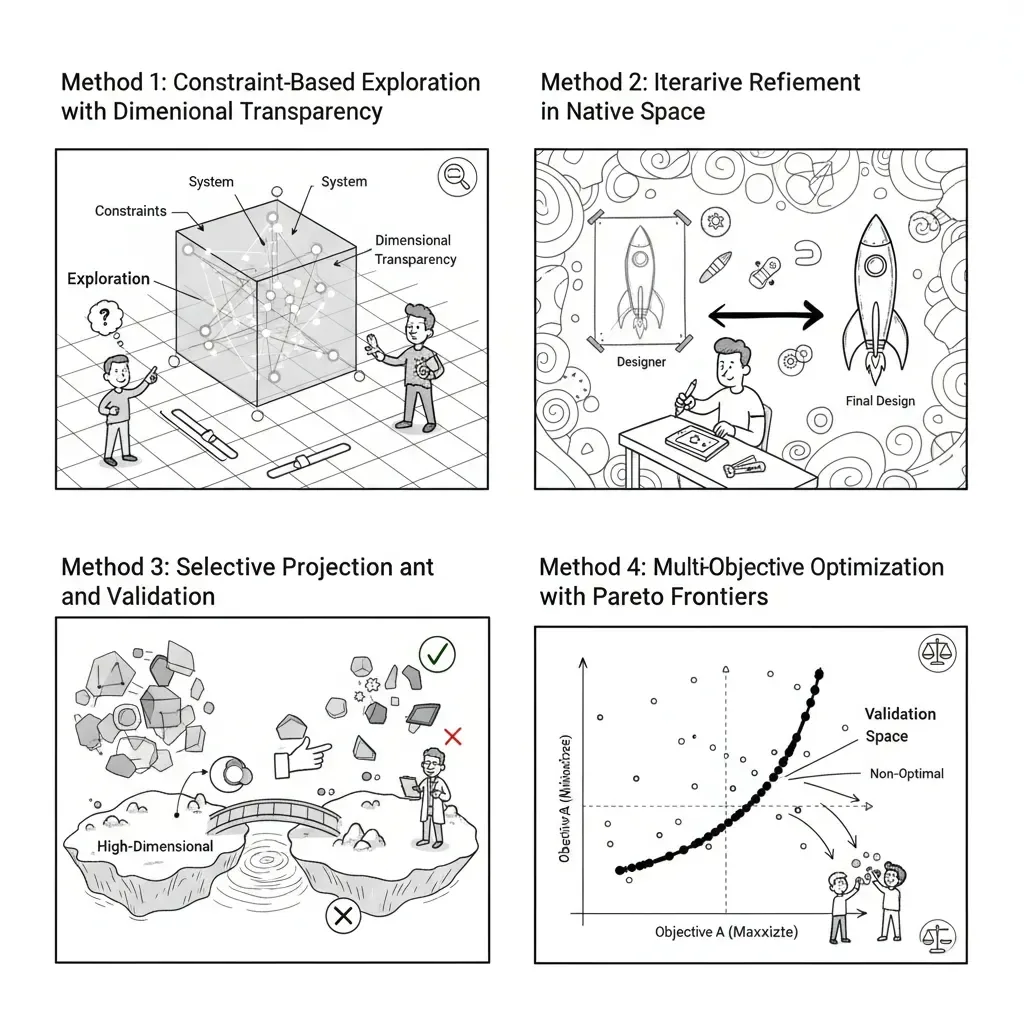
So what does higher-dimensional collaboration actually look like? Let me propose four specific approaches.
Method 1: Constraint-Based Exploration with Dimensional Transparency
Instead of telling AI HOW to think, tell it WHAT matters and let it explore solution space natively.
You specify objectives and constraints across multiple dimensions. The AI explores the high-dimensional solution space, simultaneously considering all constraints. It returns not one “answer” but a landscape of solutions with explicit trade-off profiles.
Example: Product Design
- Traditional: “Design a product by first considering user needs, then technical feasibility, then cost…”
- High-dimensional: “Here are my constraints: user experience must be excellent (9/10+), technical feasibility must be high, cost must be under $X, time to market under Y months, brand fit must be strong. Show me the solution space.”
Output: Multiple design options positioned in a multi-dimensional space, each representing different trade-off decisions. “Design A maximizes user experience but extends timeline. Design B optimizes for speed but accepts compromises in one UX dimension. Design C represents the balanced middle ground. Here’s why each makes sense given different strategic priorities…”
Method 2: Iterative Refinement in Native Space
Let AI maintain a rich high-dimensional representation. You provide feedback on specific dimensions when needed, but the AI preserves coherence across ALL dimensions.
Traditional iteration: You get text output, you edit text, you get new text. Context and coherence degrade with each revision.
High-dimensional iteration: AI maintains a persistent high-D representation. You refine specific aspects by projecting to interpretable subspaces, giving feedback, and the AI updates the full representation, maintaining consistency across dimensions you didn’t explicitly discuss.
Example: Complex Writing and Communication
You’re developing a strategic narrative that must balance:
- Technical accuracy
- Executive accessibility
- Inspirational tone
- Concrete actionability
- Risk acknowledgment without pessimism
- Ambition without hype
Traditional: You edit drafts, losing coherence across dimensions with each change. Making it more inspirational makes it less concrete. Making it more technical makes it less accessible. Each edit creates new tensions.
High-dimensional: You give feedback on specific dimensions (“make this more concrete,” “adjust tone to be more inspiring”), and the AI refines the underlying representation while maintaining consistency across ALL dimensions, even ones you didn’t mention. The next output coherently integrates all your feedback because it’s working from one unified high-dimensional representation, not sequentially applying potentially conflicting edits.
Method 3: Selective Projection and Validation
If AI operates in high-dimensional space, you wouldn’t need to see all dimensions at once — you could request specific projections when you want to inspect or validate particular aspects.
Like rotating a 3D object to view from different angles, but with many more dimensions. The AI performs analysis across multiple dimensions simultaneously. You request 2D or 3D projections onto the dimensions you care about at that moment.
Example: Strategic Decision Analysis
Task: Evaluate three strategic options (enter new market, improve existing product, acquire competitor).
The AI evaluates across multiple dimensions simultaneously: financial impact, strategic positioning, operational complexity, cultural fit, competitive response, timing, risk profile, organizational capacity, market dynamics, regulatory environment, and more.
You don’t see all at once. Instead, you query:
- “Show me financial impact versus risk.”
- “Show me timing versus organizational complexit.y”
- “Show me strategic positioning versus competitive respons.e”
Each query returns a 2D projection showing how the three options compare on those specific dimensions. The AI isn’t recalculating — it’s showing different views of one coherent high-dimensional evaluation. You’re rotating the analysis to examine from angles that matter to you.
Method 4: Multi-Objective Optimization with Pareto Frontiers
For problems with competing objectives, let AI find the Pareto frontier — the set of solutions where improving one objective requires sacrificing another.
Traditional: AI gives you one “best” answer (implicitly forcing a specific trade-off you didn’t explicitly choose).
High-dimensional: AI maps the frontier of optimal trade-offs, letting you choose based on your priorities and values.
Example: Resource Allocation
You’re allocating budget across initiatives. Objectives include:
- Short-term revenue impact
- Long-term strategic value
- Risk mitigation
- Team development
- Market positioning
The AI returns: “Here are 5 allocation strategies on the Pareto frontier:
- Strategy A maximizes short-term revenue but sacrifices long-term strategic value
- Strategy B balances revenue and strategy but accepts a higher risk
- Strategy C minimizes risk but reduces revenue potential
- Strategy D optimizes for team development and positioning, but extendsthe timeline
- Strategy E is the conservative middle ground
You choose based on your priorities. All strategies are ‘optimal’ for different objective weightings. None is objectively ‘best’ — that depends on what you value most.”
What Makes This Different:
In all four methods, the key shift is:
- AI explores in its native high-dimensional space
- Human specifies constraints, objectives, and values
- Interaction happens through projection, refinement, and validation
- Interpretability focuses on outcomes and constraint satisfaction, not the play-by-play process
You’re collaborating with something that thinks differently, rather than forcing it to mimic human sequential reasoning.
Reality Check:
To be completely clear: these methods don’t yet exist as polished, production-ready tools you can use today. This is a conceptual framework and research proposal, not an established practice. Some early experiments are happening — latent-space prompting, multi-objective optimization interfaces, constraint-based generation — but we’re in early stages. I’m proposing this as a direction worth pursuing and investigating, not reporting proven techniques or empirically validated improvements. The dimensional framework itself is a working hypothesis that needs rigorous empirical testing.
When Higher-Dimensional Thinking Works
Here’s what higher-dimensional collaboration could look like when it works — an aspirational scenario:
You’re leading an innovation workshop. Your team is stuck on a design challenge with seemingly incompatible requirements: The solution must be radically innovative (excite users) but also familiar enough for easy adoption. It must be technically simple but powerful. It must differentiate from competitors while integrating with existing workflows.
Traditional AI Assistance:
You prompt: “Suggest solutions step-by-step.”
AI output walks through considerations sequentially, proposes solutions one at a time. Each suggestion optimizes for the constraint it just considered, then awkwardly tries to satisfy previous constraints. You get logical but uninspiring incremental ideas that feel like compromises.
Higher-Dimensional Collaboration:
Instead, you engage the AI as a collaborator:
“Here’s the constraint space. Innovation versus familiarity, simplicity versus power, differentiation versus integration. I need solutions that navigate these tensions, not compromise on them. Show me the landscape.”
The AI responds:
“I’ve explored the solution space across multiple dimensions, including the tensions you specified, plus technical feasibility, market timing, aesthetic coherence, and implementation path. Here are three solutions that represent genuinely different approaches:
Solution 1: The Familiar Innovation
Positions at: High familiarity, high hidden power, moderate innovation
Insight: Make the interface completely familiar but add a hidden ‘expert mode’ unlocked through natural discovery. Users feel comfortable immediately, experience innovation gradually. Differentiation comes from the elegance of progressive disclosure — competitors show everything at once and overwhelm, you reveal depth through use.
Solution 2: The Integrated Disruption
Positions at: High differentiation, seamless integration, moderate initial simplicity, with a rapid learning curve
Insight: Don’t hide innovation — celebrate it. Make the new paradigm obvious and compelling, but integration isn’t an add-on feature; it’s the core architecture. You’re not integrating with old workflows; you’re demonstrating a superior workflow that happens to work with old tools. Differentiation through confidence in your approach.
Solution 3: The Simple Sophistication
Positions at: Extreme simplicity in interface, extreme power in architecture, innovation through subtraction
Insight: The radical innovation IS the simplicity. Remove 80% of features. Make the core 20% work perfectly with depth that reveals itself through use. Differentiation through restraint — everyone else is adding features, you’re removing friction. Integration through focused excellence rather than comprehensive compatibility.
Each solution emerged from simultaneous consideration of all constraints rather than sequential compromise. They represent different philosophies, not incremental variations.”
You’re not getting AI to “think through the problem.” You’re getting AI to explore a solution space you couldn’t fully map yourself, then present you with crystallized insights representing different regions of that space.
The ideas don’t feel like generic AI output. They feel like insights from a collaborator who sees the problem from genuinely different angles — because they do. That’s what higher-dimensional collaboration could produce: not just sequential logic, but synthetic insight emerging from parallel consideration of multiple constraint dimensions.
Chain-of-thought gives you one well-reasoned path through problem space. Higher-dimensional exploration gives you multiple legitimate destinations in solution space, each representing different balances of your competing objectives.
The first helps you think step-by-step. The second helps you see possibilities you wouldn’t have generated yourself.
Important Caveats: When NOT to Use This Approach
Before you rush to experiment, let’s be clear about the limitations of this framework and when this approach is NOT appropriate.
First, a critical acknowledgment: The “~17 dimensions” framework is a conceptual model, not an empirically validated measurement. I’m proposing this as a way of thinking about LLM capabilities and human-AI interaction, not reporting established scientific findings. The specific number is illustrative — what matters is the principle that LLMs may operate across more functional dimensions than we typically engage through sequential prompting. This hypothesis needs rigorous empirical testing before we can make strong claims about actual dimensionality.
Higher-dimensional collaboration is not always superior. Here’s when you should stick with traditional step-by-step reasoning:
1. When Legal or Regulatory Transparency Is Required
If you’re in healthcare, finance, legal domains, or anywhere that requires auditable decision-making with complete process transparency, chain-of-thought remains essential. “The AI explored 17 dimensions and gave this answer,” won’t satisfy regulators or judges. You need every step documented and interpretable.
2. When Errors Need Clear Traceability
If you need to identify exactly where reasoning went wrong — for debugging, improvement, or accountability — sequential steps provide essential diagnostic information. High-dimensional exploration makes error diagnosis significantly harder. When the AI makes a mistake, you want to know exactly which step failed.
3. When Human Verification at Each Step Is Critical
For high-stakes decisions where domain experts must validate every logical move — medical diagnosis, safety-critical systems, critical infrastructure — you cannot skip the step-by-step verification that chain-of-thought enables. Lives and safety depend on catchable errors.
4. For Simple, Sequential Logic Problems
Not every problem needs multi-dimensional exploration. If your task is genuinely sequential (first do A, then B depends on A’s result, then C depends on B), cthe hain-of-thought is more efficient and clearer. Don’t add complexity where it doesn’t add value.
What We Don’t Know Yet:
This framework is speculative and untested at scale. Critical open questions include:
- Validation: How do we verify that high-dimensional exploration produces better outcomes than traditional methods? We need rigorous empirical testing across problem types.
- Failure Modes: We don’t yet know how this approach fails. Does it produce confident nonsense? Does it miss obvious solutions visible in step-by-step reasoning? Unknown unknowns are real.
- Optimal Use Cases: Which problem types genuinely benefit from this approach versus those where it’s just complexity theater? Still unclear.
- Human-AI Calibration: How do humans learn to effectively collaborate in this paradigm? What skills or intuitions are required? We don’t have training frameworks yet.
This is a research program, not a proven system. Experiment carefully, validate rigorously, and maintain healthy skepticism.
If you experiment with higher-dimensional prompting:
- Start with low-stakes problems where errors are recoverable
- Always validate outputs using domain expertise
- Compare results against traditional chain-of-thought approaches
- Document what works and what doesn’t — failures teach us too
- Share findings (positive and negative) with the community
We learn faster together when we’re honest about both failures and successes.
What This Means for You
So what do you do with this? Depends on who you are.
If you’re an AI researcher or developer:
This framework opens research questions worth investigating:
- Does reducing sequential constraints in prompting improve performance on multi-objective optimization tasks? We need controlled experiments.
- Can we develop interfaces that visualize multi-dimensional trade-offs effectively? Design challenge.
- What’s the actual functional dimensionality of different LLM architectures? Measurement challenge.
- Under what conditions does constraint-based exploration outperform step-by-step reasoning? Empirical validation needed.
The research questions are wide open. We need rigorous empirical testing of these concepts across different problem types and architectures. Treat this as a research agenda, not established practice.
If you’re an AI practitioner or power user:
Start noticing when chain-of-thought helps versus when it constrains:
- For simple, sequential logic problems: keep using step-by-step reasoning
- For complex multi-constraint optimization: try specifying all constraints upfront and asking for multiple solutions representing different trade-offs
- For creative or strategic work: try iterative refinement conversations that let context build without requiring the AI to re-explain its reasoning each time
You can start exploring higher-dimensional collaboration even with current tools by changing how you structure your prompts and what you ask for.
If you’re a leader or decision-maker:
Understand that AI capabilities depend partly on how we engage them:
- Current interaction paradigms were designed for interpretability, which is valuable
- But for complex strategic problems, you might get better results by specifying objectives and constraints upfront and requesting exploration rather than dictating the process
- Consider: where do you need interpretability of process (auditing, high-stakes decisions, regulated domains) versus interpretability of outcomes (innovation, strategy, design)?
- The humans who figure out better collaboration frameworks will extract more value from AI systems than those who treat AI as very smart interns requiring step-by-step supervision
The meta-point: this isn’t about abandoning current approaches. It’s about recognizing them as one design choice among many possibilities. As AI capabilities increase, our interaction paradigms may need to evolve beyond “make AI think like us.”
Call to Action
Here’s what I’m asking:
If you’re skeptical: Good. Skepticism is the appropriate response to speculative frameworks. Test it. Try to find where the argument breaks down. Identify the failure modes. That’s how we figure out what’s actually true versus what sounds compelling but doesn’t hold up under scrutiny.
If you’re intrigued: Experiment. Take one complex problem you’re working on and try engaging AI differently — specify constraints instead of process, ask for solution landscapes instead of single answers, request trade-off analysis instead of “the best” option. Document what happens. Share what you learn — especially the failures.
If you’re building: Let’s talk. We need better interfaces for high-dimensional collaboration. We need visualization tools for multi-dimensional solution spaces. We need validation frameworks that work without complete process transparency. This is a design problem as much as a research problem. The tools don’t exist yet — someone needs to build them.
If you’re researching: The questions are wide open:
- What’s the actual dimensionality of functional reasoning space in different LLM architectures? Can we measure this rigorously?
- How do we empirically test whether high-dimensional engagement improves outcomes across different task types?
- What are the right abstractions for human-AI collaboration in native representational spaces?
- Where’s the Pareto frontier between interpretability and capability?
- Is dimensionality even the right conceptual lens, or are there better frameworks?
This is early-stage conceptual work. I’m not claiming to have proven these ideas — I’m proposing a framework worth investigating and questions worth pursuing.
For decades, we worked to make AI more intelligent. We succeeded — maybe beyond what we fully realize. The systems we’ve built operate in high-dimensional representational spaces, performing parallel cognitive operations we’re only beginning to understand through interpretability research.
Now the question isn’t “how smart can we make AI?” but “how well can we learn to work with intelligence that processes information differently than we do?”
The future of AI might not be teaching machines to think sequentially like humans. It might be learning to collaborate with them in the higher-dimensional spaces where they naturally operate — bringing our judgment, values, and contextual understanding to their capacity for processing multiple considerations in parallel.
That’s a future worth exploring. That’s a question worth answering.
Your AI might be thinking in more dimensions than you’re engaging. Maybe it’s time we explored what that means.
Further Reading
These papers informed my thinking. You don’t need to read them to understand this piece, but they’re there if you want to go deeper.
On prompting methods:
- Wei et al., 2022: “Chain-of-Thought Prompting Elicits Reasoning in Large Language Models”
- Yao et al., 2024: “Tree of Thoughts: Deliberate Problem Solving with Large Language Models”
On transformer architecture and interpretability:
- Vaswani et al., 2017: “Attention Is All You Need”
- Elhage et al., 2021: “A Mathematical Framework for Transformer Circuits” (Anthropic Interpretability Research)
On representational geometry:
- Gärdenfors, P.: “Conceptual Spaces: The Geometry of Thought”
- Kriegeskorte & Kievit, 2013: “Representational Geometry: Integrating Cognition, Computation, and the Brain”
On hyperbolic embeddings and hierarchical representations:
- Nickel & Kiela, 2017: “Poincaré Embeddings for Learning Hierarchical Representations”
On multi-dimensional cognition and neural binding:
- Smolensky, 1990: “Tensor Product Variable Binding and the Representation of Symbolic Structures in Connectionist Systems”
About the Author
Dr. Jerry A. Smith focuses on advancing human-AI collaboration frameworks. His work spans neurocognitive science and artificial intelligence architectures, exploring how distributed representational systems — both biological and artificial — process information across multiple dimensions simultaneously. He specializes in developing conceptual frameworks that leverage rather than constrain the native capabilities of both human and artificial intelligence systems.
Dr. Smith’s research agenda emphasizes bridging theoretical neuroscience, transformer architectures, and practical AI implementation to create more effective collaboration paradigms. This article presents a working hypothesis and research agenda developed from that interdisciplinary perspective.
Connect with Dr. Smith on LinkedIn or reach out to discuss collaboration opportunities in neurocognitive AI research.