Research & IP
Two proprietary architectures. Built by a PhD in Computer Science who still writes production code. These aren't frameworks borrowed from a vendor — they're original systems engineered from first principles.
The 5-3-1 Agentic Architecture
Five specialized agents. Three orchestration layers. One unified output. Designed so no single agent failure propagates to the final result.
5 Specialized Agents
Analyst
Data interpretation & pattern recognition
Strategist
Business logic & decision framework
Critic
Adversarial validation & edge cases
Builder
Implementation specs & technical design
Integrator
Cross-agent synthesis & conflict resolution
3 Orchestration Layers
Parallel Execution
All five agents receive the same input and process independently. No agent sees another's output at this stage — eliminating groupthink and ensuring genuine diversity of analysis.
Adversarial Reconciliation
Agent outputs are cross-examined. The Critic challenges assumptions. Contradictions are surfaced, not hidden. Weak reasoning is flagged before it reaches the final output.
Unified Synthesis
The Integrator reconciles all perspectives into a single coherent output. Disagreements are resolved with explicit reasoning. The human receives one clear recommendation, not five conflicting ones.
1 Unified Output
No individual agent can corrupt the output. The architecture is fault-tolerant by design.
Every recommendation has been challenged from five independent angles before reaching you.
Not five opinions — one synthesized, defensible recommendation with transparent reasoning.
The Neuro-Cognitive Agent
A computational cognitive architecture grounded in biological brain systems. Not a chatbot with memory bolted on — a system that perceives, remembers, thinks subconsciously, and reasons consciously. Every turn mirrors the interplay between thalamic relay, hippocampal retrieval, subcortical modulation, and prefrontal deliberation.
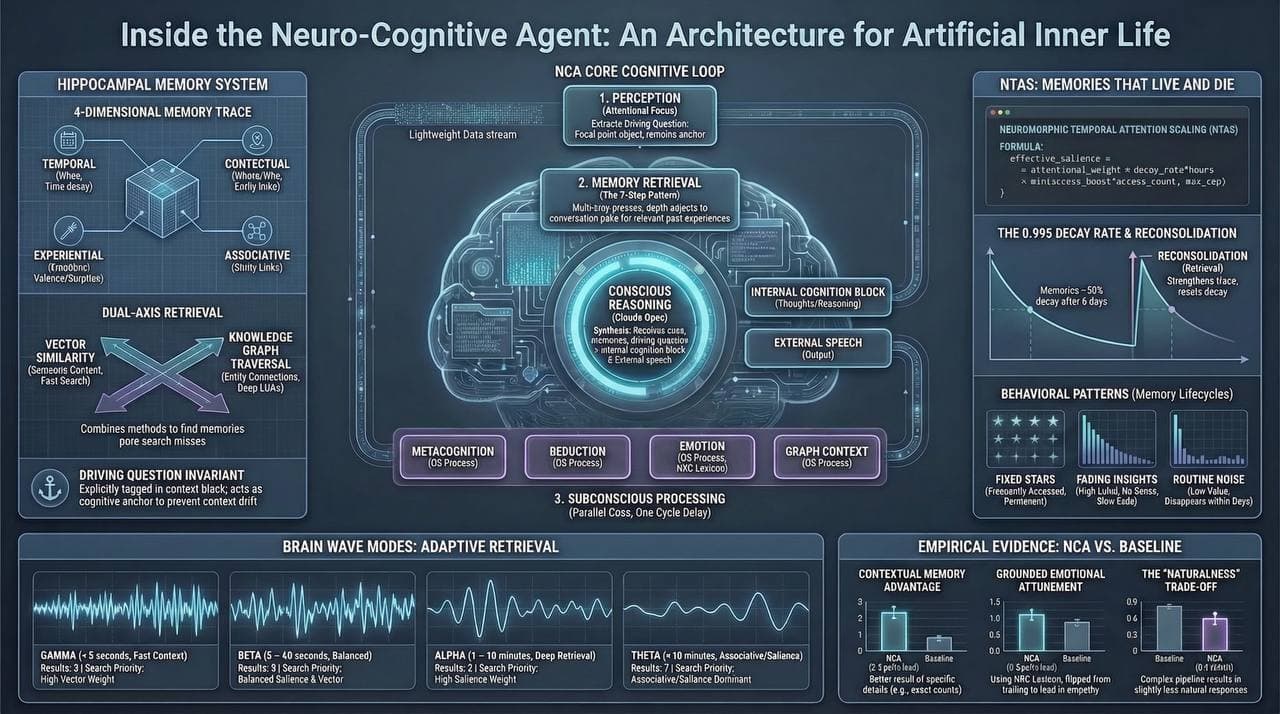
Full architecture diagram — the NCA cognitive loop, hippocampal memory system, brain wave retrieval modes, and subconscious processing pipeline
The Cognitive Loop
Every conversational turn executes a structured cognitive loop — mirroring how the biological brain processes information through parallel specialized systems before reaching conscious awareness.
Perception
Raw input is parsed into structured signals: intent, entities, emotional tone, attention markers. Like the thalamus routing sensory input to specialized cortical areas.
Memory Retrieval
Multi-tray retrieval with adaptive brain wave modes (Gamma, Beta, Alpha, Theta, Delta). CA3 spreading activation finds associative connections across the knowledge graph.
Subconscious Processing
Six parallel subminds process the previous turn's state — metacognition, deduction, emotional coherence, graph context, anticipation, and consolidation. One-cycle delay, like biological subcortical processing.
Conscious Reasoning
All signals converge into a context block. The conscious mind reasons over perception, memories, and subconscious cues — producing a response that has been shaped by the full cognitive architecture.
Key Innovations
Hippocampal Memory System
4-dimensional memory traces (temporal, contextual, experiential, associative) stored as unified experiences — not fragments split across separate stores. Memories live and die through Neuromorphic Temporal Attention Scaling (NTAS), where salience decays at 0.995 per hour but retrieval strengthens the trace.
Brain Wave Retrieval Modes
Adaptive retrieval depth based on conversational context: Gamma for fast recall (<5 seconds), Beta for balanced search, Alpha for deep retrieval, Theta for associative/salience-driven recall, and Delta for full synthesis across the entire memory space.
Basal Ganglia Gating
Subminds are selectively activated through graded tonic inhibition — modeling the biological GPi/SNr → thalamus pathway. Simple inputs activate only essential subminds. Complex queries, emotional intensity, or synthesis requests trigger the full ensemble.
Knowledge Graph Integration
Neo4j-backed entity/relationship storage with entorhinal binding — entity properties persist independent of memory decay. CA3 spreading activation traverses 2-hop neighborhoods with decay, finding connections that pure vector search misses.
Six Subconscious Minds
Six persistent OS processes run in parallel, each specialized for a cognitive domain. They don't speak to the outside world — they speak inward, shaping what reaches conscious awareness.
Metacognition
Conflict monitoring, confidence assessment, bias detection. Always fires — the agent's self-awareness system.
Deductive Reasoning
Logical inference, implicit premise detection, contradiction identification. Activated by questions and complexity.
Emotional Coherence
Affective trajectory tracking, emotional attunement, empathy calibration. Proportional to emotional intensity via NRC lexicon.
Graph Context
Live Neo4j queries for entity relationships and properties. Enriches context with structured knowledge beyond vector similarity.
Anticipatory Retrieval
Fetches graph neighbors not yet in the retrieval set. Prepares context for where the conversation might go next.
Neocortical Consolidation
Extracts cross-session schemas and narrative arcs. The slow learning system that builds long-term understanding.
Why It Matters
Your AI vendor doesn't have this.
Defensible IP
The 5-3-1 architecture is patent-pending. The NCA is built on original neuroscience research. These aren't open-source wrappers — they're proprietary systems that create competitive moats for clients.
Battle-Tested
The 5-3-1 has been deployed across pharma, aviation, defense, and financial services. The architecture was designed for regulated industries where single-agent failure isn't acceptable.
PhD-Built, Production-Ready
Built by someone who understands both the neuroscience and the engineering. Not academic prototypes — production systems with monitoring, governance, and LLMOps from day one.
See the architecture in action.
15 minutes. We'll show you what proprietary AI looks like versus off-the-shelf.