Building Minds
The Sequencing Problem: Why Publicly Traded Services Firms Keep Getting AI Wrong
Dr. Jerry A. Smith · February 20, 2026 · 10 min read
The acknowledgment appears at the earnings call, in the letter to shareholders, or in the prepared remarks before the analyst questions begin. The business model built on billable hours cannot persist. Clients are asking about value delivered rather than time spent. The economic conditions that made service firms durable for so long are no longer stable. Leadership knows this. The board knows this. The analysts covering the firm know this.
And yet the margins are the same as they were three years ago. The revenue mix has not shifted. The pilots that launched with considerable internal attention have produced results that appear in no line item. The Chief AI Officer position, filled with some ceremony eighteen months ago, is either vacant or quietly diminished. The announced transformation has not arrived.
This is not, as it is sometimes framed, a failure of will or vision. Most of the leaders in question understand what AI can do. They have seen the demonstrations. They have read the case studies. They have hired the consultants. The failure is something more structural, and more interesting: a failure of sequence.
The standard playbook for AI transformation in a services firm proceeds as follows. Leadership announces a commitment to AI-enabled delivery. A senior technology executive is hired or elevated. A series of pilots is launched across practice areas, often selected for visibility rather than economic impact. Consultants are enrolled in training programs. Slides are prepared for the next investor day.
Three years pass. The pilots have produced useful tools that a handful of practitioners use occasionally. The training programs have produced awareness, not capability. The margins have not moved because the billing model has not moved. The fundamental unit of the business — the hour, the engagement, the headcount — is exactly where it was. The CAIO, if the position still exists, is now advisory rather than operational, and a search for a replacement has quietly begun.
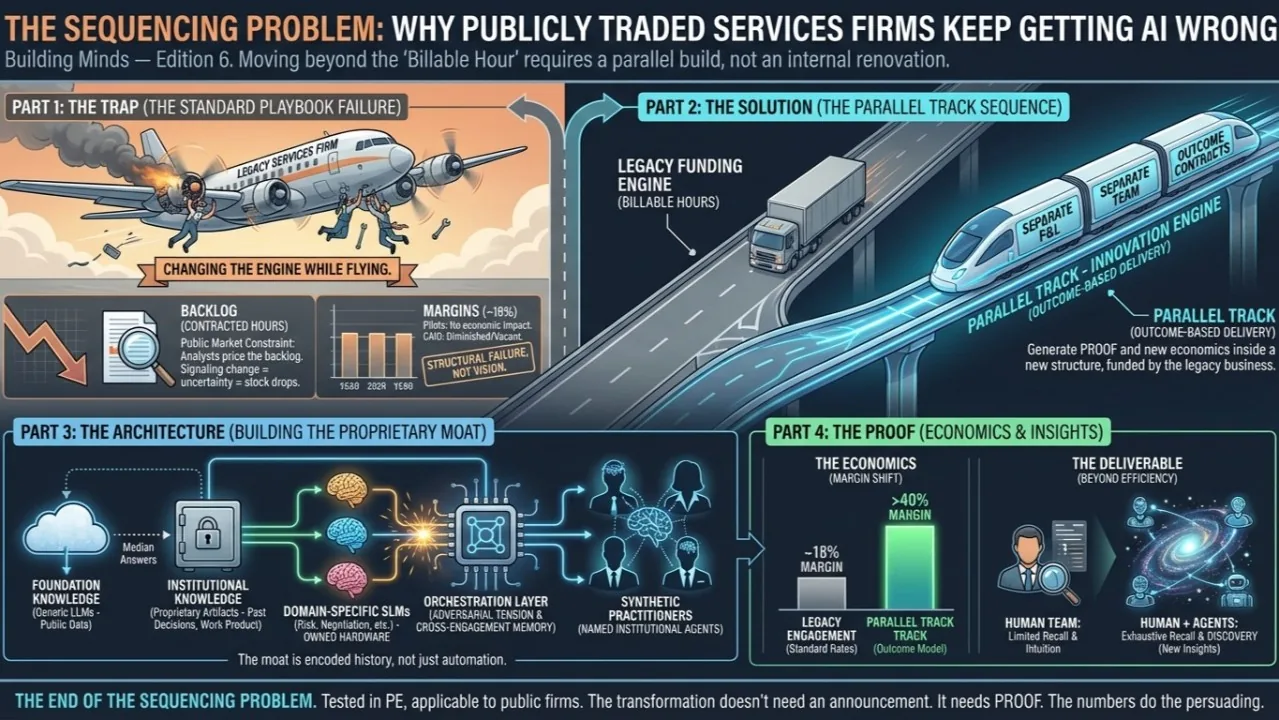
The metaphor that circulates in strategy discussions is that the firm tried to change the engine while flying the plane. But this locates the problem in the wrong place. The challenge was not that the transformation was attempted while operations continued. The challenge was that the transformation was attempted through operations. The mechanism for change was the same organizational structure, the same incentive system, and the same revenue model that the change was supposed to alter.
Publicly traded services firms face a constraint that private ones do not. Analysts price the backlog. The backlog is hours — contracted future work at agreed rates, a predictable revenue stream that the market has already priced into the equity. When a firm signals that it is moving away from an hours-based model, what reaches the street is not news of greater productivity. What reaches the street is that the existing backlog may be less reliable than it appeared.
This is not irrational on the part of the analysts. It is a correct reading of the signal. If the firm's revenue will no longer come from contracted hours, then the backlog — the primary basis for the revenue forecast — is uncertain. The valuation framework appropriate to a services firm may no longer apply. Markets do not reward disruption in the incumbent.
The practical consequence is that genuine transformation announcements tend to damage the stock. Boards grow cautious. Leadership grows careful about what it signals. Transformation is either announced loudly with no real mechanism behind it, or quietly killed before it reaches the public. Either way, the margins stay where they are.
There is a way through this. But it requires abandoning the premise that you are transforming the existing firm. You are not. You are building a new business inside it.
The structure is a separate profit and loss, a separate team with different compensation, and separate contracts with clients who have agreed to outcome-based terms. This new unit does not cannibalize the legacy practice — not at first, not intentionally. It runs in parallel, operating under different economics, accumulating its own results. The legacy business continues generating the revenue that funds the enterprise. The parallel track generates proof.
But the parallel track only generates proof if it is built correctly. This is where most attempts fail. The instinct is to deploy agents — to connect a foundation model to a workflow and automate the production of deliverables. This is not wrong, but it is insufficient. The margins that distinguish the parallel track from the legacy practice cannot come from automation alone. Any firm with an API connection can automate production. That is not a moat.
The moat is in the knowledge that drives the automation. That knowledge comes in two forms that are not equivalent.
Foundation knowledge is the knowledge encoded in large language models — the patterns embedded in the network weights and attention heads of foundation systems. GPT-5x, Claude, Gemini: these models carry the statistical regularity of most documented human knowledge. They are available to every firm that can pay the subscription fee. When a foundation model answers a specialized question, it produces the statistically median answer, because its training was optimized to perform well across the widest possible range of inputs. In specialized professional services work, the median answer is routinely the wrong one.
Institutional knowledge is different. It is the knowledge that exists only within a specific organization and cannot be recovered from any public source. It is the actual decision patterns of the firm's best practitioners — what they attend to and what they ignore when reviewing a document, how they weigh conflicting signals when forming a recommendation, the judgment calls that were never written down because they were made in conference rooms, in margins, in the silence between a client's question and the answer that resolved it. This knowledge does not appear in training manuals. It appears in the artifacts of work: the outputs that were accepted and the ones that were revised, the inclusions and the discards, the sequence of decisions that shaped every finished engagement.
The critical insight is that you are not training on what your experts wrote. You are training on what they did — reconstructed from the traces their decisions left in the work product. That is where the process actually lives.
The architecture that encodes institutional knowledge does not begin with a large model. It begins with smaller ones. Small language models (SLM), fine-tuned on domain-specific data drawn from the firm's own history, are built for specific functions. One handles a specific category of risk analysis. Another handles a category of client communication. A third handles the synthesis of inputs from other models. These models run on hardware the firm controls. They do not require infrastructure rented from a provider. They do not route proprietary data through an external system.
Recommended by LinkedIn
[ The Tool That Trains Your Replacement — And How to Use…
David Wong MRICS
The Tool That Trains Your Replacement — And How to Use…
David Wong MRICS
5 months ago](https://www.linkedin.com/pulse/tool-trains-your-replacement-how-use-anyway-david-73sgc)
[ The Override — and Why the People With the Power to…
Patricia Collins
The Override — and Why the People With the Power to…
Patricia Collins
4 months ago](https://www.linkedin.com/pulse/override-why-people-power-fund-didnt-patricia-collins-uwfgc)
[ The Last Great Consulting Pyramid
Pradeep Sanyal
The Last Great Consulting Pyramid
Pradeep Sanyal
7 months ago](https://www.linkedin.com/pulse/last-great-consulting-pyramid-pradeep-sanyal-qni9c)
These specialist models are coordinated by an orchestration layer. The orchestration layer creates adversarial tension between them — models do not simply produce outputs and pass them along. They challenge each other's outputs. Reconciliation is forced before anything reaches the human layer. The system does not surface a response until internal disagreements have been resolved into a coherent position, with the terms of the disagreement visible to the practitioner who makes the final call.
The orchestration logic also maintains institutional memory across engagements. What was learned in one engagement is available in the next. The system accumulates, rather than resetting.
This combination — the knowledge extraction methodology, the adversarial coordination mechanism, the cross-engagement memory — is patent-pending. Not the agents themselves, which are available in various forms from various vendors, but the specific mechanism by which institutional knowledge is extracted, encoded, and coordinated. The value is not in the architecture description. It lies in the training data, the adversarial dynamics calibrated to the firm's specific domain, and the orchestration logic that governs how conflicts are resolved. Reading about it does not replicate it.
When the parallel track is built this way, the numbers become the argument.
What emerges from this architecture are not generic tools. They are named, institutionalized agents — synthetic practitioners that carry the encoded judgment of the firm's own experts. One might be built from twenty years of a specific practice area's case history. Another might embody the negotiation patterns of the firm's most effective client partners. These agents have names because they have identities — specific capabilities, specific knowledge, specific ways of reasoning that reflect the organization that created them. They cannot be duplicated by a competitor, because the institutional knowledge they carry does not exist anywhere else. They are, in a meaningful sense, proprietary minds.
A legacy engagement at standard billing rates generates margins in the range of 18%, which has been the industry standard for a long time. The parallel track, operating on an outcome-based pricing model with the cost structure of a technology business rather than a staffing one, generates margins above 40%. These numbers are not theoretical. They are actual line items in an actual profit and loss.
But the margin improvement is not the most interesting result. Something else happens when institutionalized agents work alongside human practitioners on a live engagement. The agents do not simply execute faster. They surface connections that no one on the team was looking for — patterns across the firm's entire history of similar engagements, correlations between variables that a human analyst would never think to test because the combinatorial space is too large to hold in working memory. The agents do not have intuition. What they have is exhaustive recall and the ability to test every permutation against every prior outcome the firm has ever recorded. The result is not just efficiency. It is discovery — insights that would not have emerged from the human team alone, regardless of how talented or experienced its members were. The parallel track does not just deliver the same work at higher margins. It delivers work that was not previously possible.
At that point, no strategy presentation is required. The board does not need to be persuaded that a pivot is necessary. The numbers do the persuading. The firm does not announce a transformation. It reports a new segment with better economics. Analysts, who price what they can measure, notice. The stock reflects what the new segment implies about the future composition of revenue. The board never had to authorize a disruption of its own business model. It merely had to approve a new line item that kept performing.
The version of this approach tested under the most rigorous conditions is not the publicly traded firm version. It is the private equity portfolio version.
PE firms operate on compressed time horizons. They do not wait three years to assess a strategy. They have neither the patience nor, in many cases, the capital structure to absorb extended investment without return. The approach described here has been deployed simultaneously across six portfolio companies. The pressure that comes from PE ownership — the expectation of measurable results within a defined period, the oversight that does not accept promising progress as sufficient — is real, and the architecture holds under it.
If the parallel track holds under PE pressure, it holds under public company pressure. The conditions in a PE portfolio are harder, not easier.
What the firms that are not making progress have in common is not a failure of ambition. They are attempting to transform the existing business — to change the billing model, retrain the workforce, rebuild the delivery architecture, and maintain investor confidence simultaneously. These objectives are individually achievable. Pursued together, in sequence, through the existing business as the vehicle of transformation, they tend to produce the same result they have always produced: press releases about pilots, and margins that do not move.
This is not an AI problem. The tools exist. The models exist. The talent to build and operate these systems exists. The problem is a sequencing problem.
Build the proof first. Build it inside the existing firm, but separately from it — different team, different contracts, different P&L. Let the proof accumulate until its economics are impossible to argue with. The integration with the legacy business happens later, when the numbers make the argument that the strategy team never convincingly made. The transformation does not require an announcement. It requires proof.
The firms that understand this will not need to announce what they are becoming. The results will announce it for them. The ones that keep trying to transform in place will keep producing the same press releases about the same pilots — not because they lacked vision, but because they started in the wrong place.
Dr. Jerry A. Smith builds AI organizations within large enterprises. Connect on LinkedIn or reach