Building Minds · Special edition
Korn Ferry Called It: Firms Are Hiring for Projects, Not Growth
Dr. Jerry A. Smith · February 19, 2026 · 5 min read
Building Minds — Special Edition
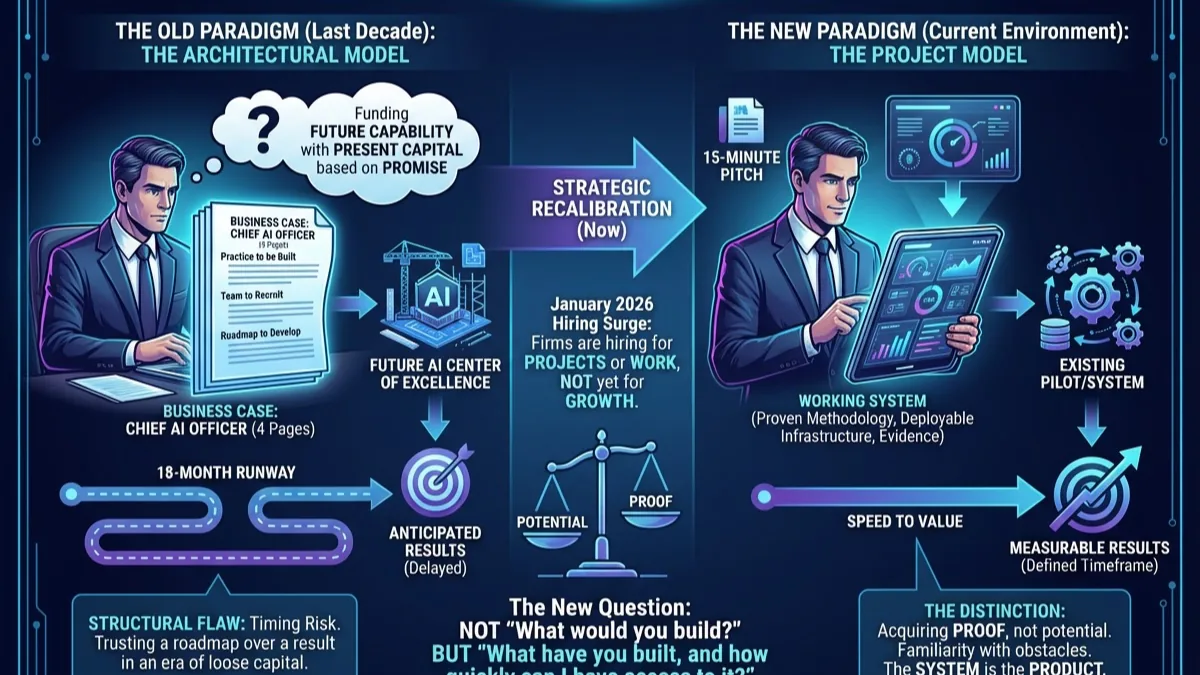
A CFO is reviewing a headcount request. The title reads: Chief AI Officer. The business case runs four pages. It describes a practice to be built, a team to be recruited, and a roadmap to be developed. They set it down.
They are not being obstinate. They are being rational.
What they are reading is a request to fund a future capability with present capital, based on a promise rather than proof. They have seen this proposal before. They have approved versions of it before. In most cases, the capability was eventually built, but the results the proposal had anticipated did not arrive on the schedule it had described. They have learned something from this. The something they have learned is: the proposal is not the work.
For most of the last decade, the dominant model for bringing AI capability into a large organization was architectural. A company would hire a leader to build something — a center of excellence, a data science function, an AI practice — on the hypothesis that capability, once established, would generate value. The leader's job was to construct the infrastructure from which that value would eventually emerge. Boards accepted this arrangement because it was the only arrangement available. AI was new enough that no one was certain what deploying it at scale actually looked like. So organizations hired people who had read the map and trusted them to find the territory.
The territory has since been found. And what it revealed is that the architectural model carries a structural flaw.
The flaw is not one of execution. It is one of timing. To fund a practice before the practice has produced a single outcome is to ask a finance committee to trust a roadmap over a result. In a period of loose capital and organizational patience, this is possible. Organizations have done it, and some of them have been rewarded for it. But the current environment is not that environment.
In January 2026, the US economy added 130,000 jobs in a single month — nearly three-quarters of the total added across all of 2025. Analysts called it a hiring surge. Korn Ferry's assessment was more precise: firms are hiring when they have projects or work. They are not yet hiring for growth.
That sentence is worth slowing down on, because it contains an entire strategic recalibration for anyone positioning themselves as an AI leader right now.
When a company hires for a project, it is not acquiring potential. It is acquiring proof. The project already exists in some form — a pilot that needs to cross into production, a system that has demonstrated results in one context and needs to be applied to another, a problem that has been scoped, funded, and assigned to someone who will be evaluated on what it produces. The person hired into that role is not being asked to design the work. They are being asked to complete it.
This is a fundamentally different job than the architectural model describes. The architectural model hires a strategist. The project model hires someone who arrives carrying a working system — proven methodology, deployable infrastructure, and evidence that it has functioned before under comparable conditions.
The distinction matters because it changes the risk profile entirely. When an organization acquires a project rather than a practice, it is not taking a bet on future capability. The capability already exists. What they are purchasing is the ability to apply it to their specific problem, at speed, without the eighteen-month runway the architectural model requires. The CFO's calculus is different. The scrutiny is different. The question they ask is different.
For most of the post-pandemic period, the question was: what would you build? The question now is: what have you built, and how quickly can I have access to it?
This shift is not a subtle adjustment in how AI executives should position themselves. It is a different premise. The career asset that matters most right now is not a title or a track record in the abstract. It is a working system — something that can be deployed into an unfamiliar organization, regardless of existing infrastructure, and produce a measurable result within a defined timeframe. The executive who has that system does not compete for roles in the conventional sense. They render the headcount conversation unnecessary by arriving before it begins.
Consider what has been driving the recent uptick in AI hiring: not the generalized expansion of capability budgets, but the specific demand created when pilots need to become products. The executives being absorbed into those roles are not being brought in to design the transition. The transition has already been scoped. What the organization needs is someone who has made that crossing before and knows what it costs. The value is not in the vision. It is in the familiarity with the obstacles.
This has implications for how organizations should think about evaluation. The right question is no longer whether a candidate can articulate a theory of AI transformation. It is whether they can demonstrate, in concrete terms, what they have already transformed. The consultant with five case studies is a different proposition than the executive with a vision deck. The market has been moving in this direction for years without quite naming it. Corporate enterprise is arriving at the same conclusion through a different door.
For the executive, the implication is this: the business case is no longer the product. The system is the product. And a system, unlike a business case, does not need to be argued for. It needs to be shown.
The CFO who declined that four-page headcount request was not making an error. They were responding accurately to the information in front of them. A promise is not proof, and they have learned to tell the difference. The executive who walks in with the proof does not need to rewrite the proposal.
They don't need four pages. They need fifteen minutes.
Dr. Jerry A. Smith builds AI organizations within large enterprises — practices, products, teams, and revenue. Specializing in moving AI from pilot to deployed system at scale.
Connect on LinkedIn or reach out at jerry@drjerryasmith.com.