Building Minds
Overriding the Immune System: The Seven Moves Every CAIO Must Make
Dr. Jerry A. Smith · February 23, 2026 · 8 min read
Eighteen months is not very long. It is long enough to learn an organization's politics, to understand where the real decisions are made, to build one meaningful proof of concept. It is not long enough to transform a business.
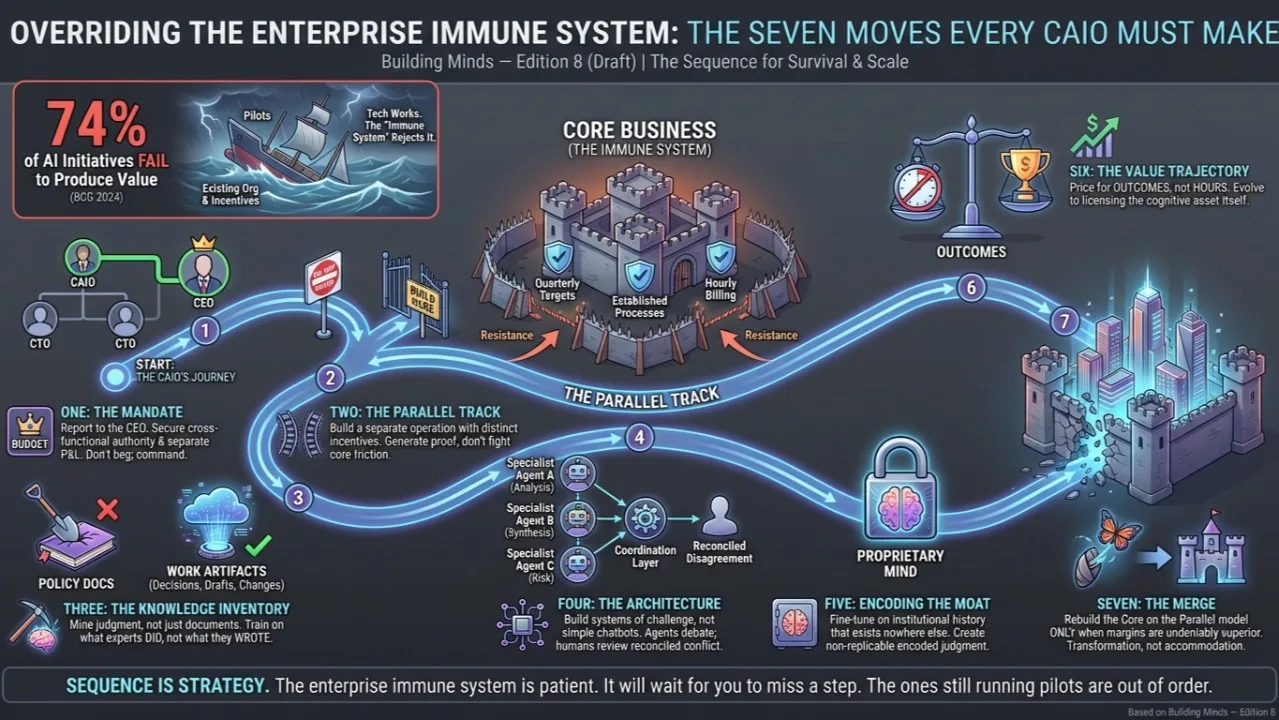
The Chief AI Officers (CAIO) cycling out of their roles right now are not leaving because the technology failed them or because they lacked the intelligence to deploy it. They are leaving because the job they were hired to do and the job they actually had were different things. 74% of enterprise AI initiatives fail to deliver tangible value, according to BCG's 2024 research. The technology works. Something else is failing.
What follows is the sequence followed by those who survive.
One: The Mandate
The first decision the CAIO makes is not a technical one. It is a question of reporting structure.
Most CAIOs report to the CTO or, in less fortunate configurations, to the Chief Digital Officer. This feels logical. AI is technical. Technical things belong to the CTO. But the CTO's authority is bounded by the CTO's budget, organizational relationships, and mandate — which is infrastructure, not transformation. The CTO can deploy software. The CTO cannot compel the head of the firm's most profitable practice area to open twenty years of client work for use as training data. That requires a different kind of authority.
The CAIO who reports to the CEO inherits a different problem set. Not a better one, necessarily — but one where the tools match the task. Cross-functional authority. The ability to set outcome-based success metrics that business units are required to acknowledge. The organizational standing to build a separate operation rather than beg for resources from existing ones.
Without a P&L, the CAIO's only tool is persuasion. And persuasion against entrenched incentive structures, deployed by someone with advisory authority rather than operational standing, is a predictable losing proposition. The structure matters before anything else does.
Two: The Parallel Track
Once the mandate is secured, the CAIO faces a decision that determines everything that follows. The instinct — and the preference of most boards — is to inject AI directly into the existing business. This instinct should be resisted.
The existing business has an immune system. It is not a metaphor. Business unit leaders are measured on quarterly performance. Their teams are measured on throughput within established processes. Any change that adds friction to those processes — regardless of what it promises in three years — will be treated as a threat. Not because the people involved are shortsighted. Because their incentive structures have correctly classified the disruption as dangerous to them personally.
You cannot overcome this with better training programs or more compelling internal presentations. BCG's data is specific: only 26% of companies successfully scale AI beyond proof of concept, and the ones that do operate through dedicated, ring-fenced teams with separate economics—not through enterprise-wide transformation programs running through existing management chains.
The parallel track is a separate profit-and-loss account. A separate team under different incentives. Client engagements are structured around outcome-based pricing from the first conversation. It runs alongside the core business, not against it. The core business continues generating the revenue that sustains the enterprise. The parallel track generates proof. These are its only two requirements.
Three: The Knowledge Inventory
The parallel track needs something to encode. This is where most AI initiatives fail even after surviving the first two steps.
The accessible material is the wrong material. Employee handbooks. Policy documents. Publicly available research. These can be quickly indexed and easily demonstrated. They provide no competitive advantage. A competitor with access to the same foundation models will produce the same outputs from the same information. A retrieval-augmented pipeline over the company's internal documentation is a better search engine. It is not a moat.
The moat is different in kind. It is the actual decision-making patterns of the firm's best practitioners: what they chose to flag and what they chose to ignore, which approaches they abandoned after three days because something in the client situation made them wrong, and which risks they surfaced in the internal review that no one else had thought to raise. This knowledge does not exist in training manuals. It exists in the artifacts of work — the tracked-changes documents, the discarded drafts, the revision history that shows what was considered and rejected and why.
The principle that governs this step is direct: train on what they did, not what they wrote. The writing describes the process. The artifacts are the process.
The knowledge inventory is the work of mapping where this material lives, who carries it, and how much of it can be recovered before it leaves the organization.
Four: The Architecture
The technical foundation of the parallel track has to be designed for systems, not for individual tools.
Most enterprise AI deployments are, at their core, chatbot-shaped: a prompt enters, an output emerges, and a human reviews it. This handles isolated tasks. It cannot generate the margin differential between an AI-native operation and a traditional one. The gap between a useful tool and a different business model is the gap between a single agent and a system of agents built to challenge each other.
The architecture begins with specialist models — small, fine-tuned, running on hardware the organization controls. One handles a specific category of analysis. Another handles a specific category of synthesis. A third handles risk identification within a defined domain. They do not share a single model's general capabilities. They share a coordination layer.
Recommended by LinkedIn
[ Issue #47: AI Does Not Expand Margin. Operating Model…
Deva I J.
Issue #47: AI Does Not Expand Margin. Operating Model…
Deva I J.
6 months ago](https://www.linkedin.com/pulse/issue-47-ai-does-expand-margin-operating-model-rewiring-deva-i-justhy-btifc)
[ Strategy Liberated: Realising Collective Wisdom as the…
Paul Barnett
Strategy Liberated: Realising Collective Wisdom as the…
Paul Barnett
7 months ago](https://www.linkedin.com/pulse/strategy-liberated-realising-collective-wisdom-brain-paul-barnett-uwjhe)
[ From AI Buzz to Business Results: Breaking Free from…
Rob Bikoko
From AI Buzz to Business Results: Breaking Free from…
Rob Bikoko
5 months ago](https://www.linkedin.com/pulse/from-ai-buzz-business-results-breaking-free-activity-trap-rob-bikoko-uepbf)
That coordination layer is where the system's actual value accumulates. The agents do not pass outputs to each other for approval. They challenge each other's outputs. Conflicts are surfaced and resolved before anything reaches the human layer. The practitioner reviewing the final recommendation sees not a consensus but a reconciled disagreement — what each model flagged, how the system weighed those flags, and the resolution. The human judgment applied at this stage is better calibrated than it would have been otherwise, because the disagreement that preceded the recommendation is visible rather than silent.
Five: Encoding the Moat
The knowledge inventory identified what was worth encoding. This step is the encoding itself.
The institutional knowledge extracted from work artifacts is used to fine-tune the specialist models. These models are not general-purpose assistants made slightly more domain-aware. They are trained specifically on the decision histories of the firm's top performers in a given domain — what they attended to, what they discarded, and how they resolved conflicts between competing signals. The resulting models carry encoded judgment. They have identities because they have distinct capabilities that derive from a specific provenance.
What makes these models competitively significant is not the architecture, which any firm with a competent team can build. It is the training data: institutional knowledge that exists nowhere else. It cannot be acquired by a competitor licensing the same foundation model, because it was never published, never indexed, never accessible except through the specific history of the firm's own engagements. The model trained on two decades of actual decisions in a specific practice area is not replicable by any other method.
This is what a proprietary mind is. Not a tool. Not a product. An encoded practitioner.
Six: The Value Trajectory
A service priced by the hour cannot capture the value of a system that does in four hours what previously took forty.
This is not a complex observation, but its implications are consistently underestimated. If AI deployment makes a team twice as productive under an hourly billing model, the same deliverable now generates half the revenue. The technology succeeds. The business model fails to capture the success. This is why 45% of AI leaders, according to BCG's research, deploy AI for cost reduction rather than revenue transformation — and why the organizations that focus only on internal efficiency rarely see the margin impact they anticipated.
The parallel track is priced differently from the beginning. Not by time spent, but by value delivered. This is Phase 3 of a four-phase evolution: from selling hours, to augmenting hours, to selling outcomes, to eventually licensing the encoded judgment itself — the named agent as a cognitive asset, priced not on the work it performs in any single engagement but on its capability as reusable intellectual property. The contracts governing the parallel track's early engagements should establish the rights and frameworks for that fourth phase, not retrofit them later.
Seven: The Merge
The parallel track was always a temporary structure. It was built to generate proof, not to run indefinitely alongside the core business.
The timing of the merge is the CAIO's most consequential decision, and the asymmetry of error matters here. Merge too early — before the parallel track's unit economics are clearly, empirically superior — and the core business's immune system will absorb and neutralize it. The AI-native operating model will be required to conform to the legacy firm's approval processes, risk models, and management rhythms. The agility that made the parallel track work will be a casualty of the integration. Merge too late, and two organizations are competing for the same resources, clients, and strategic attention.
The merge happens when the numbers have made the argument that the strategy presentations never could. When the parallel track's margin on an outcome-priced engagement exceeds the core business's margin on a comparable hourly engagement by a factor no one in the room can dispute, the question of whether to integrate stops being a debate about strategy and becomes a decision about execution. The board does not need to be persuaded. The board can see.
At that point, the parallel track's operating model does not get absorbed by the core business. The core business gets rebuilt on the parallel track's operating model. The distinction is not semantic. One is accommodation. The other is transformation.
Seventy-four percent of AI initiatives fail. The technology is not why.
The organizations that are building something durable did not start with the most sophisticated models or the most ambitious transformation agenda. They started with the mandate. Then the parallel track. Then the knowledge inventory. Then the architecture. Then the encoding. Then the pricing. Then the merge. The sequence is the entire insight.
The ones still running pilots are not failing because they lack ambition or capability. Many of them are staffed by people who understand the technology better than anyone. They are failing because they reached for the proof before they had the standing to protect it, announced the transformation before the economics could sustain the argument, and tried to change the core business using tools borrowed from the core business, under incentives that made the change dangerous to everyone whose cooperation it required.
The enterprise immune system did not have to defeat them. It only had to wait.
Dr. Jerry A. Smith builds AI organizations within large enterprises. Connect on LinkedIn or reach out at jerry@drjerryasmith.com.