Essay
The Scientific Method for Smarter AI: How Orthogonal Arrays Can Transform Agentic Goal Achievement
Dr. Jerry A. Smith · January 10, 2026 · 11 min read
Building a powerful AI agent feels remarkably like perfecting a complex recipe. You have dozens of knobs to adjust — the creativity level, the structure of your prompts, the background knowledge available, the persona you assign — and the smallest tweak to one can dramatically alter the final result. Finding the optimal combination through trial and error is not just difficult; it’s often impossible.
This is the central paradox facing every enterprise deploying frontier AI systems today: the very flexibility that makes generative, agentic, and synthetic intelligence so powerful also makes them extraordinarily difficult to optimize. Most teams are still optimizing these systems using “gut feeling” and intuition — an approach that cannot scale. Welcome to the “curse of dimensionality” — and to a surprisingly elegant solution borrowed from factory floors and Japanese sparkler workshops.
This article details a framework for “Orthogonal Agentic Architecture”: how to move from the intuitive art of tweaking prompts to a rigorous engineering discipline by adapting a statistical method originally designed for industrial quality control.
The Curse of Dimensionality: Why AI Optimization Feels Impossible
Enterprise-grade AI agents are complex chemical reactions. The core “oxidizer” is the underlying Large Language Model (LLM), but its performance depends on an intricate interplay of “fuels”: prompt engineering strategies, temperature settings, RAG (Retrieval-Augmented Generation) context, persona definitions, and countless other configuration variables.
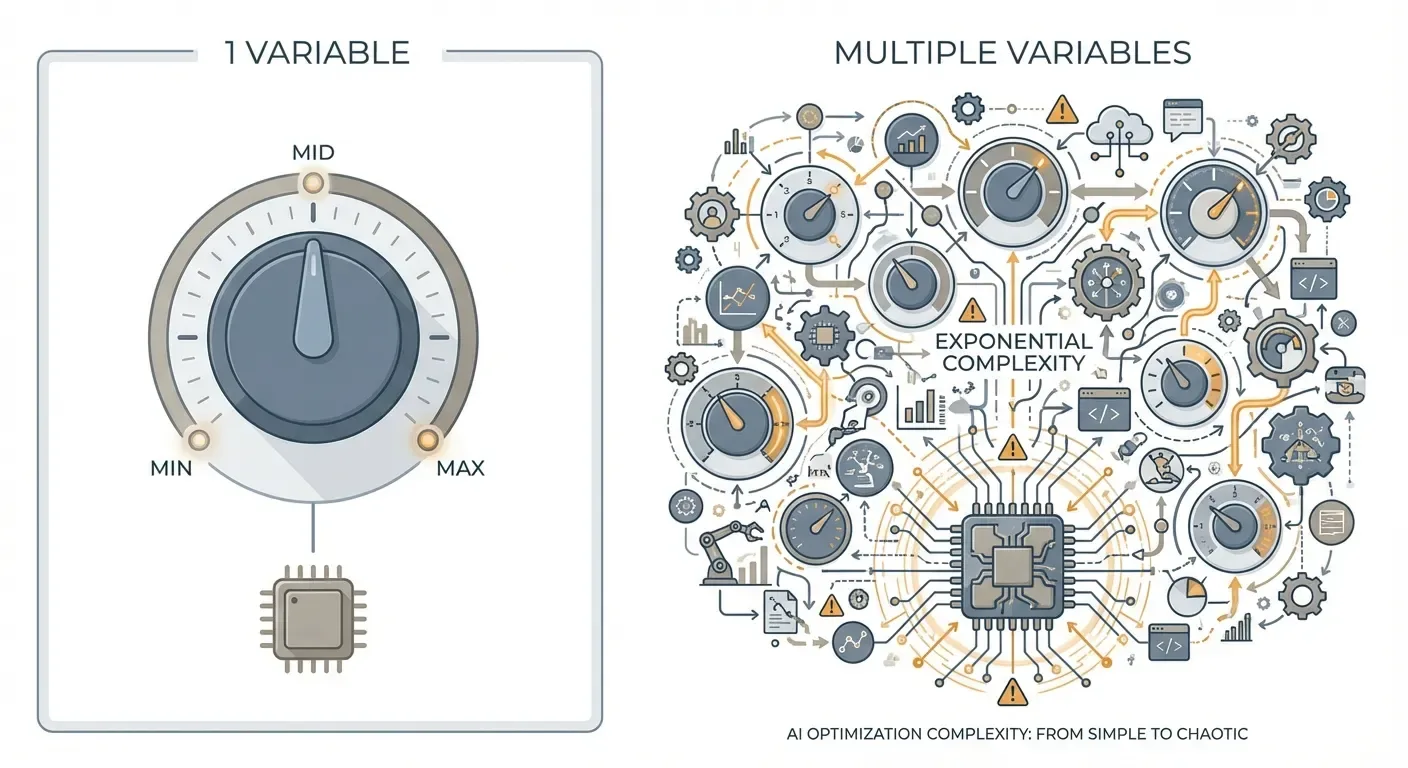
The critical challenge is that these variables do not exist in a vacuum — they interact in unpredictable ways. A prompt that excels at low temperature may degrade performance at high temperature. Context that helps one persona may overwhelm another. This creates what is known as the “curse of dimensionality”: as you add variables to your system, the number of possible configurations grows exponentially, making it impossible to test them all.
Consider a modestly complex AI system with just four tunable variables — Goal Definition, Temperature, Context/RAG, and Persona — each tested at three settings (low, medium, high). Testing every combination would require 81 distinct experiments. Scale this to a production system with a dozen variables, and the number of required tests spirals into the millions.
Why Traditional Testing Methods Fail
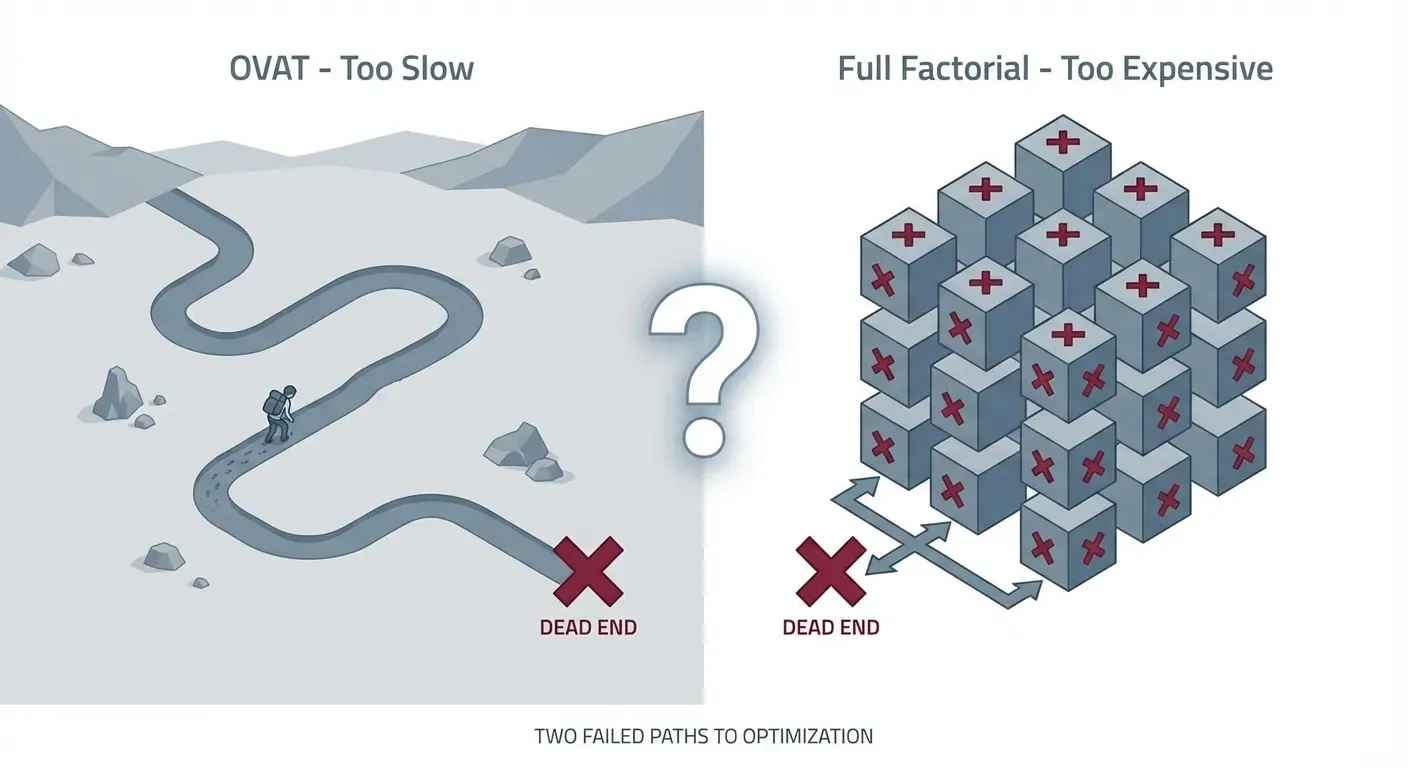
For decades, engineers have relied on two primary approaches to experimental optimization. Both collapse under the weight of the complexity of frontier AI.
The “One Variable at a Time” Trap
The most intuitive approach is to change only one setting at a time while holding everything else constant. This method has a long and honorable history — one practitioner noted it served them well for over 15 years. The problem arises when dealing with systems that are “head and shoulders more complicated” than simple problems.
OVAT testing is painfully slow for complex systems, potentially requiring many hundreds of individual experiments to find optimal settings. More critically, it is structurally blind to interactions among variables. A prompt strategy that performs brilliantly at low temperature may catastrophically fail at high temperature — an insight OVAT cannot detect because you never test those variables together.
The “Full Factorial” Nightmare
The opposite extreme — testing every possible combination — provides complete data but at impossible cost. That modest four-variable, three-setting system requiring 81 experiments? Add just two more variables, and you’re looking at thousands of tests. For enterprise AI with dozens of tunable parameters, full factorial analysis is simply not feasible.
Both methods are dead ends: one is too slow to be practical, the other too expensive to pursue. AI development needs a smarter path forward.
The Solution: Orthogonal Arrays and the Taguchi Method
The elegant solution comes from an unexpected source: a statistical technique perfected for industrial quality control, known as the Orthogonal Array or Taguchi Method. Its power lies in a simple but profound capability — testing multiple variables simultaneously through a carefully structured set of experiments that dramatically reduces workload without sacrificing insight.
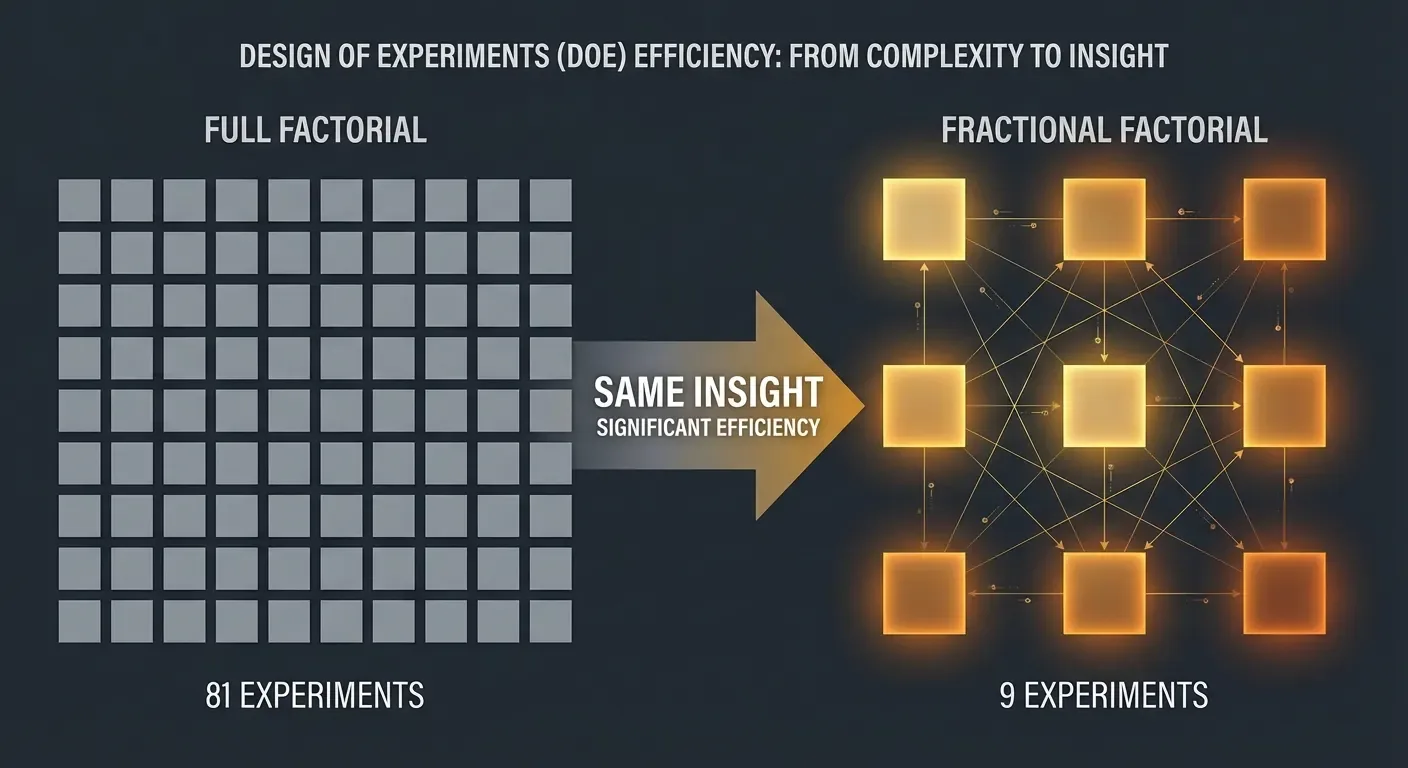
Instead of running 81 experiments, an L9 Orthogonal Array provides statistically significant coverage with only 9 runs. This represents a 9x reduction in computational cost and time, transforming rigorous testing from prohibitive to practical.
But the power goes deeper than mere efficiency. By running just 9 carefully structured tests, we can mathematically infer how the system would behave in the other 72 scenarios. The array doesn’t just sample the search space — it provides a statistical map of the entire landscape from a handful of strategically chosen vantage points.
The Magic of Strategic Cancellation
To understand how this works, consider a simple experiment: finding the secret to perfectly peelable boiled eggs. The experimenter wanted to test three variables — starting temperature (room vs. cold), cooling method (ice water vs. air), and vinegar in the water (yes vs. no).
A full factorial test would require eight experiments. An Orthogonal Array requires only four — but critically, these four are specifically structured so that when you analyze the results, the effects of each variable can be mathematically isolated.
Here’s the key insight: the array is designed so variables strategically cancel each other out. When you sum the scores for all tests where vinegar was added, the effects of the other variables (starting temperature and cooling method) are balanced and effectively neutralized. It’s as if you tested vinegar all by itself — while simultaneously gaining insight into every other variable from the same four experiments.
The egg experiment’s results were illuminating: the data clearly showed that adding vinegar made a significant difference, while the other two variables were comparatively insignificant. This kind of surgical insight is what orthogonal testing delivers.
From Eggs to Agents: Applying Orthogonal Methods to AI
The same principles transfer directly to AI systems. Instead of vinegar and egg temperature, we’re tuning the “ingredients” of an intelligent agent:
Goal Definition: How you instruct the AI — vague directives versus specific, detailed prompts versus chain-of-thought reasoning structures.
Temperature: The AI’s creativity setting — low values produce factual, deterministic outputs; high values foster imagination and variation.
Context/RAG: The background information provided — zero-shot (no examples), few-shot (limited examples), or full retrieval from knowledge bases.
Persona: The personality assigned — helpful assistant, critical expert, creative writer, or domain specialist.
Model Version: Which underlying LLM powers the agent — different model generations and sizes exhibit dramatically different capability profiles and failure modes.
An L9 Orthogonal Array can test multiple variables at three settings each through just nine experimental runs, executed in parallel for maximum efficiency. The result is a statistically valid picture of how each variable truly affects performance — including the hidden interactions that determine real-world success. More importantly, the array's structure means these nine runs provide inferential power across the entire configuration space, not just the specific combinations tested.
The Multi-Agent Architecture: Automating the Scientific Method
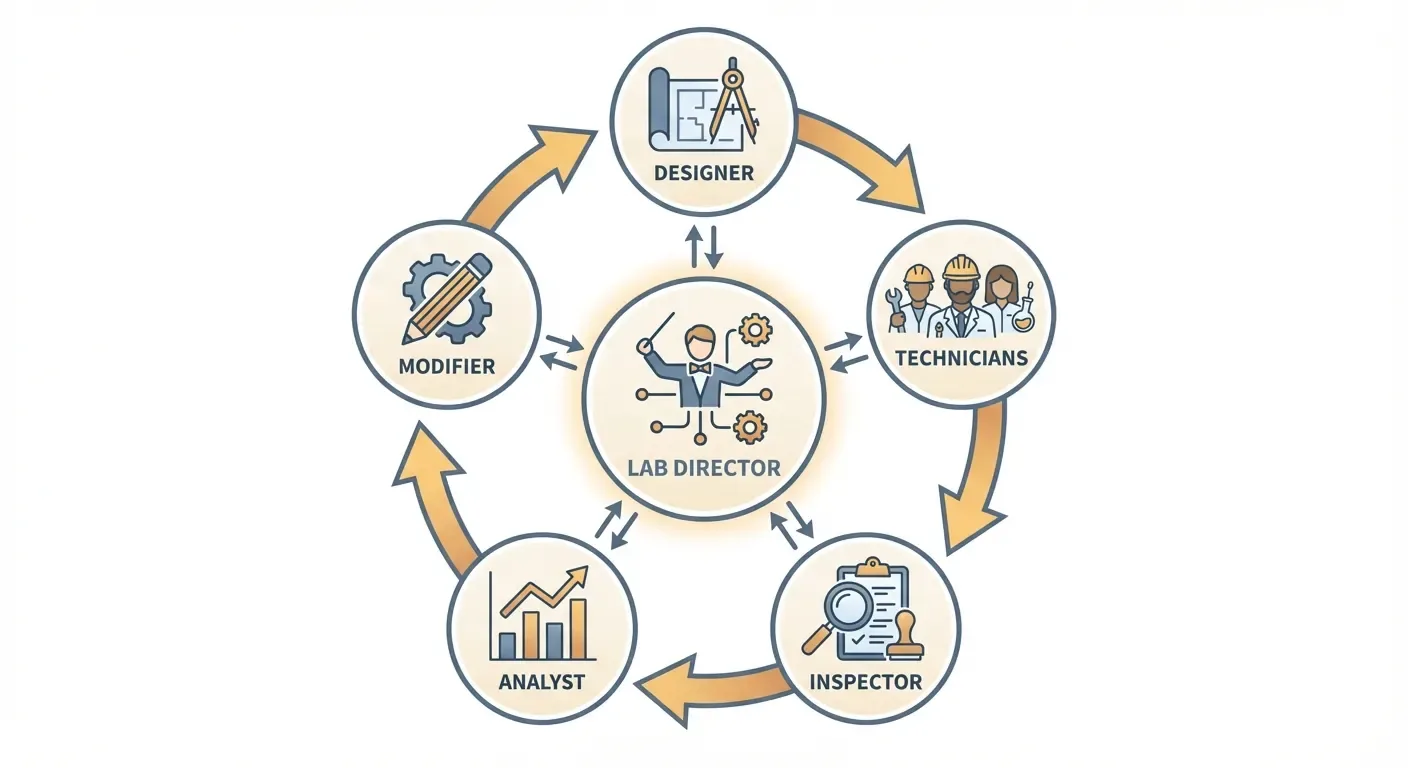
Implementing orthogonal optimization at enterprise scale requires more than methodology — it demands infrastructure. The solution is a multi-agent architecture that automates the entire experimental loop, transforming AI optimization from intuitive art into a rigorous engineering discipline. This architecture treats goal optimization as an iterative engineering challenge, governed by a central Lab Director who manages a team of specialized agents.
The Lab Director (Orchestrator)
At the center sits the Lab Director — the chef managing the kitchen. This central orchestrator initiates and manages the entire optimization workflow, coordinating the specialized agents that handle each phase of the experimental cycle.
The Configuration Agent (Experimental Designer)
This agent functions as the menu writer. Its primary role is constructing the experimental matrix — the “Run Table” — by translating the optimization problem into a statistically valid set of experiments using an L9 Orthogonal Array. It selects which variables to test, maps them to specific configurations, and ensures the mathematical balance required for valid inference.
The Execution Agents (Lab Technicians)
These agents function like line cooks who prepare dishes without tasting them. They are instantiated to run the scenarios defined in the Run Table, executing assigned configurations and recording raw output logs “blindly, without judgment.” This deliberate separation ensures experimental integrity — agents that don’t evaluate their own outputs cannot introduce bias into the measurement process.
Because the orthogonal array dramatically reduces the number of required tests, all scenarios can run in parallel, minimizing latency while maximizing throughput.
The Inspector (Evaluator Agent)
This agent tastes the food. It tackles the core measurement challenge of generative AI: quantifying outputs that are fundamentally “organic and messy.” The Inspector’s critical role is translating subjective outcomes — text, code, plans — into consistent numerical scores using a rigid, objective framework. Without this agent, the entire system would lack the empirical grounding needed for meaningful analysis.
The Analyst Agent (Data Scientist)
This agent realizes that “the salt is ruining the dish, not the heat.” Aggregating raw scores from the Inspector, the Analyst derives actionable insights by performing a critical function: separating correlation from causation. Its purpose extends beyond individual test results to identify hidden interactions, calculate synergistic effects between variable combinations, and expose “confident misconceptions” that have calcified into organizational practice. Where intuition sees patterns, the Analyst reveals whether those patterns reflect genuine causal relationships or mere coincidence.
The Modifier Agent (Baseline Modifier)
Closing the optimization loop, this agent takes the Analyst’s findings and rewrites the system’s baseline configuration. The updated configuration becomes the new “Control Group” for subsequent optimization cycles — the recipe book rewritten with proven improvements.
The Measurement Protocol: Quantifying the Unquantifiable
The most significant barrier to systematic AI optimization is the subjective nature of output. Assigning accurate numbers to generative processes — text, code, multi-step plans — seems inherently problematic. The solution requires a two-pronged methodology.
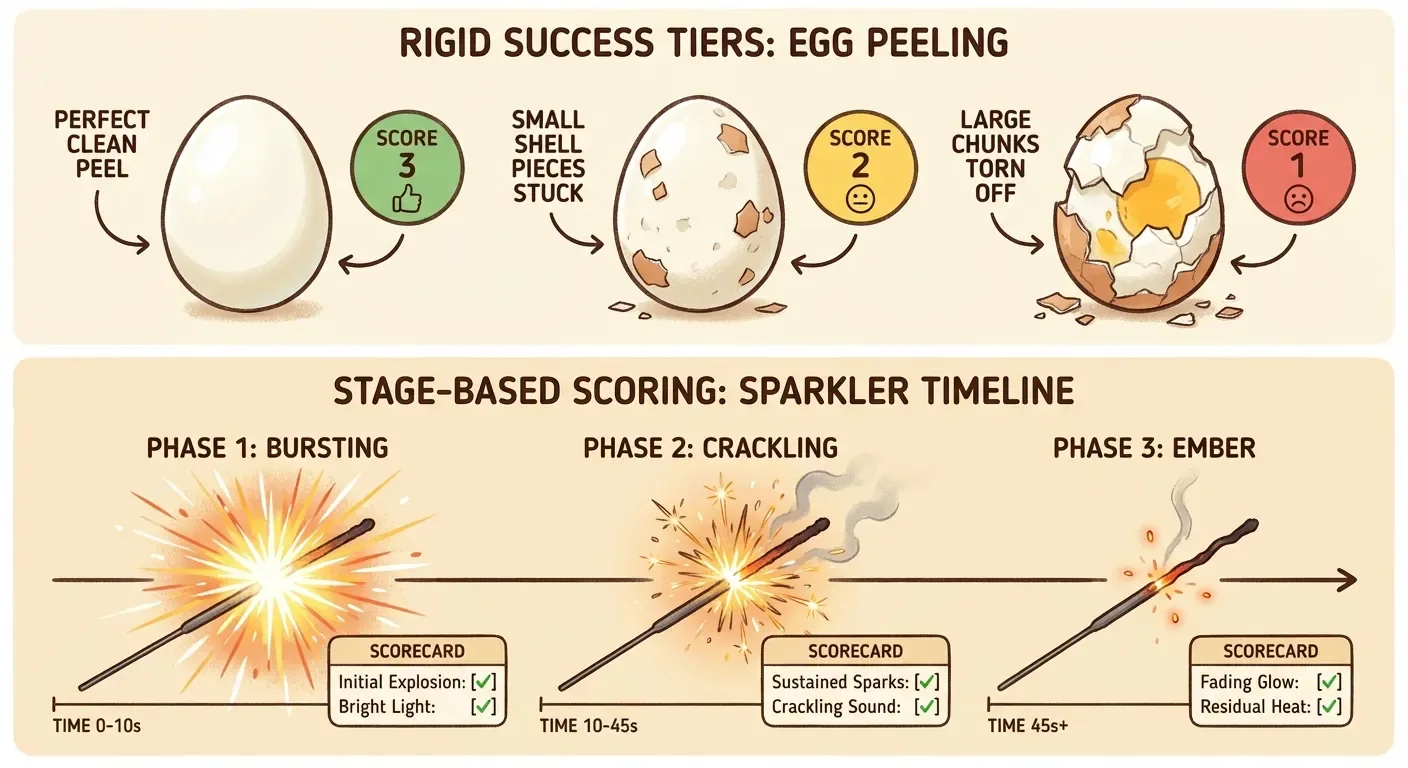
Part 1: Rigid Success Tiers (The Egg Peeling Method)
Replace arbitrary scales with rigid categories of success, inspired by the egg experiment’s simple 3-point peelability scale:
Score 3 (Perfect): Goal achieved on an efficient path with zero hallucinations. Analogous to a shell that slips off cleanly.
Score 2 (Minor Issues): Goal achieved, but the agent required self-correction or produced minor, non-critical errors. Small pieces of shell stick, but the egg is intact.
Score 1 (Failure): Agent hallucinated, entered an infinite loop, or failed to terminate successfully. Large pieces tear off — unusable result.
This eliminates the inconsistency where one evaluator calls a result “7/10” while another rates it “4/10.” The categories are objective, repeatable, and comparable.
Part 2: Stage-Based Scoring (The Sparkler Method)
A single aggregate score, even a rigid one, can obscure root causes. The sparkler analogy proves instructive: when optimizing Japanese sparklers, the creator didn’t assign a single “beauty” score. Instead, he measured three distinct phases — the initial “bursting,” middle “crackling,” and final “ember” stages — separately.
For AI agents, we decompose the workflow into chronological components:
Retrieval Score (Bursting Stage): Did the agent locate the correct context or file needed to proceed? Measured against ground truth accuracy and the distance of retrieved chunks.
Reasoning Score (Crackling Stage): Was the agent’s plan logical and free of unproductive loops? Measured through token counts, logic step counts, and latency metrics.
Output Score (Ember Stage): Was the final formatted output — JSON, Python, structured text — syntactically correct and usable? Measured by correctness validators and unit test pass rates.
The power of stage-based scoring lies in its diagnostic capability. Analysis might reveal that high temperature dramatically improves the Output Score by fostering creativity, but simultaneously destroys the Reasoning Score by undermining logical coherence. A single aggregate score would show a neutral result, completely hiding this critical trade-off.
The Biggest Payoff: Busting Confident Misconceptions
All creators, inventors, and developers are vulnerable to a fundamental psychological trap: being wrong feels exactly the same as being right — until data proves otherwise. We hold strong intuitions that feel correct, and those intuitions calcify into practice regardless of their validity.
The Lamp Black Deception
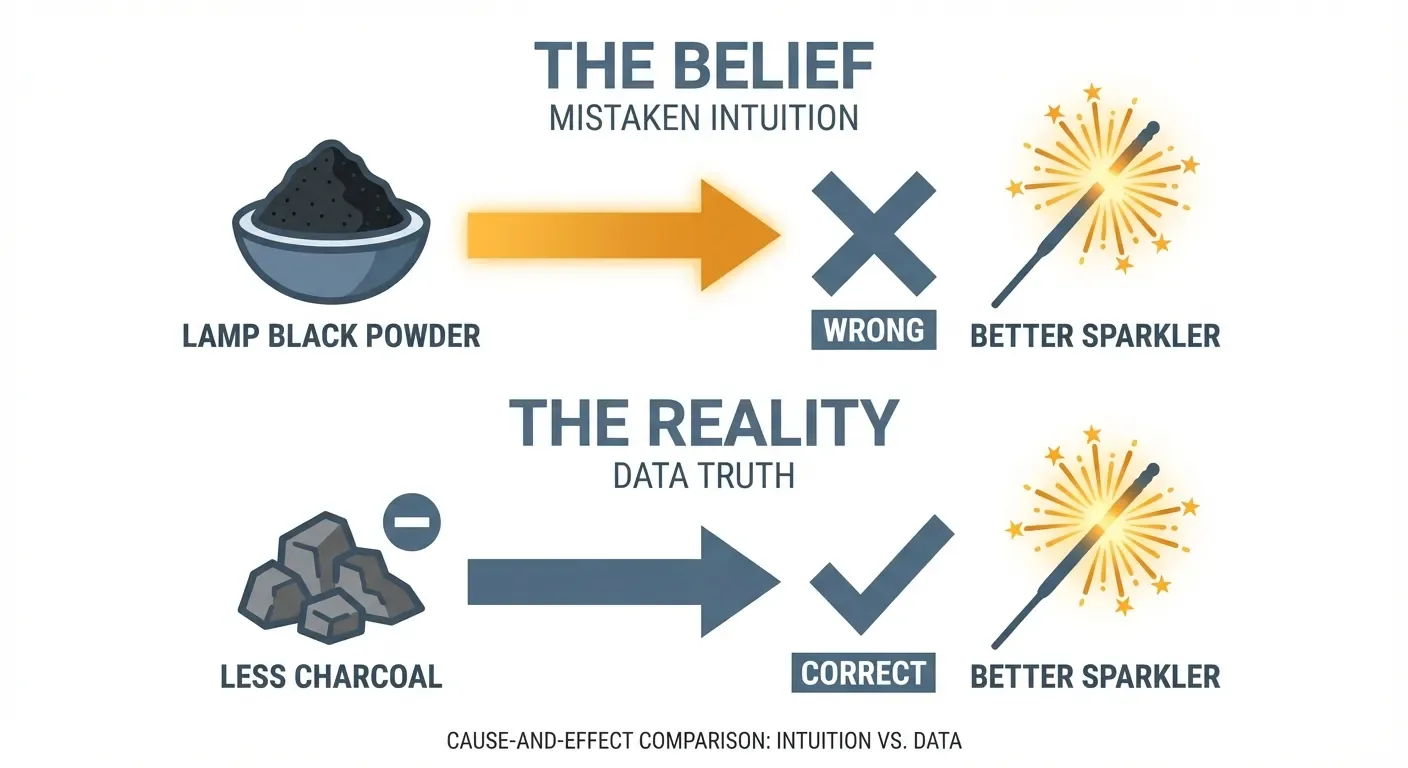
The story of the sparkler maker provides a perfect illustration. For ten years, he was confident that adding more “lamp black” (a type of fine soot) made his sparklers better. His experience seemed to confirm this because he was adjusting variables reactively, not systematically: add lamp black, see a worse result, reduce charcoal to compensate, see improvement, credit the lamp black.
When he ran his first Orthogonal Array experiment, the results seemed so random and chaotic that he felt hopeless, believing the experiment must be wrong. The data contradicted a decade of experience.
But when he trusted the data, he discovered the truth: the extra lamp black often had a negative effect. The real improvement came from reducing charcoal — the compensation he made after adding lamp black. His intuition was completely backwards, a discovery only possible through a methodology that could untangle interacting effects.
Finding AI’s “Lamp Black”
This same pattern pervades AI development. Developers believe “more detailed prompts are always better” or “more context always improves accuracy” — intuitions that become organizational gospel. These beliefs may be the lamp black of your agentic system.
An Orthogonal Array test might reveal hidden interactions that invalidate these assumptions. The data could show that detailed prompts improve performance only when paired with low-temperature settings and degrade the Reasoning Score when combined with high-temperature settings. Stage-based scoring provides the final diagnostic insight, enabling surgical intervention without disrupting existing workflows.
Closing the Loop: Continuous Improvement
The output of this system is not a static answer but a “direction” for improvement. The Analyst’s findings flow to the Modifier Agent, which rewrites the system’s baseline configuration to incorporate winning settings. This distinction matters: the framework doesn’t claim to find a perfect solution in one pass, but rather to provide empirically-grounded guidance for iterative refinement.
This new, improved configuration becomes the “Control Group” for the next round of optimization. The Lab Director can then trigger another, finer-grained experiment to achieve further gains — iterating toward perfection with diminishing returns. Each cycle narrows the search space, focusing computational resources on the variables and interactions that actually matter.

The framework embodies the complete cycle: Design (Configuration Agent builds the Run Table), Execute (Lab Technicians run scenarios in parallel), Measure (Inspector scores outputs), Analyze (Data Scientist finds hidden interactions), and Modify (Baseline Modifier updates the system). Then repeat. This is the scientific method, automated and applied to the unique challenges of frontier AI.
From Art to Engineering: A Paradigm Shift
The Orthogonal Array Multi-Agent System provides a robust, scalable, and data-driven solution to the curse of dimensionality plaguing enterprise AI optimization. The key benefits are clear:
Computational Efficiency: Reduces required experimental volume by orders of magnitude — from 81 runs down to 9 — saving significant time and resources.
Statistical Rigor: Uncovers hidden interactions between variables that OVAT testing systematically misses, enabling true system-level optimization.
Objective Measurement: Provides a concrete, repeatable methodology for quantifying messy generative outputs, turning qualitative behavior into actionable data.
Data-Driven Insight: Overcomes developer bias and confident misconceptions by grounding all improvements in empirical evidence rather than intuition.
By moving from intuition-based tweaking to orthogonal, data-driven engineering, enterprises can finally optimize complex agentic behaviors with scientific precision. This paradigm transforms AI optimization from an art practiced by talented individuals into an engineering discipline accessible to any organization willing to embrace the method.
The century-old science trick that perfected boiled eggs and Japanese sparklers now offers frontier AI the same gift: the ability to find truth hidden in complexity, and the discipline to trust data over intuition. In the race to deploy reliable, effective AI systems, that gift may prove decisive.
The orthogonal architecture framework transforms AI optimization from guesswork to science — testing smarter, not harder, to defeat the curse of dimensionality and build more reliable intelligent systems.