Essay
The Hidden Toll: Neuro-Cognitive Harm from Sustained Manual Verification Work
Dr. Jerry A. Smith · January 8, 2026 · 20 min read
Listen to the article on Apple Podcasts
Listen to the article on Soundcloud
Abstract
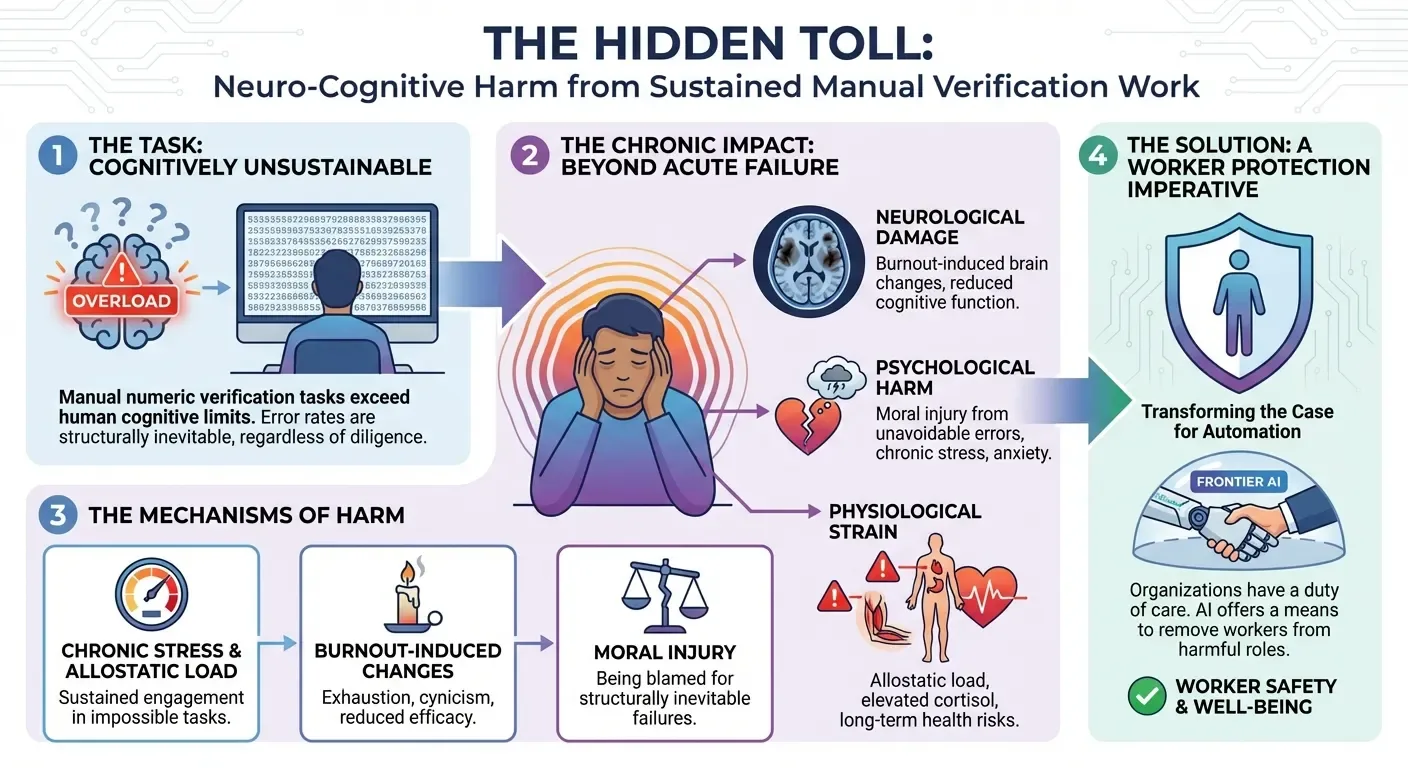
A companion paper established that manual numeric verification tasks exceed fundamental human cognitive limits, producing error rates that cannot be overcome through training or diligence. This article extends that analysis by examining what happens to workers who perform such tasks over extended periods. Drawing on research in occupational health, neuropsychology, stress physiology, and organizational psychology, we demonstrate that sustained engagement in cognitively impossible tasks produces measurable harm — not only the acute cognitive failures documented in human factors research, but chronic neurological, psychological, and physiological damage. The mechanisms include allostatic load from chronic stress, burnout-induced brain changes, and moral injury from being blamed for structurally inevitable failures. These findings transform the case for automation from an operational-efficiency argument into a worker-protection imperative. Organizations have a duty of care to avoid placing workers in roles known to cause harm, and Frontier AI offers a means to fulfill that duty.
1. Introduction: From Task Failure to Worker Harm
1.1 The Prior Argument
In “The Neuro-Cognitive Case for Frontier AI in Numeric Verification and Data Integrity,” we established that manual numeric review fails not because workers are inattentive but because such tasks violate fundamental cognitive constraints. Working memory limitations, vigilance decrement, perceptual automation, and confirmation bias combine to produce error rates that no amount of training or motivation can overcome.
That analysis focused primarily on task outcomes: error rates, detection failures, and organizational risk. It treated cognitive constraints as parameters affecting performance — limits that exist, that cause problems, and that automation can address.
This article asks a different question: What happens to the workers?
1.2 The Missing Dimension
Human factors research typically examines task performance under controlled conditions: how long can vigilance be sustained, what error rates emerge, how do breaks affect detection. These studies treat cognitive constraints as fixed parameters and workers as interchangeable units operating within those parameters.
But workers are not interchangeable units. They are biological organisms with stress response systems, neural architectures that change in response to experience, and psychological needs for competence, fairness, and meaning. When we place humans in roles that exceed their cognitive capacity — and keep them there for months or years — we are not merely accepting predictable error rates. We are subjecting them to conditions that research increasingly shows cause lasting harm.
1.3 Scope and Structure
This article synthesizes findings from occupational health, stress physiology, neuroplasticity research, burnout science, and moral injury literature to establish that sustained manual verification work produces measurable harm across multiple dimensions: neurological changes in brain structure and function, psychological damage including burnout and moral injury, physiological effects through chronic stress pathways, and cognitive impairment that may persist beyond the period of exposure.
We argue that these findings transform the ethical calculus around automation. The question is no longer merely whether AI can perform verification tasks more accurately or efficiently than humans. The question is whether organizations can ethically continue to place workers in roles known to cause harm when technological alternatives exist.
2. The Stress Physiology of Cognitively Impossible Tasks
2.1 Acute Stress and the Verification Task
Any verification task that exceeds cognitive capacity activates stress-response systems. When a worker faces a spreadsheet with thousands of values to check, knowing that errors will occur, knowing that missed errors may produce serious consequences, knowing that they will be held responsible for outcomes they cannot fully control — this is not neutral cognitive work. It is a stressor.
The acute stress response is well-characterized. The hypothalamic-pituitary-adrenal (HPA) axis activates, releasing cortisol and other stress hormones. The sympathetic nervous system engages, shifting resources toward vigilance and threat detection. In the short term, this response can enhance performance: acute stress sharpens attention and improves memory consolidation for significant events.
But verification tasks are not acute stressors followed by recovery. They are sustained demands that continue for hours, recur daily, and extend across careers. The stress response that evolved to help humans escape predators on the savanna is persistently activated by spreadsheets.
2.2 Allostatic Load: The Cumulative Cost of Adaptation
Bruce McEwen and colleagues developed the concept of allostatic load to describe the cumulative physiological cost of repeated stress adaptation. Allostasis — the process of maintaining stability through change — is essential for survival. But when stress systems are chronically activated, the mediators that enable adaptation begin to cause damage.
Research demonstrates that elevated allostatic load produces measurable changes across multiple physiological systems. Chronic cortisol elevation affects metabolism, immune function, and cardiovascular health. Inflammatory markers increase. Sleep architecture degrades. The very systems that enable stress response become dysregulated.
Most relevant to our purposes, allostatic load affects the brain itself. Systematic reviews confirm associations between elevated allostatic load indices and structural changes in multiple brain regions, particularly the hippocampus (critical for memory), the amygdala (involved in emotional processing and threat detection), and the prefrontal cortex (essential for executive function and the cognitive control required for verification tasks).
2.3 The Verification Worker’s Stress Profile
Consider the specific stress profile of sustained verification work. The worker faces tasks that exceed their cognitive capacity — this is not subjective stress but objective cognitive overload. They experience repeated failure despite genuine effort, as vigilance decrement and perceptual automation produce errors regardless of intention. They work under time pressure that prevents adequate rest and recovery. They know that errors have consequences — financial, regulatory, reputational — yet cannot prevent those errors through any amount of diligence.
This profile combines multiple established risk factors for elevated allostatic load: high demand, low control, effort-reward imbalance, and repeated failure. The worker is not merely stressed in the colloquial sense. They are experiencing chronic activation of stress response systems under conditions known to produce cumulative physiological damage.
3. Burnout and Brain Changes
3.1 Burnout as an Occupational Phenomenon
Burnout, now recognized by the World Health Organization as an occupational phenomenon with its own ICD-10 code, comprises three dimensions: emotional exhaustion, depersonalization (cynicism), and reduced sense of personal accomplishment. Originally identified in human service professions, burnout has been extensively documented across occupations characterized by high demands and inadequate resources.
Verification work combines conditions known to produce burnout: monotonous tasks that nonetheless require sustained attention, high-stakes conditions that create pressure without adequate control, and repeated exposure to situations in which failure is structurally inevitable. Workers who take pride in accuracy often struggle to meet the standards they value. Those who persist develop exhaustion; those who protect themselves through disengagement develop cynicism. Both pathways lead to reduced effectiveness and personal distress.
3.2 Neuroimaging Evidence
Recent burnout research has accumulated neuroimaging evidence demonstrating that burnout is not merely a subjective state but is associated with measurable brain changes.
Studies using structural MRI have found that individuals with burnout show pronounced thinning of the medial prefrontal cortex compared to controls , greater than would be expected from normal aging. The prefrontal cortex is the brain region essential for the executive functions required by verification tasks. Additional findings include reduced gray matter volume in the anterior cingulate cortex and dorsolateral prefrontal cortex, enlarged amygdala volume (associated with heightened threat sensitivity), and reduced caudate nucleus volume (involved in goal-directed behavior and habit formation).
Functional connectivity studies reveal weaker connections between the amygdala and regions involved in emotional regulation. This pattern suggests that burnout compromises the brain’s ability to modulate emotional responses — explaining why burned-out workers often report difficulty managing frustration, anxiety, and negative reactions to workplace challenges.
3.3 Cognitive Consequences
Meta-analyses of cognitive function in clinical burnout consistently find impairment across multiple domains. A comprehensive systematic review and meta-analysis identified deficits in episodic memory, short-term and working memory, executive function, attention and processing speed, and verbal fluency. Effect sizes ranged from moderate to substantial.
These are precisely the cognitive capacities required by verification tasks. Burnout does not merely make workers feel exhausted — it impairs the specific cognitive functions needed for the tasks that produce the burnout. This creates a vicious cycle: cognitively demanding work produces burnout, burnout impairs cognitive function, impaired function makes the work more difficult and stressful, which deepens the burnout.
3.4 Reversibility and Persistence
Research on the reversibility of stress-induced brain changes offers a complex picture. Animal studies demonstrate that many stress-induced changes in the prefrontal cortex are reversible when stress is removed — dendritic retraction can be followed by regrowth, and functional impairments can resolve. This is encouraging: the brain retains substantial plasticity.
However, several factors complicate this optimistic view. First, recovery requires removal of the stressor — continued exposure does not allow recovery, even with weekends and vacations. Second, recovery capacity appears to decline with age; changes that reverse readily in young animals are blunted or absent in older animals. Third, some evidence suggests that repeated stress-recovery cycles may themselves alter brain architecture, potentially reducing future recovery capacity. Finally, psychological patterns established during chronic stress — learned helplessness, anxiety, hypervigilance — may persist even after neurological recovery.
For workers who have spent years in cognitively unsustainable roles, the research suggests that some recovery is possible but may not be complete, particularly for older workers or those with prolonged exposure.
4. Moral Injury: The Harm of Unjust Blame
4.1 Defining Moral Injury
Moral injury, a concept originally developed to describe the psychological wounds of military service, refers to the lasting psychological, social, and spiritual harm that results from actions — or failures to act — that transgress one’s moral code. Unlike post-traumatic stress disorder, which centers on fear and threat to life, moral injury centers on guilt, shame, betrayal, and violations of deeply held values.
The concept has been extended beyond military contexts to healthcare workers, educators, and other professionals who face situations where they cannot deliver the care or outcomes they believe they should. Research increasingly recognizes moral injury as a distinct occupational hazard with measurable psychological and physiological consequences.
4.2 Moral Injury in Verification Work
How does moral injury apply to verification work? The connection operates through the mechanism of blame.
When verification errors occur — as they inevitably do, given cognitive constraints — organizational response typically attributes failure to the individual reviewer. The worker who missed the transposition, failed to notice the discrepancy, and signed off on the incorrect value is identified as the point of failure. Performance reviews, incident investigations, and accountability systems treat the error as a failure of attention, training, or diligence.
But we have established that such errors arise from structural cognitive limitations, not individual failings. The worker who is blamed for missing an error after forty-five minutes of continuous review was experiencing normal vigilance decrement. The auditor who failed to catch a familiar-looking discrepancy was experiencing predictable perceptual automation. These are not failures of character but predictable consequences of human cognitive architecture.
When workers are blamed for outcomes they could not have prevented — when they are held to standards that human cognition cannot meet — they experience moral injury. They feel guilt for failures that were not their fault. They feel shame when they take pride in accuracy but cannot achieve it. They feel betrayed when organizations demand impossible performance and then punish inevitable shortfalls. They feel alienated from their professional identity when they cannot be the careful, accurate workers they aspire to be.
4.3 Psychological and Physiological Consequences
Research documents substantial negative outcomes associated with moral injury. These include depression and anxiety, sometimes at clinical levels; reduced self-efficacy and learned helplessness; cynicism and distrust of organizational leadership; disengagement from work and erosion of professional identity; and relationship difficulties extending beyond the workplace.
Moral injury is associated with burnout but is conceptually distinct. Burnout can result from an overwhelming workload without a moral dimension; moral injury specifically involves violations of values and unjust treatment. Many verification workers likely experience both the exhaustion from cognitively impossible demands and the moral wound of being blamed for structurally inevitable failures.
Prevalence data, while limited, suggest the problem is substantial. Studies of moral injury across occupations find elevated rates compared to general population estimates, with one meta-analysis finding approximately 26% of workers across occupations displaying clinically significant levels of post-traumatic embitterment disorder — a condition closely related to moral injury.
4.4 Organizational Betrayal
The moral injury framework emphasizes betrayal by legitimate authority as a key mechanism. Workers trust that organizations will place them in roles they can perform, will provide resources adequate to meet expectations, and will evaluate them fairly based on factors within their control.
Organizations that rely on manual verification systems violate this trust. They place workers in cognitively impossible roles, set accuracy expectations that exceed human capacity, and blame individuals for systemic failures. Whether this betrayal is intentional (knowing that human review is inadequate but maintaining it anyway) or negligent (failing to understand cognitive limitations), the effect on workers is the same.
5. Cumulative and Interactive Effects
5.1 The Compounding Problem
The various harm pathways we have identified do not operate in isolation. They interact and compound, creating cumulative damage greater than any single mechanism would produce.
Chronic stress impairs prefrontal function. Impaired prefrontal function makes verification tasks more difficult. More difficult tasks produce more errors. More errors produce more blame. Blame produces moral injury. Moral injury produces psychological distress. Distress elevates stress hormones. Elevated stress hormones further impair prefrontal function.
This spiral can continue indefinitely, with each cycle deepening the damage. Workers may not recognize what is happening — the changes are gradual, the mechanisms invisible. They know only that work has become more difficult, that they feel exhausted and cynical, that they no longer trust their own accuracy, that they dread tasks they once performed with confidence.
5.2 Individual Variability and Hidden Vulnerability
Not all workers are equally vulnerable. The prior article noted that approximately 3–6% of the population has developmental dyscalculia, and perhaps 5–10% have subclinical weaknesses in numeric processing. For these individuals, verification tasks are not merely at the edge of human capacity — they significantly exceed it.
For workers with unrecognized numeric processing difficulties, the stress of verification work is amplified. They must work harder to compensate for processing weaknesses they may not be aware of. They experience more frequent failures despite greater effort. They absorb more blame for outcomes even further beyond their control. The same job that produces burnout in typical workers may produce severe psychological damage in those with hidden vulnerabilities.
Because dyscalculia and related conditions are often undiagnosed — particularly in high-achieving individuals who have developed compensatory strategies — organizations cannot identify these vulnerable workers. They experience verification work as a steady erosion of capability and confidence without understanding why.
5.3 Long-Term Trajectories
What happens to workers who spend decades in verification-intensive roles? The research base is insufficient to answer this question definitively, but patterns emerge from the adjacent literature.
Longitudinal studies of shift workers — another population exposed to chronic circadian disruption and cognitive demand — find cumulative cognitive effects with exposure duration. Workers with 10–20 years of shift work exposure show poorer memory performance than those with shorter exposure, and these effects appear at least partially reversible when exposure ends.
Studies of occupational cognitive demands and dementia risk find complex patterns. Some research suggests that cognitively demanding work may build cognitive reserve that protects against late-life decline. But this protective effect appears to depend on the nature of the demands: stimulating, varied work may be protective, while monotonous, stressful work may not be. Verification tasks — repetitive, stressful, and characterized by failure — may lack the protective qualities of other cognitively demanding work.
6. The Ethical Transformation
6.1 From Optimization to Protection
The standard framing of workplace automation emphasizes efficiency: AI can perform tasks faster, cheaper, and more accurately than humans. This framing positions automation as an economic choice to be evaluated through cost-benefit analysis.
The evidence presented here requires a different framing. If sustained verification work causes measurable harm to workers — neurological damage, psychological injury, physiological stress — then automation is not merely an efficiency improvement. It is a worker protection measure.
Organizations have legal and ethical duties to protect worker health and safety. These duties are well-established for physical hazards: employers must provide protective equipment, maintain safe facilities, and avoid exposing workers to known toxins. The evidence increasingly supports extending these duties to cognitive and psychological hazards.
6.2 The Moral Case for Automation
The ethical argument proceeds as follows. First, we know that sustained verification work exceeds human cognitive capacity. Second, we know that performing such work under conditions of chronic stress causes measurable harm. Third, we know that blaming workers for structurally inevitable failures compounds this harm through moral injury. Fourth, technological alternatives exist that can perform verification tasks without exposing humans to these harms.
Given this knowledge, continuing to rely on manual verification is not merely inefficient — it is a choice to harm workers when alternatives exist. This is not a new ethical principle; it is the application of existing workplace safety principles to cognitive and psychological hazards.
6.3 The Duty of Care
Duty of care requires organizations to take reasonable steps to avoid foreseeable harm to workers. The harms described in this article are foreseeable: the research literature clearly establishes that chronic stress, burnout, and moral injury cause damage, and that verification work creates the conditions for all three.
What constitutes “reasonable steps” will depend on context. For some organizations, immediate full automation may be feasible. For others, transition periods may be necessary. But duty of care requires at minimum that organizations acknowledge the harm potential of verification work, take steps to minimize exposure (through automation, task rotation, workload limits), refrain from blaming workers for errors that result from cognitive constraints, monitor worker well-being and respond to signs of burnout and distress, and develop transition plans toward sustainable human-AI collaboration.
6.4 Reframing Accountability
The moral injury analysis requires fundamental rethinking of accountability systems. When errors arise from structural cognitive limitations rather than individual failures, accountability systems that focus on individual blame are not only ineffective but harmful.
Organizations should shift from individual blame to system responsibility. Verification errors should be analyzed as design failures — failures to provide adequate automation, to structure tasks within cognitive limits, or to deploy verification methods appropriate to risk levels. This reframing does not eliminate accountability; it redirects it toward those with authority to change systems rather than those operating within systems they did not design.
7. Implications for System Design and Transition
7.1 Human-AI Collaboration as Worker Protection
The prior article argued for human-AI task allocation based on comparative cognitive advantages: AI handles sustained verification while humans handle exception adjudication and accountability. This article adds a second rationale: human-AI collaboration that shifts humans from verification to oversight protects workers from the harms of cognitively unsustainable tasks.
The distinction matters for system design. If the goal is merely to optimize accuracy, humans might be assigned to verification tasks in which AI is uncertain or to spot-checking AI outputs. If the goal includes worker protection, these assignments must be evaluated not only for their effects on accuracy but for their effects on worker well-being. Spot-checking, for example, may reintroduce vigilance demands and responsibility for errors — reproducing the conditions for burnout and moral injury.
Well-designed human-AI systems should limit human exposure to verification tasks, ensure that human roles involve meaningful judgment rather than vigilance, distribute responsibility appropriately so workers are not blamed for AI errors, and provide variety and cognitive engagement rather than monotony.
7.2 Transition Considerations
For organizations with established verification workforces, transition to AI-based systems raises legitimate concerns about worker displacement. These concerns are real and should not be dismissed — but they should be weighed against the harms of continued manual verification.
Workers currently in verification roles are experiencing the harms described in this article, whether or not those harms are visible or acknowledged. Transitioning to AI systems reduces ongoing exposure to harm. The challenge is to manage transition in ways that provide workers with new roles, retraining opportunities, and economic security rather than simply displacing them.
The appropriate comparison is not “current role versus unemployment” but “current harmful role versus alternative employment with transition support.” When framed this way, the ethical balance clearly favors transition — provided organizations fulfill their obligations to affected workers.
7.3 Monitoring and Intervention
Even with well-designed AI systems, some human involvement in verification will likely continue. Organizations should monitor for early signs of the harms described here: burnout indicators (exhaustion, cynicism, reduced efficacy), stress symptoms, and error patterns that suggest cognitive overload.
Early intervention is important because the harms compound over time. A worker exhibiting early burnout symptoms who receives a workload reduction, task variety, and support may fully recover. A worker whose burnout progresses to clinical severity may experience lasting effects. Organizations should establish monitoring systems, provide access to occupational health services, and foster cultures in which workers can report difficulties without fear of blame.
8. Conclusion: The Hidden Toll and the Path Forward
8.1 Summary of Findings
This article has established that sustained manual verification work produces measurable harm to workers through multiple mechanisms.
Chronic stress from cognitively impossible tasks activates physiological stress responses that, when persistently elevated, produce allostatic load affecting brain structure and systemic health. Burnout resulting from sustained cognitive demands combined with inevitable failure produces documented brain changes, cognitive impairment, and psychological distress. Moral injury from being blamed for errors that result from structural cognitive limitations causes lasting psychological harm, including depression, anxiety, and alienation from professional identity.
These harms interact and compound over time, creating cumulative damage that may not fully reverse even when exposure ends.
8.2 Transformation of the Automation Case
These findings transform how we should think about AI adoption in verification contexts. The question is no longer merely whether AI can perform verification more accurately or efficiently , though it can. The question is whether organizations can ethically continue to place workers in roles known to cause harm when technological alternatives exist.
The standard framing positions automation as an economic choice: Does the cost of AI exceed the cost of human verification? This framing is inadequate. It treats worker harm as an externality — a cost borne by workers rather than organizations, invisible in cost-benefit calculations.
The appropriate framing treats worker protection as a primary consideration. Organizations have duties to avoid foreseeable harm. The harms of sustained verification work are foreseeable based on the evidence presented here. Automation that removes workers from harmful conditions is not merely an efficiency improvement but a fulfillment of the duty of care.
8.3 Call to Action
Organizations should acknowledge the harm potential of sustained verification work and communicate this honestly to affected workers. They should assess current verification workloads with respect to the risk factors identified in this article, including duration, frequency, stakes, and individual vulnerability. They should accelerate AI adoption in verification contexts, treating this as a worker protection priority rather than merely an efficiency initiative. They should redesign accountability systems to focus on system performance rather than individual blame for structurally inevitable errors. They should provide transition support for workers moving from verification to other roles, including retraining, job placement assistance, and economic security during transition. Finally, they should monitor worker well-being even after the transition, as some effects of prolonged exposure may emerge over time.
8.4 The Larger Principle
The specific case of verification work illustrates a broader principle that applies as AI capabilities expand. Many tasks currently performed by humans exceed sustainable cognitive capacity — they can be performed for short periods but cause harm when sustained over careers. As AI becomes capable of performing these tasks, the ethical calculus shifts.
We are accustomed to thinking of automation as a threat to workers — taking their jobs, reducing their bargaining power, making their skills obsolete. This framing is not wrong, but it is incomplete. Automation can also be a protection — removing workers from conditions that harm them, freeing them for tasks that engage their capabilities without exceeding their limits, allowing human work to be sustainable rather than depleting.
The transition from harmful human work to protective human-AI collaboration will not happen automatically. It requires recognizing that harm exists, committing to addressing it, and designing systems that prioritize worker well-being alongside organizational outcomes. This article has attempted to provide the recognition; the commitment and design remain for organizations to supply.
The workers performing verification tasks today are being harmed in ways they may not fully understand, by mechanisms that operate invisibly, for outcomes they cannot control. They deserve better. The technology to provide better now exists. What remains is the will to use it.
References
Arnsten, A. F. T. (2009). Stress signalling pathways that impair prefrontal cortex structure and function. Nature Reviews Neuroscience, 10(6), 410–422.
Blix, E., Perski, A., Berglund, H., & Savic, I. (2013). Long-term occupational stress is associated with regional reductions in brain tissue volumes. PLoS ONE, 8(6), e64065.
Fava, G. A., McEwen, B. S., Guidi, J., Gostoli, S., Offidani, E., & Sonino, N. (2019). Allostatic load and its impact on health: A systematic review. Psychotherapy and Psychosomatics, 88(1), 11–27.
Gavelin, H. M., Neely, A. S., Andersson, M., Eskilsson, T., Järvholm, L. S., & Boraxbekk, C. J. (2022). Cognitive function in clinical burnout: A systematic review and meta-analysis. Work & Stress, 36(1), 86–104.
Girotti, M., Adler, S. M., Bulin, S. E., Fucich, E. A., Parber, D., & Morilak, D. A. (2017). Prefrontal cortex executive processes affected by stress in health and disease. Progress in Neuro-Psychopharmacology and Biological Psychiatry, 85, 161–179.
Greenberg, N., Docherty, M., Gnanapragasam, S., & Wessely, S. (2020). Managing mental health challenges faced by healthcare workers during COVID-19 pandemic. BMJ, 368, m1211.
Litz, B. T., Stein, N., Delaney, E., Lebowitz, L., Nash, W. P., Silva, C., & Maguen, S. (2009). Moral injury and moral repair in war veterans: A preliminary model and intervention strategy. Clinical Psychology Review, 29(8), 695–706.
McEwen, B. S. (2007). Physiology and neurobiology of stress and adaptation: Central role of the brain. Physiological Reviews, 87(3), 873–904.
McEwen, B. S., & Gianaros, P. J. (2011). Stress- and allostasis-induced brain plasticity. Annual Review of Medicine, 62, 431–445.
McEwen, B. S., & Morrison, J. H. (2013). The brain on stress: Vulnerability and plasticity of the prefrontal cortex over the life course. Neuron, 79(1), 16–29.
McEwen, B. S., & Stellar, E. (1993). Stress and the individual: Mechanisms leading to disease. Archives of Internal Medicine, 153(18), 2093–2101.
Portoghese, I., Galletta, M., Coppola, R. C., Finco, G., & Campagna, M. (2014). Burnout and workload among health care workers: The moderating role of job control. Safety and Health at Work, 5(3), 152–157.
Promislo, M. D., Giacalone, R. A., & Welch, J. (2025). Investigating the aftermath of moral injury in organizations: Job stress, trauma-induced ill-being, and moral post-traumatic stress disorder as serial outcomes. Journal of Business Research, 193, 115279.
Radley, J. J., Rocher, A. B., Janssen, W. G., Hof, P. R., McEwen, B. S., & Morrison, J. H. (2005). Reversibility of apical dendritic retraction in the rat medial prefrontal cortex following repeated stress. Experimental Neurology, 196(1), 199–203.
Salvagioni, D. A. J., Melanda, F. N., Mesas, A. E., González, A. D., Gabani, F. L., & Andrade, S. M. (2017). Physical, psychological and occupational consequences of job burnout: A systematic review of prospective studies. PLoS ONE, 12(10), e0185781.
Sandström, A., Rhodin, I. N., Lundberg, M., Olsson, T., & Nyberg, L. (2005). Impaired cognitive performance in patients with chronic burnout syndrome. Biological Psychology, 69(3), 271–279.
Savic, I. (2015). Structural changes of the brain in relation to occupational stress. Cerebral Cortex, 25(6), 1554–1564.
Shay, J. (2014). Moral injury. Psychoanalytic Psychology, 31(2), 182–191.
Soares, J. M., Sampaio, A., Ferreira, L. M., Santos, N. C., Marques, F., Palha, J. A., … & Sousa, N. (2012). Stress-induced changes in human decision-making are reversible. Translational Psychiatry, 2(7), e131.
Williamson, V., Stevelink, S. A., & Greenberg, N. (2018). Occupational moral injury and mental health: Systematic review and meta-analysis. British Journal of Psychiatry, 212(6), 339–346.