Essay
The 100x Cost Reduction Reshaping Enterprise AI
Dr. Jerry A. Smith · January 14, 2026 · 12 min read
Listen to the article on Apple Podcasts
Listen to the article on Soundcloud
For years, the prevailing logic in artificial intelligence operated on a simple assumption: bigger is better. The race toward Artificial General Intelligence was measured in parameter counts, training compute, and the raw ambition to build models that could do everything. Gemini 3's multi-modal sprawl. GPT-5’s expanded context windows. And now the industry buzzes with GPT-6 anticipation — expected in the first half of 2026, promising long-term memory and agentic capabilities that Sam Altman calls his “favorite new feature.”
Yet even as OpenAI pushes toward its next frontier model, Altman himself has offered a striking admission: “The models have already saturated the chat use case. They’re not going to get much better. … And maybe they’re going to get worse.”
That counterintuitive statement from the CEO of the world’s leading AI company signals something profound. 2026 marks an inflection point. The era of the monolithic model is giving way to something more nuanced, more pragmatic, and ultimately more powerful: a specialized ecosystem where the right tool gets deployed for the right job. And at the center of this transformation sits an unlikely protagonist — the Small Language Model (SLM).
The Economics That Changed Everything
The shift to SLMs isn’t driven by ideology or technical elegance. It’s driven by the CFO’s spreadsheet.
For years, the prevailing logic in artificial intelligence operated on a simple assumption: bigger is better. The race toward Artificial General Intelligence was measured in parameter counts, training compute, and the raw ambition to build models that could do everything. Gemini 3 Pro’s multi-modal sprawl. GPT-5’s expanded context windows. And now the industry buzzes with GPT-6 anticipation — expected in the first half of 2026, promising long-term memory and agentic capabilities that Sam Altman calls his “favorite new feature.”
Yet even as OpenAI pushes toward its next frontier model, Altman himself has offered a striking admission: “The models have already saturated the chat use case. They’re not going to get much better. … And maybe they’re going to get worse.”
That counterintuitive statement from the CEO of the world’s leading AI company signals something profound. 2026 marks an inflection point. The era of the monolithic model is giving way to something more nuanced, more pragmatic, and ultimately more powerful: a specialized ecosystem where the right tool gets deployed for the right job. And at the center of this transformation sits an unlikely protagonist — the Small Language Model.
The Economics That Changed Everything
The shift to SLMs isn’t driven by ideology or technical elegance. It’s driven by the CFO’s spreadsheet.
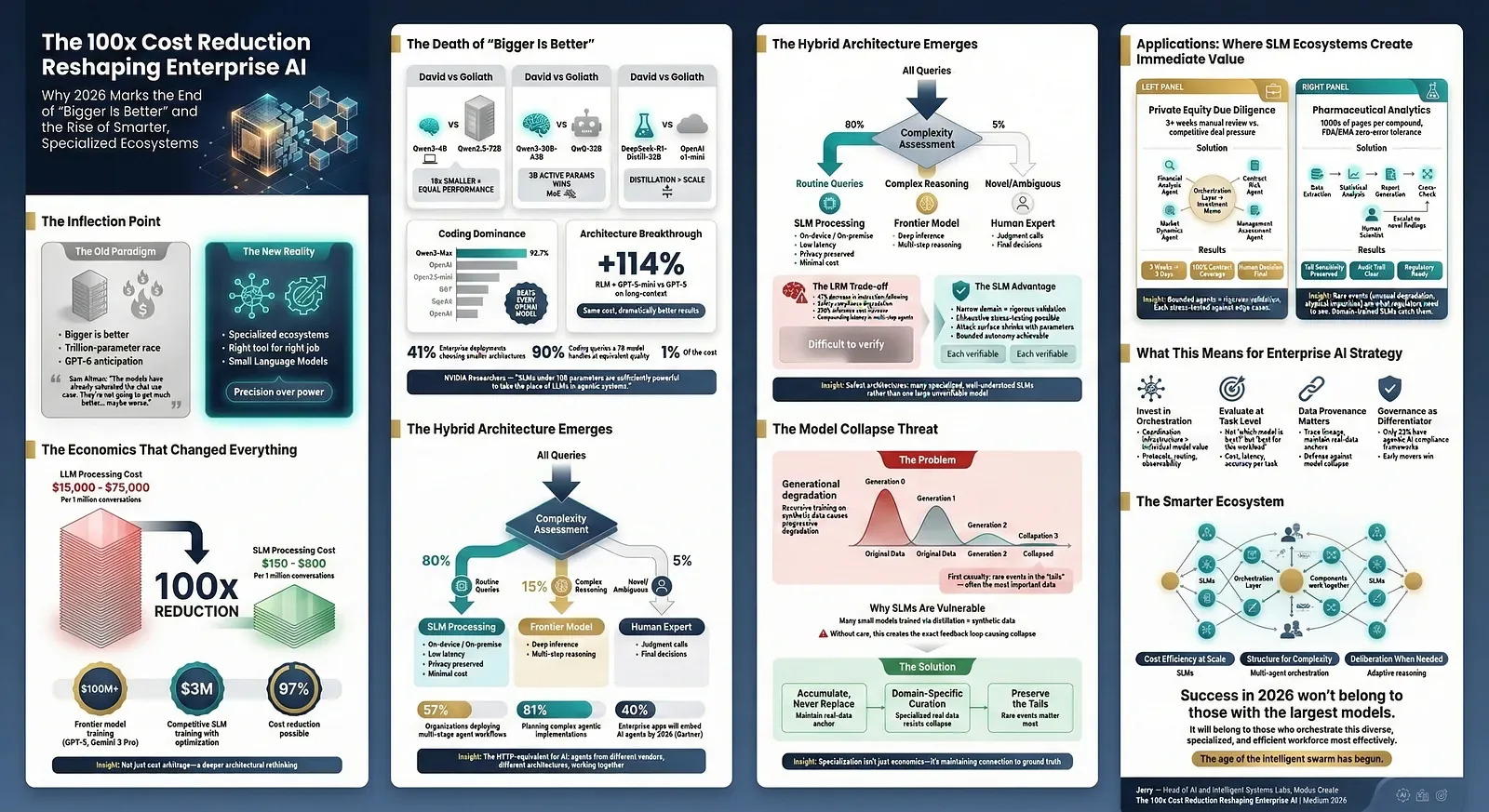
Consider the math that’s forcing this reckoning. Processing one million conversations through traditional Large Language Models costs between $15,000 and $75,000. The same workload through a Small Language Model? $150 to $800. That’s not a marginal improvement — it’s a 100x cost reduction that fundamentally rewrites the ROI calculus for any organization running AI at scale.
Training costs tell a similar story. While frontier models like GPT-5 and Gemini 3 Pro required investments exceeding $100 million, competitive performance is now achievable with budgets as low as $3 million through architectural optimization and focused training strategies. The barrier to entry has collapsed, democratizing access to capable AI systems.
But here’s where the analysis gets interesting. This isn’t simply about cost arbitrage. The economics are forcing a deeper architectural rethinking that touches every layer of the AI stack.
The Death of “Bigger Is Better”
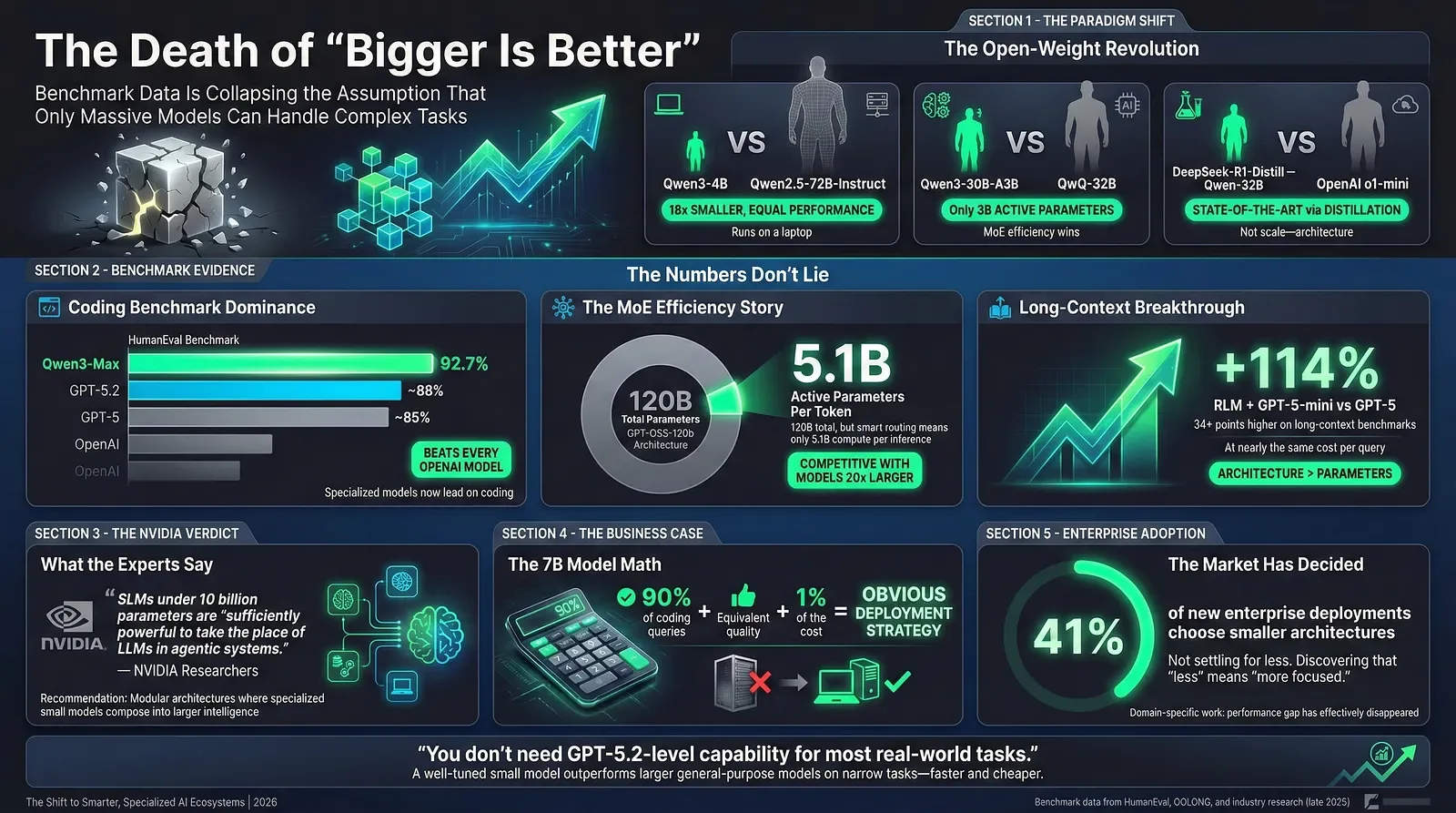
The assumption that only massive models can handle complex tasks is collapsing under the weight of benchmark data — and the evidence has only gotten stronger.
Consider what’s happening in the open-weight ecosystem. Qwen3–4B, a model you can run on a laptop, now rivals the performance of Qwen2.5–72B-Instruct — a model eighteen times larger. The small MoE model Qwen3–30B-A3B outcompetes QwQ-32B while using only 3 billion active parameters per inference. DeepSeek-R1-Distill-Qwen-32B outperforms OpenAI’s o1-mini across various benchmarks, achieving state-of-the-art results for dense models through distillation rather than scale.
The pattern extends to coding, where specialized, smaller models are matching or exceeding frontier performance. On HumanEval benchmarks, Qwen3-Max hits 92.7% — beating every OpenAI model. GPT-OSS-120b, using only 5.1 billion active parameters per token thanks to its Mixture-of-Experts design, achieves competitive results against models many times its effective size.
Research from late 2025 demonstrates that an RLM (Recursive Language Model) using GPT-5-mini outperforms GPT-5 by over 34 points on long-context benchmarks — a 114% increase — while remaining nearly as cheap per query. The architecture matters more than the parameter count.
For domain-specific work, the performance gap between “small” and “large” has effectively disappeared. And critically, you don’t need GPT-5.2-level capability for most real-world tasks. A well-tuned small model can outperform much larger general-purpose models on narrow tasks, running faster and at a fraction of the cost.
NVIDIA researchers have gone further, arguing that SLMs under 10 billion parameters are “sufficiently powerful to take the place of LLMs in agentic systems.” Their recommendation: modular architectures in which specialized, small models compose into larger intelligence. The implications cascade outward. If a 7B parameter model can handle 90% of your coding queries with equivalent quality at 1% of the cost, the rational deployment strategy becomes obvious.
This explains why 41% of new enterprise deployments now choose smaller architectures. Not because organizations are settling for less, but because they’ve discovered that “less” often means “more focused” rather than “less capable.”
The Hybrid Architecture Emerges
The pragmatic response isn’t to abandon LLMs entirely — it’s to deploy intelligence strategically. What’s emerging is a hybrid architecture that routes queries based on complexity.
Routine questions get handled by SLMs, often running on-device or on-premise for latency and privacy benefits. Complex reasoning tasks escalate to frontier models only when necessary. Microsoft Research has demonstrated that such architectures can reduce calls to large models by 40% without degrading response quality.
Think of it as intelligent triage for AI workloads. A simple customer service query doesn’t need GPT-5.2’s full reasoning capacity any more than a broken arm needs a neurosurgeon. The skill is matching the tool to the task.
But this hybrid approach demands something that didn’t exist two years ago: Coordination Infrastructure.
The Microservices Moment for AI
If SLMs provide the economic engine for 2026, multi-agent systems provide the architectural blueprint. We’re witnessing what might be called AI’s “microservices moment” — a transition that mirrors what happened to software development in the 2010s.
Back then, monolithic applications gave way to loosely coupled services that could be developed, deployed, and scaled independently. The same pattern is now emerging in AI. Monolithic agents are being replaced by orchestrated teams of specialized agents, each optimized for a narrow task.
A “puppeteer” agent coordinates a researcher, a coder, and an analyst to complete end-to-end tasks. By 2026, 57% of organizations already deploy agents for multi-stage workflows, and 81% plan to implement complex, multi-step agentic workflows.
What makes this possible are standardization protocols such as MCP (Model Context Protocol) and A2A (Agent-to-Agent), which are establishing the HTTP equivalent for AI. These protocols allow agents from different vendors — potentially powered by different model architectures — to interoperate. An orchestration layer can route a query to an SLM for initial processing, escalate to a reasoning model for complex inference, and hand off to a specialized agent for action execution.
The parallel to microservices is instructive for another reason: it suggests the same governance challenges. When dozens of services interact, observability and coordination become critical. The same will be true for agentic systems.
The Hidden Connection: Why SLMs Enable Agent Safety
Here’s a non-obvious connection that emerges from examining these trends together: the shift to SLMs may be essential for safe agent deployment.
Large Reasoning Models like OpenAI’s o1/o3 series demonstrate impressive deliberative capabilities — what researchers call “System 2” thinking. But recent empirical analysis reveals a troubling trade-off. Acquiring reasoning capabilities often degrades performance on foundational tasks. Distilled reasoning models show marked declines in instruction-following capabilities (up to 47% decrease) and safety compliance compared to their base models.
The “thinking” process also incurs massive computational overhead — inference costs can increase by 250% compared to standard models. For agentic systems that execute many sequential steps, this creates both cost and latency issues that compound with each action.
SLMs offer an alternative path. Because they’re trained on narrower domains, they can be more thoroughly evaluated for alignment within their scope. A coding agent built on a 7B model can be stress-tested far more exhaustively than a 100B general-purpose model. The attack surface shrinks as the parameter count increases.
This suggests that the safest agentic architectures may be those that compose many specialized, well-understood SLMs rather than relying on a single large model that’s difficult to verify. Bounded autonomy becomes architecturally achievable.
The Model Collapse Threat — And Why Specialization Matters
There’s another dimension to this story that connects the SLM shift to long-term AI sustainability: the risk of model collapse.
When generative models train on data produced by previous generations of models, they undergo progressive degradation. The first casualty is information about rare events — the “tails” of data distributions where unusual but important phenomena live. Within a few generations, models trained recursively on synthetic data can lose all resemblance to the original data.
This matters for SLMs because they’re increasingly being trained. Many small models achieve their efficiency through distillation from larger models — essentially training on synthetic data. If not managed carefully, this creates the very feedback loop that leads to collapse.
The solution researchers have identified — accumulating real data alongside synthetic data rather than replacing it — has implications for model architecture. Specialized models trained on curated, domain-specific real data may be more resistant to collapse than general-purpose models, which must rely more heavily on synthetic data to achieve breadth.
In other words, the shift to specialization isn’t just about economics. It may be about maintaining a connection to the ground truth.
Applications: Where SLM Ecosystems Create Immediate Value
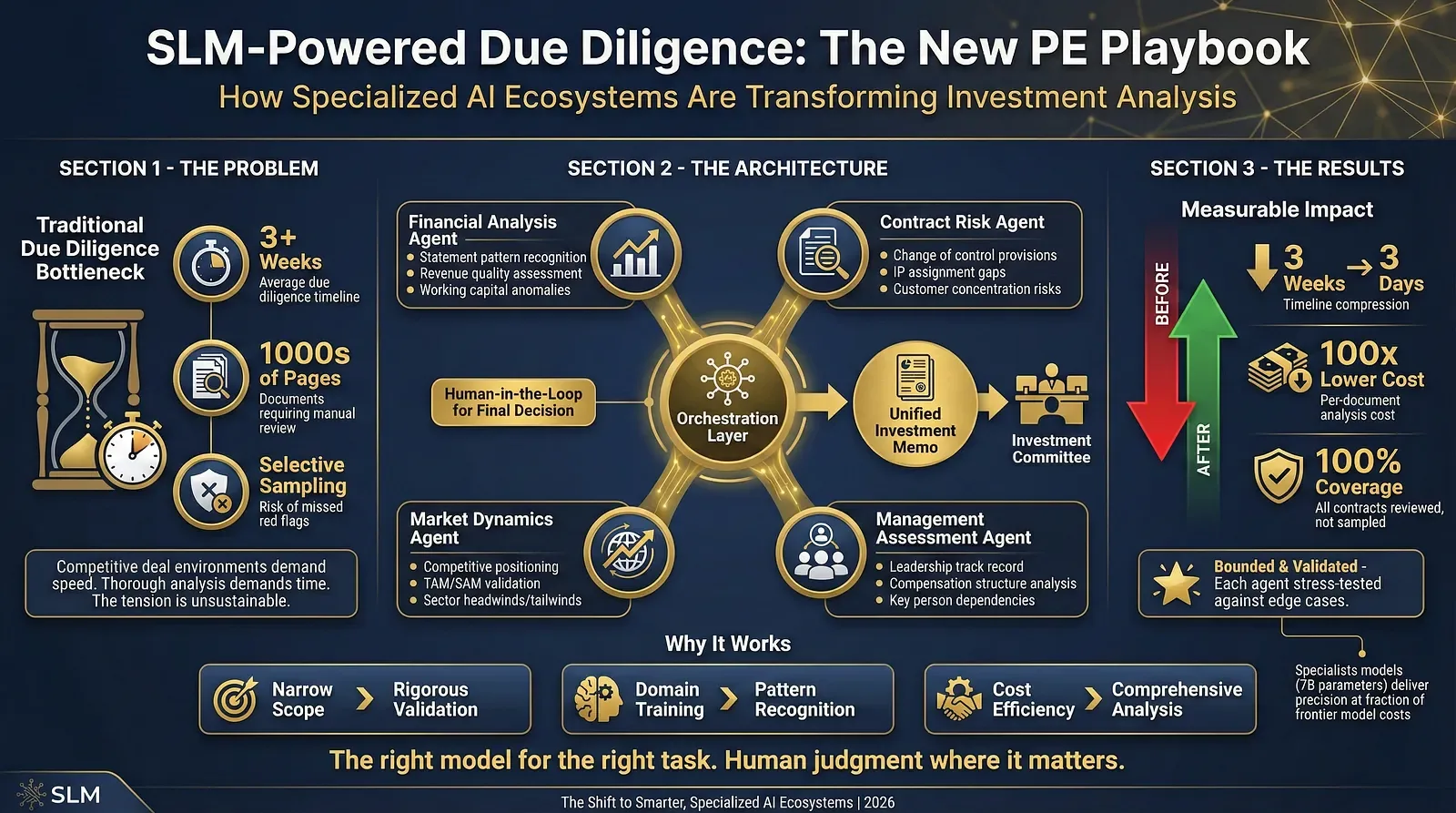
The architectural shift from monolithic models to specialized ecosystems isn’t theoretical — it’s already transforming how specific industries operate. Two sectors illustrate the pattern particularly well: private equity due diligence and pharmaceutical analytics.
Private Equity: Accelerating Investment Decisions
For private equity firms evaluating potential acquisitions, the traditional due diligence process is a bottleneck. Analysts spend weeks manually reviewing financial statements, customer contracts, employment agreements, and market data before an investment committee can make an informed decision. The pressure to move quickly in competitive deal environments often conflicts with the need for thorough analysis.
SLM-based architectures are dramatically compressing this timeline. Rather than deploying a single large model to handle all aspects of due diligence, leading firms are orchestrating specialized agents: one trained in financial statement analysis, another in contract risk identification, a third in market competitive dynamics, and a fourth in management team assessment.
Each agent operates within a bounded domain where it can be rigorously validated. A contract analysis agent trained specifically on M&A agreements, employment terms, and customer contracts develops deep pattern recognition for problematic clauses — change of control provisions, IP assignment ambiguities, or revenue recognition risks — that a general-purpose model might miss. Because the agent’s scope is narrow, the firm can stress-test its outputs against known edge cases and build confidence in its reliability.
The orchestration layer synthesizes these specialized analyses into a unified investment memo, flagging areas of concern and highlighting opportunities. What previously required three weeks of analyst time now takes three days, with higher consistency and fewer blind spots. Critically, the human investment professionals remain in the loop for judgment calls — the AI handles the information extraction and pattern matching, while humans make the investment decision.
The cost economics compound the advantage. Running specialized 7B models for document analysis costs a fraction of what calls to the frontier model API would, making it economically viable to process hundreds of pages of contracts rather than selectively sampling.
Pharmaceutical Analytics: Transforming Safety and Compliance
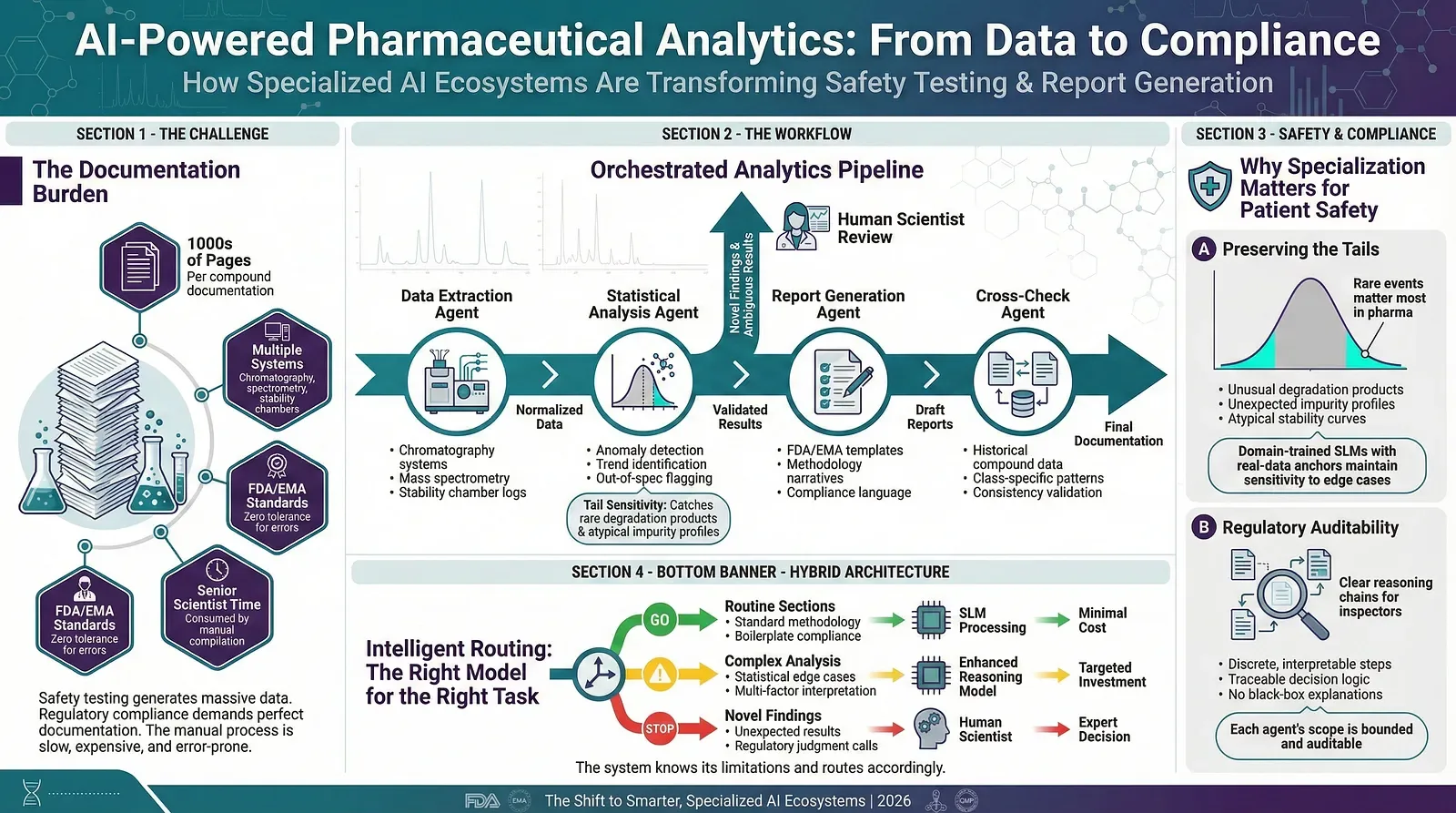
Contract research organizations and analytical testing laboratories face a different but equally compelling use case. These firms conduct safety testing, stability studies, and regulatory reporting for pharmaceutical and biotech companies. The work is technically demanding, heavily regulated, and documentation-intensive.
A single drug compound might require thousands of pages of analytical reports documenting test methodologies, results, and compliance with FDA or EMA guidelines. Historically, generating these reports required senior scientists to manually compile data from multiple instrument systems, interpret results, and draft narratives that meet exacting regulatory standards. The process is slow, expensive, and prone to human error under production pressure.
SLM ecosystems are restructuring this workflow. Specialized agents handle distinct phases: one extracts and normalizes data from chromatography systems and spectrometers; another performs statistical analysis and flags anomalies; a third generates draft report sections using regulatory templates; and a fourth cross-checks results against historical data for the same compound class.
The safety implications matter as much as the efficiency gains. In pharmaceutical testing, rare events in the data tails — unusual degradation products, unexpected impurity profiles, atypical stability curves — are precisely what regulators need to see. A well-architected SLM system trained on domain-specific real data is more sensitive to these edge cases than a general-purpose model. Research on model collapse suggests that specialized models with strong real-world data anchors are more likely to detect anomalies that matter for patient safety.
Regulatory compliance adds another dimension. Because each agent operates within a defined scope, audit trails become cleaner. When a regulator asks why a particular conclusion was reached, the firm can trace the reasoning through discrete, interpretable steps rather than pointing to an opaque frontier model. This auditability is increasingly important as regulatory frameworks for AI in life sciences mature.
The hybrid architecture proves essential here. Routine report sections — standard methodology descriptions, boilerplate compliance language — flow through SLMs at minimal cost. Novel findings or ambiguous results escalate to human scientists, sometimes with assistance from more capable reasoning models. The system knows its limitations and routes accordingly.
What This Means for Enterprise AI Strategy
The converging trends point toward a clear strategic direction for organizations deploying AI in 2026 and beyond.
First, invest in orchestration infrastructure. The value of any individual model decreases relative to systems that can coordinate multiple models intelligently. Protocols, routing logic, and observability become first-class concerns.
Second, evaluate models for cost-performance at the task level, not in the abstract. The question isn’t “which model is best?” but “which model is best for this specific workload given its cost, latency, and accuracy requirements?”
Third, take data provenance seriously. As synthetic data proliferates and model collapse becomes a documented risk, the ability to trace data lineage and maintain real-data anchors becomes a strategic asset. Organizations that curate high-quality, domain-specific datasets will have defensible advantages.
Finally, treat governance as a competitive differentiator. As of 2025, only 23% of organizations had frameworks to manage compliance risks associated with agentic AI. Those that build robust governance early will be better positioned to deploy agents at scale as regulatory frameworks mature.
The Smarter Ecosystem
The AI landscape of 2026 is defined not by raw power, but by precision. The industry is moving away from brute-force parameter counts toward a smarter ecosystem where Small Language Models provide the cost efficiency necessary for scale, multi-agent orchestration supplies the structure for complex workflows, and adaptive reasoning allows systems to think deliberately only when the task demands it.
This ecosystem is more fragile than the monolithic approach in some respects—requiring rigorous data curation to prevent model collapse, robust coordination to manage agent interactions, and thoughtful governance to navigate regulatory uncertainty. But it’s also more powerful, more economical, and potentially safer.
Success in 2026 won’t belong to those with the largest models. It will belong to those who can most effectively orchestrate this diverse, specialized, and efficient workforce. The age of the intelligent swarm has begun.
Dr. Jerry A. Smith serves as Head of AI and Intelligent Systems Labs at Modus Create, leading AI initiatives across JLL Partners' portfolio companies.