Building Minds
The Professional Services AI Blueprint: Stop Selling Hours, Start Selling Minds
Dr. Jerry A. Smith · February 17, 2026 · 6 min read
There is a particular silence that falls over a conference room when a technologist has lost the audience. It isn't hostile. It's the quiet of people who have politely decided to wait for the meeting to end.
I've watched it happen dozens of times. Someone stands up with a genuinely compelling vision for how AI could transform the firm's business. They talk about retrieval-augmented generation, vector databases, and agentic orchestration. The architecture is sound. The vision is real. And the room goes still — not because the idea is wrong, but because no one in leadership can connect it to one of the most important numbers they care about:
Revenue.
The instinct, when this happens, is to explain more clearly. Add a diagram. Use an analogy. But the problem was never clarity. The problem was orientation. The technologist was describing how the machine works. Leadership wanted to know the machine's earnings*.
Professional services firms don't sell architecture. They sell the ability to move faster, know more, and deliver outcomes their competitors can't. Any AI strategy that doesn't start from that truth is just engineering theater.
What follows is an attempt to reorient the conversation — a blueprint that translates technical capability into business trajectory. Not how it works. How does it pay?
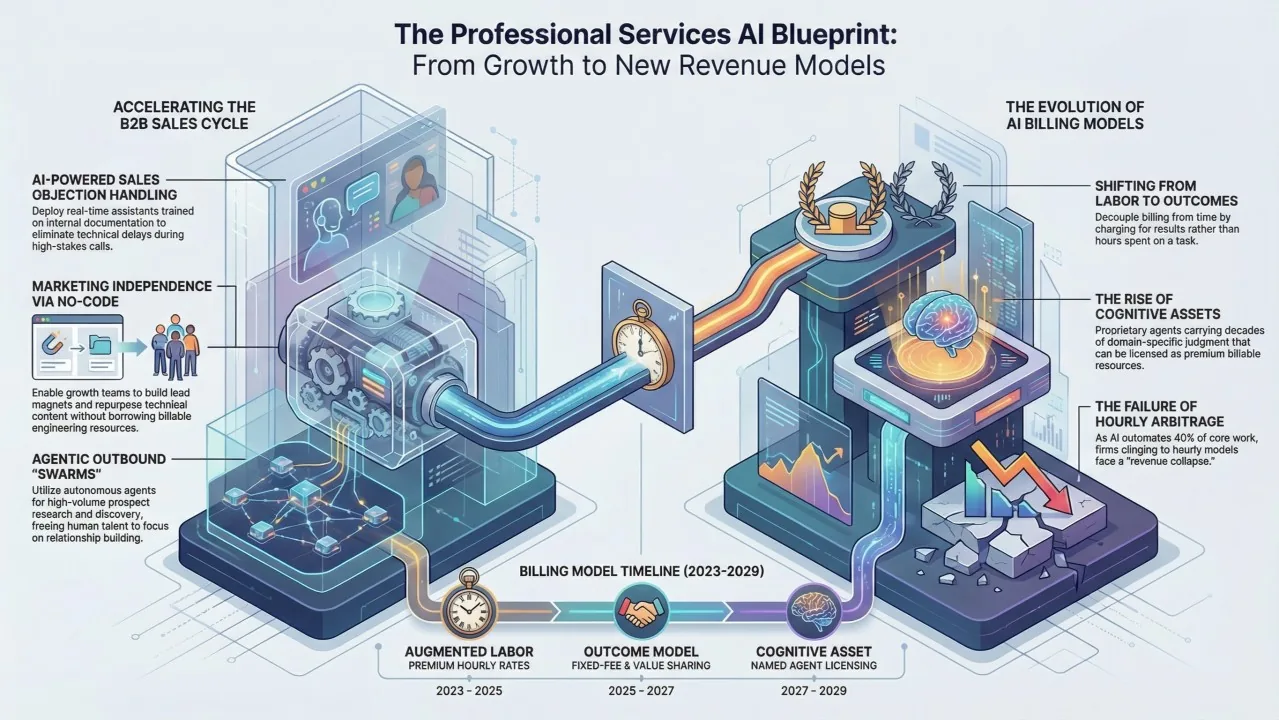
Part 1: Accelerating the Sale
Before a firm can change how it bills, it needs to change how it grows. The first half of this blueprint has nothing to do with replacing people. It's about removing the friction that sits between talent and revenue.
Zero-Latency Expertise
Every partner knows the moment. A high-stakes pitch. The client asks a sharp, specific question — a compliance edge case, a reference engagement from three years ago. The partner pauses. "Let me get back to you on that."
That pause is where deals go to die.
The technology exists to eliminate it entirely. AI assistants trained on every case study, white paper, and technical document the firm has ever produced can surface the precise answer in real time. The partner doesn't need to know everything. The system does. The partner just needs to keep the conversation moving.
This isn't speculative. The underlying capability—context-aware retrieval across large document corpora—is mature. The firms that deploy it first will close deals in the room while their competitors are still drafting follow-up emails.
Unblocking Revenue
At most professional services firms, marketing operates at the speed of the engineering backlog. A lead magnet requires a dev sprint. A landing page gets queued behind client work. The growth team has ideas, but they can't ship them without borrowing billable resources.
This is a solved problem. No-code tools and generative design have reached the point where a competent marketing team can build interactive calculators, landing pages, and content assets without touching a line of code. The constraint was never their capability. It was their dependency.
Removing that dependency saves time. It changes the metabolism of the firm's growth engine. Marketing moves at the speed of the market, not the sprint backlog.
The Swarm
The traditional outbound model — hiring junior SDRs, burning through call lists, measuring dials per day — was always a brute-force solution. It scaled linearly with headcount and degraded with turnover.
Autonomous agents offer something different. Not spam bots, but digital researchers that read annual reports, map organizational structures, identify strategic pain points, and draft outreach that sounds like it was written by someone who did the homework. Because, in a meaningful sense, it was.
These agents don't replace the relationship. They create the opening. They run continuously, across thousands of prospects, surfacing the conversations worth having. Human talent then does what it has always done best: build trust, read the room, close.
The firms that adopt this model will not only have larger pipelines but also stronger competitive positions. They'll have better ones.
Part 2: The Revenue Shift
Growth is necessary. But growth alone won't save a firm whose business model is dissolving underneath it.
Recommended by LinkedIn
[ Why Your Team Nods at AI in the Meeting -And Ignores…
Eubrics AI
Why Your Team Nods at AI in the Meeting -And Ignores…
Eubrics AI
5 months ago](https://www.linkedin.com/pulse/why-your-team-nods-ai-meeting-and-ignores-after-eubrics-vq47c)
[ How to Calculate ROI for AI Negotiation
Rosie Bailey
How to Calculate ROI for AI Negotiation
Rosie Bailey
9 months ago](https://www.linkedin.com/pulse/how-calculate-roi-ai-negotiation-rosie-bailey-5wvne)
[ The First of Your Newsletters
Tomasz Tunguz
The First of Your Newsletters
Tomasz Tunguz
2 years ago](https://www.linkedin.com/pulse/first-your-newsletters-tomasz-tunguz-npl3c)
Professional services have operated on the same economic engine for over a century. Hire intelligent people. Mark up their time. Bill by the hour. It is an elegant model, and AI is about to break it.
Consider: if an associate uses AI to complete ten hours of research in fifteen minutes, and the firm bills hourly, revenue on that task just fell by 97 percent. The work got better. The economics got worse. This is not a hypothetical — it is already happening in legal research, financial modeling, and technical documentation.
You cannot optimize your way out of a model that penalizes efficiency.
The only viable path leads through two fundamental shifts.
From Time to Outcomes
The first shift is conceptual. Stop selling hours. Start selling results.
A firm that charges for "legal research" is selling time. A firm that charges for "risk mitigation below threshold X" is selling an outcome. The distinction matters because AI makes the time component worthless while making the outcome component more reliable.
Value-based pricing isn't new. What's new is that AI makes it necessary. When the cost of production approaches zero, the only defensible price is the value of the result.
From People to Cognitive Assets
The second shift is structural and will separate the firms that thrive from those that get commoditized.
Every established firm has something extraordinarily valuable locked inside its senior partners: decades of judgment, pattern recognition, and institutional knowledge. Today, that knowledge leaves the door every evening and eventually retires.
The opportunity is to capture it — not as documents in a knowledge base, but as functioning systems. A synthetic version of the firm's best negotiator, available around the clock. A digital strategist who has internalized every engagement the firm has ever run. These are not chatbots. They are licensable cognitive assets.
The economy changes dramatically. A services firm earns revenue only when its people are working. An asset firm earns revenue when its systems are running, which is always. That's the difference between low-margin labor arbitrage and high-margin recurring revenue.
By 2027, the leading professional services firms won't just be renting out their people. They'll be licensing their institutional mind.
The Bifurcation
The market is splitting, quietly but irreversibly.
On one side: firms that cling to the hourly model. As AI compresses the cost of knowledge work, its margins will follow. They will compete on price, hire at lower wages, cut corners, and eventually become indistinguishable from low-cost outsourcers. The race to the bottom has a finish line, and it isn't profitable.
On the other side: firms that treat AI not as a cost-reduction tool but as the foundation of a new asset class. They accelerate growth with intelligent systems. They capture their best thinking in licensable form. They sell answers, not hours. They own the value they create.
This blueprint is a map of that second path. Not a technology roadmap — a revenue roadmap.
The question isn't whether your firm will adopt AI. Every firm will. The question is whether you'll use it to do the same work cheaper, or to build something your competitors can't replicate.
That's not a technology decision. It's a business model decision. And the window to make it is closing.
Dr. Jerry A. Smith is a technology executive specializing in AI strategy for professional services. He has led enterprise AI initiatives across financial services, life sciences, and consulting. He writes Building Minds to explore how firms navigate the shift from labor-based to asset-based business models.