Building Minds
Why Most AI Initiatives Fail — And What the Survivors Do Differently
Dr. Jerry A. Smith · February 17, 2026 · 7 min read

By Dr. Jerry A. Smith
Roughly 70% of enterprise AI initiatives fail to deliver measurable value within 18 months. I find that number interesting, not because it's alarming, but because of what it reveals about how organizations understand — or fail to understand — what they're actually building when they build AI.
Over the past several years, I've led AI strategy and deployment across pharmaceutical testing, aviation services, litigation consulting, government intelligence, and investment analysis. Before that, I built intelligence systems for the government agencies where a failed system isn't a budget conversation. It's a gap in national security. Across all of these contexts, the failure mode is remarkably consistent. A company allocates budget. A vendor is hired. Someone builds a chatbot or a dashboard. Fourteen months later, leadership is asking why AI spend is up 40% with nothing to show for it.
The consistency itself is the data point worth examining. These aren't random failures. They're the same failure, repeated across industries, because the underlying misconception is the same.
The Infrastructure Mistake
A pharmaceutical testing company I worked with had spent $1.2 million with a systems integrator to implement AI. They received an Azure OpenAI deployment with a Copilot license, a prompt library, and a change-management deck with 47 slides. Nobody in the lab was using it. The scientists didn't trust it. The compliance team hadn't validated it. The executive who championed it had already moved on.
I've watched the same sequence play out in government agencies that buy AI platforms incapable of operating within their data classification boundaries. In hospital systems that deploy clinical AI without mapping it to clinical workflows. In manufacturers that implement predictive maintenance without consulting maintenance crews about how they actually make decisions.
The mistake is categorical. These organizations treated AI as infrastructure — a server to rack, a license to procure. But AI is a reasoning system. It must be embedded in actual decision-making workflows, and that requires understanding those workflows at a depth no external integrator will invest in.
What changes the outcome is specificity. At one company, we fine-tuned a model on 15 years of pharmacopoeia updates, method transfer protocols, and internal SOPs. The result wasn't a chatbot. It was a regulatory radar system that could flag relevant changes across 700 client engagements — work that previously required a senior scientist spending two days a month on manual review. At scale, that system represents $3.5 to $7 million in annual revenue.
The difference wasn't deploying AI. It was capturing institutional knowledge and scaling it.
The Island Problem
There is a particular kind of waste that only becomes visible from a certain altitude. Division A builds a regulatory monitoring tool. Division B, in a different function entirely, needs the same underlying capability — regulatory change detection, compliance impact assessment, proactive alerting — but nobody connects the dots. Division B starts from scratch, hires its own vendor, and builds an 80%-similar system at 100% of the cost.
I watched this happen across three companies in the same investment portfolio. Aviation needed airworthiness directive monitoring. Pharma needed pharmacopoeia change tracking. A litigation consulting firm needed regulatory shift analysis for expert testimony. Three industries. The same AI pattern: ingest a regulatory corpus, detect changes, assess impact, route alerts.
Government is worse. I've seen three agencies within the same department build functionally identical document intelligence systems without comparing notes.
The solution requires thinking at a different level of abstraction. We built one regulatory intelligence platform with a shared core — ingestion, change detection, impact scoring — and domain-specific fine-tuned layers on top. The aviation instance monitors FAA directives. The pharma instance tracks USP and EP updates. The litigation instance watches federal register changes. Same engine. Three products. One development cost.
The AI patterns repeat. If leadership can see the abstraction layer, you build once and deploy many times. If they can't, you pay full price every time.
The Talent Mismatch
An organization hired a Head of AI — a PhD from a top program, published in NeurIPS, genuinely brilliant. Six months later, they had a model architecture of real elegance, a Jupyter notebook that could predict customer churn with 94% accuracy, and zero production deployment.
The model couldn't connect to the CRM. Nobody had considered latency requirements. The compliance team hadn't approved the use of customer data for predictions. The sales team, who was supposed to act on the predictions, had never been asked what they actually needed.
This is a mismatch between what the organization hired for and what it required. They needed a systems architect who understood how AI integrates into business processes, regulatory environments, and human decision-making loops. The best AI person I can place in any organization isn't the one with the most citations. It's the one who can sit with a lab director, a case officer, or a claims adjuster and understand the workflow before writing a line of code.
What I call systems intelligence — thinking in workflows rather than models. Deployment teams that include domain translators sitting between AI engineers and business operators. Success is measured not by model accuracy but by the number of accelerated decisions, revenue generated, and the reduction in risk surface. A 94% accurate model that nobody uses has an ROI of zero. A rules-based system achieving 80% accuracy and saving 200 hours per month is a success. The math is simple. The organizational shift required to accept it is not.
Recommended by LinkedIn
[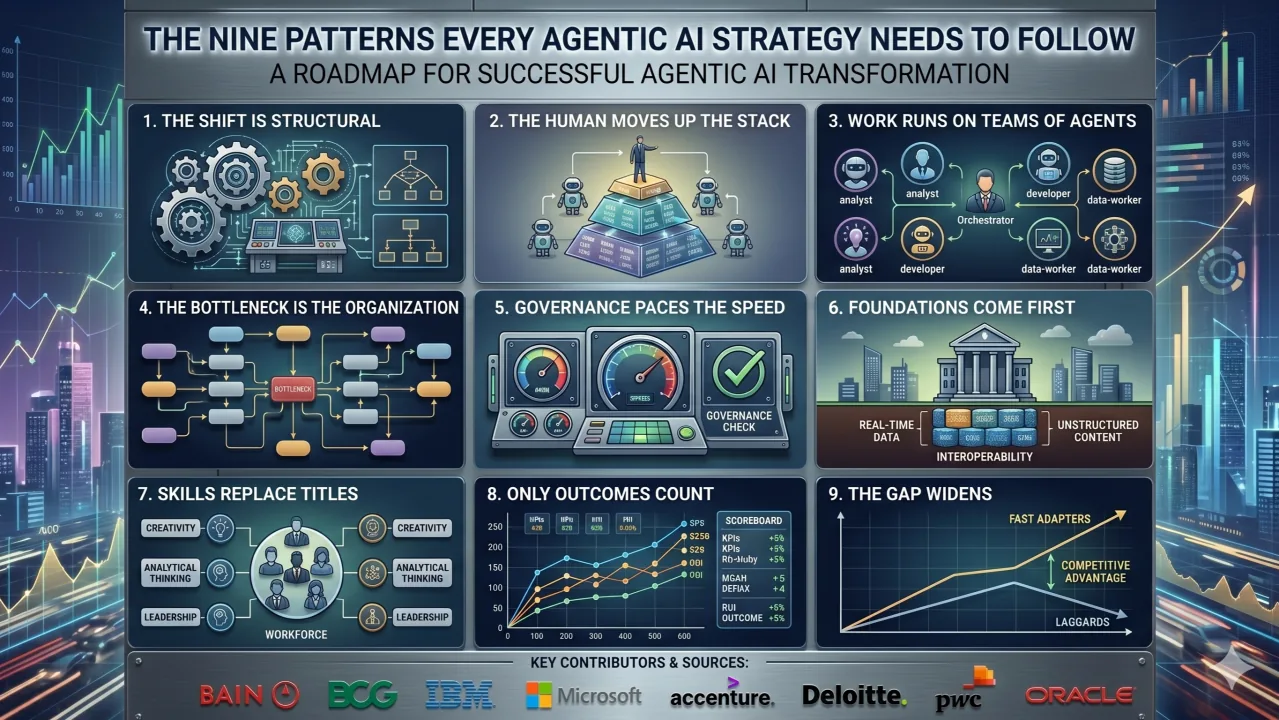 The Nine Patterns Every Agentic AI Strategy Needs To…
Gilbert Traverse, MS, CISSP
The Nine Patterns Every Agentic AI Strategy Needs To…
Gilbert Traverse, MS, CISSP
4 months ago](https://www.linkedin.com/pulse/nine-patterns-every-agentic-ai-strategy-needs-follow-gilbert-traverse-wxfsc)
[ 📬 Neotheta – AI Doses | Week 27th Feb 2026
🔥…
Priyank Sharma
📬 Neotheta – AI Doses | Week 27th Feb 2026
🔥…
Priyank Sharma
7 months ago](https://www.linkedin.com/pulse/neotheta-ai-doses-week-27th-feb-2026-enterprise-agents-priyank-sharma-rmphc)
[ The Human & AI Embrace - We've got tools for that!
Faith Addicott
The Human & AI Embrace - We've got tools for that!
Faith Addicott
1 month ago](https://www.linkedin.com/pulse/human-ai-embrace-weve-got-tools-faith-addicott-kygxc)
The Rent Problem
The most consequential sentence in any boardroom is: "We're using Large Platform Vendor's AI solution."
I've watched organizations lock themselves into vendor ecosystems where they pay per-API-call for models they don't own, generate insights they can't retain, and build no proprietary advantage. Every dollar is rent. Nothing accrues.
One company was spending $40,000 a month on API calls to a frontier model for document analysis. When we benchmarked a fine-tuned 8-billion-parameter model on their specific document types, it matched the frontier model's performance at roughly one-tenth the cost. And the organization owned the model outright. For regulated industries—healthcare, defense, and financial services—this also resolves the data sovereignty problem that makes cloud-dependent AI infeasible.
The architecture we use follows a principle I call 5-3-1: frontier models handle the 30% of work requiring maximum reasoning capability, while fine-tuned small language models handle the 70% of volume work. The small models run on the organization's own infrastructure. The weights are owned assets. Over time, as the fine-tuned models improve from production data, dependence on expensive frontier APIs decreases.
Rent the reasoning you need today. Own the intelligence you're building for tomorrow. Whether the context is a PE firm preparing a portfolio company for exit, an enterprise protecting competitive advantage, or a government agency safeguarding classified workflows — the AI capability should be an asset on the balance sheet, not a line item on someone else's invoice.
The Measurement Failure
"We've processed 10,000 documents with AI." This tells you money was spent. It does not tell you that value was created. "We've deployed AI to 200 users." This tells you software was installed. It tells you nothing about whether a single decision changed as a result.
Organizations report AI activity to leadership instead of AI outcomes. Documents processed, models trained, users onboarded — these are vanity metrics. They describe motion. They don't describe progress.
What works is tying every deployment to a business outcome before writing the first line of code. Not "we'll process documents faster" but "we'll reduce screening time from eight hours to 45 minutes, enabling the team to evaluate three times more opportunities per quarter." Not "we'll monitor regulatory changes" but "we'll identify revenue-relevant updates 60 days before competitors, creating a proactive outreach window worth a specific dollar amount per client."
The engagements I lead increasingly use outcome-based billing—compensation tied to the value delivered. If the AI doesn't produce measurable results, we haven't earned our fee. That alignment changes everything about how you build.
What These Patterns Share
Every organization — PE-backed, publicly traded, government, nonprofit — possesses an AI advantage that almost nobody is exploiting correctly. Institutional knowledge is locked in the heads of your best people. Operational data nobody else can access. Domain expertise that no foundation model will replicate on its own.
The five failures I've described are not five separate problems. There are five symptoms of a single misunderstanding: treating AI as a technology procurement exercise rather than as the construction of institutional intelligence.
The organizations that define the next decade will not be the ones that deploy the most AI tools. They will be the ones who built systems capable of capturing, preserving, and scaling human judgment—systems that improve with every decision, every regulatory shift, and every operational cycle.
We're not building tools anymore. We're building minds.
The organizations that understand that distinction will own the future.
Dr. Jerry A. Smith is a systems intelligence architect and AI strategist who designs and deploys AI across complex, regulated, multi-entity organizations. He currently leads cross-organization AI initiatives spanning pharmaceutical testing, aviation services, litigation consulting, and investment analysis through Modus Create. Previously, he built intelligence and analysis systems for the NSA and CIA. His background spans computational neuroscience, neuroevolution, and multi-agent systems architecture. He is the inventor of the 5-3-1 Higher-Dimensional Analysis Architecture and serves as Head of the AI and Systems Intelligence Lab. He writes about the intersection of artificial intelligence, institutional knowledge, and value creation.
Connect with him on LinkedIn