Building Minds
The Mind Audit: Five Questions That Reveal Whether Your AI Strategy Will Survive
Dr. Jerry A. Smith · February 18, 2026 · 7 min read
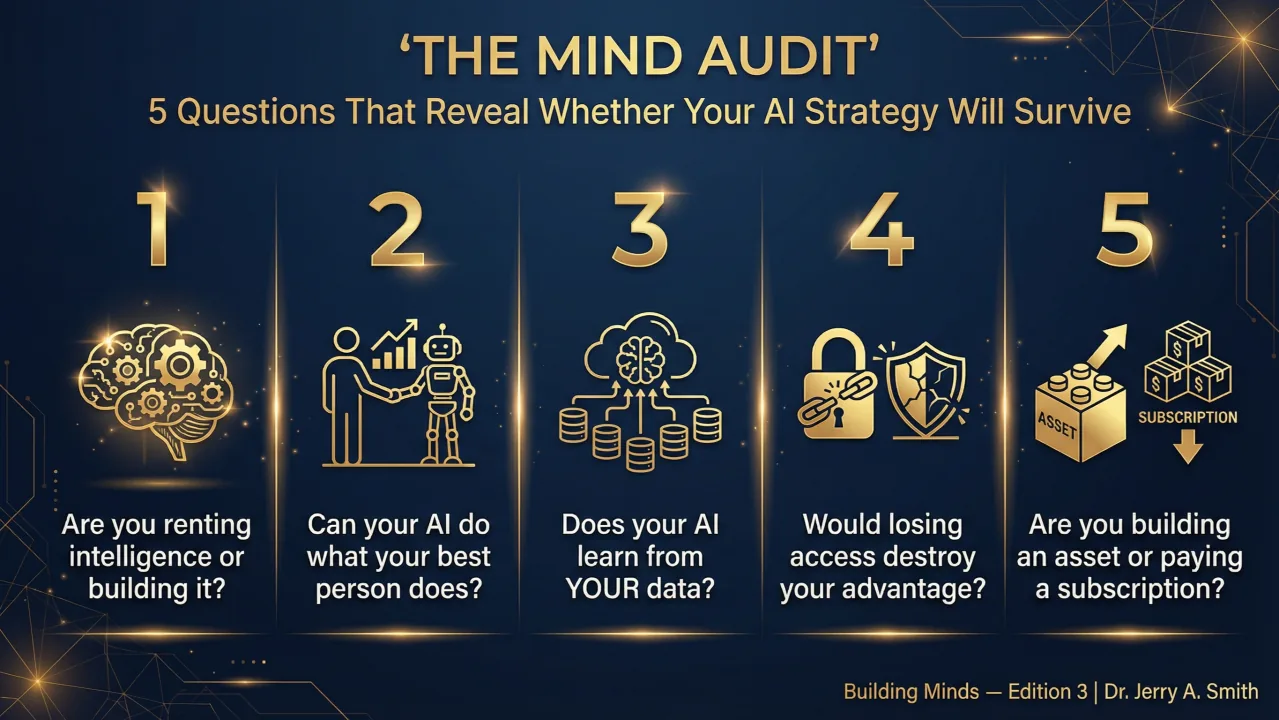
There is a distinction that most organizations overlook when considering artificial intelligence: a brain is not a mind.
A foundation model — GPT, Claude, Gemini — is a brain. It processes language, identifies patterns, and generates text with remarkable fluency. It has absorbed more written knowledge than any human could read in a thousand lifetimes. In raw cognitive capability, it surpasses every professional in every firm on Earth.
And yet.
A senior pharmaceutical consultant reads a compliance filing and feels something is wrong before she can articulate why. A restructuring advisor walks into a client meeting and knows — from a decade of similar situations — that the stated problem is not the actual problem. A regulatory specialist hears a question from the FDA and, based on its framing, understands what the agency is concerned about.
These are not feats of processing. They are feats of judgment. They are the products of minds — intelligence shaped by experience into something that raw capability alone cannot replicate.
The firms that understand this distinction will build something defensible. The rest will compete on speed in a market where speed is free. What follows are five questions that reveal which side you're on.
The Setup: Two Firms, Same Market
Consider two firms operating in the same industry.
The first deploys a foundation model across the organization. Consultants use it to draft reports faster, analyze data more quickly, and generate presentations in half the time. Productivity improves by twenty percent. Margins widen. The CEO presents this at an industry conference as an AI transformation success story.
The second firm does something structurally different. They take thirty years of domain expertise — the decision patterns of their best people, the institutional knowledge that exists in no database, the judgment that distinguishes competent analysis from genuinely valuable counsel — and they encode it. Not into a chatbot. Into a system that reasons the way their best senior partner reasons, except that it can do so at scale, around the clock, across every engagement simultaneously.
The first firm got faster. The second firm got smarter.
Within a year, the gap between them is visible. Within two, it is structural. The first firm competes on speed in the commodity territory. The second competes on judgment — a moat that widens with every engagement, because compounding advantages do not converge. They diverge.
This is the mind gap. Not the gap between firms that have adopted AI and those that have not. The gap between firms that build minds and firms that merely deploy brains.
Most leadership teams cannot tell you which side their firm is on. These five questions will.
Question One: If Your Best Partner Left Tomorrow, How Much Judgment Would Survive Them?
Not their documents. Not their client list. Their judgment.
The way they read a room. The pattern recognition that tells them which deals will close and which are theater. The instinct — built over decades — is that this regulatory filing has a problem before they can articulate what it is.
If the answer is "very little survives," you have a people business, not a knowledge business. That was always a vulnerability. AI hasn't changed it — it's made it more expensive. Because now your competitor can encode that kind of judgment into a system that runs continuously, improves with every engagement, and never retires.
Firms that capture their top talent's reasoning in AI systems are building an asset. The firms that don't are watching their most valuable intellectual property walk out the door every evening — and eventually, permanently.
Question Two: Can Your AI Reason From What It Hasn't Seen?
A brain retrieves what it was given. A mind connects what it knows to what it hasn't encountered before.
If your AI system can only surface documents it's already ingested, you have a search engine with better syntax. That's useful. It is not strategic.
A mind recognizes that the compliance pattern from a pharmaceutical client two years ago is structurally identical to the regulatory question your manufacturing client just asked — even though the industries, the terminology, and the specific regulations are entirely different. It transfers judgment across contexts, the way your best senior people do without thinking about it.
This is the difference between retrieval and reasoning. Most firms have built retrieval. The firms that build reasoning will own their markets.
Question Three: Does Your AI Compound?
This is the test that separates tools from assets.
Recommended by LinkedIn
[ The Seven Principles of Responsible AI: When Good…
Stephanie Gradwell
The Seven Principles of Responsible AI: When Good…
Stephanie Gradwell
11 months ago](https://www.linkedin.com/pulse/seven-principles-responsible-ai-when-good-intentions-meet-gradwell-qvspe)
[ Working with AI, or letting AI work for you?
Multiplier
Working with AI, or letting AI work for you?
Multiplier
2 months ago](https://www.linkedin.com/pulse/working-ai-letting-work-you-usemultiplier-ppd8c)
[ Could We Inherit Someone Else's AI Memory?
Gita Poudel
Could We Inherit Someone Else's AI Memory?
Gita Poudel
1 month ago](https://www.linkedin.com/pulse/could-we-inherit-someone-elses-ai-memory-gita-poudel-s09ac)
A brain is static. Same model, same capability, same output — whether it's the first project or the hundredth. A mind accumulates. Each engagement feeds data back. Each correction from a senior expert refines its judgment. Each outcome—successful or unsuccessful—becomes a data point that no competitor can access.
After a hundred engagements, the mind has encountered patterns that would take a human analyst years to see. After a thousand, the advantage is structural and permanent.
If your hundredth engagement looks exactly like your first from the AI's perspective, you've built a tool. The firms building minds are creating systems that get measurably better every quarter — and the distance between them and everyone else increases on a curve, not a line.
Question Four: Could a Competitor Replicate Your AI in 90 Days?
If a competitor could license the same foundation model, point it at publicly available data, and achieve substantially the same results you're getting, you have a deployment, not a differentiator.
If they couldn't — because your system is trained on proprietary engagement data, refined by your senior experts' corrections, and shaped by thousands of client interactions no one else has access to — you have a moat.
The question is really about what your AI knows that no other AI knows. Foundation models are brilliant and general, meaning they are accessible to everyone. Your firm's thirty years of specialized experience are not available to everyone. It is the most valuable training data available—precisely because no foundation model has it.
The firms that encode this proprietary knowledge into their AI systems are building something that cannot be replicated by a competitor with a bigger budget and the same API key. That is the definition of defensible advantage.
Question Five: Are You Pricing for Speed or Judgment?
This is where the mind gap becomes a revenue gap.
Speed pricing is a race to the bottom. AI gives everyone speed equally. When your competitor can draft the same report in the same time using the same model, the only differentiator is price, and price competition in a market with near-zero marginal cost has exactly one outcome.
Judgment pricing is a race to the top. Clients don't pay a premium for faster answers. They pay a premium for better answers — answers informed by decades of domain expertise, refined by pattern recognition no generic model possesses, and delivered with the confidence that comes from a system that has seen a thousand variations of this exact problem.
The firms competing on speed will see margins compress. Firms competing on judgment will see their pricing power increase. Same technology. Opposite trajectories. The difference is what you built with it.
Score Yourself
If four or five of your answers pointed to "mind" characteristics — compounding systems, proprietary knowledge, judgment-based pricing — you're building something defensible. Something that becomes more valuable with each engagement and harder to replicate with each quarter.
If most of your answers pointed to "brain" territory — static deployments, retrievable but not reasoning, speed-based value propositions — you have productivity gains. Real ones. But nothing that survives the next model release, the next price cut, or the next competitor who decides to build what you chose not to.
The market is splitting. On one side: firms that build minds, encode their domain expertise into compounding AI systems, and shift from selling time to selling judgment. They will pull away, and they will not be caught.
On the other side: firms that deploy brains, achieve genuine but temporary productivity gains, and compete on speed in a market where speed is no longer scarce. They will get faster. They will not get smarter. And they will watch their margins follow the price of the commodity on which they compete.
The brain is already here. Everyone has it. The question these five answers reveal is whether you're building something more — or hoping that faster is enough.
Dr. Jerry A. Smith builds AI organizations within large enterprises—practices, products, teams, and revenue. He has led cross-portfolio AI strategy for private equity platforms and developed patent-pending agentic architectures deployed across multiple industries. Connect on LinkedIn or reach out at jerry@drjerryasmith.com.
Building Minds — Edition 3.