Essay
The Neuro-Cognitive Case for Frontier AI in Numeric Verification and Data Integrity
Dr. Jerry A. Smith · January 8, 2026 · 29 min read
Listen to the article on Apple Podcasts
Listen to the article on Soundcloud
Abstract
Manual copy-paste, transcription, and visual review of numeric information remain ubiquitous in regulated, technical, and knowledge-work environments. However, decades of research in cognitive psychology, human factors engineering, neuropsychology, and safety science demonstrate that humans are inherently unreliable in sustained numerical verification tasks. This paper synthesizes empirical findings on attentional limits, perceptual automation, fatigue, and numeric cognition to quantify error rates, time-on-task degradation, and review inefficiencies. We argue that manual numeric review is not merely inefficient but structurally unsafe at scale. Traditional automation — rule-based validation, robotic process automation, and statistical anomaly detection — addresses only a subset of failure modes, leaving a critical semantic gap that humans were expected to fill but cannot sustain. Frontier AI systems, including generative, agentic, and emerging synthetic architectures, map directly to the specific cognitive deficits that cause human failure. Automation at this level is therefore not an optimization but a cognitive and ethical necessity. Implications for system design, quality assurance, organizational policy, and human-AI collaboration are discussed.
1. Introduction
1.1 The Persistence of Manual Review
Despite repeated warnings from safety-critical industries, organizations continue to rely on human operators to copy, paste, and visually audit numeric data across spreadsheets, PDFs, laboratory reports, financial statements, and regulatory submissions. This persistence is not irrational — it reflects genuine organizational needs for semantic judgment, contextual interpretation, and exception handling that traditional automation cannot provide.
Yet the continued reliance on manual review also reflects a deeper problem: the belief that human attention, properly motivated and supervised, can be made reliable through diligence, training, or process discipline. This belief is incorrect. The scientific literature demonstrates that errors in numeric transcription and review arise from predictable and measurable limits of human cognition — limits that cannot be overcome through effort or intention.
What results is a kind of diligence theater: review processes that appear rigorous, satisfy audit requirements, and distribute responsibility across multiple signatories, but do not actually achieve the error-detection rates their design implies. Organizations operating under this illusion accumulate risk without visibility, discovering failures only when downstream consequences force attention.
1.2 The Cost of Misattribution
When errors escape manual review, the typical organizational response is to attribute failure to the individuals involved: insufficient attention, inadequate training, or lack of diligence. This framing is not merely inaccurate — it is harmful.
Blaming individuals for errors arising from structural cognitive limitations inflicts moral injury on conscientious professionals placed in roles where failure is statistically inevitable. It diverts organizational attention from system design toward supervision and discipline. And it perpetuates the conditions that produce errors by reinforcing faith in processes that cannot deliver their promised outcomes.
Understanding that manual review failures are cognitive rather than behavioral is essential for reframing automation initiatives. The question is not whether automation can make review faster or cheaper, but whether human review can be made reliable at all without support from automation.
1.3 Scope and Purpose
This document synthesizes findings from cognitive psychology, human factors research, safety science, and AI capability analysis to establish a rigorous foundation for the adoption of frontier AI in numeric verification and data integrity tasks.
The argument proceeds in five stages. First, we establish the neurocognitive basis of human failure during sustained numerical review. Second, we examine why traditional automation — while valuable — leaves a critical semantic gap. Third, we map frontier AI capabilities directly to the specific cognitive deficits that cause human failure. Fourth, we derive design principles for human-AI collaboration that leverage the strengths of both. Finally, we address organizational, ethical, and implementation implications.
The goal is not to argue that AI is better than humans in some abstract sense, but to demonstrate that certain cognitive tasks exceed human capacity in ways that frontier AI can specifically address. This reframing — from optimization to necessity — has profound implications for how organizations justify, design, and govern automation initiatives.
2. The Neuro-Cognitive Basis of Human Failure in Numeric Review
2.1 Working Memory and Capacity Limits
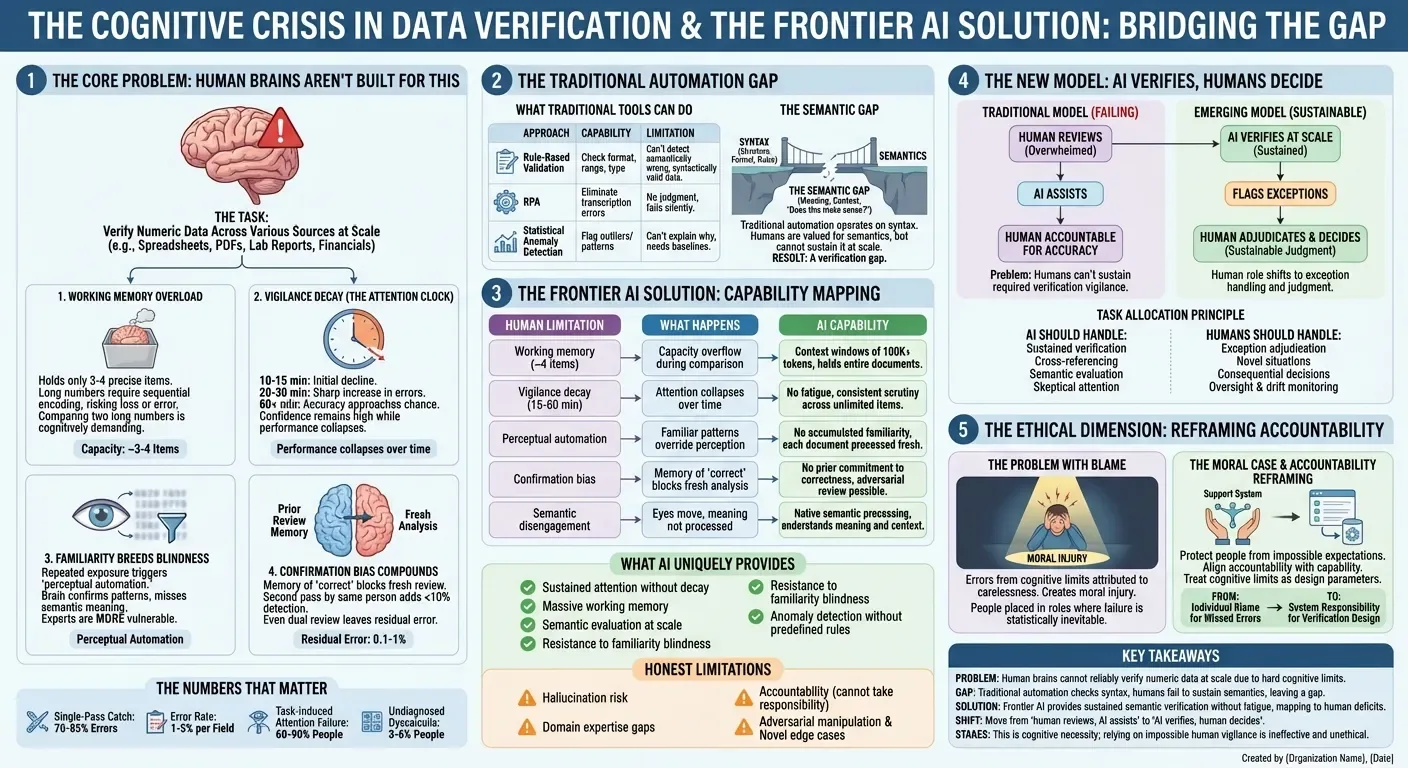
Human working memory — the cognitive system responsible for temporarily holding and manipulating information — is severely limited. George Miller’s classic 1956 finding suggested a capacity of approximately seven items, plus or minus two. Subsequent research has revised this estimate downward: Nelson Cowan’s influential 2001 analysis indicates an effective capacity closer to three to four items for precise, unitary representations.
Multi-digit numbers present a particular challenge because they exceed this capacity limit. A ten-digit account number cannot be held as a single chunk; it must be encoded sequentially, creating multiple opportunities for loss, substitution, and transposition. When comparing two such numbers — the core operation of verification — both must be maintained simultaneously while attention shifts between them. This process is vulnerable at every stage: initial encoding, maintenance during comparison, and retrieval for judgment.
The implications for transcription and reconciliation tasks are significant. Errors are not random failures of attention but predictable consequences of capacity overflow. Longer numeric strings, faster work pace, and concurrent cognitive demands all increase error probability in ways that can be modeled and quantified.
2.2 Attention, Vigilance, and Temporal Decay
Sustained attention to monotonous stimuli degrades rapidly — a phenomenon extensively documented in vigilance research. Joel Warm, Raja Parasuraman, and Gerald Matthews summarized decades of findings in their 2008 review, demonstrating that vigilance tasks impose a significant cognitive workload and produce reliable performance decrements within fifteen to thirty minutes of continuous monitoring.
The vigilance decrement follows a predictable curve. Initial performance is typically adequate, reflecting the allocation of attentional resources to a novel task. Within ten to fifteen minutes, detection rates begin to decline. By twenty to thirty minutes, missed discrepancies increase sharply. After thirty to sixty minutes, researchers observe a transition to semantic disengagement: the eyes continue to track stimuli, but the deeper processing required for meaningful evaluation diminishes. Beyond sixty minutes, accuracy for anomaly detection approaches chance levels in many experimental paradigms.
Critically, subjective confidence does not decline in parallel with objective performance. Reviewers often believe they are maintaining vigilance even as their detection rates collapse. This confidence-accuracy gap is dangerous precisely because it is invisible to the individual experiencing it. People do not perceive their attention as failing; they feel they are still working.
Numeric review tasks are particularly susceptible to vigilance decrement because they combine low stimulus variability (digits look similar), high similarity between successive items (most values are correct), and minimal intrinsic interest. The cognitive system, evolved for detecting novel threats in dynamic environments, is poorly suited to sustained comparison of static numeric displays.
2.3 Perceptual Automation and Confirmation Bias
Repeated exposure to similar layouts, templates, or reports introduces a distinct failure mode: perceptual automation. As Parasuraman and Riley documented in their 1997 analysis of human-automation interaction, familiarity causes the cognitive system to shift from analytical processing to pattern confirmation. The brain begins to see what it expects rather than what is present.
This phenomenon is related to but distinct from vigilance decrement. Vigilance decrement refers to the decline in resources for sustained tasks. Perceptual automation involves a qualitative shift in processing mode that occurs specifically with familiar stimuli. A reviewer who has seen hundreds of similar reports develops top-down expectations that override bottom-up perception. Deviations that would be obvious to a naive observer become invisible to the experienced one.
Eye-tracking studies illustrate this mechanism at the perceptual level. Keith Rayner’s extensive research on eye movements during reading demonstrates that fixation on a stimulus does not guarantee semantic processing. The eyes may land on digits without the visual information being fully encoded or compared. In repetitive review tasks, saccadic patterns become routinized, skipping regions where variation is not expected.
Confirmation bias compounds these perceptual effects at the cognitive level. Raymond Nickerson’s comprehensive 1998 review documents how prior beliefs shape information processing, causing people to notice and remember information that confirms expectations while discounting or forgetting disconfirming evidence. In numeric review, the expectation that documents are correct — an expectation reinforced by the fact that most values in most documents are indeed correct — biases perception toward confirmation.
The counterintuitive implication is that familiarity increases, rather than decreases, the likelihood of error. The experienced reviewer, who has seen a thousand similar reports, is more susceptible to perceptual automation than the novice who must examine each element analytically. Expertise in this narrow domain is a risk factor rather than a protective factor.
2.4 Individual Variability and Hidden Vulnerability
Cognitive capacity for numeric processing varies substantially across individuals, often in ways that are not apparent to the individuals themselves or their organizations.
Developmental dyscalculia — a specific learning disability affecting numeric processing — occurs in approximately three to six percent of the population, as documented by Butterworth, Varma, and Laurillard in their 2011 Science review. Individuals with dyscalculia may have normal or superior intelligence and verbal abilities, yet experience significant difficulty with numerical comparison, magnitude estimation, and arithmetic. Because dyscalculia is less recognized than dyslexia and because affected individuals often develop compensatory strategies, many reach professional roles without diagnosis.
Subclinical weaknesses in numeric processing remain prevalent. Perhaps five to ten percent of the population experiences subtle visuospatial or numeric processing deficits that do not meet diagnostic criteria but nonetheless affect performance on sustained verification tasks. These weaknesses may never surface in typical professional work but become apparent under the specific demands of numeric review: high volume, time pressure, and consequences of error.
Transient factors further modulate performance. Amy Arnsten’s 2009 review of the effects of stress on prefrontal function demonstrates that stress and fatigue reduce executive control, thereby increasing reliance on heuristics and automated responses. Under these conditions, numeric verification degrades disproportionately compared to narrative text processing because numeric tasks demand more precise, controlled attention.
The organizational implication is that error rates observed in research settings — already concerning — likely underestimate error rates in practice. Research subjects are typically rested, motivated, and screened for obvious impairments. Operational personnel work under time pressure, competing demands, and varying states of fatigue and stress. Some unknown proportion have unrecognized processing weaknesses that make numeric review particularly difficult.
2.5 The Compounding Problem: Review Does Not Scale
Perhaps the most counterintuitive finding from this literature is that additional review by the same individual produces diminishing or negligible improvements. This challenges the intuition that careful re-examination should catch errors missed on first pass.
The problem is cognitive, not motivational. On re-review, the brain accesses its memory of the prior review rather than conducting fresh analysis. The reviewer remembers judging an item correct and — via confirmation bias — processes it as correct again. Perceptual automation is even more pronounced on re-review because the stimuli are now doubly familiar. Studies consistently show that second reviews by the same reviewer yield less than 10% additional error detection, and third reviews often show no improvement.
Independent second reviewers substantially improve detection rates, which is why dual-review protocols are standard in regulated industries. But even an independent review does not eliminate error. James Reason’s extensive work on human error in safety-critical systems, summarized in his 2000 BMJ paper, documents residual error rates between 0.1 and 1 percent even after dual independent review — rates that are unacceptable in contexts where errors produce patient harm, financial loss, or regulatory violation.
This is why high-reliability organizations — aviation, nuclear power, pharmaceutical manufacturing — have moved beyond reliance on human review as a primary control. They assume that humans will miss discrepancies and design systems accordingly. Automated cross-checks, constraint validation, and machine-readable data pipelines are standard, not because they are cheaper but because human review alone is known to be insufficient.
3. The Limits of Traditional Automation
If human review is unreliable, the obvious response is to automate. Traditional automation approaches have been available for decades and are widely deployed. Yet they have not eliminated the problem. Understanding why requires examining what traditional automation can and cannot do.
3.1 Rule-Based Validation
Rule-based validation systems check data against predefined constraints: format requirements, range limits, type specifications, referential integrity, and arithmetic consistency. A field that should contain a date rejects alphabetic characters. A percentage that should sum to 100 triggers an alert if it sums to 99.7. An account number that should have 10 digits is flagged if it has 9.
These systems are highly effective within their scope. They eliminate entire categories of error that would otherwise require human detection. They operate consistently, without fatigue or confirmation bias, across unlimited volumes of data.
However, rule-based validation cannot detect errors that satisfy all specified constraints yet are substantively incorrect. A transposition error that converts 1,234,567 to 1,234,657 produces a value that remains numeric, within range, and properly formatted. The error is semantic — the number does not represent what it should represent — but there is no syntactic signal for the validation system to detect.
More fundamentally, rule-based systems can only check what they are programmed to check. Novel error types, unusual combinations of valid values, and contextual anomalies that violate no explicit rule pass through undetected. The system enforces the rules it knows, but has no capacity to notice that something seems wrong beyond those rules.
3.2 Robotic Process Automation
Robotic process automation (RPA) addresses a different failure mode: transcription error. By automating data movement between systems, RPA eliminates copy-and-paste operations that introduce human error. Data flows from source to destination without manual intervention, preserving accuracy at each transfer.
Within well-defined workflows, RPA is highly effective. It removes the keyboard from the error chain, eliminating transposition, omission, and insertion errors that occur during manual data entry. It operates at speeds and volumes that would be impossible for human operators.
But RPA inherits the brittleness of the processes it automates. It follows predefined paths through predefined screens, extracting and inserting data at predefined locations. When inputs deviate from expected patterns — a field that has moved, a format that has changed, a pop-up that was not anticipated — RPA systems fail. More concerning, they may fail silently, extracting incorrect data or skipping steps without generating alerts.
RPA has no capacity for judgment, interpretation, or exception handling. It cannot evaluate whether the data it is moving is meaningful, whether the source document is correct, or whether the destination context is appropriate. It automates the mechanics of data movement but not the cognition that was supposed to accompany it.
3.3 Statistical Anomaly Detection
Statistical process control and machine learning-based anomaly detection represent a more sophisticated approach. These systems learn patterns from historical data and flag observations that deviate from learned expectations. They can detect outliers, trend breaks, and unusual combinations without requiring explicit rule specification.
This capability is valuable for monitoring and surveillance applications. A value that is technically valid but historically unusual triggers attention. Emerging patterns that would be invisible to human reviewers become detectable through statistical aggregation.
But statistical anomaly detection has important limitations. It requires historical baselines to define normal, making it less effective for new processes or changing contexts. It can identify that something is unusual, but cannot explain why or whether the anomaly represents an error versus a legitimate variation. It produces false positives that require human adjudication, and its false negative rate for subtle errors embedded in otherwise normal-looking data can be substantial.
Most critically, statistical anomaly detection operates on patterns rather than meaning. It can learn that certain value ranges are typical, but cannot understand that a specific number represents a dosage, a price, or a regulatory threshold with particular implications. The semantic gap remains.
3.4 The Semantic Gap
Traditional automation, across all its forms, operates on syntax rather than semantics. It can validate formats, move data, and flag statistical outliers, but it cannot understand what numbers mean in context.
Human reviewers were valued precisely because they could provide this semantic layer. They could recognize that a drug dosage appeared excessive for a pediatric patient, that a financial projection appeared inconsistent with market conditions, or that a test result appeared implausible given the specimen type. This contextual judgment — the ability to notice that something does not make sense — was supposed to catch errors that passed through automated checks.
The problem, as documented above, is that humans cannot sustain semantic engagement at scale. The very capability that justified their role in the verification process — contextual judgment — degrades and fails under the conditions that verification tasks impose. Humans provide semantic understanding, but not reliably, consistently, or at the volumes required by modern organizations.
This is the gap that frontier AI is positioned to address: not the syntactic checking that traditional automation already handles, but the semantic evaluation that humans were supposed to provide but cannot sustain.
4. Frontier AI Capabilities Mapped to Cognitive Deficits
4.1 Defining Frontier AI
Frontier AI encompasses the most advanced artificial intelligence systems currently available or emerging, distinguished from traditional automation by their capacity for flexible, context-dependent processing of unstructured information.
Generative AI systems, exemplified by large language models, demonstrate remarkable capacity for pattern completion, contextual generation, and semantic fluency. They process natural language and numeric information not as syntactic tokens but as meaningful content with contextual relationships. They can summarize, compare, explain, and evaluate in ways that approximate — and in some dimensions exceed — human semantic processing.
Agentic AI extends these capabilities through goal-directed behavior, tool use, and iterative reasoning. Rather than responding to single prompts, agentic systems can plan multi-step processes, execute actions, evaluate results, and adjust their approach based on feedback. They can be directed to verify a document by checking it against multiple sources, flagging inconsistencies, and explaining their concerns.
Emerging synthetic architectures push further toward genuine reasoning capability. While current systems excel at pattern recognition and completion, research directions, including causal reasoning, nested learning structures, and integration with formal verification systems, point toward AI that can not only recognize anomalies but also understand why they are anomalous in principled ways.
For the purposes of numerical verification and data integrity, the relevant question is not whether these systems think in a philosophical sense, but whether their capabilities map to the specific cognitive deficits that cause human failure. The evidence suggests they do.
4.2 Sustained Attention Without Decay
Frontier AI systems do not experience vigilance decrement. The thousandth item in a verification task receives the same processing resources as the first. There is no attentional fatigue, no wandering focus, no progressive disengagement from semantic evaluation.
This is not a minor advantage. Vigilance decrement is perhaps the most reliable finding in human factors research, and it imposes fundamental limits on human review capacity. An AI system that maintains consistent attention across arbitrarily long documents and unlimited time periods eliminates this constraint entirely.
The practical implication is that verification tasks can be scaled to organizational needs rather than to human attention spans. A document with ten thousand line items can be reviewed with the same per-item scrutiny as a document with ten. Review processes that currently require multiple human sessions, with attendant handoff errors and context loss, can be completed in a single pass.
4.3 Working Memory as Context Window
Modern frontier AI systems operate with effective context windows of tens to hundreds of thousands of tokens. Within these windows, the system can hold and cross-reference information without the chunking limitations, sequential encoding vulnerabilities, and capacity overflow errors that constrain human working memory.
A verification task that requires comparing values across multiple sections of a document, checking consistency between a summary and its supporting details, or identifying patterns across dozens of line items falls well within AI context capacity while exceeding human working memory. The AI does not need to remember what was on page one while looking at page fifty; both are simultaneously accessible.
This capability addresses not only transcription errors but also logical consistency checking at scales that are impossible for human reviewers. Contradictions between document sections, inconsistencies between stated totals and itemized components, and patterns visible only across large data sets become detectable.
4.4 Semantic Processing as Native Function
Large language models process meaning, not just symbols. They encode semantic relationships between concepts, understand contextual implications, and evaluate whether content is coherent given background knowledge.
This capability directly addresses the semantic gap that traditional automation cannot cross. An AI system can recognize that a dosage appears high for a pediatric patient, that a financial projection appears inconsistent with stated assumptions, or that a test result appears implausible given other information in the document. It provides the contextual judgment that humans were supposed to provide but cannot sustain.
The semantic processing is imperfect — AI systems can miss implications that humans would catch and can hallucinate relationships that do not exist. But the relevant comparison is not AI versus ideal human performance; it is AI versus actual human performance under operational conditions. Against that benchmark, AI semantic processing offers consistency and coverage that human review cannot match.
4.5 Resistance to Confirmation Bias
AI systems have no prior commitment to the correctness of the documents they review. Unlike human reviewers, who have seen thousands of similar reports and developed expectations about their contents, an AI approaches each document without accumulated familiarity bias.
This characteristic can be amplified through prompting. AI systems can be explicitly directed to adopt adversarial review postures: to identify errors, to question assumptions, and to identify potential issues. Humans can be given similar instructions, but their cognitive systems override those instructions through automatic perceptual and confirmatory processes. AI systems follow instructions more literally, maintaining skeptical attention when directed to do so.
The result is that each verification pass is genuinely fresh. The AI does not remember approving this document type a hundred times before. It has no stake in the document's accuracy. It processes each element with the same scrutiny regardless of how many similar elements it has previously processed.
4.6 Anomaly Detection Without Predefined Rules
Frontier AI systems can identify that something seems wrong without requiring explicit specification of what wrong would look like. Through their training on vast corpora of text and data, they have developed implicit models of what normal looks like across many domains. Deviations from these implicit models — a number that seems unusually large, a phrase that seems out of place, a combination that seems improbable — trigger attention even without explicit rules.
This capability complements rather than replaces rule-based validation. Explicit rules catch violations of known constraints. AI anomaly detection catches violations of implicit expectations — the things that a knowledgeable human reviewer would notice as odd without being able to specify in advance what to look for.
The practical implication is that verification systems can catch novel error types and unusual combinations that rule-based systems would miss. As new error modes emerge or as data complexity increases, AI systems can adapt without requiring rule updates.
4.7 What Frontier AI Does Not Solve
Intellectual honesty requires acknowledging the limitations of current frontier AI systems. These limitations do not invalidate the case for AI verification, but they do shape how systems should be designed and deployed.
Frontier AI systems can hallucinate — generating plausible-sounding content that is factually incorrect. In verification contexts, this could manifest as false-positive error flags (indicating errors that do not exist) or false confidence in incorrect conclusions. Verification systems must be designed with appropriate uncertainty quantification and human oversight for consequential decisions.
AI systems lack the domain expertise that comes from years of professional practice in specialized fields. They can process information semantically but may miss implications that would be obvious to domain experts. For novel situations requiring specialized judgment, human expertise remains essential.
Accountability and liability remain with humans. AI systems can identify potential errors but cannot take responsibility for decisions. Organizational and regulatory frameworks require human decision-makers who can be held accountable for outcomes.
Adversarial manipulation is possible. AI systems can be misled by inputs crafted to exploit their processing characteristics. Verification systems operating in contexts where adversarial actors might attempt to pass fraudulent documents require additional safeguards.
These limitations point toward a collaborative model in which AI handles sustained verification at scale while humans provide oversight, exception handling, and accountability. The goal is not to replace human judgment but to deploy it where it is most valuable.
5. From Cognitive Science to System Design
5.1 The High-Reliability Organization Model
High-reliability organizations — those operating in domains where failures produce catastrophic consequences — have developed design principles that explicitly acknowledge human cognitive limitations. Aviation, nuclear power, pharmaceutical manufacturing, and spaceflight share a common insight: safety cannot depend on sustained human vigilance.
These industries design systems to prevent, detect, and mitigate errors through multiple independent mechanisms. They assume that humans will make mistakes — not through negligence but through normal cognitive function — and build defenses accordingly. Checklists externalize memory requirements. Automation handles routine monitoring. Independent verification catches errors that pass through primary checks. Incident analysis focuses on system factors rather than individual blame.
Frontier AI extends these principles to domains that previously lacked technological alternatives to human review. The same design philosophy that led aviation to automate flight monitoring and nuclear power to automate reactor safety systems can now be applied to data verification tasks that were previously assumed to require human judgment.
The conceptual shift is significant. Rather than viewing AI as an enhancement to human review, the high-reliability framework treats AI as a primary control that addresses known human limitations. Human involvement shifts from verification to oversight — from checking data directly to monitoring AI performance and handling exceptions that AI flags.
5.2 Human-AI Task Allocation
Optimal human-AI collaboration allocates tasks according to the comparative advantages of each. Based on the cognitive analysis above, a principled allocation emerges.
AI systems should handle sustained verification of high-volume, repetitive data streams in which vigilance decrement renders human review unreliable. They should perform cross-referencing and consistency checking that exceeds human working memory capacity. They should provide semantic evaluation at scale, flagging anomalies and potential errors for human attention. They should maintain adversarial skepticism that human confirmation bias undermines.
Humans should adjudicate exceptions flagged by AI systems, applying domain expertise and contextual judgment that AI may lack. They should handle novel situations that fall outside AI training distributions. They should make consequential decisions that require accountability. They should provide oversight of AI performance and monitor for drift, bias, or systematic errors.
This allocation reverses the traditional model in which humans reviewed and AI assisted. In the emerging model, AI verifies and humans decide. The human role becomes more cognitively demanding in some ways — focusing on exception handling rather than routine checking — but more sustainable because it eliminates the vigilance demands that human cognition cannot meet.
5.3 Designing for Appropriate Trust
Human-automation interaction research identifies two failure modes that system design must address: automation complacency (over-trust) and automation disuse (under-trust).
Automation complacency occurs when users trust automated systems more than their actual reliability warrants, failing to detect errors that automation misses. This risk is particularly acute when automation is usually correct — users learn that checking is rarely necessary and stop checking effectively. Complacency is mitigated by designing systems that surface their uncertainty, that occasionally present test cases to maintain user vigilance, and that clearly communicate their limitations.
Automation disuse occurs when users distrust automated systems and override or ignore their outputs, negating the benefits of automation. This often follows highly visible automation failures that erode user confidence. Disuse is mitigated by transparent explanations of how systems reach conclusions, accurate calibration of system confidence to actual accuracy, and demonstrated reliability over time.
For AI verification systems, appropriate trust requires calibrated transparency: showing reasoning where feasible, explicitly surfacing uncertainty, and enabling users to understand why the system flagged or did not flag particular items. Users should trust AI verification for tasks in which cognitive analysis indicates that AI has advantages, while remaining appropriately skeptical about edge cases and novel situations.
5.4 Data Architecture and Auditability
Effective AI verification requires a data architecture that supports machine processing. Documents designed primarily for human reading — PDFs with complex formatting, scanned images, narrative text with embedded numbers — create barriers to automated analysis. While modern AI systems can process such documents, accuracy improves substantially when data is structured for machine readability.
Organizations seeking to leverage AI verification should invest in data lineage systems that track information from source to destination, preserving provenance at each transformation. They should adopt machine-readable formats that enable automated parsing and validation. They should design workflows that minimize manual transcription by using integration rather than copy-and-paste to move data between systems.
Audit trails should capture not only final values but the verification processes applied to them, including AI confidence scores, exception flags, and human adjudication decisions. This enables retrospective analysis when errors are discovered and supports continuous improvement of verification processes.
6. Organizational and Ethical Implications
6.1 Reframing Accountability
The cognitive analysis presented here has profound implications for how organizations understand and assign accountability for verification errors.
When errors arise from structural cognitive limitations rather than individual failures of attention or diligence, assigning blame to individuals is not only ineffective but also unjust. The reviewer who misses an error after forty-five minutes of continuous verification is not careless; they are experiencing normal vigilance decrement. The auditor who fails to notice a transposition in the thousandth line item is not negligent; they are experiencing normal working memory limitations.
Organizational accountability frameworks should shift from individual blame to system responsibility. Errors should be analyzed as design failures: failures to provide adequate automation, to structure tasks within cognitive limits, or to deploy verification methods appropriate to risk levels. This reframing does not eliminate accountability but redirects it toward those with authority to change systems rather than those operating within systems they did not design.
6.2 The Moral Case for Automation
Beyond effectiveness and efficiency, there is a moral case for automation of verification tasks.
Placing humans in roles where failure is statistically inevitable — and then blaming them when failure occurs — is ethically problematic. It creates moral injury among conscientious professionals who are asked to guarantee outcomes they cannot reliably produce. It exploits the gap between perceived and actual accuracy, allowing organizations to claim rigor while accepting risk. It treats human cognitive limitations as personal failings rather than design parameters.
Automation that addresses these limitations is not merely an operational improvement but a moral imperative. It protects individuals from impossible expectations. It aligns accountability with actual capacity. It forces organizations to confront risk honestly rather than displacing it onto human reviewers who cannot bear it.
6.3 Workforce Implications
AI verification changes the nature of human work in verification-dependent roles, but it need not eliminate that work. The shift is from verification to judgment — from checking data directly to evaluating AI-flagged exceptions and making decisions that require human accountability.
This shift requires new skills. Workers who previously spent hours comparing numbers now need skills in AI oversight: understanding how AI systems work, recognizing when AI outputs warrant scrutiny, and making sound decisions about flagged exceptions. They require domain expertise to evaluate AI judgments, not merely procedural compliance with review protocols.
The transition period may be difficult. Organizations must invest in training and change management. Workers must develop new identities and capabilities. The psychological shift from autonomous verification to AI oversight may feel like a loss of agency even when it improves outcomes.
But the alternative — continuing to place humans in cognitively unsustainable roles — is worse. It produces errors, frustrates workers, and wastes human capacity on tasks that do not require uniquely human capabilities. Thoughtfully designed human-AI collaboration can create roles that are more cognitively sustainable, more professionally satisfying, and more valuable to organizations than the vigilance-dependent roles they replace.
6.4 Regulatory and Compliance Considerations
Current regulatory frameworks often assume human review as a control mechanism. Auditing standards, quality assurance requirements, and compliance protocols frequently specify that trained personnel must verify critical data. These requirements reflect historical assumptions about the relative reliability of human versus automated verification — assumptions that the cognitive science literature and AI capability advances call into question.
Forward-thinking organizations have an opportunity to shape emerging regulatory norms. By demonstrating that AI verification can meet or exceed the reliability of human review for appropriate task types, they can build the evidence base for updated standards. By developing robust AI governance frameworks — including documentation, validation, monitoring, and oversight protocols — they can establish models for responsible AI deployment that regulators can adopt.
The goal should be outcome-based regulation rather than process-based regulation: standards that specify required accuracy and reliability rather than required methods. This would allow organizations to deploy the verification approaches best suited to their contexts while maintaining accountability for results.
7. Implementation Framework
7.1 Assessment: Identifying High-Risk Manual Review
Organizations should begin by mapping current reliance on manual numeric review and assessing cognitive risk profiles across verification tasks.
High-risk indicators include: high volume of items requiring review, creating vigilance sustainability challenges; time pressure that accelerates cognitive fatigue; high similarity between items, promoting perceptual automation; significant consequences of undetected errors; reliance on single reviewers rather than independent dual review; extended review sessions without breaks; reviewer familiarity with document types, enabling confirmation bias.
Tasks exhibiting multiple high-risk indicators should be prioritized for AI verification pilots. These are the contexts where human review is most likely to fail without organizational awareness — where the gap between perceived and actual accuracy is largest.
7.2 Pilot Design Principles
Effective AI verification pilots should begin with well-defined tasks where success criteria are clear: specific document types, specific error categories, measurable accuracy benchmarks.
Pilots should be designed to measure AI performance against human baselines under operational conditions — not idealized conditions. Baseline error rates should be established through methods that do not rely on human review: seeded errors, downstream detection, or third-party audit.
Human oversight should be maintained throughout pilots, both to catch AI failures and to build the expertise needed for ongoing oversight roles. Pilots should explicitly track both AI accuracy and human-AI collaboration dynamics, including complacency and disuse patterns.
Pilots should be treated as learning opportunities, with systematic capture of failure modes, edge cases, and unexpected behaviors. The goal is not merely to demonstrate that AI works but to understand how it fails and to design safeguards accordingly.
7.3 Scaling Considerations
Scaling AI verification from pilots to production requires attention to integration, change management, and ongoing governance.
Integration should leverage existing data infrastructure where possible, adding AI verification as a layer within established workflows rather than replacing entire systems. API-based integration enables the deployment of AI capabilities across multiple use cases without requiring custom development for each.
Change management must address both technical and human factors. Users need training not only on new tools but on new roles — shifting from verification to oversight. Organizational culture must evolve from blame-focused incident response to system-focused continuous improvement.
Ongoing governance should include continuous monitoring of AI performance, regular recalibration against known-error test sets, periodic audit by independent parties, and clear escalation paths for novel failure modes. Governance frameworks should be documented and integrated into existing quality management systems.
8. Conclusion
8.1 Summary of Argument
This document has established three foundational claims.
First, human cognitive limits make sustained numeric verification structurally unreliable. Working memory constraints, vigilance decrement, perceptual automation, and confirmation bias combine to produce error rates that cannot be reduced through training, motivation, or discipline. These are not behavioral problems but cognitive constraints inherent to human information processing.
Second, traditional automation addresses only syntax, leaving a semantic gap that humans were expected to fill but cannot sustain. Rule-based validation, robotic process automation, and statistical anomaly detection are valuable but incomplete. They catch structural violations but miss contextual errors that require meaning-based evaluation.
Third, frontier AI capabilities map directly to the specific cognitive deficits that cause human failure. AI systems do not experience vigilance decrement, working memory overflow, confirmation bias, or perceptual automation. They provide semantic processing at scale — the capability that justified human involvement in verification, but that humans cannot reliably deliver.
The implication is that AI verification is not an optimization — a faster or cheaper way to do what humans already do adequately — but a cognitive necessity. For tasks that require sustained, accurate semantic evaluation of numeric information, human review is inadequate at scale. AI addresses this inadequacy not by making humans better but by providing capabilities that humans lack.
8.2 Implications for Practice
Organizations should audit their current reliance on manual numeric review and identify tasks for which cognitive risk profiles suggest that human verification is likely failing. They should prioritize deploying AI verification for high-risk tasks in which the consequences of undetected errors are significant.
System design should shift from human-reviews-AI-assists to AI-verifies-human-decides. Human roles should focus on oversight, exception handling, and accountability rather than routine verification. Task allocation should reflect the comparative advantages of human and AI cognition.
Accountability frameworks should evolve from individual blame to system responsibility. Errors should be analyzed as design failures, prompting system-level improvements rather than individual disciplinary action. The moral injury of placing humans in impossible roles should be recognized and addressed.
8.3 A Call for Cognitive Realism
The persistence of manual review as a primary control mechanism reflects a kind of cognitive optimism: the belief that human attention, properly motivated, can be made reliable. The evidence does not support this belief.
Cognitive realism requires accepting that certain tasks exceed human capacity — not because humans are flawed but because human cognition evolved for different purposes. Sustained, accurate verification of dense numeric information across extended time periods is not among the capabilities that evolution optimized.
Frontier AI offers capabilities specifically suited to this cognitive niche. Deploying these capabilities is not a matter of technological enthusiasm or cost reduction. It is a matter of aligning verification methods with cognitive reality — of designing systems that work with human limitations rather than pretending those limitations can be overcome.
The organizations that recognize this earliest will capture not only operational benefits but competitive advantage. More importantly, they will protect their people from unrealistic expectations and their stakeholders from hidden risks. The case for frontier AI in numeric verification is ultimately a case for cognitive honesty — for building systems on foundations of what humans and machines can actually do rather than what we wish they could.
References
Arnsten, A. F. T. (2009). Stress signalling pathways that impair prefrontal cortex structure and function. Nature Reviews Neuroscience, 10(6), 410–422.
Butterworth, B., Varma, S., & Laurillard, D. (2011). Dyscalculia: From brain to education. Science, 332(6033), 1049–1053.
Cowan, N. (2001). The magical number 4 in short-term memory: A reconsideration of mental storage capacity. Behavioral and Brain Sciences, 24(1), 87–114.
Endsley, M. R. (1995). Toward a theory of situation awareness in dynamic systems. Human Factors, 37(1), 32–64.
Miller, G. A. (1956). The magical number seven, plus or minus two: Some limits on our capacity for processing information. Psychological Review, 63(2), 81–97.
Nickerson, R. S. (1998). Confirmation bias: A ubiquitous phenomenon in many guises. Review of General Psychology, 2(2), 175–220.
Parasuraman, R., & Riley, V. (1997). Humans and automation: Use, misuse, disuse, abuse. Human Factors, 39(2), 230–253.
Rayner, K. (1998). Eye movements in reading and information processing: 20 years of research. Psychological Bulletin, 124(3), 372–422.
Reason, J. (1990). Human error. Cambridge University Press.
Reason, J. (2000). Human error: Models and management. BMJ, 320(7237), 768–770.
Warm, J. S., Parasuraman, R., & Matthews, G. (2008). Vigilance requires hard mental work and is stressful. Human Factors, 50(3), 433–441.
Wickens, C. D., Hollands, J. G., Banbury, S., & Parasuraman, R. (2015). Engineering psychology and human performance (4th ed.). Routledge.