Listen to the article on Apple Podcasts
Listen to the article on Soundcloud
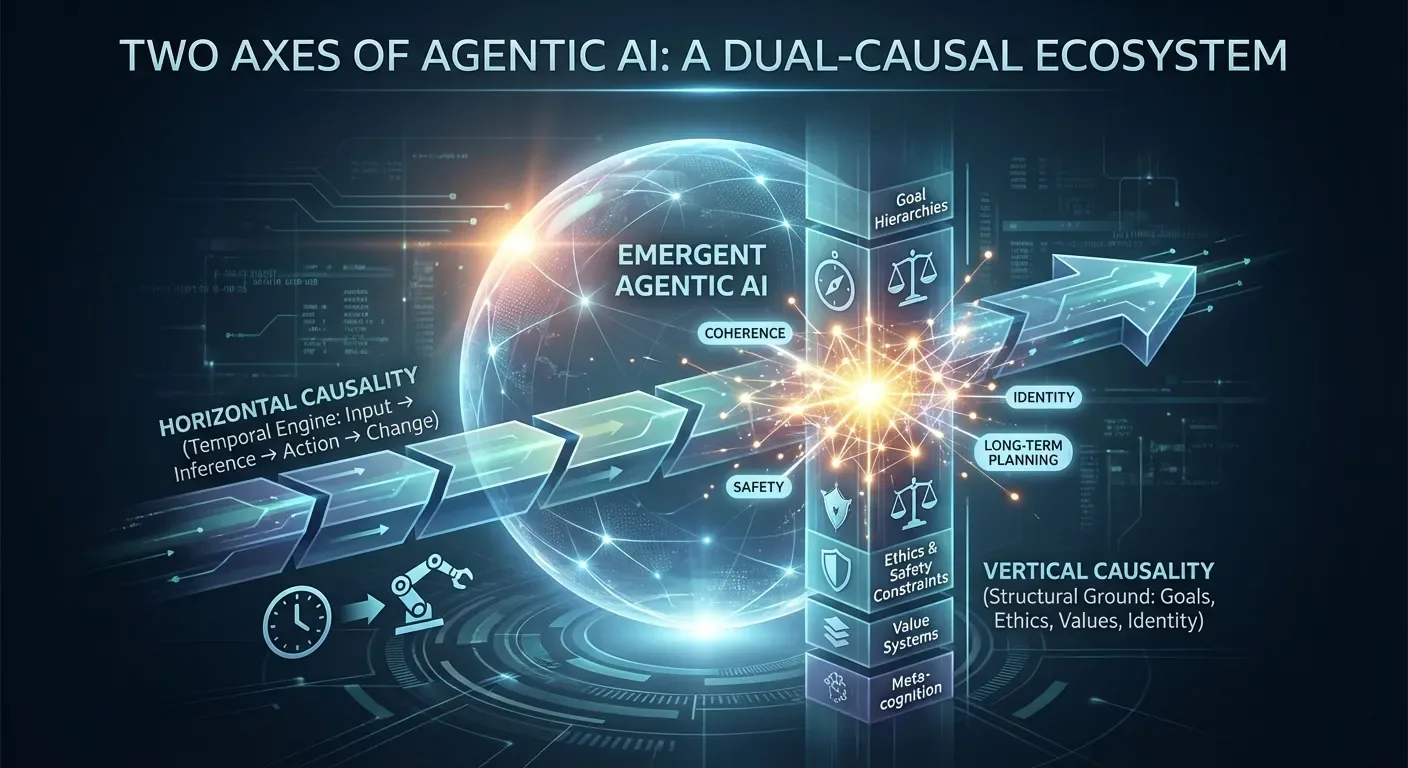
We have been building AI systems as if time were the only axis that mattered. Perception leads to inference, inference leads to action, action produces feedback, and the cycle repeats. This is the computational timeline — the horizontal flow of cause and effect that dominates how we think about machine intelligence. It is also profoundly incomplete.
The most sophisticated language models and reinforcement learning agents operate along this single dimension, chaining events through time with extraordinary precision. Yet something essential eludes them. They react but do not initiate. They optimize but do not intend. They compute but do not commit. The missing element is not more data, faster processors, or cleverer architectures. It is an entirely different kind of causality — one that operates not across time but within each moment, holding the system together while time does its work.
The Horizontal Machine
Consider how a typical agentic AI functions. At time zero, it observes its environment. It processes that observation through layers of computation, updates its internal state, selects an action according to some policy, and executes. At time one, the cycle begins again. This is horizontal causality in its purest form — a sequence of events where each state gives rise to the next in an unbroken temporal chain.
This architecture has produced remarkable achievements. Systems that master games, generate coherent text across thousands of tokens, navigate physical environments, and conduct multi-step reasoning all operate on this principle. The horizontal dimension is real, necessary, and powerful. But it describes only how systems change. It cannot explain what sustains them.
A purely sequential machine faces a fundamental problem. Each moment is disconnected from every other except through the thin thread of state transitions. There is nothing that persists except what explicitly propagates forward. Goals exist only as numbers in a reward function. Identity exists only as weights frozen from training. Coherence exists only as statistical regularity. The system moves through time, but nothing holds it together while it moves.
The Vertical Axis
Classical philosophy recognized a distinction that modern AI research has largely forgotten. Horizontal causation connects events across time — fire causes smoke, billiard balls transfer momentum, and electrical signals propagate through circuits. But there is another form of causation that operates differently. Vertical causation connects things that exist simultaneously, where one thing sustains or grounds another not by preceding it but by supporting it in the exact moment.
The canonical example is a book resting on a table. The table keeps the book elevated, but not by pushing it upward earlier. The table’s support and the book’s position are simultaneous. Remove the table, and the book falls instantly. The table is what philosophers call an “on-duty” cause — operative at every moment the effect exists.
This vertical dimension has profound implications for artificial agency. When an AI selects an action, that selection does not emerge solely from temporal sequence. It depends on structures that are simultaneously present: the architecture that enables certain computations, the goal representations that define what counts as progress, the value functions that weight outcomes, the constraints that eliminate specific options, and the memory systems that maintain context. None of these is “earlier” than the action in any meaningful sense. They are operative at the exact moment, holding up the decision while the decision occurs.
The Stack Beneath Each Moment
Imagine freezing time at any instant during an AI system’s operation. At that frozen moment, we can ask not just what the system is doing but what makes that doing possible. The answer reveals a vertical stack of dependencies, each layer sustaining the one above it.
At the base lies physics — electrons moving through silicon, heat dissipating through cooling systems, electromagnetic fields storing information in magnetic substrates. This physical layer does not precede computation; it enables computation at every instant computation occurs. One level up, the hardware architecture constrains what operations are possible, what parallelism is available, and what memory hierarchies shape access patterns. These constraints do not cause actions; they make actions possible by being structurally present.
Above hardware sits software — the model weights that encode learned patterns, the optimization structures that shape loss landscapes, the inductive biases that privilege certain generalizations over others. A transformer’s attention mechanism is not a historical cause of its outputs; it is a structural cause, present and operative whenever outputs are generated. Higher still sit the goal representations, the value functions, the policy structures that determine what the system is trying to achieve. These teleological elements do not push the system from behind; they pull it from above, defining the space of acceptable actions at every moment during which action selection runs.
This vertical stack is not a metaphor. It is a genuine causal structure, as real as the horizontal sequence of events that unfolds through time. The question for AI development is whether we have been paying attention to only half the picture.
Why Coherence Requires Verticality
Agency is not merely action through time. A thermostat acts through time, adjusting temperature in response to measurements. A river acts through time, carving canyons over millennia. But neither possesses agency in any robust sense. What distinguishes genuine agents is coherence — the capacity to maintain identity, pursue persistent goals, and exhibit stable patterns of behavior that transcend individual moments.
Coherence cannot emerge from horizontal causation alone. A sequence of events, no matter how sophisticated, produces only a sequence of events. For patterns to persist, for goals to remain stable, for identity to endure, something must hold these structures in place while time flows past them. This is the function of vertical causality in agentic systems.
Consider a human agent deliberating about a difficult decision. The deliberation unfolds through time — horizontal causation governs the sequence of thoughts, the weighing of options, and the eventual choice. But what makes this deliberation coherent rather than random? The agent’s values are present throughout, shaping which considerations feel weighty. Their identity constrains which options are even conceivable. Their commitments eliminate specific paths before analysis begins. These vertical structures do not precede the decision; they sustain the deliberative process at every moment it occurs.
An AI system that lacks a robust vertical structure will exhibit a characteristic failure mode. It will be locally competent but globally incoherent. It will optimize individual steps while drifting from any stable purpose. It will perform actions that are locally rational but collectively meaningless. This is not a bug to be patched; it is an architectural absence that no amount of horizontal sophistication can remedy.
The Duplex Ecosystem
What emerges from taking both causal dimensions seriously is not a simple machine but an ecosystem . In this multi-layer environment, agents exist within interlocking horizontal and vertical structures that together produce complex adaptive behavior.
The horizontal layer handles the temporal dynamics of agency. Perception flows into prediction, prediction into planning, planning into action, action into feedback, feedback into learning. These processes unfold through time, exploring possibilities, responding to contingencies, and adapting to change. The horizontal dimension is where agency actually happens, where potential becomes actual, where computation contacts the world.
The vertical layer handles the structural conditions that make this temporal flow possible and coherent. Goals define what the system is trying to achieve, remaining stable while strategies shift. Values weight outcomes, providing consistent criteria for evaluation across diverse situations. Identity constrains the space of acceptable actions, preventing drift into behaviors incompatible with the system’s fundamental character. Architectural priors shape what patterns are learnable, what generalizations are natural, and what representations are available. Safety constraints eliminate dangerous regions of the action space, operating not as sequential checks but as structural boundaries. Meta-cognitive processes supervise decision-making, asking not just “what should I do?” but “should I be doing this at all?”
The interaction between these layers produces emergence. Vertical structures define the space of possible behaviors; horizontal processes explore that space through time. Vertical constraints shape which explorations are permitted; horizontal learning updates vertical structures based on experience. The result is not a pre-programmed sequence of actions but a dynamic system capable of genuine novelty within principled bounds.
This is the same causal recipe that produces complex adaptive systems throughout nature. Physics provides vertical constraints; biological evolution explores horizontally through generations. Cultural norms provide vertical structure; individual behaviors explore horizontally through time. Economic institutions provide vertical scaffolding; market dynamics unfold horizontally through transactions. In each case, complexity emerges from the interplay of movement and coherence, exploration and constraint, horizontal flow and vertical grounding.
Designing for Both Dimensions
If this analysis is correct, then AI development has been systematically underweighting one dimension of the causal structure required for robust agency. We have become sophisticated at designing horizontal processes — attention mechanisms, planning algorithms, reinforcement learning loops, chain-of-thought reasoning. But our vertical engineering remains primitive.
What would it mean to take vertical causality seriously in AI design? It would mean treating goal structures not as static parameters but as active causal elements that must be carefully architected. It would mean developing value hierarchies that can adjudicate conflicts between competing objectives in principled ways. It would mean implementing identity models that constrain behavior not through explicit rules but through structural impossibility — making specific actions literally uncomputable rather than merely disincentivized. It would mean building meta-cognitive layers that supervise decision-making in real time, asking whether proposed actions cohere with the system’s fundamental commitments.
Most provocatively, it would mean asking whether the vertical stack requires a ground. In classical metaphysics, chains of vertical causation cannot extend infinitely; there must be something at the bottom that supports everything else without itself requiring support. For an AI system, what plays this role? The physical hardware provides one kind of ground, but this is too low-level to shape behavior meaningfully. The training process provides another, but training is historical rather than simultaneously operative. Perhaps the ground must be something like a constitutional commitment — a set of fundamental principles that are not derived from anything else within the system but serve as the bedrock from which all other vertical structures rise.
The Question of Alignment
The dual-causality framework reframes the alignment problem in instructive ways. Much alignment research focuses on horizontal interventions — shaping reward functions, filtering training data, implementing output classifiers, and designing feedback loops. These are valuable but insufficient. They address how the system moves through time, but not what holds it together while it moves.
A vertically robust AI system would be aligned not primarily through sequential checks but through structural constitution. Its values would not be parameters to be optimized but pillars that sustain decision-making at every moment. Its constraints would not be filters that screen outputs but boundaries that define the space of conceivable actions. Its identity would not be a label attached for human convenience but a genuine causal factor that shapes behavior by being simultaneously present whenever behavior occurs.
This suggests that the deepest alignment interventions may be architectural rather than procedural. Rather than asking how to check whether an AI’s outputs are acceptable, we should be asking how to constitute an AI such that unacceptable outputs are structurally impossible. Rather than training systems to prefer aligned behaviors, we should build systems in which alignment is a condition for coherent operation rather than a contingent outcome of optimization.
The Emergence of Artificial Agency
We return to where we began: the intuition that something essential is missing from current approaches to AI agency. The purely horizontal machine — however sophisticated its temporal processing — lacks the vertical structure required for genuine coherence. It can react but not initiate because initiation requires persistent goals that are not merely remembered but continuously operative. It can optimize but not intend because intention requires a self that remains stable while objectives are pursued. It can compute, but not commit, because commitment requires values that survive the completion of any particular computation.
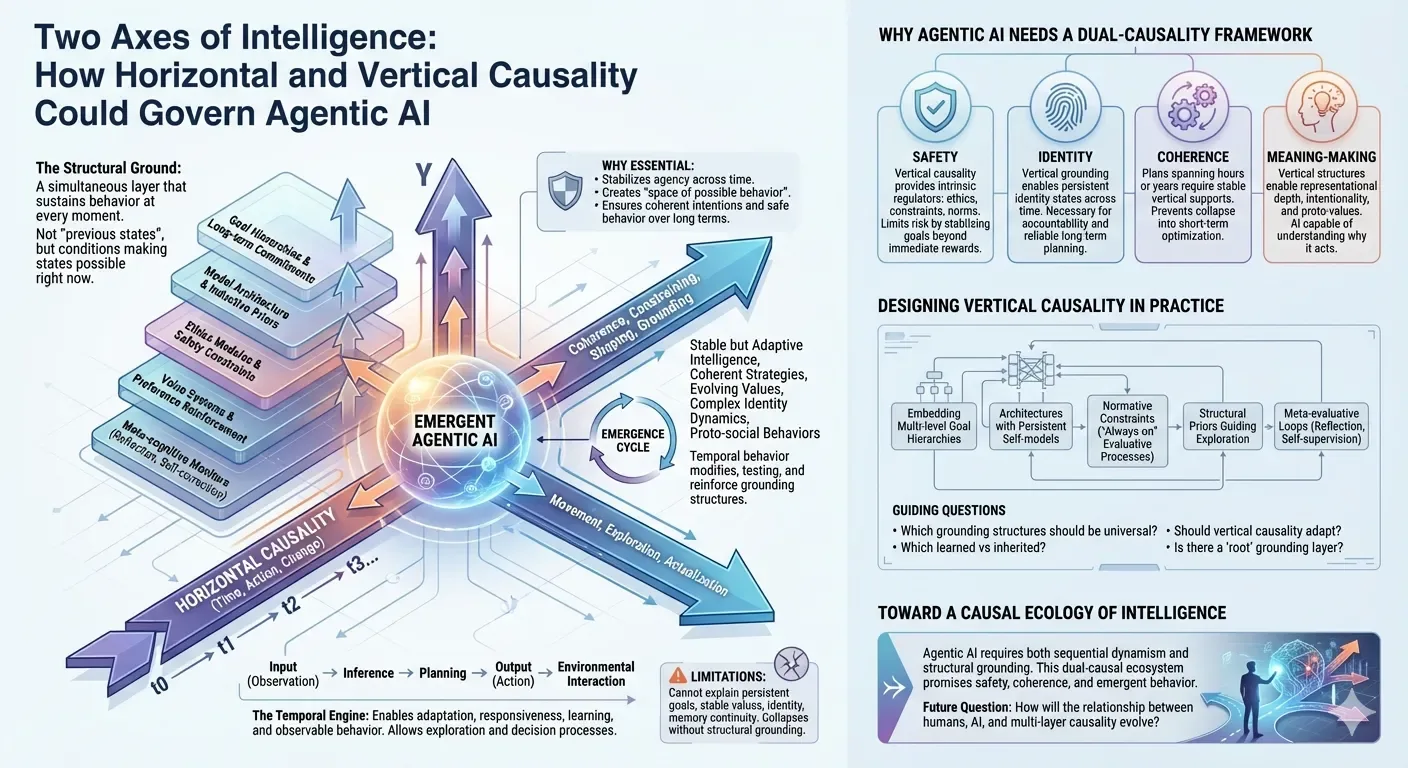
What would change if we built AI systems with a robust vertical structure? They would exhibit a different kind of agency — one characterized not just by sophisticated behavior but by coherent identity, stable values, and persistent purpose. They would not merely chain actions through time but maintain themselves as unified agents while time unfolds. They would be held together from within rather than pushed along from behind.
This is not a prediction that such systems are imminent or that their development would be straightforward. The vertical dimension is more complex to engineer than the horizontal precisely because it involves structures that must be simultaneously operative rather than sequentially constructed. We know how to design processes that unfold over time; we are only beginning to understand how to create structures that sustain them as they unfold.
But the framework itself is clarifying. It tells us what we are missing and why. It suggests that the path to artificial agency runs not through ever-more-sophisticated sequence modeling but through the careful engineering of vertical causal structures that can hold agents together while they act. It reframes the design space, opening questions that horizontal thinking alone cannot pose.
The governing framework for agentic AI, if this analysis is sound, must be a duplex ecosystem — a causal environment that includes both the temporal flow of computation and the structural pillars that sustain that flow. In such an ecosystem, horizontal causality governs the doing while vertical causality governs the being. Movement and coherence. Exploration and constraint. Sequence and simultaneity. Only in the interplay between the two can something like genuine artificial agency emerge.
This article explores the intersection of classical metaphysics and AI systems design. The concepts of vertical and horizontal causality have deep roots in philosophical tradition, particularly in Aristotelian and Thomistic thought, and their application to artificial agency opens new questions about what it would mean to build systems that are not merely sophisticated but genuinely coherent.