Building Minds
The Architecture of Judgment
Dr. Jerry A. Smith · February 19, 2026 · 8 min read
Building Minds — Edition 4
Consider what a managing partner actually does. They do not write the briefs. They do not build the financial models. They do not conduct the interviews. What they do is direct: they know which specialist to consult for which problem, and they know how to weigh their answers when they conflict. Their value is not in the breadth of their knowledge but in the precision of their judgment about whose knowledge to trust, and when.
This is a description of a management function. It also describes how the most effective AI architectures currently function.
The dominant assumption in enterprise AI has been that larger models are better models. The frontier systems—GPT-5, Claude Opus, Gemini Ultra—are defined by their scale: parameter counts in the trillions and training data that encompass most of the documented human knowledge. If you need to solve a difficult problem, the thinking goes, you reach for the largest tool available.
The assumption is not unreasonable. These models do genuinely remarkable things. A single system can write working code, analyze contract terms, explain the tax implications of a merger, and summarize regulatory filings—all with competence that would have seemed implausible five years ago. The generality is real.
But generality has a cost that is easy to overlook. A model trained to predict the most likely continuation of text drawn from the entire internet will, in response to any specific query, produce the statistically median answer. In most consumer contexts, this is sufficient. In a specialized business context, the median answer is often incorrect.
The average of all legal arguments is not a winning legal argument. It is the average, unremarkable, undifferentiated, equally available to every firm that connects to the same API. The average of all supply chain configurations is not a competitive advantage. Value in specialized work does not emerge from the mean. It emerges from deviation: the specific, idiosyncratic judgment that distinguishes how one organization approaches a problem from how every other organization would.
A generalist model cannot provide that deviation. By design, it averages it away.
What Expertise Actually Is
A senior partner does not know more than a junior associate in the way that an encyclopedia knows more than an article. She knows differently. Years of specific experience have restructured her attention. She ignores irrelevant information automatically—not through effort, but through the accumulated weight of cases that taught her it was irrelevant. She recognizes patterns that appear as noise to anyone without her background. She makes confident decisions with incomplete data because she knows which data are relevant and which are not.
The cognitive science term for this is the reduction of the search space. Expertise is not the accumulation of knowledge so much as the progressive narrowing of the space of possibilities that need to be considered. The novice must evaluate everything. The expert has already eliminated most of it before the question is fully formed.
This kind of expertise is also domain-specific in a way that does not transfer. The same partner who can read a restructuring situation in minutes is no better than a layperson on maritime law. Her pruned attention operates only within the domain in which the pruning occurred. It is not intelligence in the general sense. It is a very precisely shaped tool.
A model can be trained to approximate this. But not by making it larger. By making it smaller.
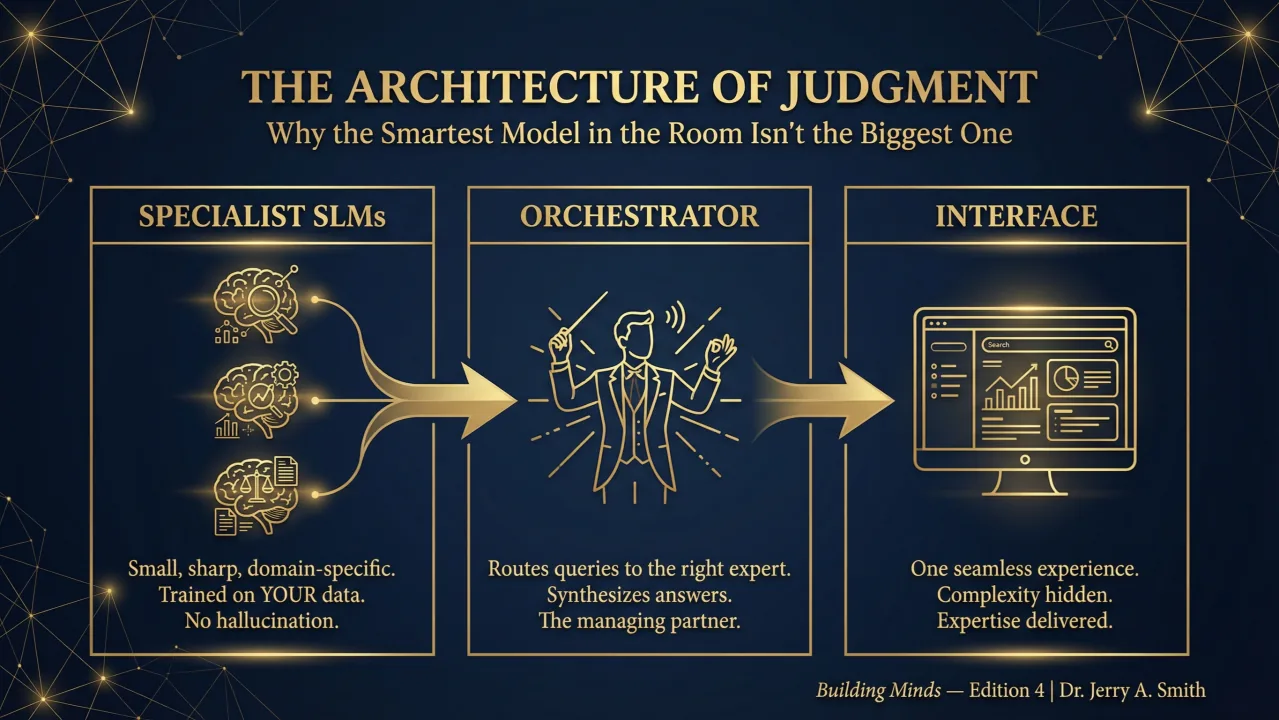
The Small Language Model—the SLM—is a system stripped of general knowledge and trained only on a narrow domain. One model might hold twenty years of a firm's regulatory filings and nothing else. Another might know only the syntax of a proprietary internal coding language. A third might be fine-tuned to the correspondence of the firm's most effective client negotiators, absorbing not only their vocabulary but also the structure of their arguments and the patterns of their concessions.
These models do not know who won the 1998 World Series. They do not know how to write a sonnet. What they know, within their domain, they know with a precision that a generalist system cannot match. Because they are small, they run fast on modest hardware. Because they are narrow, they do not hallucinate—the paths to error have been systematically closed.
The Orchestration Problem
A room full of specialists does not automatically function as a team. It needs direction.
When a client submits a complex query—the implications of a new tariff regulation on a global logistics network, say—no single specialist model can answer it fully. The question is, in fact, several questions. There are legal components requiring knowledge of regulatory frameworks. There are financial components requiring knowledge of cost structures and margin analysis. There are operational components requiring knowledge of vendor relationships and lead times. Each component must be routed to a distinct system, and the results must be combined in a coherent manner rather than in contradiction.
This is the orchestration layer. Its job is decomposition, routing, and synthesis. It receives the query, decomposes it into components, dispatches each component to the appropriate specialist, and assembles the outputs into a coherent response.
The analogy to the managing partner is not decorative. It is structural. The orchestrator does not perform the analysis itself. It makes judgments about which specialist to ask, in what order, and how to reconcile their answers when they point in different directions. Its value is not in what it knows directly but in what it understands about the capabilities and limitations of the systems it coordinates.
From the end user's perspective—the junior consultant submitting the query through a chat interface—the complexity is invisible. A question goes in. An answer comes out. Beneath the surface, a coordinated team of synthetic specialists has done what no single generalist could have done as well.
Recommended by LinkedIn
[ Architecture in the Age of Agentic AI: From Design to…
Senthil Jayachandran ☁️ 🍁
Architecture in the Age of Agentic AI: From Design to…
Senthil Jayachandran ☁️ 🍁
7 months ago](https://www.linkedin.com/pulse/architecture-age-agentic-ai-from-design-senthil-jayachandran--gytyc)
[ What AI Leaders Taught Me About Sustainable AI…
Muthukumar Gopalakrishnan
What AI Leaders Taught Me About Sustainable AI…
Muthukumar Gopalakrishnan
3 months ago](https://www.linkedin.com/pulse/what-ai-leaders-taught-me-sustainable-architecture-gopalakrishnan-fna4c)
[ Defining a Solutions Practice: Enterprise AI
Stephen Lahanas
Defining a Solutions Practice: Enterprise AI
Stephen Lahanas
1 year ago](https://www.linkedin.com/pulse/defining-solutions-practice-enterprise-ai-stephen-lahanas-2cjtf)
The Economics of Ownership
Running a frontier model for every internal query is expensive in a specific and structural way. Each query incurs a fee that is remitted to the provider. The cost scales with usage. And the underlying asset—the model itself—belongs to someone else. You are renting intelligence from a provider who owns it, sets the price, and can change both.
Small, specialized models change this structure. They run on a fraction of the compute required by frontier systems. They can be deployed on hardware your organization controls. The variable cost becomes a fixed one—infrastructure you pay for once and operate indefinitely.
But the cost argument, while real, is not the most important one. The more important argument is about what you own.
If your AI strategy is a sophisticated wrapper around a public API, you have no structural advantage over any competitor who builds an equally sophisticated wrapper. The underlying model is the same. The training data is the same. The baseline capabilities are the same. You are competing on implementation quality in a domain where implementation is increasingly well understood.
When you train specialist models on your proprietary data and orchestrate them with your own logic, you build something categorically different. The models encode knowledge that your competitor cannot access—because it came from your experience, your cases, your transactions, and not from any public source. The orchestration logic encodes the judgment embedded in how your firm makes decisions. These are not features of a software product. They are assets. They belong to you, they do not depreciate with use, and they cannot be replicated by someone who simply subscribes to the same API.
What Compounds
A generalist model is the same on the day you start using it as it is two years later. It does not learn from your interactions. It does not adjust when it encounters a context-specific error. It remains fixed to the parameters established during its last training run, until the provider releases a new version—at which point the improvement belongs to the provider, not to you.
A specialist architecture compounds.
Each time a human expert reviews a model's output and corrects it, that correction is a signal. It can be captured and used to retrain the model. The specific error becomes less likely. The model's judgment gradually shifts toward that of the person who corrected it. Over time, across many corrections from many experts, the system drifts closer to the particular way of reasoning that makes your best people valuable.
This is not software getting better with patches. It is something closer to the accumulation of institutional memory—the encoding, in a system you own, of the weighting that distinguishes expert judgment from merely competent performance. Which factors to prioritize? Which signals to trust? Which situations call for caution rather than confidence?
The divergence between this system and the generalist alternative is initially small. After six months, it is noticeable. After two years, it is decisive. The firm using the generalist model remains tied to whatever the provider has most recently released. The firm that built the specialist architecture has accumulated something that was not available for purchase at any price when it started: a system that has learned to think the way they think.
The Extraction Problem
This is not primarily an engineering project. The code is standard—orchestration frameworks, fine-tuning pipelines, and retrieval systems. These components can be assembled from open-source libraries or purchased from any of a dozen vendors.
The hard part is extraction. It requires identifying which decisions create value in your specific context and locating the data that represent those decisions. This means sitting with the partner who does not read most of what crosses her desk and figuring out, precisely, what she does read—and what that selectivity reveals about how she thinks. It means making tacit knowledge explicit enough to encode. It means converting implicit and often unarticulated judgment into a training signal, which is explicit.
You cannot purchase your way past this. The GPUs are available. The base models are available. The frameworks are available. What is not available at any price is the accumulated judgment of your specific organization. That must be extracted, formalized, and encoded—from the raw material of what your people actually know, built piece by piece, from experience that belongs to no one else.
The next edition follows this logic to its edge. Once you have built the architecture of judgment, the question becomes whether you can go further: encoding not just technical knowledge, but the intuition that operates beneath it. The question of the Synthetic Genius—and it is harder than it sounds.
Dr. Jerry A. Smith builds AI organizations within large enterprises. Connect on LinkedIn or reach out at jerry@drjerryasmith.com.
Edition 1: Why Most AI Initiatives Fail (And What the Survivors Do Differently) — Link (https://www.linkedin.com/pulse/why-most-ai-initiatives-fail-what-survivors-do-dr-jerry-a-smith-kioxe/)
Edition 2: The Professional Services AI Blueprint: Stop Selling Hours, Start Selling Minds — Link (https://www.linkedin.com/pulse/professional-services-ai-blueprint-stop-selling-hours-smith-dr-jerry/)
Edition 3: The Mind Audit: Five Questions That Reveal Whether Your AI Strategy Will Survive — Link (https://www.linkedin.com/pulse/mind-audit-five-questions-reveal-whether-your-ai-strategy-smith-dr-jerry/)
Edition 4: The Architecture of Judgment: Why the Smartest Model in the Room Isn't the Biggest One — (not yet published)
Edition 5: The Synthetic Genius — (not yet published)