Building Minds
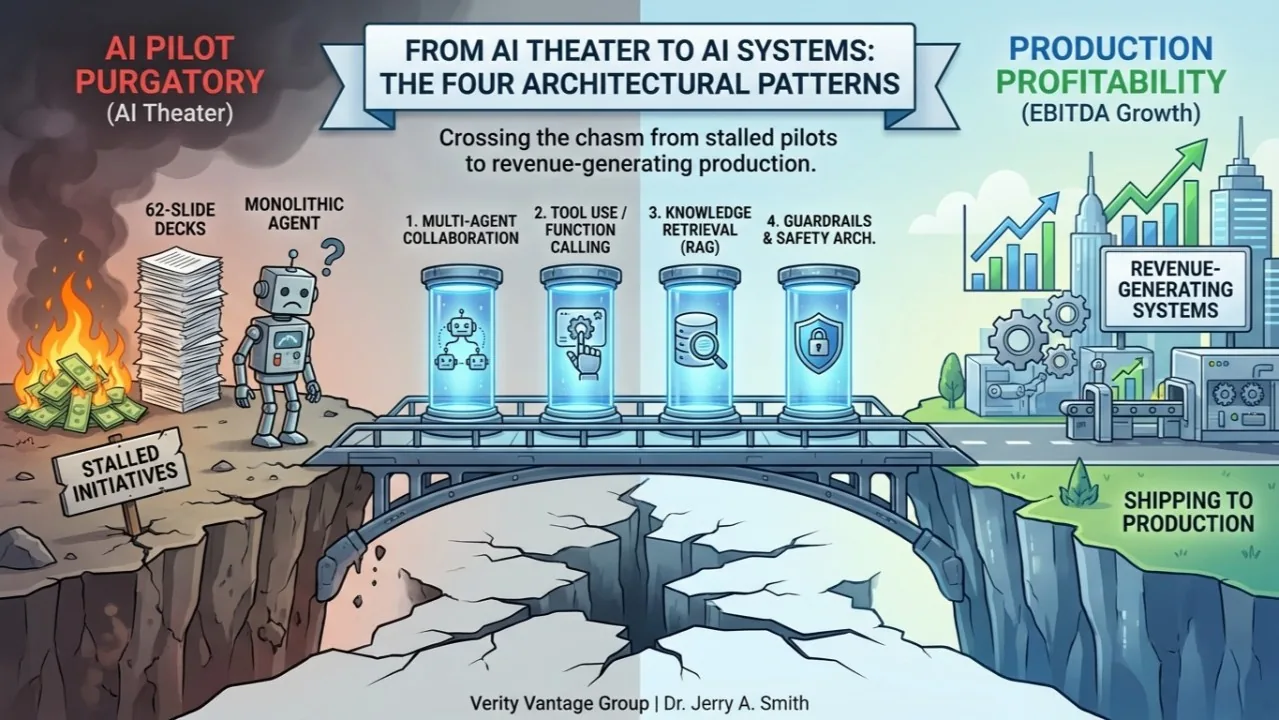
The Four Patterns That Separate AI Systems from AI Theater
Dr. Jerry A. Smith · March 24, 2026 · 6 min read
Building Minds | Dr. Jerry A. Smith | Verity Vantage Group
Eighteen months ago, I sat across from an SVP at a pharma CRO. His team had spent $2.3M on AI initiatives. They had dashboards. They had pilots. They had a roadmap deck that was sixty-two slides long.
Not a single system was in production.
He wasn't incompetent. His team wasn't lazy. The technology worked. The problem was the architecture — and specifically, the absence of it. They had built AI the way most enterprises build AI: one model, one prompt, one system expected to handle everything. A monolithic agent doing the work of five specialists.
I know that pattern cold. I've seen it inside six global firms. The failure mode is always the same.
Here's what I told him — and what I've since deployed across 14 portfolio companies in 7 industries in 41 working days.
There are four architectural patterns that determine whether an AI system reaches production or dies in a pilot. Miss any one of them and the system stalls. Implement all four, and you have something that moves EBITDA.
Know someone burning budget on AI pilots that never ship? Forward this to them.
The Failure Map
Before the patterns, understand what breaks.
Enterprise AI fails in four specific ways, each with a specific technical cause.
Cognitive collapse under complex tasks. A single LLM hits a ceiling fast. As cognitive load increases, models start ignoring constraints, drifting context, and propagating errors downstream. This isn't a model quality problem. It's a physics problem. You're asking one agent to do the work of a research team, an analyst, and a synthesizer simultaneously.
Conversational isolation. Without the ability to trigger real-world actions, an agent is a frozen reasoning engine. It can explain your inventory problem with precision. It cannot touch your ERP to fix it.
Confident hallucinations. An LLM's knowledge is frozen at the moment training concludes. It doesn't know your Q3 pricing, your current regulatory posture, or what your top customer asked yesterday. It will answer questions about all three anyway — confidently, and often wrong.
Compliance and security rejection. Technically impressive. Organizationally unacceptable. Legal, compliance, and leadership won't approve a system they can't audit, explain, or constrain. This is where more AI projects die than people admit.
Four failure modes. Four patterns that address them directly.
Pattern 1: Multi-Agent Collaboration
The failure it fixes: Cognitive collapse
The monolithic agent architecture has a ceiling. When a task is genuinely complex — multi-domain, multi-step, requiring different types of reasoning — a single model starts cutting corners. It ignores constraints. It confuses context. It produces output that looks right at a glance and falls apart under scrutiny.
The fix is distributed decomposition. Break the task into sub-problems. Assign each to a specialized agent with a narrowly scoped role, its own tools, and its own domain knowledge. A supervisor agent coordinates. Results reconcile at an orchestration layer before reaching the human.
These systems outperform not because the agents are smarter. They outperform because adversarial tension between specialized nodes surfaces errors that consensus-driven monolithic models miss every time.
In production: A five-agent adversarial architecture at a pharma CRO caught a protein regeneration anomaly the research team had missed entirely. Not smarter than the researchers. Designed to disagree with itself.
Pattern 2: Tool Use / Function Calling
The failure it fixes: Conversational isolation
Without tools, an LLM is a frozen reasoning engine. It can explain concepts and identify patterns. It cannot trigger real-world actions.
Tool use changes the category an agent belongs to. The LLM describes what it needs. The framework executes it. A structured JSON payload names the tool, specifies the parameters, and the orchestration layer triggers the external system.
The result: an agent that reads from your CRM, queries your ERP, posts to your ticketing system, executes code, and sends a notification in a single workflow. The integration layer that was always supposed to be intelligent finally becomes intelligent.
In production: At an aviation MRO, a multi-agent RFQ system connected to live pricing data and historical win/loss records doubled the win rate from 5% to 10%. That's $10M per year in net new revenue from a system that had been answering questions manually the year before.
Pattern 3: Knowledge Retrieval (RAG)
The failure it fixes: Confident hallucinations
Recommended by LinkedIn
[ Self‑Improving Agentic AI: Formal Models, Stability…
Vatsa Joshi
Self‑Improving Agentic AI: Formal Models, Stability…
Vatsa Joshi
7 months ago](https://www.linkedin.com/pulse/selfimproving-agentic-ai-formal-models-stability-policies-vatsa-joshi-oj99f)
[ The Realization Factor: What Turns AI Spend Into AI…
Jason L Zimmerman
The Realization Factor: What Turns AI Spend Into AI…
Jason L Zimmerman
2 months ago](https://www.linkedin.com/pulse/realization-factor-what-turns-ai-spend-return-jason-l-zimmerman-uovoc)
[ AI Isn’t Replacing Professionals.
TD Michaelsen FCIPD
AI Isn’t Replacing Professionals.
TD Michaelsen FCIPD
7 months ago](https://www.linkedin.com/pulse/ai-isnt-replacing-professionals-tim-david-td-michaelsen-fcipd-rhhoe)
A base LLM's knowledge is frozen at the exact moment its training concludes. Your Q3 pricing changed. Your regulatory posture shifted. Your customer had a conversation with your sales team last Tuesday about a model that the customer had no access to.
Retrieval-Augmented Generation solves this by grounding every reasoning step in current, verifiable, external data before a single word is generated. The query routes to a retrieval layer first. Semantic search — not keyword matching — finds the most relevant chunks from your indexed knowledge base. Those chunks are injected into the prompt as ground truth. The model generates a response anchored in your data, not its priors.
In regulated industries, confident wrong answers are a legal liability. RAG is what makes the answer traceable back to a specific source.
In production: At a financial services firm, an analyst assistant retooled with RAG over internal financial reports turned a two-day budget reconciliation task into a twenty-minute query — with exact citations back to specific rows in secure documents.
Bonus Pattern: Guardrails & Safety Architecture
The failure it fixes: Compliance and security rejection
This is the most frequently skipped pattern. It is also the sole determinant of whether legal, compliance, and leadership approve your deployment.
The purpose of guardrails is not to restrict capability. It is to make the capability trustworthy enough to ship.
The six-layer defense: Input Sanitization filters malicious injections at the perimeter. Behavioral Constraints define strict operational boundaries. Output Filtering runs post-generation compliance checks. Tool Use Restrictions hard-code limits on API execution rights. Semantic Routing directs sensitive queries to secure internal instances. Human-in-the-Loop establishes exception handling for high-stakes execution.
An agent without this architecture is technically impressive and organizationally unacceptable. Every enterprise I've assessed has at least one AI initiative that stalled at the approval stage — not because the technology failed, but because nobody built the controls that make approval possible.
How the Four Patterns Work Together
The patterns aren't independent. They compose.
In the 5-3-1 architecture deployed across 14 PE portfolio companies — five specialized agents, three orchestration layers with adversarial reconciliation, one unified output before the human layer — all four patterns operate simultaneously.
Multi-Agent handles cognitive load through specialization and adversarial tension. Tool Use connects each agent to the live systems it needs. RAG grounds every agent's reasoning in the firm's specific, current data. Guardrails wrap the entire system in a defense-in-depth ring that makes deployment defensible.
The numbers: $10–20M in identified revenue in the first two companies assessed. 6–15x Year 1 ROI across engagements. Idea to production in two weeks, every time.
None of that is possible with a monolithic agent and a good prompt.
The Diagnostic Question
Which of these four failure modes is your current AI initiative running into?
Is your agent producing outputs that look plausible but fall apart on complex tasks? That's Pattern 1.
Is your system making recommendations it has no mechanism to act on? That's Pattern 2.
Are your agents confident about things they shouldn't be? That's Pattern 3.
Is the system technically ready, but organizationally stuck because no one will approve something they can't audit? That's Pattern 4.
Most enterprise AI initiatives have at least two of these. Knowing which one is the primary constraint tells you exactly where to start.
Your Next Move
The architecture in this issue is currently running in production across pharma, aviation, medical devices, logistics, and financial services. The patterns aren't theoretical. The proof points are live.
The 17-slide Blueprint deck that goes with this framework — comment BLUEPRINT below and I'll send it to you directly.
Start with a 15-minute diagnostic conversation. No pitch. Just an honest assessment of where AI moves your margin fastest.
jerry.smith@verityvantagegroup.com 484.678.3518 linkedin.com/in/drjerryasmith
Dr. Jerry A. Smith — AI executive and engineer. Built AI practices from zero inside six global firms. PhD in Computer Science. Navy veteran — nuclear engineer, then carrier-based jet pilot. Still writes production code.
Verity Vantage Group | Production AI That Moves EBITDA | verityvantagegroup.com