Building Minds · Special edition
I Built the Thing I Kept Wishing Existed
Dr. Jerry A. Smith · March 30, 2026 · 7 min read
By Dr. Jerry A. Smith | March 30, 2026
Every engagement ends the same way.
You have spent weeks — sometimes months — inside an organization. You have mapped the data. Redesigned the workflows. Built the agents. Watched the system go live. Measured the results. And somewhere in the final week, a senior leader pulls you aside and says some version of the same thing:
"Why didn't anyone tell us about this sooner?"
I have heard this question more times than I can count. Across six global firms. Fourteen engagements. Seven industries. The question is always the same, and it is never really a question. It is a statement about how the market works, and about what is missing from it.
What is missing is a firm that gets there before the damage is done.
What I Kept Seeing
The pattern is consistent enough that I could describe it before walking through the door.
A leadership team that has read about AI and believes it is important. A technology team that has run pilots — maybe several — and cannot explain why none of them made it to production. A gap between what was promised and what was delivered that nobody wants to own. And underneath all of it, a suspicion that they are falling behind, without any clear picture of what catching up would look like.
The tools are not the problem. The models work. The APIs connect. By the time I arrive, there are usually several proof-of-concept deployments already running — small, isolated, impressive in demonstrations, irrelevant to the actual business.
The problem is everything around the tools. The data that was never transformed into something agents can actually use. The workflows that were designed for humans and handed to AI without modification. The governance structure was built to slow things down, not to ship things fast. The organizational layer that never changed, even as the technology layer was supposed to.
And the vendors. The vendors who architected a beautiful solution, delivered it on time, and left before anyone realized it did not work in production.
I would fix these things. Then I would leave. And six months later, I would hear that the next firm had the same problem.
The Conversation That Changed My Thinking
Late in an engagement, a CFO asked me a question I had not been asked before.
We were reviewing the ROI model together — the numbers were good, the system was working, and the team was starting to believe it. He looked at the projection for year two and said, "What happens if you're not here?"
It was not a hostile question. He was not doubting the work. He was asking something more honest: Does any of this survive without you?
I told him what I believed to be true — that we had built it to survive, that the team was trained, that the documentation was thorough. But I drove home thinking about a different version of his question. Not what happens if you're not here at this company, but what happens to the companies that never got you at all?
The firms in that category are not obscure. They are a mid-market manufacturing company that does not make the minimum engagement size for McKinsey. The regional professional services firm that cannot afford a Big 4 retainer. The software company that is growing fast and cannot wait nine months for a strategy document. The private equity portfolio needs results across 12 companies simultaneously, not a separate engagement for each.
These are real organizations with real AI problems, and the market has largely left them to figure them out on their own.
What Verity Vantage Group Is
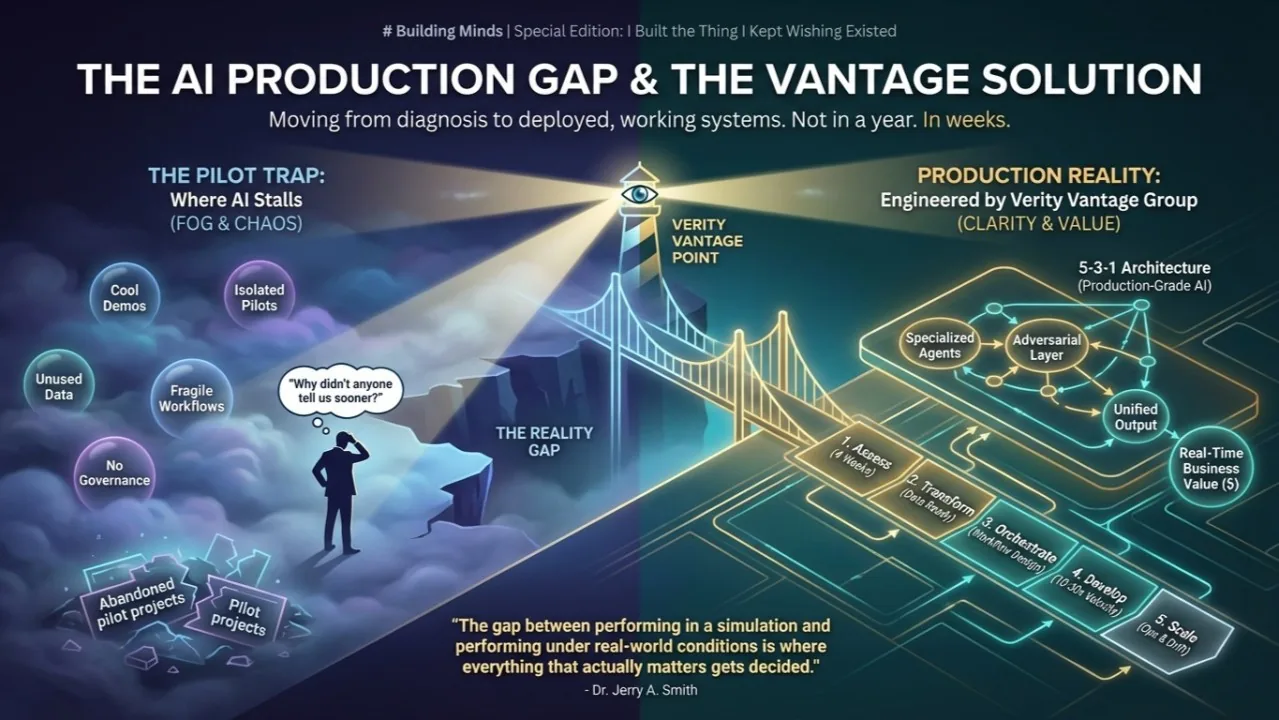
Today, I am announcing Verity Vantage Group — an AI engineering practice for organizations that are done with pilots and ready for production.
The name is intentional. Verity — the quality of being true; accuracy; the ability to see clearly. Vantage — a position giving a wide or favorable view. The firm is built around the idea that the problem most organizations have with AI is not a technology problem. It is a visibility problem. They cannot see where they are, how far they have to go, or what a working system would actually look like.
We fix that. Then we build it.
VVG operates across five service lines — Assess, Transform, Orchestrate, Develop, Scale — designed to move an organization from diagnosis to a deployed, working system. Not in a year. In weeks.
The assessment engagement is four weeks: AI landscape mapping, EBITDA opportunity quantification, agent-readiness scoring, and a sequenced deployment roadmap with ROI projections. This is what I wish every client had before they ran a single pilot.
Recommended by LinkedIn
[ The Great IT Odyssey: A Tale of Misalignment and Mayhem
Tomasz Wosiński
The Great IT Odyssey: A Tale of Misalignment and Mayhem
Tomasz Wosiński
1 year ago](https://www.linkedin.com/pulse/great-odyssey-tale-misalignment-mayhem-tomasz-wosi%C5%84ski-zhonf)
[ Complex Member Questions Don't Scare It
Kevin Ordonez, AAiP
Complex Member Questions Don't Scare It
Kevin Ordonez, AAiP
5 months ago](https://www.linkedin.com/pulse/complex-member-questions-dont-scare-kevin-ordonez-aaip-npdtc)
[ The frontier model in every enterprise is sitting in…
Sudheesh Nair
The frontier model in every enterprise is sitting in…
Sudheesh Nair
2 months ago](https://www.linkedin.com/pulse/frontier-model-every-enterprise-sitting-conference-room-sudheesh-nair-8iecc)
Transform is the step that everyone skips. Raw company data is not agent-ready. It needs to be cleaned, structured, chunked, tagged, and embedded before an AI system can reason about it. Most organizations discover this problem mid-deployment, after they have already committed to a timeline. We do it first, deliberately, before anything is built on top of it.
Orchestrate is where the architecture comes together: multi-agent workflow design using our 5-3-1 Architecture — five specialized agents, three adversarial orchestration layers, one unified output. The adversarial layer is what makes it production-grade. Agents that critique each other's outputs do not hallucinate at scale. This is not a theoretical property. It is something we have measured.
Develop is spec-driven AI development at 10 to 30 times the velocity of traditional software delivery. The spec comes from the Assess and Orchestrate phases, which means by the time development begins, we are building a defined thing — not figuring out what to build while building it.
Scale is the post-deployment layer: LLMOps infrastructure, drift detection, production governance, value realization tracking. This is the piece that keeps the system working after we leave.
The Numbers That Matter
Across fourteen engagements:
→ 41 working days to assess a private equity portfolio of 14 companies
→ $10–20 million in identified AI opportunity per engagement
→ Regulatory intelligence platform monitoring 20,000+ pharmacopoeia pages for a pharmaceutical CRO → Agentic RFQ system eliminating response lag for an aviation MRO
→ AI network security monitoring running 24/7 — four agents, no humans in the loop
That last number is the one I care about most.
Who I Am, and Why That Matters Here
I graduated from the Navy Nuclear Power School — selected by Kinnaird R. McKee (replaced Admiral Rickover), who did not pass people out of sentimentality. I was assigned to USS Sam Houston (SSN-609), where I owned the nuclear reactor during overhaul (fun). I flew carrier-based jets from the deck of USS Constellation (CVA-64/CV-64). I earned a PhD in Computer Science. I have built AI practices from zero inside six global firms across four continents.
I say this not to build a resume. I say it because the thing that connects nuclear engineering, carrier aviation, and production AI is the same thing: the gap between performing in a simulation and performing under real-world conditions is where everything that actually matters gets decided.
AI in the lab is easy. The model is smart, the inputs are clean, and the demo looks great. AI in production is where systems encounter bad data, adversarial conditions, organizational inertia, and users who do not behave as designers assumed.
The Navy did not let me land on a carrier because I could describe what it would be like to land on one. It required demonstrated competence under real conditions, evaluated by people who would also be on the ship.
I apply the same standard to every system we ship.
What This Newsletter Becomes
Building Minds has been, from its first edition, about one question: what does it take to build AI that actually works?
That question has not changed. But the context around it has.
From here forward, this newsletter will serve as the thought leadership engine of Verity Vantage Group. Every edition is a window into how we think — about AI failure patterns, about what production readiness actually requires, about the organizational and technical conditions that determine whether a system lives or dies between the lab and the business.
If you have read every edition and thought: "This person understands the problem I'm trying to solve — I would like to talk to you," I would like to talk to you.
The problem you are trying to solve is exactly what we work on.
Jerry Smith is the founder and CEO of Verity Vantage Group. He writes Building Minds weekly.
→ jerry.smith@verityvantagegroup.com → verityvantagegroup.com → DM on LinkedIn