Building Minds
The 5-Step Escape Plan: How to Get Your AI Out of Pilot Purgatory and Into Production in 2026
Dr. Jerry A. Smith · March 23, 2026 · 5 min read
By Dr. Jerry A. Smith — Verity Vantage Group
The $547 Billion Bonfire
Last year, a PE operating partner called me about a portfolio company. They'd spent 18 months and $2.3 million on an AI initiative. They had a beautiful dashboard. A team of three data scientists. Executive buy-in. Industry press.
They had zero AI in production.
Not one model serving a customer. Not one workflow is automated. Not one dollar of measurable return.
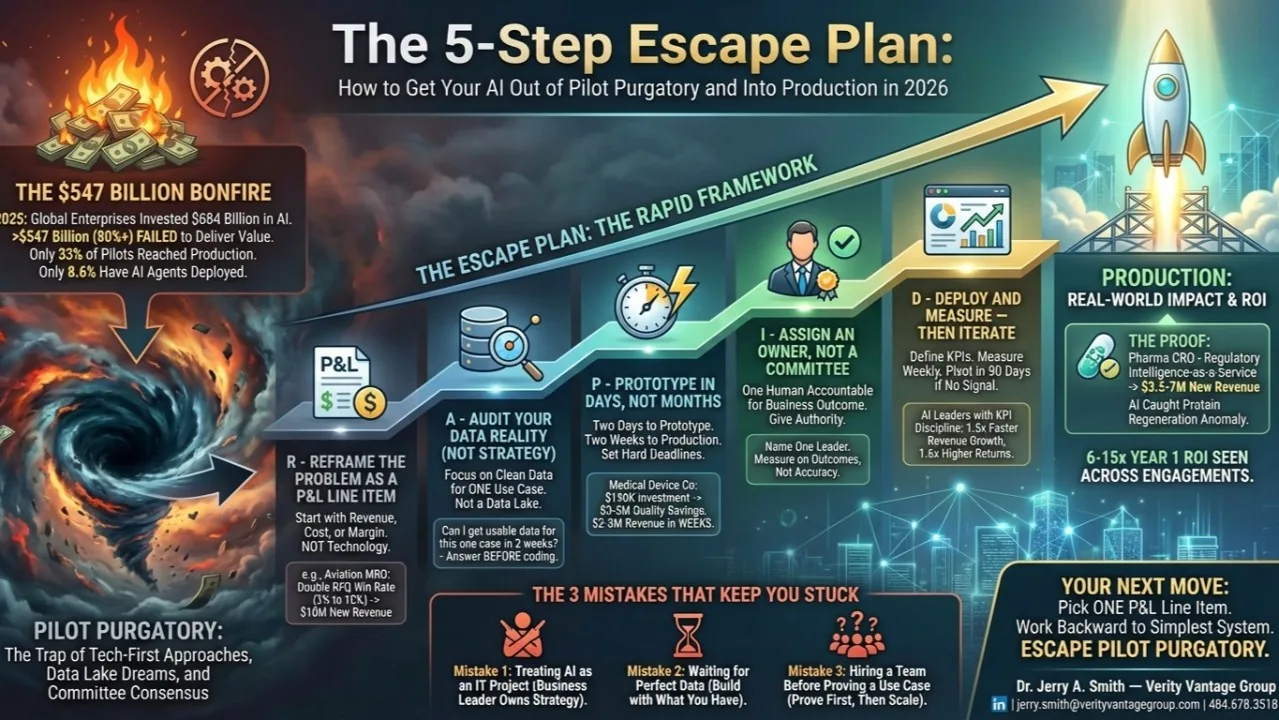
They weren't alone. In 2025, global enterprises invested $684 billion in AI. Over $547 billion of that — more than 80% — failed to deliver intended business value. Only 33% of AI pilots ever reached production. And only 8.6% of companies today have AI agents actually deployed and working.
I've built AI practices from zero inside six global firms. I've assessed 14 portfolio companies across 7 industries in 41 working days. The pattern is always the same: the technology works. The organization doesn't.
Here's the escape plan.
Know someone stuck in pilot purgatory? Share this with them. It might save them a year and a few million dollars.
The Production AI Framework: 5 Steps That Actually Work
I call this the RAPID Framework — because speed is the point. Every week your AI stays in pilot is a week your competitors are compounding their advantage.
Step 1: Reframe the Problem as a P&L Line Item
Most AI projects start with technology. "Let's try GPT on our customer data." That's backwards.
Start with a specific P&L line. Revenue you're leaving on the table. Cost you can measure. Margin you can move.
At one aviation MRO company, we didn't start with "AI for operations." We started with a number: their RFQ win rate was 5%. We built an AI system that doubled it to 10%. That's $10M per year in new revenue.
Do this: Pick one number on your P&L that matters. Build backward from there.
Step 2: Audit Your Data Reality (Not Your Data Strategy)
73% of failed AI projects lack clear executive alignment on success metrics. But here's what they don't tell you: 68% also underinvest in data governance.
You don't need a data lake. You need clean data for one use case.
I diagnose this in 48 hours with an outside-in assessment. Fresh eyes. No politics. Just the truth about what your data can and can't support today.
Do this: Before you write a single line of code, answer: "Can I get the data I need for this one use case, in a usable format, within two weeks?"
Step 3: Prototype in Days, Not Months
Two days to prototype. Two weeks to production. That's not a slogan — it's what we deliver on every engagement.
The companies stuck in pilot purgatory share a pattern: 6-month roadmaps, quarterly reviews, consensus-driven architecture decisions. By the time they finish planning, the technology has moved.
At a medical device company, a $190K investment produced $3–5M in quality savings and $2–3M in revenue. The entire cycle from assessment to production was measured in weeks.
Recommended by LinkedIn
[ AI for the Edge and AI for the Core — Two Grammars…
Sunny J.
AI for the Edge and AI for the Core — Two Grammars…
Sunny J.
11 months ago](https://www.linkedin.com/pulse/ai-edge-core-two-grammars-one-fragile-intelligence-sunny-jaisinghani-wyfze)
[ The AI Iceberg Theory
Chandra Pandiripalli(PMI-CPMAI)™
The AI Iceberg Theory
Chandra Pandiripalli(PMI-CPMAI)™
2 months ago](https://www.linkedin.com/pulse/ai-iceberg-theory-chandra-pandiripalli-pmi-cpmai--dvpgf)
[ TB;DA | AI & Data Transformation in Construction
Karl Sorensen
TB;DA | AI & Data Transformation in Construction
Karl Sorensen
4 days ago](https://www.linkedin.com/pulse/tbda-ai-data-transformation-construction-karl-sorensen-cnvje)
Do this: Set a hard deadline. If your prototype isn't in users' hands in 30 days, something is structurally wrong.
Step 4: Assign an Owner, Not a Committee
56% of AI projects lose active C-suite sponsorship within 6 months. And 61% are treated as IT projects rather than business initiatives.
AI in production needs one person who owns the outcome. Not a steering committee. Not a center of excellence. One human who wakes up every morning accountable for whether this thing delivers.
Do this: Name that person. Give them authority to make decisions without committee approval. Measure them on business outcomes, not model accuracy.
Step 5: Deploy and Measure — Then Iterate
The companies seeing real returns — Deloitte found 88% reported revenue increases — share one trait. They deployed early, measured everything, and iterated fast.
AI leaders with KPI discipline achieve 1.5x faster revenue growth and 1.6x higher shareholder returns over three years. The measurement isn't optional. It's the engine.
Do this: Define three KPIs before deployment. Measure weekly. If you're not seeing signal in 90 days, pivot.
The 3 Mistakes That Keep You Stuck
Mistake 1: Treating AI as an IT project. AI that moves EBITDA is a business initiative with technical components. Not the other way around. The CIO shouldn't own AI strategy. The business unit leader should.
Mistake 2: Waiting for perfect data. You'll never have perfect data. Build for the data you have. Improve it as you go. The companies waiting for their "data foundation" project to finish will wait forever.
Mistake 3: Hiring a team before proving a use case. Don't build a 10-person data science team to explore possibilities. Prove one use case first. Then staff to scale it.
The Proof
A pharma CRO we worked with built a Regulatory Intelligence-as-a-Service platform. Result: $3.5–7M in new revenue. During development, our AI caught a protein regeneration anomaly that human reviewers had missed.
Across all engagements, we see 6–15x Year 1 ROI on AI investments. Not because we're smarter than anyone else. Because we build production systems, not demos. Deployed, not demoed.
Your Next Move
Pick one P&L line item where AI could move the number. Not three. Not a roadmap. One line. Then work backward to the simplest system that moves it.
That's how you escape pilot purgatory. Not with a strategy deck. With a working system.
Follow Dr. Jerry Smith for more frameworks like this. I share one every week in Building Minds on LinkedIn.
Start with a 15-minute diagnostic conversation. No pitch. Just an honest assessment of where AI moves your margin fastest.
Dr. Jerry A. Smith is an AI executive and engineer who has built AI practices from zero inside six global firms. He holds a PhD in Computer Science and still writes production code. A Navy veteran — nuclear engineer, then carrier-based jet pilot — he brings engineering rigor and operational discipline to every engagement.