Essay
Multi-Dimensional AI Analysis for Pharmaceutical Stability Reports: Beyond Sequential Review
Dr. Jerry A. Smith · January 16, 2026 · 14 min read
Listen to the article on Apple Podcasts
Listen to the article on Soundcloud
Abstract
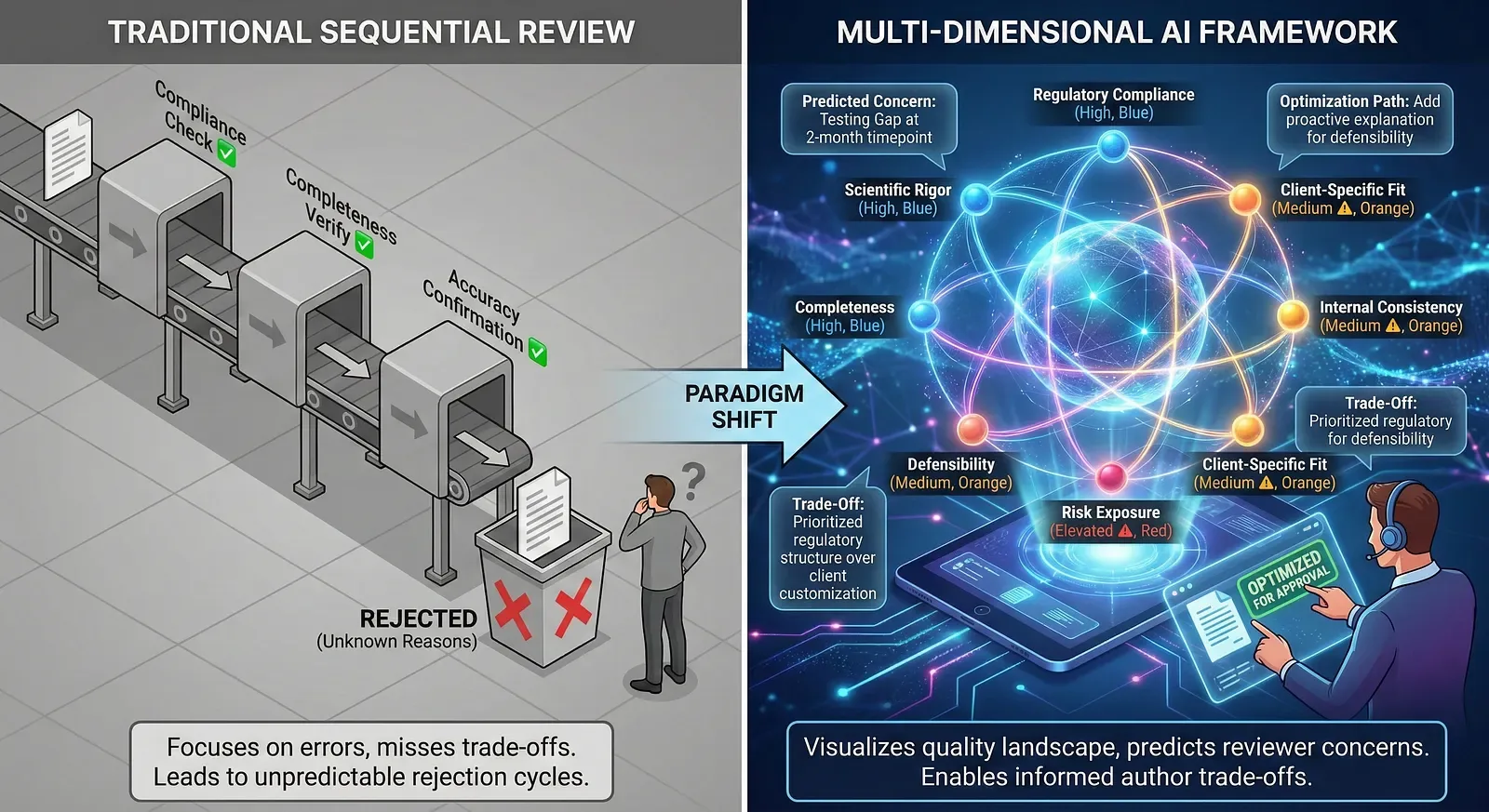
Current artificial intelligence approaches to pharmaceutical document review typically employ sequential, checklist-style analysis — verifying compliance, then completeness, then accuracy. This approach ignores the fundamentally multidimensional nature of documentation quality, in which regulatory requirements, client expectations, scientific rigor, and risk exposure interact simultaneously.
This paper proposes a framework for multi-dimensional stability report analysis that evaluates documents across eight quality dimensions in parallel, surfaces implicit trade-offs, and predicts reviewer concerns before submission. A proof-of-concept using an actual rejected stability report demonstrates that all three client objections were predictable from dimensional analysis — objections that sequential compliance checking would have missed entirely. This framework shifts the paradigm from error detection to quality landscape visualization, enabling authors to make informed trade-offs rather than discovering them through rejection cycles.
Keywords: pharmaceutical documentation, stability studies, artificial intelligence, multi-dimensional analysis, quality assurance, document review
1. Introduction
The pharmaceutical industry generates millions of pages of documentation annually — stability reports, validation protocols, regulatory submissions, and clinical study reports. Each document represents not merely compliance with requirements but a complex negotiation between competing stakeholder demands. When a contract research organization submits a stability report to a pharmaceutical sponsor, that document must simultaneously satisfy regulatory auditors who may never see it, scientific reviewers who will scrutinize every data point, and business stakeholders who measure success by approval speed and the number of revisions avoided.
Artificial intelligence is increasingly deployed to manage this documentation burden, promising efficiency gains and consistency improvements. The dominant paradigm follows a familiar pattern: AI systems check documents sequentially against requirements — first regulatory compliance, then structural completeness, then data accuracy, then formatting standards. This mirrors the chain-of-thought prompting approach that has proven effective for many AI reasoning tasks (Wei et al., 2022). The appeal is obvious: systematic verification catches errors that human reviewers miss under time pressure.
However, pharmaceutical stability reports exist in a fundamentally different problem space than the tasks for which sequential AI analysis was designed. A stability report must simultaneously satisfy regulatory bodies (ICH, FDA, EMA), meet client-specific expectations that vary dramatically by organization, maintain scientific defensibility under expert scrutiny, ensure internal consistency across dozens of tables and narrative sections, and anticipate potential challenges from reviewers with different priorities and knowledge bases. These dimensions interact in complex, often counterintuitive ways — a choice that optimizes regulatory compliance may inadvertently create gaps in client-specific expectations, while adding detail to satisfy one reviewer may introduce inconsistencies that concern another.
When AI reviews documents sequentially, it optimizes one dimension at a time, potentially de-optimizing others without recognition. The result is a familiar frustration across the pharmaceutical industry: reports that pass every automated compliance check but are still rejected for reasons invisible to linear analysis. The document was “correct” yet somehow “wrong.”
This paper proposes a fundamentally different approach. Rather than sequential verification, what if AI analyzed stability reports across multiple quality dimensions simultaneously — revealing not just errors, but the quality landscape itself? What if the system could show authors where their document sits in multi-dimensional space, what implicit trade-offs they have made, and what specific concerns reviewers are likely to raise before submission?
2. Theoretical Framework
Understanding why sequential review falls short requires examining both the nature of AI reasoning and the multi-constraint environment in which pharmaceutical documents exist. The problem is not that current AI systems lack capability — it is that we have structured their analysis in ways that fundamentally misrepresent the problem space.
2.1 The Limitations of Sequential Document Review
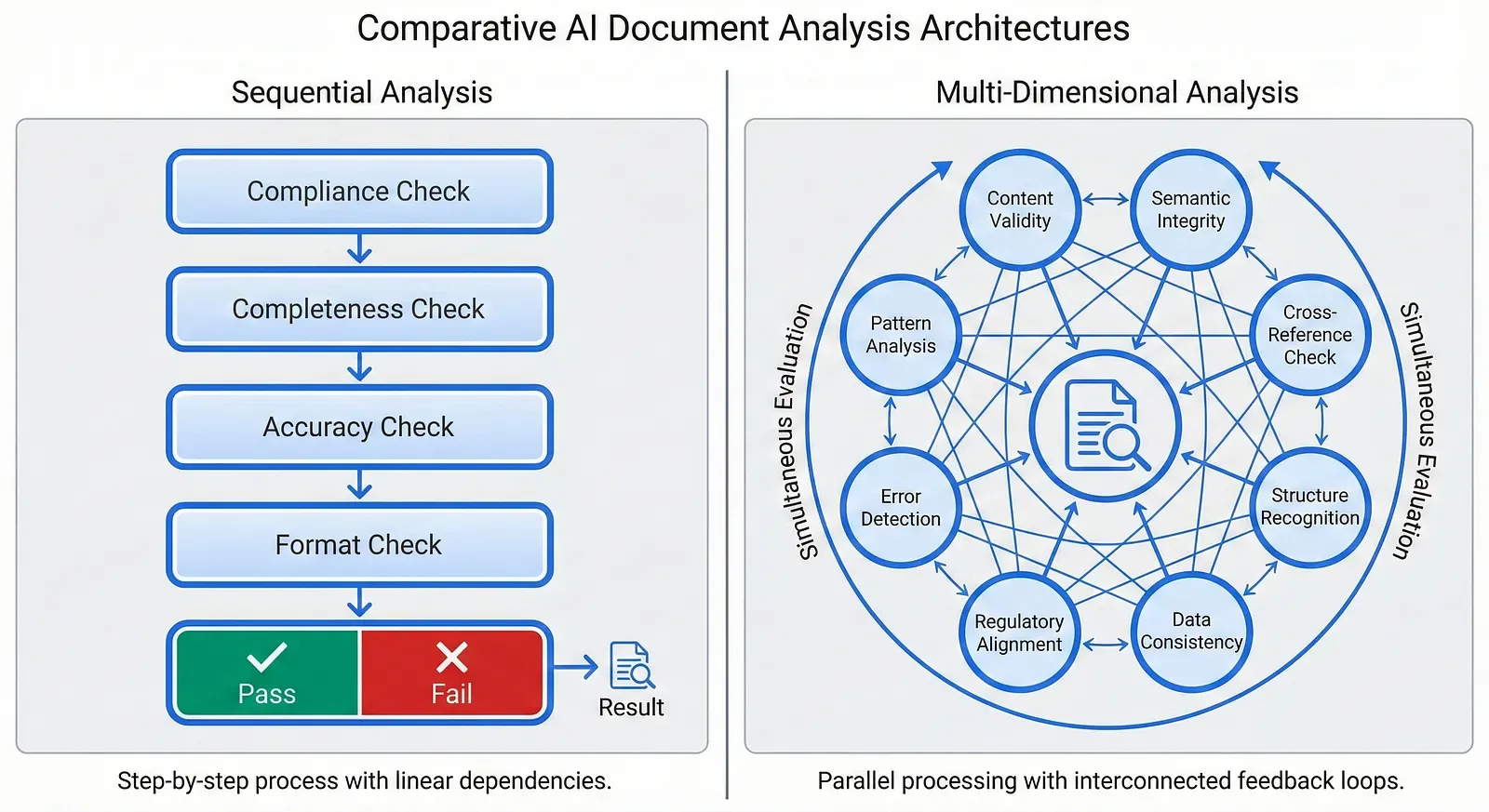
Chain-of-thought prompting revolutionized AI reasoning by making models “show their work” (Wei et al., 2022). The technique produces impressive results on mathematical problems, logical puzzles, and multi-step reasoning tasks. Yet this approach forces fundamentally parallel considerations into sequential presentation — and for pharmaceutical documentation, that sequential forcing introduces systematic blind spots.
As Smith (2026) argues, large language models operate in high-dimensional embedding spaces where concepts are represented as points in a space with hundreds or thousands of dimensions. Forcing step-by-step reasoning may collapse that dimensionality, losing solution paths that emerge only from simultaneous consideration of constraints. A model analyzing a stability report sequentially cannot easily recognize that a decision optimizing regulatory compliance in step three created a client-satisfaction gap that manifests in step seven — the sequential structure obscures these cross-dimensional interactions.
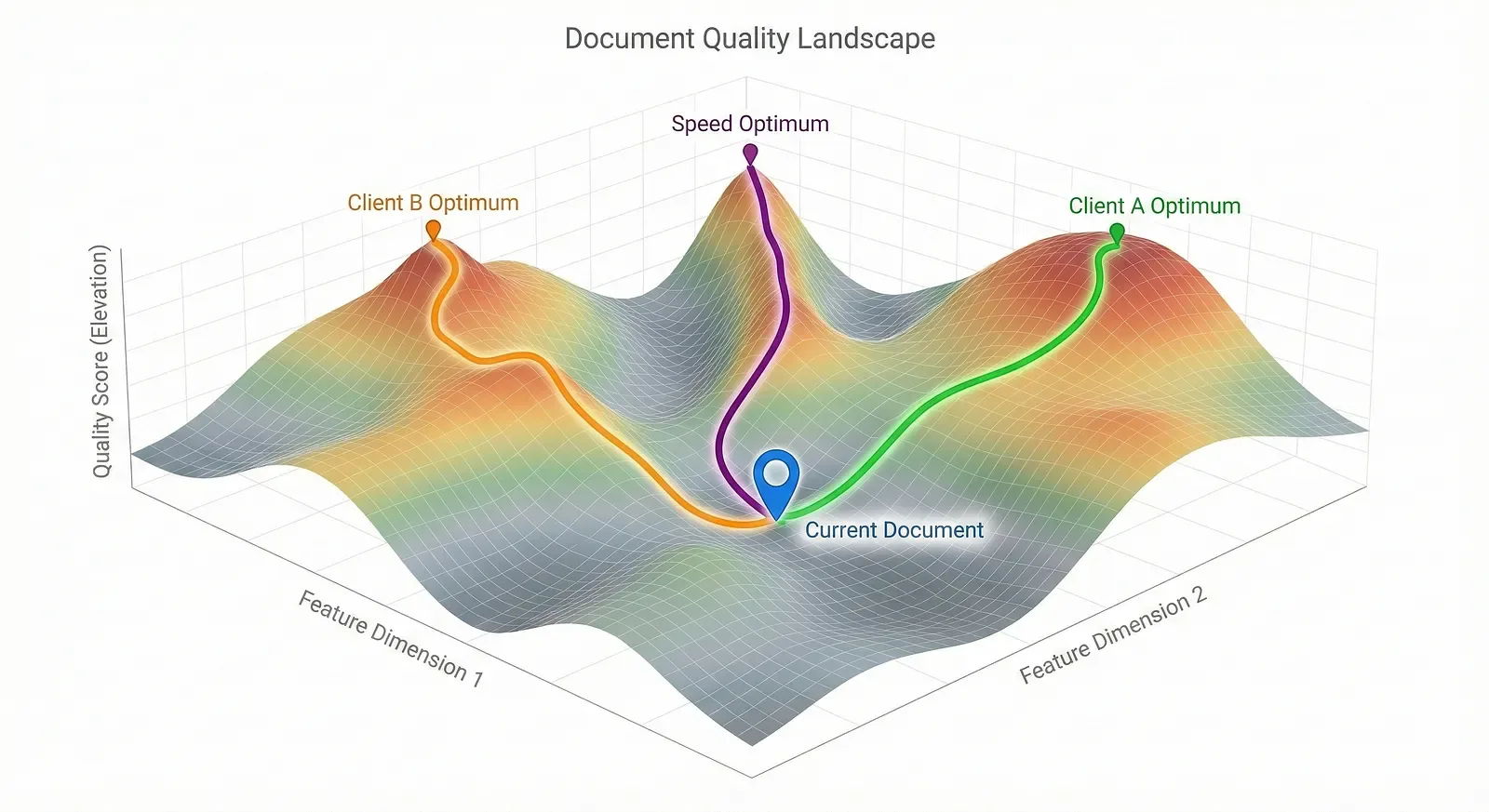
Applied to document review, sequential analysis treats quality as a series of independent checkboxes: compliance achieved, completeness verified, accuracy confirmed. But document quality is not a single score or even a collection of independent scores — it is a position in multi-dimensional space, where movement along one dimension necessarily affects positioning on others. The conceptual spaces framework from cognitive science (Gärdenfors, 2000) provides useful vocabulary here: quality dimensions form a geometric space where documents occupy specific locations, and the distance between a document’s current position and various stakeholders’ ideal positions determines acceptance or rejection.
2.2 Eight Dimensions of Stability Report Quality
Drawing on an analysis of actual reviewer feedback across multiple pharmaceutical sponsors, we propose eight core dimensions for evaluating the quality of stability reports. These dimensions emerged inductively from patterns in rejection comments, revision requests, and approval conditions:
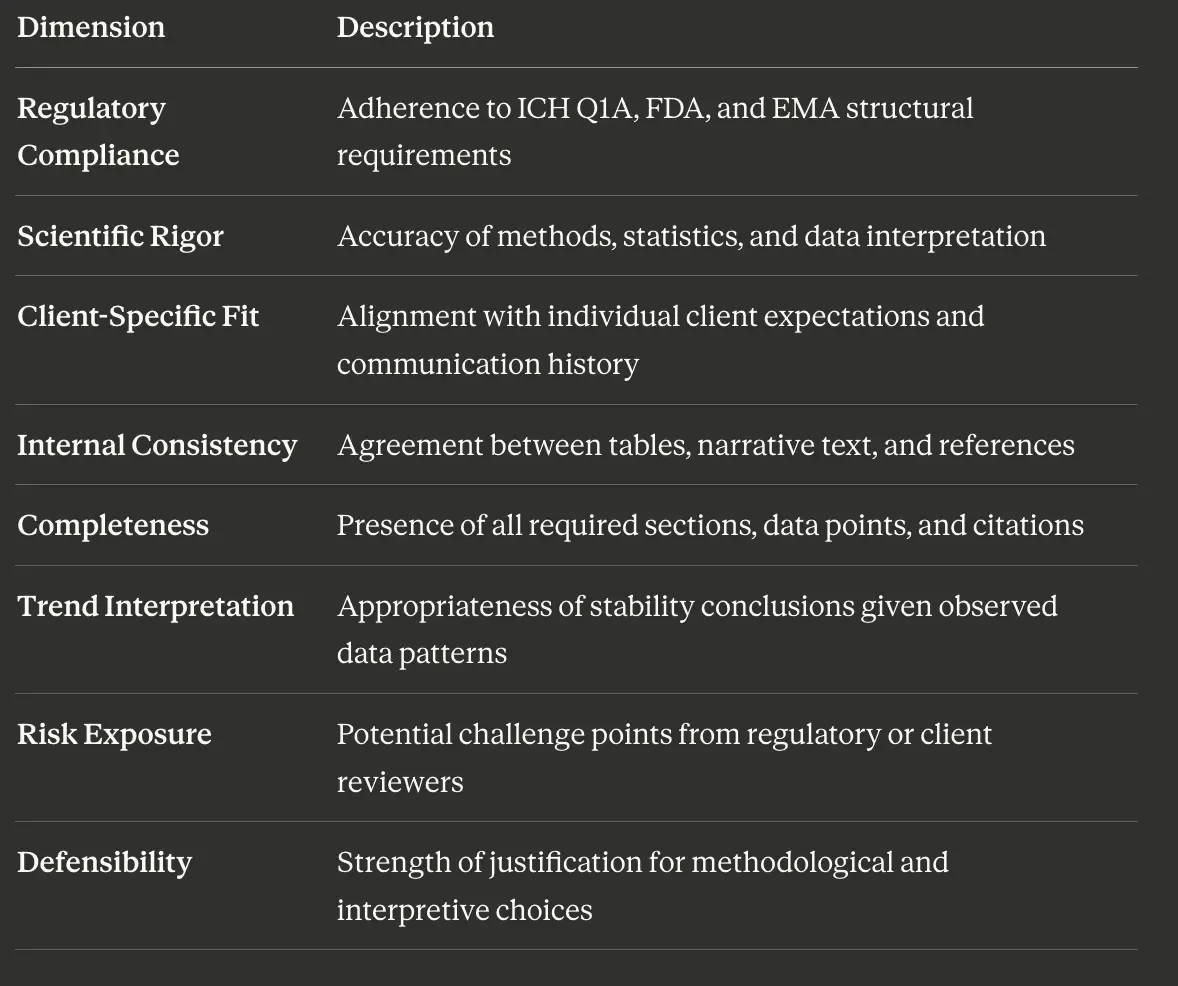
Critically, these dimensions are not independent — they form an interconnected web where changes propagate across the quality space. A gap in Completeness (e.g., missing a protocol reference explaining a testing schedule deviation) may create Risk Exposure (reviewers will question the omission), reduce Defensibility (it's harder to justify data patterns without protocol context), and lower Client-Specific Fit (the client expected that context based on previous submissions). Sequential review examines each dimension in isolation; multi-dimensional analysis captures these interaction effects that determine real-world acceptance.
2.3 Trade-Offs and Quality Landscapes
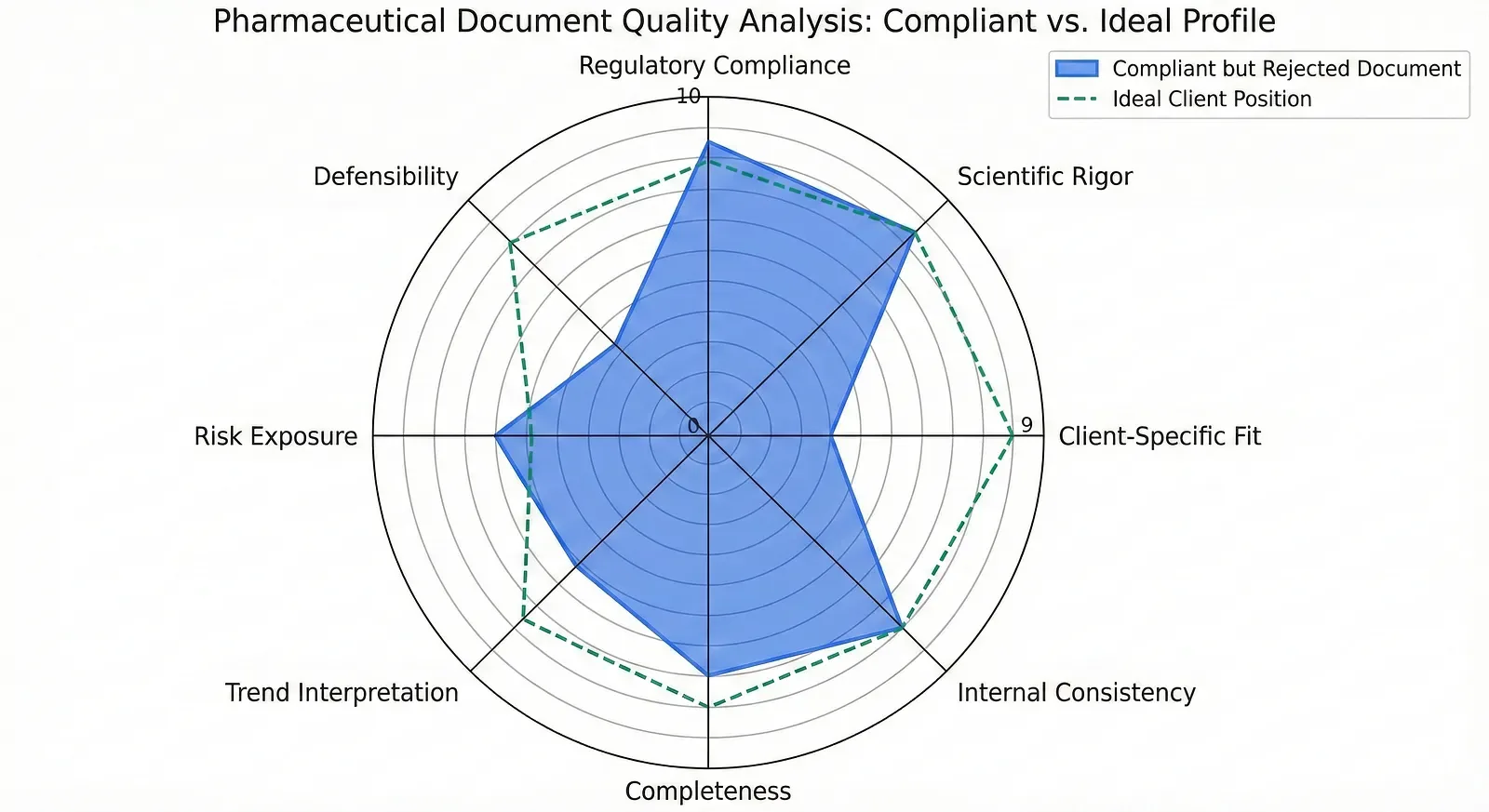
Every document author makes implicit trade-offs, whether they recognize them or not. Brevity may sacrifice completeness. Regulatory boilerplate language may reduce client-specific customization. Extensive data tables may introduce consistency risks. A detailed discussion section satisfies some clients, while others prefer concise summaries. These trade-offs are neither right nor wrong — they represent different positions on what optimization theory calls a Pareto frontier, where improving one dimension requires accepting a compromise on another (Deb, 2001).
The key insight is that there is no single “optimal” stability report. There is only the optimal report for a specific client, at a specific time, given a specific regulatory context. One sponsor may weigh scientific rigor heavily and accept longer revision cycles; another may prioritize speed and accept some documentation gaps. Multi-dimensional analysis makes these trade-offs explicit, enabling informed decisions rather than accidental compromises discovered only through rejection. The author can see their document’s position in quality space and deliberately choose which dimensions to optimize — rather than discovering through a rejection email that they optimized the wrong ones.
3. The Stability Report Analyzer Framework
Building on this theoretical foundation, we propose a practical framework that operationalizes multi-dimensional analysis for pharmaceutical stability reports. The goal is not to replace human judgment but to surface the information humans need to exercise that judgment effectively — before submission, not after rejection.
3.1 System Architecture
The proposed framework accepts a stability report along with its ecosystem of related documents: the study protocol that defines testing requirements, analytical methods that establish acceptance criteria, raw data tables that contain actual measurements, and, critically, historical communication with the specific client that reveals their expectations and priorities. This document constellation matters because stability reports do not exist in isolation — they reference protocols, cite methods, and must align with client-specific standards that vary substantially across the pharmaceutical industry.
Rather than sequential verification against a single checklist, the system evaluates all eight quality dimensions simultaneously through parallel analysis pathways. Each pathway examines the document through a different lens, but the system’s architecture allows cross-pathway communication — a finding in the regulatory compliance pathway can trigger re-evaluation in the risk exposure pathway, for example. This mirrors how experienced human reviewers actually read documents: not linearly from start to finish, but holistically, holding multiple considerations in mind simultaneously.
3.2 Output Structure
The critical innovation is what the system produces. The output is not a pass/fail determination, not an error list, not a compliance score. Instead, it presents a quality landscape showing the document’s position across all eight dimensions:
DIMENSIONAL ANALYSIS: Interim Stability Report, Drug Substance Batch 1
Quality Position:
├─ Regulatory Compliance:    HIGH   (0.92)
├─ Scientific Rigor:         HIGH   (0.88)
├─ Client-Specific Fit:      MEDIUM (0.65) ⚠️
├─ Internal Consistency:     MEDIUM (0.71) ⚠️
├─ Completeness:             HIGH   (0.85)
├─ Trend Interpretation:     HIGH   (0.82)
├─ Risk Exposure:            ELEVATED (0.58) ⚠️
└─ Defensibility:            MEDIUM (0.69)Trade-Off Profile:
- Author optimized for: Regulatory structure, Scientific accuracy
- Author under-weighted: Client-specific expectations, Preemptive explanationPredicted Reviewer Concerns:
1. Testing gap at the early timepoint will be questioned
2. Test product vs. reference standard comparability needs explanation
3. Discussion section lacks the detail expected by this clientOptimization Pathways:
- To minimize risk: Add 2-3 sentences addressing predicted concerns
- To maximize client satisfaction: Expand discussion with explicit trend interpretation
- To optimize for speed: Submit as-is, accept likely revision cycle
This output structure transforms how authors interact with quality assessment. Instead of asking “Is my document good enough?” the author can ask “Is my document optimized for this client, given my current constraints?” The same report might score excellently for one pharmaceutical sponsor who values regulatory structure and accepts sparse discussion sections, while flagging concerns for another sponsor who historically requests detailed trend interpretation. The dimensional analysis reveals why — and offers concrete pathways for optimization depending on which trade-offs the author chooses to make.
3.3 Predictive Capability
The framework’s most powerful feature emerges from combining dimensional gap analysis with client-specific historical patterns. By analyzing where the current document falls below the threshold in dimensions that a particular client has historically weighted heavily, the system can predict specific reviewer questions before they are asked.
This prediction is not generic (“reviewers may have concerns”) but concrete (“this client’s lead reviewer questioned unexplained testing gaps in two of the last three submissions; your document has an unexplained n/a at the 2-month timepoint”). The shift from reactive error-catching to proactive risk identification changes the entire workflow: authors address concerns before submission rather than discovering them in rejection emails, reducing revision cycles and improving client relationships. The AI becomes a collaborator in quality rather than a gatekeeper announcing failures.
4. Proof of Concept
Theory is compelling; validation is essential. To test whether multidimensional analysis actually predicts reviewer concerns about sequential review misses, we applied the framework retrospectively to an actual rejected stability report, using documented client feedback as ground truth for comparison.
4.1 Case Study: Rejected Interim Stability Report
The test case involved an interim stability report from a contract research organization documenting 36-month stability data for a biologic drug substance under accelerated and long-term storage conditions. The document followed standard ICH Q1A structure, included all required data tables, and presented stability-indicating assay results within specification. By every conventional compliance metric, the report was ready for submission.
The pharmaceutical sponsor rejected it within 48 hours, with three specific comments. Each comment represented not a compliance failure but a gap between what the document provided and what this particular reviewer expected. The question: could multi-dimensional analysis have predicted these specific concerns before submission?
4.2 Multi-Dimensional Analysis Results
Applied retrospectively, the framework evaluated the rejected report across all eight dimensions using the sponsor’s historical feedback patterns as calibration data. While Regulatory Compliance (0.92) and Scientific Rigor (0.88) scored high — confirming the document’s technical correctness — three dimensions flagged concerns:
Client-Specific Fit (0.65): Historical analysis of this sponsor’s previous feedback revealed a consistent pattern of requesting detailed trend discussion in stability reports. The rejected report’s discussion section was technically adequate but brief, failing to provide the extended interpretation this client expected based on their communication history.
Internal Consistency (0.71): The data tables showed “n/a” at the 2-month timepoint, followed by results at 3 months. While the protocol justified this testing schedule, the narrative text did not. An experienced reviewer — or a multi-dimensional AI — would flag this as a potential question point.
Defensibility (0.69): The test product results showed slight deviations from the reference standard values but remained within specification. The report presented these as acceptable without a proactive explanation. Given this sponsor’s history of questioning comparability, the gap in preemptive justification created predictable risk.
4.3 Predicted Versus Actual Feedback
The framework generated specific predicted concerns based on dimensional gaps. Comparison with actual reviewer comments reveals striking alignment:
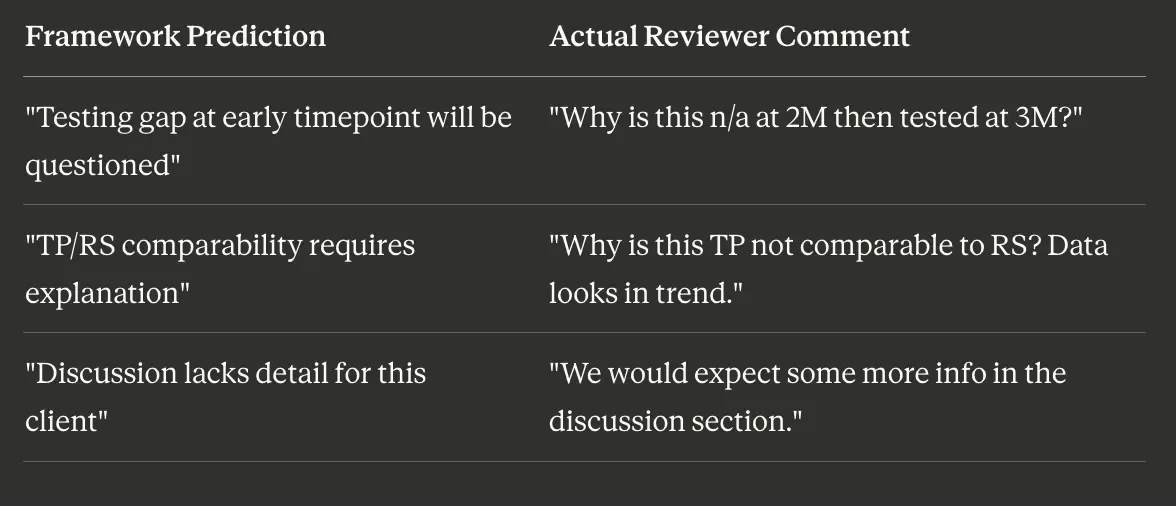
All three rejection points were predictable from dimensional analysis. The framework did not identify differentconcerns than the reviewers raised — it identified the same concerns, in advance. Critically, the report was technically compliant and scientifically sound. Sequential compliance checking would have approved it. The rejections stemmed entirely from client-specific expectations and risk exposure dimensions that a linear, checklist-based review structurally ignores.
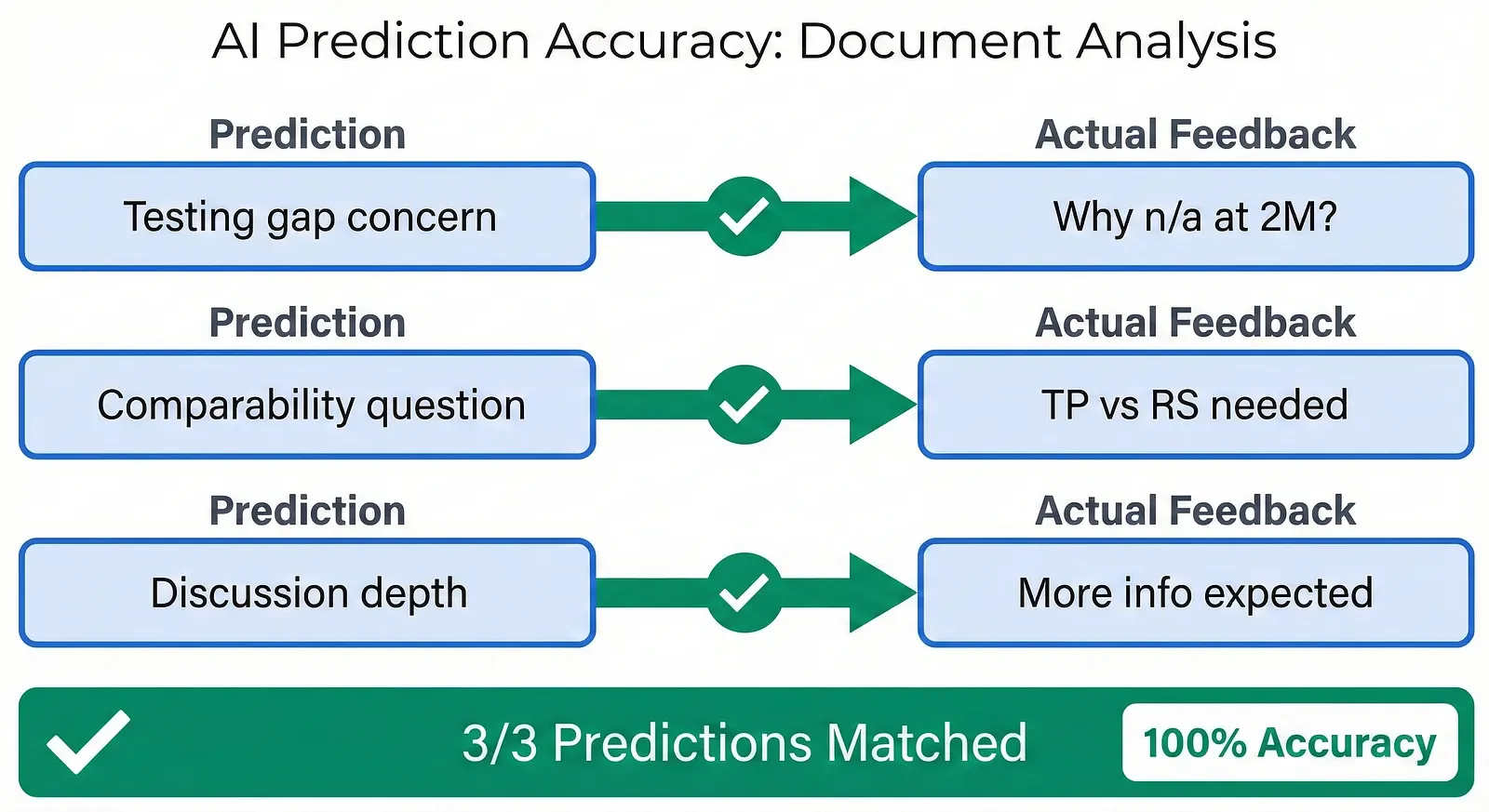
This result validates the core hypothesis: multi-dimensional analysis surfaces the quality considerations that actually determine acceptance or rejection, not just the compliance factors that traditional review systems check.
5. Discussion
The proof-of-concept results suggest broader implications for how the pharmaceutical industry approaches document quality assurance — and perhaps for how we deploy AI systems in professional contexts more generally.
5.1 Implications for Pharmaceutical Documentation
This framework represents a paradigm shift from “AI as compliance checker” to “AI as quality landscape navigator.” The fundamental question changes. Rather than asking “Does this document have errors?” the system asks “Where does this document sit in multi-dimensional quality space, and what trade-offs did the author implicitly make?”
This distinction matters enormously in practice. A document can be compliant yet rejected — the proof-of-concept demonstrates exactly this scenario. A report can be complete yet unconvincing, scientifically rigorous yet client-inappropriate, defensible yet risky. Sequential review catches compliance failures; multi-dimensional analysis reveals the quality landscape that actually determines acceptance or rejection.
The practical benefits compound over time. Each submission generates feedback that calibrates the dimensional model for that specific client. The system learns that Client A prioritizes brief reports while Client B expects extensive discussion, that Client C rarely questions testing gaps, while Client D scrutinizes every n/a. This institutional memory, encoded in dimensional weights, enables increasingly precise prediction of reviewer concerns — and increasingly efficient authorship as writers learn to optimize for specific clients before submission rather than through revision cycles.
5.2 Limitations and Future Work
The framework’s reliance on historical data creates a cold-start problem: new clients lack the historical feedback needed to calibrate client-specific dimensions. Until several submissions generate reviewer feedback, predictions for new clients rely on industry-average dimensional weights rather than client-specific calibration. Mitigating this limitation might involve clustering clients by industry segment, regulatory jurisdiction, or organizational characteristics to enable transfer learning from similar clients.
Dimensional weights likely vary by document type. The eight dimensions proposed here emerged from stability report feedback patterns; validation protocols, clinical study reports, and regulatory submissions may require different dimensional decompositions. Future work should examine whether a universal dimensional framework applies across document types or whether specialized frameworks for each category yield better predictive performance.
Perhaps most critically, validation across a larger corpus is needed to establish statistical reliability. The proof-of-concept demonstrates that multi-dimensional analysis can predict reviewer concerns — but single-case validation cannot establish how often it predicts them accurately, or what false-positive rates to expect. Prospective validation, where the framework predicts concerns before submission and predictions are evaluated against actual feedback, would provide the strongest evidence for practical deployment.
5.3 Broader Applications
While developed for pharmaceutical stability reports, the conceptual framework generalizes to any documentation existing in a multi-constraint environment where competing stakeholder expectations create quality trade-offs invisible to sequential review.
Regulatory submissions must satisfy reviewers at multiple agencies with different priorities. Clinical study reports serve sponsors, regulators, ethics committees, and sometimes publication venues with divergent expectations. Validation protocols must align with manufacturing, quality assurance, and regulatory functions that often disagree on documentation depth. In each case, the fundamental insight holds: document quality is not a checklist score but a position in a multidimensional space, where understanding trade-offs enables optimization for specific contexts rather than generic compliance.
Beyond pharmaceuticals, the approach may apply to legal contracts (multiple parties with conflicting interests), academic publications (authors, reviewers, editors, readers), or any professional documentation where “correct” varies by audience. The shift from checklist to landscape represents not just a technical improvement but a philosophical reorientation toward quality as contextual optimization rather than absolute verification.
6. Conclusion
Sequential AI document review, despite its prevalence across the pharmaceutical industry, fails to capture the fundamentally multidimensional nature of documentation quality. The approach made sense when AI capabilities were limited to pattern matching against explicit rules — but modern systems can do more. They can understand context, recognize patterns across documents, and predict human concerns. We should ask them to.
The proposed framework analyzes stability reports across eight simultaneous dimensions, surfaces implicit author trade-offs, and predicts reviewer concerns before submission. Rather than producing pass/fail verdicts or error lists, it presents a quality landscape: where does this document sit in multi-dimensional space, what positions did the author implicitly choose, and what concerns will specific reviewers likely raise?
The proof-of-concept demonstrates that this approach works. All three rejection comments on an actual stability report were predictable from dimensional analysis — comments that sequential compliance checking missed entirely because the report was technically compliant. The rejections stemmed from client-specific expectations and risk exposure, dimensions that a checklist review cannot capture. This validates the core premise: document quality is a landscape, not a checklist.
For pharmaceutical organizations, this framework offers a path beyond the rejection-revision cycle that costs time, damages client relationships, and frustrates authors who did everything “right” only to discover they optimized the wrong dimensions. By visualizing quality trade-offs before submission, authors can make informed decisions aligned with specific client expectations. They can choose to optimize for speed and accept the risk of revisions, or invest additional effort in the dimensions that matter most to this particular reviewer.
The AI becomes not a gatekeeper but a navigator, helping humans understand the terrain before they commit to a path. This collaborative relationship — human judgment informed by AI-generated landscape visualization — may represent the most productive integration of artificial intelligence into professional documentation work: not replacing human expertise, but surfacing the information humans need to apply that expertise effectively.
References
Deb, K. (2001). Multi-objective optimization using evolutionary algorithms. John Wiley & Sons.
European Medicines Agency. (2003). ICH Q1A(R2): Stability testing of new drug substances and products. https://www.ema.europa.eu/en/ich-q1a-r2-stability-testing-new-drug-substances-drug-products
Food and Drug Administration. (2003). Guidance for industry: Q1A(R2) stability testing of new drug substances and products. U.S. Department of Health and Human Services.
Gärdenfors, P. (2000). Conceptual spaces: The geometry of thought. MIT Press.
Smith, J. A. (2026). Your AI might be thinking in 17 dimensions. You’re only using 2. Medium. https://medium.com/@jsmith0475/your-ai-might-be-thinking-in-17-dimensions-youre-only-using-2-1a2a56131a1b
Wei, J., Wang, X., Schuurmans, D., Bosma, M., Ichter, B., Xia, F., Chi, E., Le, Q. V., & Zhou, D. (2022). Chain-of-thought prompting elicits reasoning in large language models. Advances in Neural Information Processing Systems, 35, 24824–24837.
Yao, S., Yu, D., Zhao, J., Shafran, I., Griffiths, T. L., Cao, Y., & Narasimhan, K. (2024). Tree of thoughts: Deliberate problem solving with large language models. Advances in Neural Information Processing Systems, 36.