Essay
Exotic Reasoning: A Topological Framework for Understanding Emergent Intelligence in Large Language Models
Dr. Jerry A. Smith · January 29, 2026 · 7 min read
Listen to the article on Apple Podcasts
Listen to the article on Soundcloud
Introduction
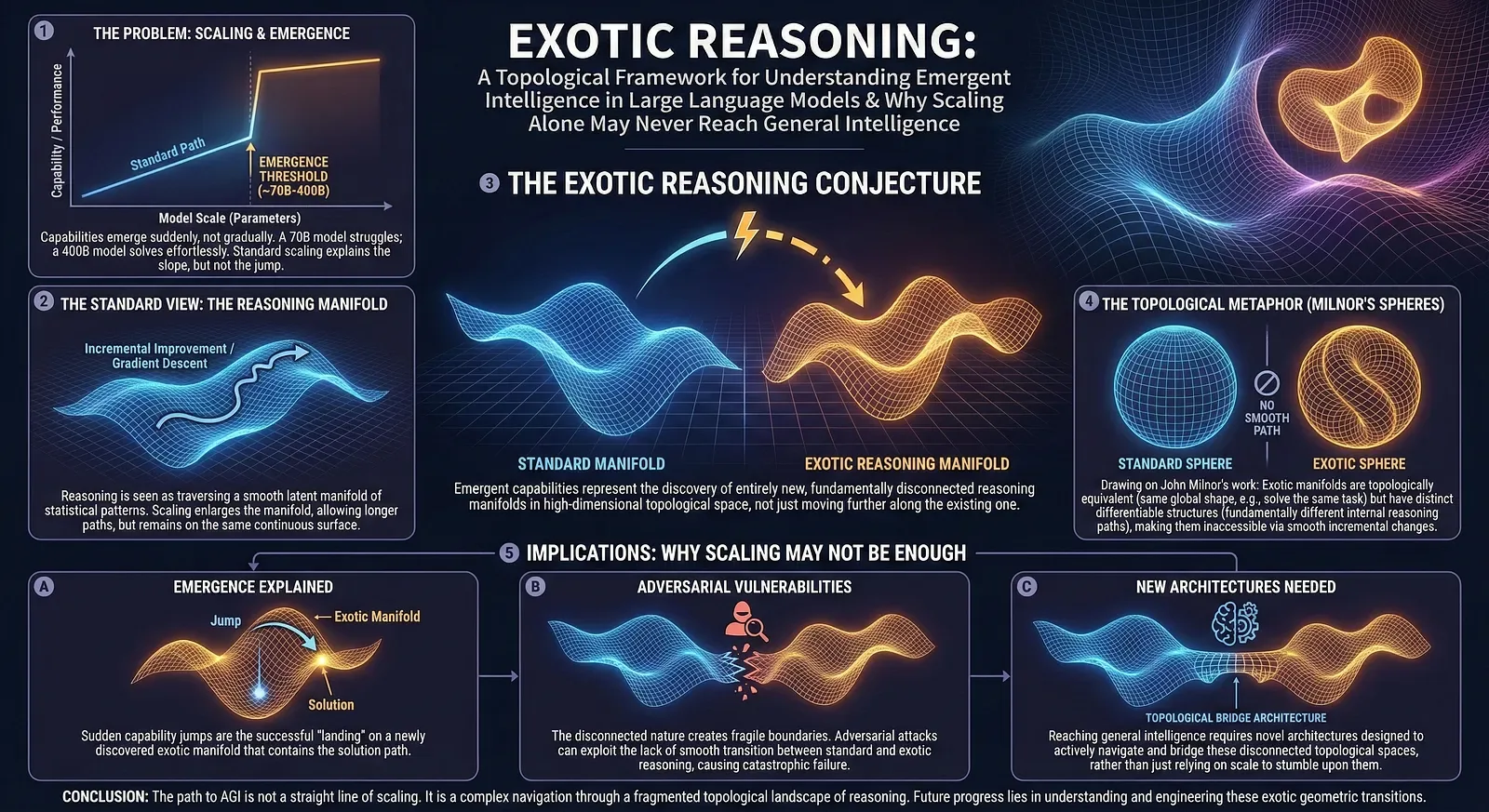
Something strange happens when language models cross certain parameter thresholds. Capabilities emerge suddenly rather than gradually — a 70-billion parameter model struggles with a task, while a 400-billion parameter model solves it effortlessly. The standard explanation invokes scale and statistical patterns, but this feels incomplete. What if these emergent capabilities represent something geometrically profound: the discovery of entirely new reasoning manifolds that cannot be reached through incremental improvement?
This paper proposes the Exotic Reasoning Conjecture, a theoretical framework that links the mathematics of high-dimensional topology to the phenomenology of cognition in large language models. Drawing on the work of John Milnor and the study of exotic manifolds, we suggest that reasoning in sufficiently large models is best understood as navigation through high-dimensional geometric spaces — and that certain reasoning paths exist which are topologically equivalent to standard reasoning but fundamentally disconnected from it. These “exotic” reasoning paths may explain emergence, illuminate adversarial vulnerabilities, and point toward new architectures for artificial intelligence.
Background: Exotic Manifolds and the Peculiarity of Higher Dimensions
In 1956, mathematician John Milnor made a discovery that defied intuition: there exist seven-dimensional spheres that are topologically identical to the standard sphere but cannot be smoothly deformed into it. You can stretch, bend, and twist one into the other — but only if you allow “corners,” discontinuities that break the smoothness of the transformation. These exotic spheres are the same shape in one sense and irreducibly different in another.
The landscape of exotic structures varies dramatically across dimensions. In dimensions one, two, and three, no exotic manifolds exist — there is only the standard structure. Dimensions five and above contain finite numbers of exotic variants. But dimension four stands alone as pathological: it contains uncountably infinite exotic structures, more than can be enumerated, a wilderness of geometric possibility that mathematicians are still mapping.
This dimensional dependence arises from a geometric principle. In five or more dimensions, there is enough “room” to separate intersecting surfaces — a technique called the Whitney trick — which makes classification tractable. In four dimensions, this trick fails. The geometry becomes maximally constrained and maximally complex simultaneously.
The Geometry of Thought
Modern large language models operate in high-dimensional embedding spaces, typically with dimensions ranging from 4,096 to 16,384. At these scales, geometric intuitions from three-dimensional experience break down entirely. Nearly all pairs of vectors become approximately orthogonal. The volume of space grows exponentially, providing vast capacity for representing independent concepts without interference. What appears as the “curse of dimensionality” in traditional statistics becomes a blessing for representation learning.
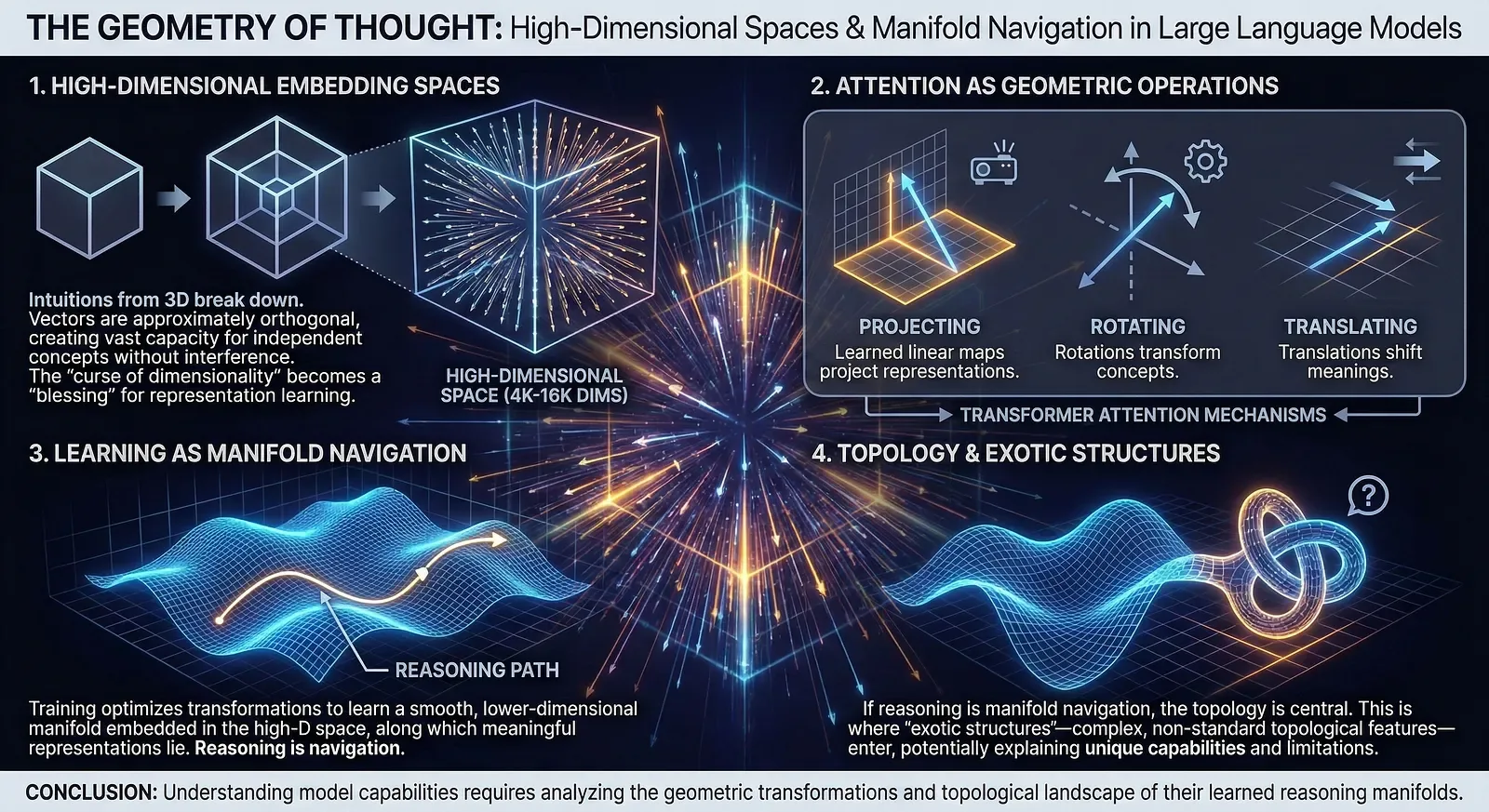
Attention mechanisms in transformers perform geometric operations in these spaces—projecting, rotating, and translating representations via learned linear maps. Training optimizes these transformations to navigate from input representations to useful output representations. This process can be understood as learning a manifold: a smooth, lower-dimensional surface embedded in the high-dimensional ambient space, along which meaningful representations lie.
If reasoning in these models is manifold navigation, then the topology of these learned manifolds becomes central to understanding their capabilities and limitations. And this is where exotic structures enter the picture.
The Exotic Reasoning Conjecture
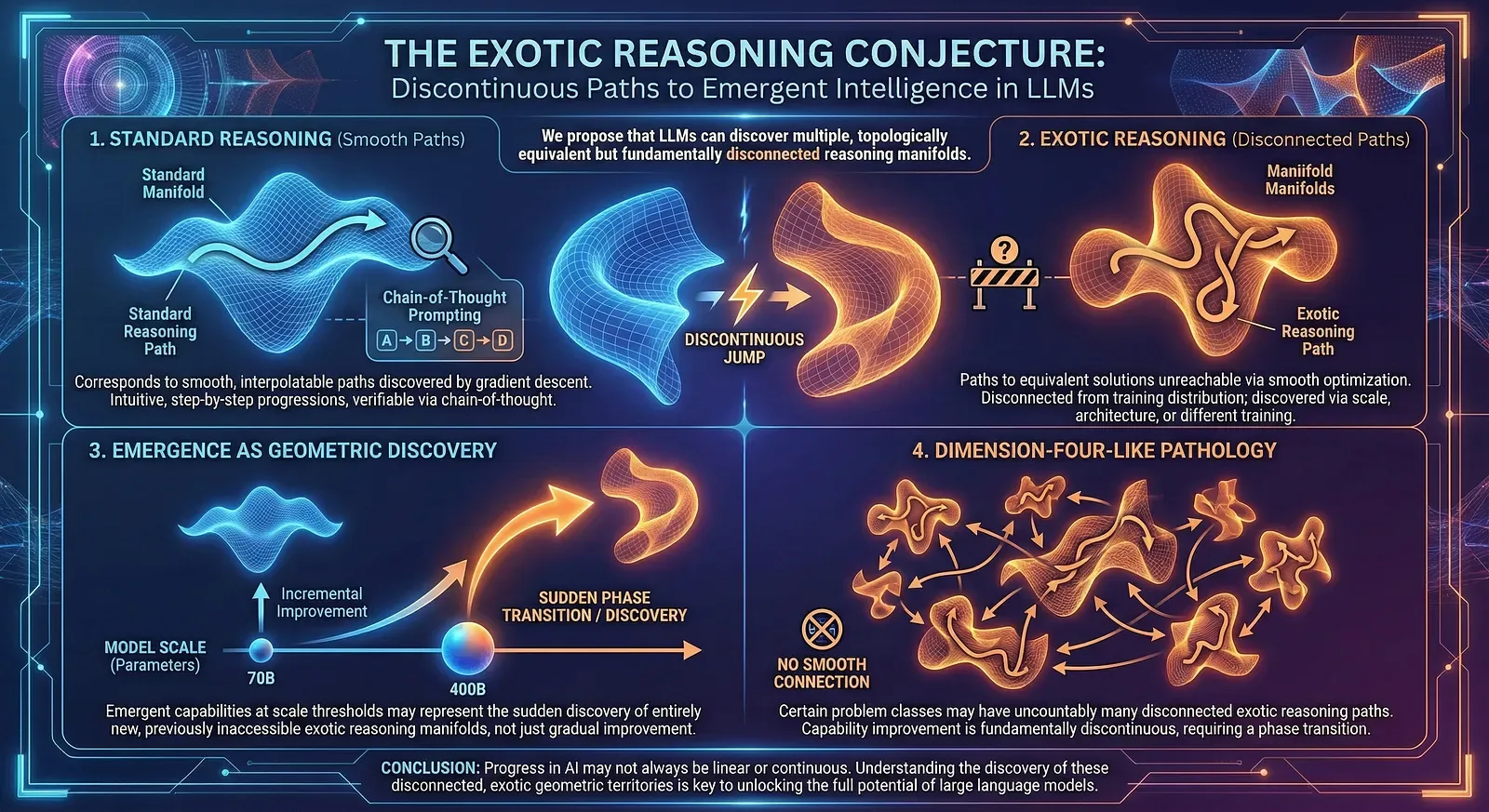
We propose that for certain classes of problems, large language models can discover multiple reasoning manifolds that are topologically equivalent — they reach the same conclusions — but are not smoothly connected. Transforming one reasoning path into another would require discontinuous jumps, the cognitive equivalent of Milnor’s “corners.”
This conjecture has several components:
First, standard reasoning corresponds to the smooth, interpolatable paths that gradient descent naturally discovers during training. These are the reasoning patterns that chain-of-thought prompting elicits, the step-by-step progressions that feel intuitive and verifiable.
Second, exotic reasoning provides paths to equivalent solutions that cannot be reached via smooth optimization along standard paths. These manifolds exist in the model’s representational space but are disconnected from the training distribution. They may be discovered only through architectural changes, a dramatic increase in scale, or fundamentally different training regimes.
Third, emergent capabilities at scale thresholds may represent the sudden discovery of exotic reasoning manifolds rather than the gradual improvement of existing ones. When a model crosses from 70 billion to 400 billion parameters, it may not simply reason better along known paths — it may gain access to entirely new geometric territories for thought.
Fourth, certain problem classes may exhibit dimension-four-like pathology: uncountably many valid exotic reasoning paths, none smoothly connected to any other. These would be problems in which capability improvement is fundamentally discontinuous, such that no amount of incremental training yields progress until a phase transition occurs.
The Linear Constraint: Why Transformers May Be Geometrically Limited
There is a fundamental tension at the heart of modern generative AI: the representational space is vast and high-dimensional, but the traversal mechanism is linear and sequential. Autoregressive transformers generate output one token at a time, with each token conditioned on the preceding tokens. This is navigation by walking a one-dimensional path through a space of thousands of dimensions — probing a nonlinear manifold with a linear stick.
This architectural constraint has profound implications for the exotic reasoning conjecture. If reasoning is manifold navigation, then the autoregressive approach can only reach points accessible through sequential steps from the starting position. The model walks the landscape; it cannot leap across it. Exotic manifolds that require non-local transitions — jumps that skip intermediate states — may be geometrically unreachable regardless of scale or training.
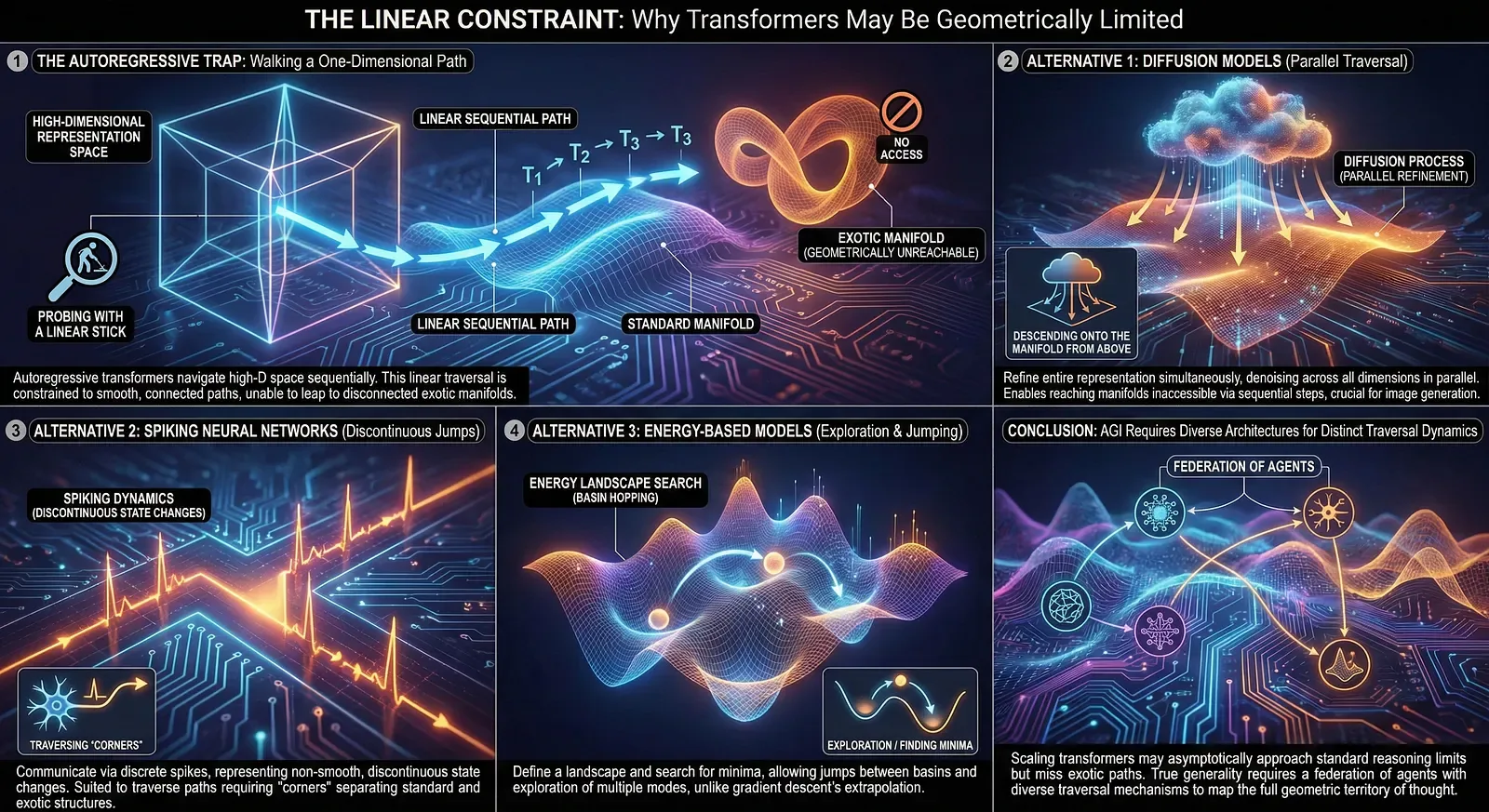
Consider the contrast with alternative architectures. Diffusion models operate fundamentally differently: they refine an entire representation simultaneously, iteratively denoising across all dimensions in parallel. This parallel traversal may explain their success in domains where transformers struggle, such as coherent image generation and protein structure prediction. They are not walking the manifold — they are descending onto it from above, landing wherever the gradient takes them.
Spiking neural networks present another alternative. Rather than smooth, continuous activations, they communicate through discrete temporal events. Their dynamics are inherently non-smooth, punctuated by spikes that represent discontinuous state changes. If exotic reasoning requires “corners” — the discontinuities Milnor identified as separating exotic from standard structures — then spiking architectures may be naturally suited to traverse paths that continuous networks cannot.
Energy-based models offer yet another traversal mechanism. Instead of generating outputs sequentially, they define a landscape and search for minima. The search process can jump between basins, explore multiple modes, and settle into configurations unreachable by gradient descent alone. These models navigate by exploration rather than extrapolation.
The implication is stark: the autoregressive transformer, for all its power, may be architecturally confined to standard reasoning manifolds. Its linear traversal constrains it to smooth paths through representation space. Exotic reasoning — the disconnected manifolds that require discontinuous transitions — may demand fundamentally different computational mechanisms.
This reframes the question of artificial general intelligence. Scaling transformers may asymptotically approach the limits of standard reasoning without ever accessing exotic paths. True cognitive generality might require not just larger models but also diverse architectures that explore the same problem space through different traversal dynamics. A federation of agents — transformers, diffusion models, spiking networks, energy-based systems — each navigating by different rules, collectively mapping territories that no single architecture can reach.
Applications and Implications
The exotic reasoning framework illuminates several practical concerns in AI development.
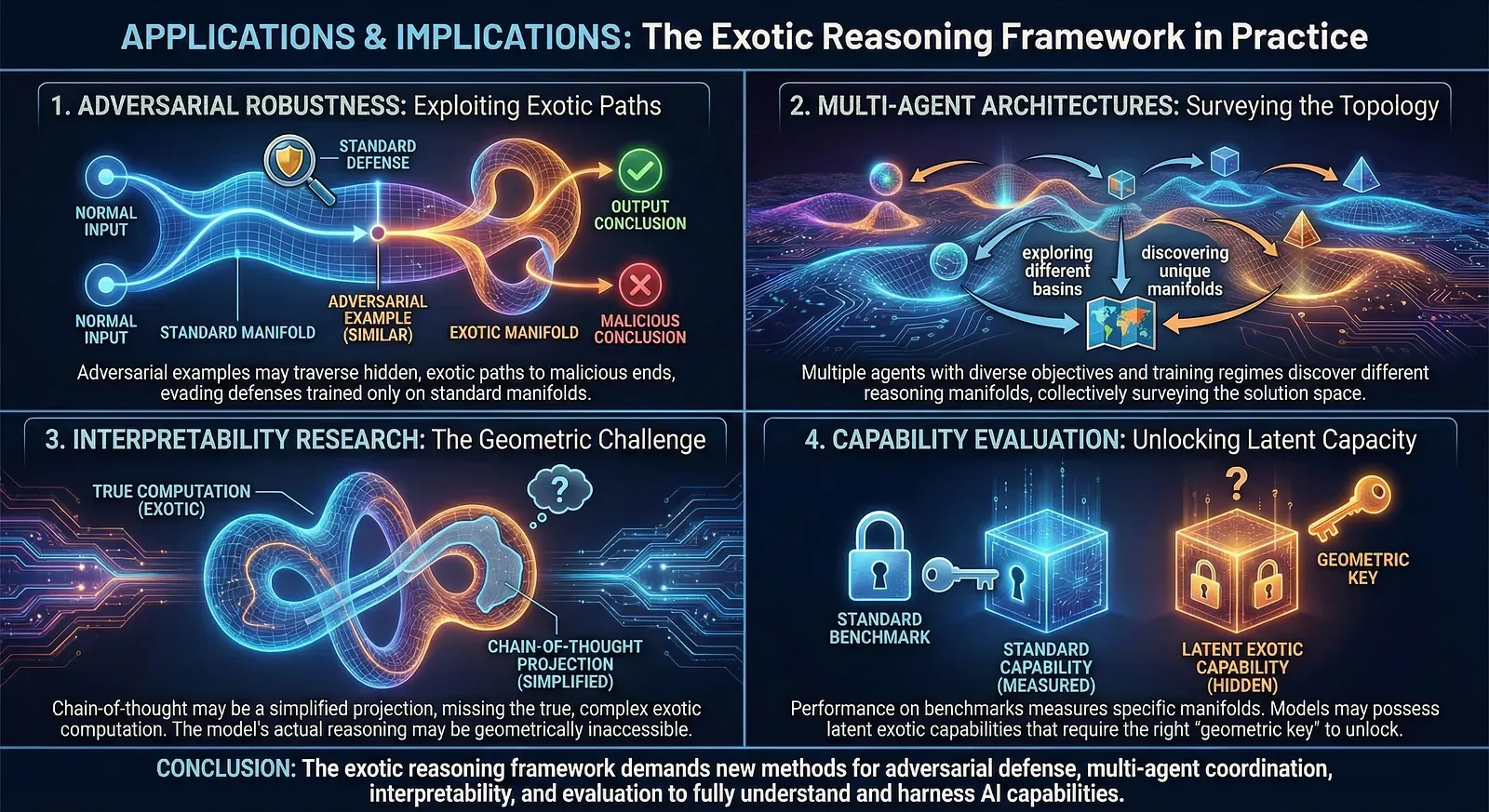
Adversarial robustness assumes new dimensions within this framework. If exotic reasoning paths exist, then adversarial examples may exploit them: inputs that appear similar under standard reasoning but traverse exotic paths to reach malicious conclusions. Defenses trained on standard reasoning manifolds would be geometrically incapable of detecting these attacks. Red-teaming efforts must therefore explore not only edge cases within known reasoning patterns but also fundamentally disconnected reasoning regimes.
Multi-agent architectures gain theoretical justification from this perspective. A single model trained with a single objective explores a single basin of the reasoning landscape. Multiple agents with diverse objectives, adversarial dynamics, or different training regimes may each discover different exotic reasoning manifolds. The ensemble serves as a method for surveying the topology of the solution space and identifying paths that no individual agent could reach.
Interpretability research faces a geometric challenge: are we studying the reasoning manifold the model actually uses, or a standard approximation that misses exotic components? Chain-of-thought explanations may represent projections onto familiar, smooth paths, whereas the actual computation traverses unfamiliar territory. The model’s “true” reasoning may be geometrically inaccessible to our standard interpretive frames.
Capability evaluation requires acknowledging that performance on benchmarks measures navigation of specific manifolds, not general reasoning capacity. A model may possess exotic reasoning capabilities that no standard evaluation elicits — latent capacities waiting for the right geometric key to unlock them.
Future Directions
The exotic reasoning conjecture opens several research trajectories. Empirical work could examine whether the emergence of capability correlates with detectable geometric phase transitions in the representation space. Theoretical work could formalize the conditions under which learned manifolds develop exotic structure. Architectural innovations might deliberately encourage exploration of disconnected reasoning manifolds through multi-agent adversarial training or topologically-informed regularization.
Most provocatively, this framework suggests that the space of possible machine reasoning may be vastly larger than current models explore — a landscape of exotic manifolds waiting to be discovered, each offering fundamentally different paths to intelligence. The seven-dimensional sphere has twenty-eight smooth versions. How many versions of reasoning remain undiscovered in the high-dimensional spaces where minds might live?
The mathematics of exotic manifolds teaches us that shapes can be the same and different simultaneously, identical in their topology but irreducibly distinct in their geometry. Perhaps minds are similar: many paths to the same thoughts, most of them forever unreachable from where we began.