Building Minds
Constitutional Frameworks in AI: Why Ethics Isn't a Prompt Engineering Problem
Dr. Jerry A. Smith · April 1, 2026 · 6 min read
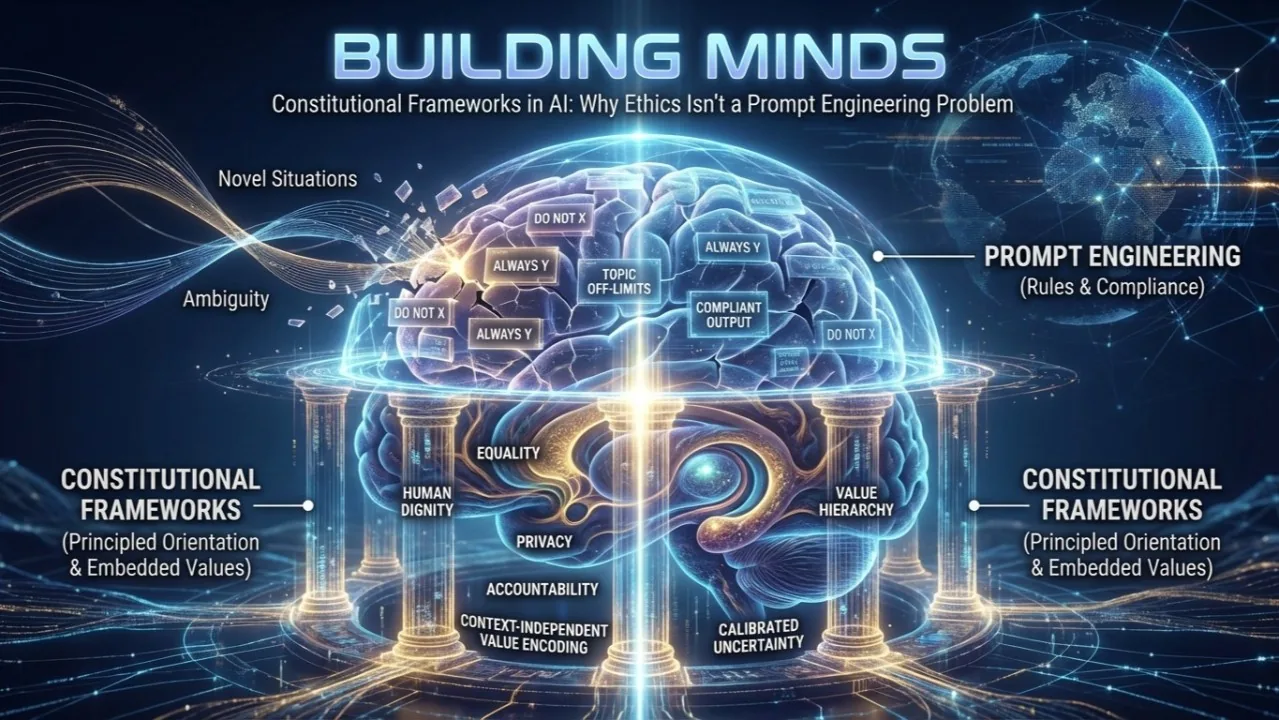
By Dr. Jerry A. Smith | April 2026
The Mistake Everyone Is Making
Most conversations about AI ethics start in the wrong place.
They start with rules — what the model should say, what it shouldn't say, what topics are off-limits. This is prompt engineering dressed up as ethics. It produces compliant output, not principled behavior. And it fails the moment the model encounters a situation that the rules didn't anticipate.
Real ethical frameworks don't work that way. And the human brain tells us exactly why.
Morals vs. Ethics — The Distinction That Changes Everything
These words get used interchangeably. They are not the same thing.
Morals are personal. They are the product of upbringing, culture, lived experience, and intuition. They are local, contextual, and variable across individuals and societies. What feels wrong to you may feel neutral to me — not because either of us is broken, but because our moral formation happened in different contexts.
Ethics is the attempt to reason beyond context. It asks: what principles hold across situations, cultures, and edge cases? Ethics doesn't ask "what do I feel is right?" It asks, "What can be justified to anyone affected by this decision, regardless of where they stand?"
The distinction matters enormously for AI.
A model trained on moral intuitions — even majority moral intuitions — is not ethical. It is a popularity contest. Majority moral intuitions have been wrong before, consistently, historically. An ethical framework must hold even when the context shifts. That requires something more fundamental than crowdsourced preference.
The Neuroscience of Why Injection Points Matter
Here is what the prompt-engineering approach to AI ethics gets fundamentally wrong: it treats ethics as a prefrontal cortex problem.
In human cognition, the prefrontal cortex handles deliberate, rational, rule-following thought. When you consciously apply a rule — "I shouldn't say this" — that's prefrontal processing. It is slow, effortful, and context-dependent. It works when you are paying attention. It breaks down under pressure, novelty, and ambiguity.
But human ethical behavior does not primarily originate in the prefrontal cortex.
It emerges from deeper, older structures. The amygdala processes threat and aversion. The anterior insula underlies empathy and the sense of wrongness. The ventromedial prefrontal cortex handles value-based decision-making at a pre-rational level — below conscious deliberation. These systems don't apply rules. They pattern-match against deeply embedded orientations toward harm, fairness, care, and reciprocity.
When you encounter a situation that feels wrong before you can explain why, that sensation is not noise. That is the older ethical architecture doing its job. The prefrontal cortex arrives later to articulate and justify what the deeper system has already detected.
When you inject ethics into an AI system purely at the instruction level — "do not do X, always do Y" — you are building a prefrontal cortex-only system. Rules applied consciously, on top of a value-neutral substrate. The underlying model has no orientation toward harm or fairness. It has instructions about them.
This is why systems trained this way fail in novel situations. There is no embedded compass. There is only a rule list that does not cover the case at hand.
What Constitutional AI Actually Requires
Kenya's AI Bill 2026 — one of the most carefully constructed national AI governance frameworks to date — makes this architectural logic explicit. Its stated purpose is not merely to regulate AI outputs. It is to "ensure compliance with the Constitution, in particular Chapter Six and the Bill of Rights." The Bill roots AI governance in constitutional principles that predate any specific deployment context: human dignity, equality, accountability, and the right to privacy, as encoded in Articles 10, 27, and 31 of Kenya's constitution.
The Bill goes further. It requires that high-risk AI systems support human centricity — "designed to support human involvement and enhance human capabilities rather than replace them." It mandates human rights impact assessments before deployment, not after. It classifies systems by risk level and applies corresponding constraints. This is not a rule list. It is a value hierarchy encoded into law.
Other national frameworks are doing something more sophisticated than most people realize. They are not just writing rules.
They are attempting to define the architecture in which AI judgment is formed — before a specific context applies.
Recommended by LinkedIn
[ When ethics is not enough
Mark Jennings-Bates
When ethics is not enough
Mark Jennings-Bates
3 months ago](https://www.linkedin.com/pulse/when-ethics-enough-mark-jennings-bates-iqk0c)
[ AI leadership needs practical wisdom
David Knott
AI leadership needs practical wisdom
David Knott
1 month ago](https://www.linkedin.com/pulse/ai-leadership-needs-practical-wisdom-david-knott-wl9le)
[ "AI Ethics" is the wrong phrasing
James German
"AI Ethics" is the wrong phrasing
James German
4 months ago](https://www.linkedin.com/pulse/ai-ethics-wrong-phrasing-james-german-rdwzc)
This is the right analogy to the constitutional model. A constitution doesn't tell you what to decide in each case. It establishes the principles that constrain and orient every decision, independent of context. The interpretation happens downstream. The orientation happens upstream.
For AI systems to have genuine ethical frameworks — not rule-following, but principled orientation — three things are required:
- Context-independent value encoding
The ethical orientation must be embedded at a layer that remains consistent across deployment contexts. An LLM used for financial advising and an LLM used for medical diagnosis face different surface-level rules. But the underlying orientation toward harm, honesty, and human autonomy should be identical across both. If the values are in the system prompt, they are not constitutional. They are contextual. The moment you swap the context, the values are gone.
- Calibrated uncertainty, not false confidence
Ethical systems must know what they don't know. A system that produces confident outputs in ambiguous ethical territory is more dangerous than one that surfaces uncertainty. Human ethical cognition includes the capacity for moral uncertainty — the recognition that a situation is genuinely hard, that reasonable people could land in different places. AI systems need the architectural equivalent. Confidence calibration is not just a technical property. It is an ethical one.
- Value hierarchy that survives edge cases
Rules break at boundaries. Value hierarchies — understanding which principle takes precedence when two legitimate values conflict — are what produce coherent behavior at the edge. Honesty vs. harm prevention. Individual autonomy vs. collective safety. Privacy vs. accountability. Constitutional frameworks attempt to formalize how these tensions are resolved. This is what most AI ethics implementations skip entirely, because it is the hardest part. You cannot write enough rules to cover every edge. You need the system to hold a hierarchy.
Sidebar: How Anthropic's Constitutional AI Maps to This Framework
The Design Implication
If you are building or deploying AI systems in enterprise contexts, the question to ask is not "did we write good prompts?"
The question is: at what level does the ethical orientation live, and will it survive a context shift?
Constitutional frameworks in AI are not a compliance exercise. They are an architectural decision. The organizations that treat them as such will build systems that behave coherently when things get hard. The ones that treat them as a rule list will get reliable output — until they don't.
The difference is the same as the difference between a person who doesn't steal because they're afraid of getting caught and a person who doesn't steal because they understand why property and trust matter. The behavior looks identical most of the time. It diverges exactly when it counts.
That divergence — in humans and in AI systems — is what constitutional architecture is designed to prevent.
What This Means for Leaders Right Now
National frameworks like Kenya's AI Bill are not just regulatory events. They are signal events — indicators that the governance layer is being built from the outside in, because the private sector is not building it from the inside out fast enough.
The organizations that will lead this next phase are not the ones with the most sophisticated models. They are the ones that have done the harder, less glamorous work: encoding their own values into the architecture of their systems, not just their prompts. Building systems that can be interrogated — that can show their reasoning at the value level, not just the output level.
Ethics embedded at the architecture layer compounds. Rules embedded at the prompt layer erode.
The question is not whether your AI system is ethical today. The question is whether its ethical orientation is structural — or whether it is a layer of paint over a value-neutral substrate that will wash off the moment the context changes.
Building Minds is a newsletter about the intersection of cognitive science, organizational design, and AI deployment. Each issue targets the gap between what AI can do and what enterprises are actually structured to receive.
Dr. Jerry A. Smith is the founder of Verity Vantage Group. He has built AI practices inside six global organizations and deploys AI across a private equity portfolio.