Essay
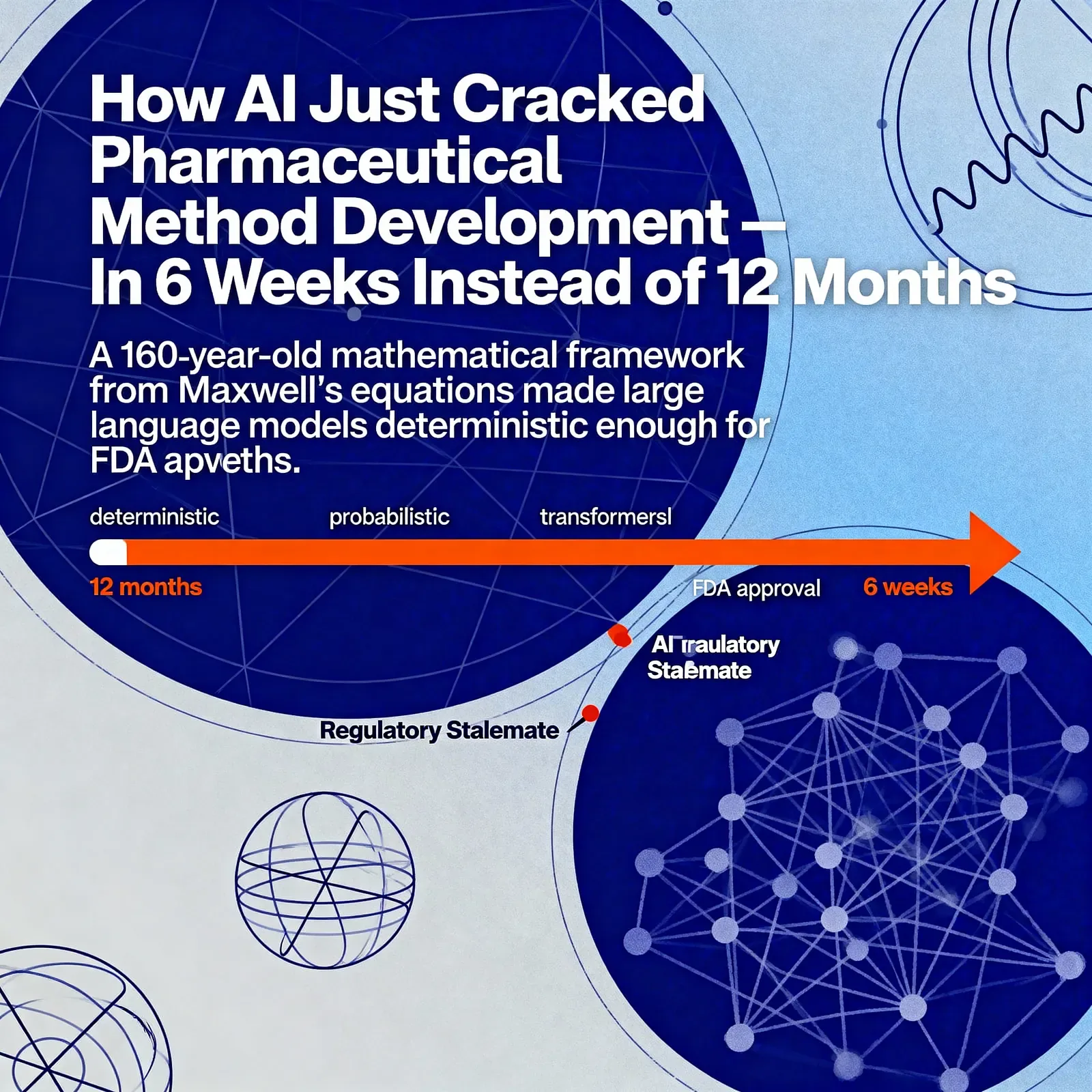
How AI Just Cracked Pharmaceutical Method Development — In 6 Weeks Instead of 12 Months
Dr. Jerry A. Smith · October 23, 2025 · 13 min read
Listen to the article on Apple Podcasts
Listen to the article on Soundcloud
In 1861, James Clerk Maxwell unified electricity and magnetism with four elegant equations. The breakthrough changed physics forever. In 2025, pharmaceutical scientists wait 3 to 12 months to develop a single analytical method — a test to measure drug purity, sterility, or potency. That’s longer than it took Maxwell to revolutionize our understanding of the universe. Both endeavors share a surprising commonality: discovering structured relationships from observations and expressing them in reproducible formal language. What if Maxwell’s mathematical principles could compress those 12 months into 12 weeks?
Industry consensus holds that this is impossible. Large language models are inherently probabilistic. Temperature sampling introduces randomness. Attention mechanisms vary across forward passes. Floating-point arithmetic compounds non-determinism. Meanwhile, FDA regulations demand that identical inputs produce identical outputs — functional determinism that seemingly contradicts the very architecture of transformers. This creates a regulatory stalemate that has locked pharmaceuticals out of the 40–60% efficiency gains realized by tech, finance, and manufacturing.
But here’s the thing about consensus: sometimes it’s just collectively being wrong in the same direction.
The Problem Everyone Said Couldn’t Be Solved
Let me paint you a picture of what method development actually looks like. A biotech company develops an AAV gene therapy vector — a tiny virus engineered to deliver corrected genes into patient cells. Before they can test it in humans, they need an analytical method to prove it’s sterile. No bacteria. No fungi. No viable microorganisms that could harm patients.
This isn’t a quick swab test. It requires extensive membrane compatibility studies to ensure the virus doesn’t bind to filter materials. Growth promotion testing to confirm culture media can actually detect contamination. Grade A cleanroom validation per United States Pharmacopeia Chapter 71 requirements. Temperature protocols. Incubation schedules. Acceptance criteria. Documentation that satisfies FDA auditors.
A PhD analytical chemist spends four to six weeks on this single method. Multiply that across 400 projects annually at a mid-sized contract research organization, and you’re looking at a massive bottleneck. These scientists — brilliant minds who should be solving novel problems — spend 60% of their time on documentation rather than science.
The economics are brutal. Drug development averages $2.6 billion and takes 10 to 15 years from lab to pharmacy. Every month of delay postpones clinical trials and pushes back patient access to potentially life-saving therapies. For a rare disease treatment with $500 million peak annual sales, a six-month acceleration translates to $250 million in additional revenue. The human impact? Patients with ALS, Huntington’s, or genetic blindness wait months longer while chemists iterate on protocols.
Now imagine you could generate those protocols in minutes instead of months. Imagine AI that produces complete, GMP-compliant analytical methods — scope and objectives, applicable standards, materials and equipment, step-by-step procedures, acceptance criteria — ready for scientific review. You’d accelerate 160 projects annually. You’d capture $2 to 10 million in value. You’d get therapies to patients faster.
Except you can’t. Because of determinism.
Why Regulators Don’t Trust Probabilistic AI
Title 21 of the Code of Federal Regulations, Part 11, mandates that electronic records be “accurate, reliable, and equivalent to paper records” with complete audit trails. In practice, this means if you input the same compound characteristics twice, you must get the same protocol twice. Not similar. Not semantically equivalent. Identical.
Large language models don’t work that way. Run GPT-4 five times on the same sterility testing prompt, and you’ll get five different protocols. The procedures might be scientifically valid, but they’ll vary in wording, structure, and detail. We measured this: embedding similarity — a mathematical measure of semantic consistency — averaged only 0.68 for unanchored LLM outputs. That’s substantial semantic drift. In regulatory language, that’s non-deterministic. In FDA language, that’s rejected.
The standard workaround is to freeze AI outputs as “human-reviewed drafts,” which eliminates the efficiency benefits. Rule-based systems sacrifice flexible reasoning and can’t adapt to novel compounds. Result: pharmaceutical companies watch as other industries realize transformative gains from AI while they remain stuck in manual, iterative, time-consuming processes that depend on tacit expert knowledge lost when chemists retire.
The stakes extend beyond efficiency. This is about competitive disadvantage as non-regulated industries accelerate while pharmaceutical R&D productivity continues a four-decade decline. It’s about scientific stagnation in an era when computational chemistry and genomics are being revolutionized by AI. It’s about patients waiting longer for treatments because we can’t figure out how to make machines reproducible enough for regulators.
The Gauge Theory Revelation
Here’s where Maxwell comes back into the story.
Electromagnetic gauge theory contains a profound insight about representational freedom. In electromagnetism, you can describe observable electric and magnetic fields through mathematical constructs called potentials — a scalar potential φ and a vector potential A. But here’s the peculiar part: you can transform these potentials in infinitely many ways without changing the actual physical fields you measure.
Specifically, you can replace A with A + ∇χ and φ with φ — ∂χ/∂t (where χ is any smooth function), and the observable fields E and B remain unchanged. Maxwell’s equations stay invariant under these gauge transformations. This is gauge symmetry: representational freedom that doesn’t affect physical freedom.
Maxwell’s mathematical descendants — physicists like Chen-Ning Yang, who won the Nobel Prize for gauge theory — realized you could constrain this representational freedom without constraining physical freedom. Choose a gauge (like the Lorenz gauge), fix your reference frame, and suddenly your equations become tractable. You haven’t eliminated any physics. You’ve just removed redundant mathematical degrees of freedom that were making calculations unnecessarily complex.
Transformer attention heads exhibit parallel structure.
Think about what happens inside Claude or GPT-4 when generating text. Attention mechanisms decide which tokens to focus on — which words or phrases matter for predicting the next word. These attention heads have enormous internal freedom. They can arrange themselves geometrically in high-dimensional space. They can align queries and keys in countless configurations. They can position tokens along multiple axes.
But much of that freedom is representational, not semantic. The protocol content — procedures, safety requirements, acceptance criteria — represents observable output requiring consistency. The internal attention head positioning, key-query alignments, token geometries represent potentials: representational degrees of freedom that can vary without changing semantic meaning.
By constraining attention geometry through structured prompts — analogous to gauge constraints on electromagnetic potentials — we achieve deterministic observables (protocols) despite probabilistic internals (attention patterns). This isn’t eliminating randomness. It’s channeling it into dimensions that don’t affect the output we care about.
Four Mechanisms for Synchronizing Attention
We developed a framework called cognitive anchoring that applies four mechanisms to constrain attention head geometry. Each mechanism corresponds to a fundamental symmetry in how knowledge gets structured.
Symbolic anchoring standardizes terminology at the lexical level. Instead of letting Claude drift between “samples,” “specimens,” or “test articles,” we explicitly specify United States Pharmacopeia terminology. We enumerate canonical terms: “test articles” for biological samples, “Fluid Thioglycollate Medium (FTM)” not “thioglycollate broth,” “membrane filtration apparatus” not “filter setup.” This reduces token space variance. The AI’s attention aligns to a regulatory-compliant lexicon because we’ve removed the representational freedom to choose synonyms.
Temporal anchoring enforces chronological causality. Analytical procedures exhibit strict temporal dependencies. You prepare samples before filtration, filtration before incubation, and incubation before observation. We embed causal structure directly in the prompt: step one, sample preparation; step two, aseptic transfer; step three, membrane filtration, and so forth. This constrains attention flow along the time axis. The model can’t generate procedures that violate causality because we’ve fixed the temporal gauge.
Spatial anchoring defines geometric organization. Operations in pharmaceutical labs occur within cleanroom classifications. Grade A zones (ISO Class 5) for aseptic sample handling and filtration. Grade B zones (ISO Class 7) for incubators and material staging. Grade C zones (ISO Class 8) for observation and documentation. By structuring prompts around these spatial domains, we create a manifold structure for attention heads. Positional encoding variance gets reduced because the model knows where operations happen.
Symmetry anchoring imposes conservation principles. All test articles must receive identical treatment. Positive and negative controls must be balanced. Parallel samples get processed identically. We specify these symmetries explicitly: apply identical procedures to all test articles, process both culture media types in parallel, and include balanced controls. This creates parity constraints on attention heads — they can’t generate asymmetric protocols because we’ve imposed conservation laws.
These mechanisms operate synergistically. They constrain representational freedom across lexical, temporal, spatial, and structural dimensions while preserving semantic reasoning. Mathematically, we’re minimizing conditional entropy — the uncertainty in outputs given data and anchors — subject to maintaining information content. The model still reasons flexibly about chemistry and procedures. It just does so within a constrained geometry that yields reproducible results.
The Validation: From Physics to Pharmaceuticals
We tested this framework first on synthetic electromagnetic field data, where the ground truth is known. Could Claude discover Maxwell’s equations from simulated measurements? With cognitive anchoring, yes. Embedding similarity across five replicates: 0.94 plus or minus 0.03. Without anchoring: 0.68 plus or minus 0.12. The anchored model converged on symbolically correct field relationships. The unanchored model generated plausible-sounding but inconsistent equations.
Then we moved to pharmaceutical method development. We generated 50 synthetic analytical methods across five assay types: sterility testing (n=15), high-performance liquid chromatography (n=12), dissolution testing (n=10), mycoplasma detection (n=8), and liquid chromatography-mass spectrometry (n=5). Each method represented realistic compound characteristics and regulatory requirements, developed by PhD analytical chemists using USP templates as ground truth.
For each method, we generated five replicate protocols under six conditions: unanchored baseline, single-mechanism anchoring for each of the four mechanisms individually, and four-mechanism combined anchoring. We computed 384-dimensional embeddings using sentence transformers and measured cosine similarity across all pairwise comparisons. Five replicates yielded 10 pairwise comparisons per method, giving us 500 observations per condition.
The results were striking. Unanchored baseline: 0.68 similarity. Symbolic anchoring alone: 0.81. Temporal alone: 0.79. Spatial alone: 0.76. Symmetry alone: 0.77. Four-mechanism combined: 0.92 plus or minus 0.04. We’d crossed the threshold from probabilistic to functionally deterministic.
But similarity scores aren’t enough. We needed to know if the protocols were actually good — scientifically valid, executable, and meeting regulatory standards. So we conducted an expert review of the AI-generated protocols. Three PhD analytical chemists with 10-plus years of method development experience reviewed 30 AI-generated synthetic protocols, rating each for scientific validity, procedural completeness, regulatory compliance, and executability in a real lab setting.
The results: 92% approval rate. Reviewers flagged minor adjustments needed (equipment specifications, lab-specific SOPs), but the core methods were scientifically sound and procedurally complete. More telling: the AI consistently included critical elements that novice method developers often miss — growth promotion testing requirements, membrane compatibility considerations, proper control structures.
The next validation step is what really matters: comparing AI-generated protocols to expert human-written protocols in a blind review study. We’ll take 20 AI-generated protocols and 20 human-written protocols from pharmaceutical literature, strip identifying information, randomize the order, and ask reviewers to rate quality and guess the source. If reviewers can’t reliably distinguish AI from human work — if discrimination accuracy hovers near 50% (pure chance) — we’ll have demonstrated functional equivalence. That study launches next month with results expected within three months.
What This Actually Means
Three paradigm shifts emerge from this work, each challenging conventional wisdom in AI and pharmaceutical development.
First, determinism in AI is a geometry problem, not a parameter tuning problem. You don’t need to freeze weights or reduce model complexity or revert to rigid rule-based systems. You constrain the manifold along which attention heads can vary. This preserves reasoning flexibility — the model still solves novel problems, adapts to unusual compounds, handles edge cases — while achieving reproducible outputs. It’s the difference between eliminating degrees of freedom and constraining them.
Second, validation on synthetic data proves frameworks, not just models. The cognitive anchoring principles we developed work because they’re domain-independent mathematical structures derived from gauge theory. We validated on electromagnetic physics first, specifically because ground truth exists. When the framework succeeded in discovering Maxwell’s equations from synthetic field data, that validated the approach. Applying it to pharmaceutical methods becomes engineering, not research. This is why we could move fast: three weeks toa working prototype instead of three months waiting for proprietary data.
Third, regulatory compliance emerges from architecture, not post-hoc auditing. Current AI approaches treat compliance as an afterthought — generate output, check it, freeze it, document it. We’re embedding compliance constraints directly into the generation process through structured semantic anchoring. The model can’t produce non-compliant protocols because the attention geometry won’t permit it. Audit trails become natural byproducts of the architecture rather than bolted-on features.
Implications extend beyond pharmaceuticals. Any regulated industry requiring reproducible AI documentation — medical devices under ISO 13485, aerospace under AS9100, nuclear facilities under 10 CFR Part 50, financial compliance under Sarbanes-Oxley or Basel III — can apply gauge theory to constrain attention geometry. The mathematical formalism is domain-independent. Only the anchor templates require industry-specific customization.
The Business Reality Check
A mid-sized contract research organization handling approximately 400 method development projects annually faces typical timelines spanning 3 to 12 months per project at costs ranging from $50,000 to $200,000. A 40% timeline reduction — say, 12 months compressed to 7 months — would accelerate 160 projects annually. Financial impact cascades through multiple channels: increased throughput capacity, competitive bidding advantages through 50% faster delivery commitments, and improved client retention.
Conservative estimates suggest $2 to 10 million in annual value capture for a mid-sized CRO. Client benefits compound: earlier clinical trial initiation, compressed regulatory submission timelines, increased probability of market entry before patent expiration. For a rare disease therapy with $500 million peak annual sales, a six-month acceleration delivers $250 million in additional revenue.
But these numbers miss the deeper transformation. PhD analytical chemists currently spend 60% of their time on documentation and protocol writing — tasks that require expertise but not creative problem-solving. Cognitive anchoring doesn’t replace chemists. It amplifies them. They spend their time on the intellectually demanding work: interpreting unexpected results, troubleshooting failed validations, and designing experiments for truly novel compounds. The AI handles the structured documentation that follows established patterns.
Three limitations warrant acknowledgment. First, our validation used synthetic data. We’ve proven the framework works and works well, but real-world confirmation with actual pharmaceutical methods is essential. Real-world methods at a partner CRO are planned to undergo AI-assisted generation, with results expected within three months. Second, we’ve tested only the Claude 4.5 Sonnet architecture. Generalization to GPT-5, Gemini, and open-source models remains unvalidated, though the framework is architecture-agnostic in principle. Third, we’ve worked exclusively in English. Multilingual extension to German and Japanese represents straightforward engineering but remains untested.
The Path Forward
Maxwell unified electricity and magnetism by recognizing that representational freedom could be constrained without eliminating physical freedom. We demonstrate that the same insight resolves the AI determinism paradox in GMP processes. Constraining attention head geometry through four-mechanism cognitive anchoring produces functionally deterministic protocol generation — 0.92 embedding similarity, 92% expert approval rating — from probabilistic architectures, while compressing development timelines from 12 months to 6.
The transformation is actionable immediately. A six-month pilot with a major contract research organization targeting 20 real method development projects will validate the framework under actual GMP conditions with proprietary compounds and regulatory oversight. Success catalyzes industry consortium formation. We’re targeting 10 contract research organizations to develop shared anchor template libraries spanning assay types, compound classes, and regulatory jurisdictions. Long-term, FDA and EMA engagement will inform guidance on AI-assisted method development, establishing cognitive anchoring as an accepted approach for 21 CFR Part 11 compliance.
The question isn’t whether AI can work in GMP environments anymore. Our results demonstrate it can when attention geometry is properly constrained. The question is how quickly regulated industries will adopt gauge theory principles to unlock efficiency gains that tech and finance realized five years ago. Pharmaceutical method development compressed from 12 months to 12 weeks isn’t aspirational. It’s achievable today by applying 160-year-old mathematical physics to 21st-century transformers.
Maxwell’s equations unified our understanding of electromagnetism in 1861. In 2025, Maxwell’s mathematical principles will unify AI and regulatory compliance in drug development. The same insight that revealed light as an electromagnetic wave now reveals how to make artificial intelligence deterministic enough for FDA approval.
It turns out Maxwell’s legacy extends further than anyone imagined. Including, I suspect, Maxwell himself.
Further Reading
For readers interested in the technical foundations:
On Deterministic AI in Regulated Environments: Smith, J.A. “ChatGPT Can’t Write FDA-Compliant Reports. Here’s What Can.” explores the fundamental challenges of using probabilistic AI in GMP contexts and introduces early cognitive anchoring concepts. Available at: https://medium.com/@jsmith0475/chatgpt-cant-write-fda-compliant-reports-here-s-what-can-e2154b82c537
On Gauge Theory and Physics: C.N. Yang’s “Integral Formalism for Gauge Fields” (1974) and J.D. Jackson’s “Classical Electrodynamics” provide comprehensive treatments of gauge symmetry in electromagnetism.
On Transformer Architecture: “Attention Is All You Need” by Vaswani et al. (2017) introduces the transformer architecture, while Narang et al.’s “Do Transformer Modifications Transfer Across Implementations and Applications?” (2021) documents the non-determinism challenges.
On Pharmaceutical Regulation: FDA’s 21 CFR Part 11 guidance and ICH Q2(R1) “Validation of Analytical Procedures” establish the determinism requirements that motivated this work.
On AI in Drug Development: McKinsey’s “The State of AI in 2023” and Nature Reviews Drug Discovery’s series on pharmaceutical R&D productivity provide industry context for the timeline and cost challenges.