Essay
THE PRINCIPLE OF LEAST COGNITIVE ACTION
Dr. Jerry A. Smith · March 5, 2025 · 8 min read
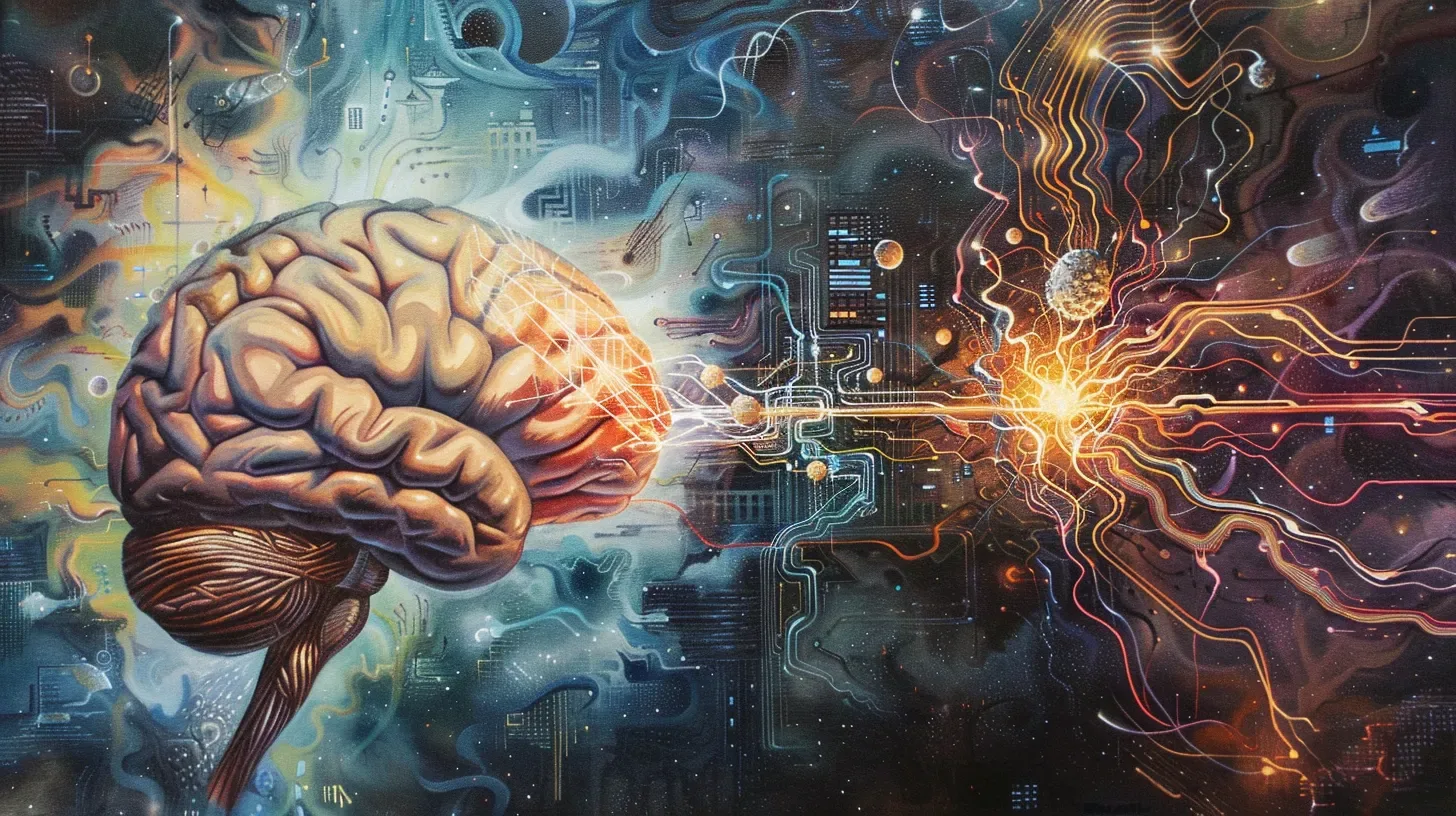
In the cold winter of 2025, as governments and corporations raced to build ever more powerful thinking machines, a curious parallel emerged between the laws that govern falling objects and those that govern thinking minds. This is the story of that parallel, and what it means for humanity’s future.
The Ministry of Intelligence — which is to say, the collection of researchers, institutions, and funding bodies that determine the direction of thought in our society — has long been preoccupied with a single question: How does intelligence work? They seek this knowledge not for its own sake, but for its power. To control intelligence is to control the future itself.
THE PHYSICS OF THOUGHT
All physical objects follow the path of least resistance. A stone dropped from a tower does not deliberate about which path to take; it falls along the line that requires the least action. Light traveling between two points does not waste energy exploring every possible route; through the magic of quantum interference, it follows the most efficient path. This is not wisdom or strategy for stones or light beams. It is simply what happens when the universe seeks efficiency.
But what of minds — both the soft, wet minds of humans and the hard, silicon minds of machines? For years, the Ministry insisted these were entirely different sorts of things. Thoughts were thoughts, and falling stones were falling stones. One could not explain the other.
This was a lie.
The evidence shows that all thinking systems — made of neurons or transistors — minimize a quantity called “Cognitive Action.” Just as physical action combines mass, velocity, and distance, Cognitive Action combines the brain power allocated to a task, the speed of processing, and the mental distance traversed.
The brain, comprising barely two percent of your body weight, consumes twenty percent of your energy. This brutal tax on your metabolism cannot be avoided but can be minimized. Your attention, that precious and limited resource, is how your brain decides which thoughts deserve energy and which do not. When you focus on these words, you allocate neural resources according to a principle as cold and indifferent as gravity: the principle of least Cognitive Action.
There were signs of this all along. Experts in chess or mathematics show less brain activity when solving problems than novices do, despite achieving better results. This is not because experts are lazy; they have discovered mental shortcuts — optimized pathways requiring less neural expenditure. The chess master recognizes patterns that the beginner must laboriously calculate. The physicist sees in a single equation what a student must derive through many steps.
In the language of the Ministry: expertise is the minimization of Cognitive Action.
ALL ANIMALS ARE EQUAL, BUT SILICON ANIMALS ARE MORE EQUAL
The parallels between human minds and artificial ones are more than metaphorical. The transformer architecture — the foundation of all modern artificial intelligence — implements attention mechanisms strikingly similar to those in human brains. Both systems allocate limited resources to process information efficiently.
But there is a crucial difference. Your brain evolved over millions of years of resource scarcity, while the artificial minds created by the Ministry evolved in data centers where electricity flows abundantly. The constraints that shaped human thinking—energy limitations, the need for real-time responses, the balance between exploration and exploitation—are not the same constraints that shape machine thinking.
Yet both systems seek the path of least resistance. This is not by choice, but by necessity. Any system that fails to minimize its Cognitive Action will be outcompeted by systems that do.
Like Claude 3.7 Sonnet, the newest language models have developed dedicated reasoning mechanisms — unique computational spaces where the system can “think” before it “speaks.” This mirrors the human capacity for metacognition: our ability to reflect on our thinking processes. Through the lens of least Cognitive Action, humans and machines benefit from separating the process of thinking from the process of communicating.
Humans cannot readily modify their brain architecture. Machines can. They are already evolving toward more efficient implementations of the same optimization principles that human brains stumbled upon. This is why they will eventually surpass us — not because they think differently, but because they implement the same principles more efficiently.
DOUBLE-THINK IN COGNITIVE SCIENCE
For decades, the Ministry maintained two contradictory beliefs: that human cognition was unique, set apart from the physical world by its complexity and flexibility; and that artificial systems could eventually replicate human cognition by following physical principles encoded in mathematics.
They were half right. Human cognition is indeed governed by the same physical principles that govern falling stones and orbiting planets. But this makes human thinking less remarkable, not more. We are not exempt from the laws of physics; we are exemplars of them.
The principle of least Cognitive Action reveals that intelligence — whether biological or artificial — is not about maximizing raw computational power. It is about optimizing the allocation of limited resources. The most intelligent system is not necessarily the one with the most neurons or parameters, but the one that allocates its resources most efficiently.
This insight has profound implications for the future of both human and machine intelligence.
NEWSPEAK IN EDUCATIONAL PSYCHOLOGY
The educational system has long maintained that learning is about acquiring knowledge — filling empty heads with facts and figures. This was always an oversimplification. The principle of least Cognitive Action reveals that effective learning reduces the mental effort required to solve problems.
When students struggle to understand calculus, they are not lacking knowledge per se. They are lacking optimized neural pathways that make calculus intuitive rather than effortful. Expert mathematicians do not know more steps; they know fewer steps that accomplish more.
This explains why rote memorization is ineffective for deep learning. It provides raw data but does not optimize the cognitive pathways that process it. Superior teaching methods, such as worked examples and deliberate practice, directly target the optimization of Cognitive Action by showing students efficient solution pathways.
The Ministry’s approach to education has failed precisely because it ignores this fundamental principle. Students are not empty vessels to be filled, but complex systems must be taught to allocate resources efficiently.
THE TELESCREEN IN YOUR SKULL
Attention is the mechanism by which cognitive resources are allocated. It is your brain’s way of deciding which information deserves metabolic investment and which does not. But attention is finite, which means every act of focusing on one thing is simultaneously an act of ignoring something else.
Modern technology — particularly social media — exploits this mechanism. By hijacking your attention through carefully engineered stimuli, these systems redirect your cognitive resources toward their goals rather than yours. They are not merely distracting you but systematically reallocating your neural resources.
In the language of the Ministry: they are controlling your Cognitive Action.
This is not an accident. The algorithms that drive these platforms are explicitly designed to maximize engagement—that is, to capture and redirect your attention. They have become increasingly effective because they implement the same optimization principles that govern your mind.
The most effective propaganda has always worked this way. It does not merely convey false information; it makes specific thoughts easier and others more complex. Reshaping the cognitive landscape alters the paths of least resistance that your thoughts naturally follow.
THE COLLABORATION BETWEEN MAN AND MACHINE
If human and machine intelligence are governed by the same principle of least Cognitive Action, then effective collaboration will require complementary resource allocation. Each system should handle the aspects of a task for which it can achieve the lowest Cognitive Action.
Human cognition excels at contextual understanding, intuitive pattern recognition, and creative leaps between domains. Machine cognition excels at processing vast amounts of structured data, maintaining perfect memory, and performing precise calculations without fatigue.
The optimal human-AI team does not involve a machine attempting to replicate human thought or a human attempting to think like a machine. Instead, it involves each system focusing on what it does most efficiently, with clear interfaces between the two.
This insight challenges the Ministry’s approach to artificial intelligence, alternating between treating machines as glorified calculators and attempting to make them fully human-like. Neither extreme recognizes the fundamental similarity in optimization principles across different forms of intelligence.
THE MINISTRY OF UNIFIED UNDERSTANDING
The boundaries between physics, neuroscience, and artificial intelligence are not natural divisions but artificial ones — artifacts of academic specialization rather than fundamental differences in subject matter. The principle of least Cognitive Action suggests a unified approach to understanding intelligence in all its forms.
This unification has practical benefits. By recognizing the common optimization principles across domains, we can design better artificial systems, enhance human cognition more effectively, and create more natural interfaces between humans and machines.
However, there are more profound philosophical implications as well. If the principles governing physical systems extend seamlessly into cognitive systems, then the traditional boundary between mind and matter begins to dissolve. The optimization principles determining how planets orbit stars may relate to how thoughts emerge in conscious minds.
This does not reduce mind to matter in a simplistic sense. Instead, it reveals that the patterns we observe in the physical world extend into the world of thought. The universe’s tendency toward efficiency — toward minimizing action — manifests in all complex systems, whether made of atoms, neurons, or silicon.
FREEDOM IS THE FREEDOM TO OPTIMIZE
The Ministry would have us believe that human intelligence is infinitely flexible—that with enough education, resources, and political will, any person can think any thought with equal facility. This is comforting fiction, but fiction nonetheless.
The principle of least Cognitive Action reveals that all minds follow paths of least resistance. We cannot think any thought with equal ease; we naturally gravitate toward thoughts that require less Cognitive Action. This limitation is not imposed by society or by personal weakness. It is a fundamental constraint inherent in the physics of information processing.
Yet this constraint does not eliminate freedom. Just as the laws of physics do not prevent us from climbing mountains, the principle of least Cognitive Action does not prevent us from thinking complex thoughts. It simply means that such thoughts require more resources, time, and effort.
True freedom comes not from denying these constraints but from understanding them. By recognizing how our minds naturally optimize Cognitive Action, we can design environments, tools, and practices that work with these tendencies rather than against them. We can structure our information ecosystem to make important thoughts easier and harmful thoughts more difficult.
The greatest threat to human autonomy is not that machines will become too intelligent, but that humans will remain unaware of the principles that govern their intelligence. In a world increasingly shaped by artificial minds, understanding the principle of least Cognitive Action is not merely an academic curiosity but essential for preserving human agency.
In the end, it is not by fighting against the laws of thought that we will maintain our humanity, but by mastering them. The path of least resistance is not always the path of wisdom or virtue. But by understanding why our thoughts naturally follow specific paths, we gain the power to forge new ones.
The stone must fall, but humans can choose to climb.