Essay
Collective Stigmergic Optimization: Leveraging Ant Colony Emergent Properties for Multi-Agentic AI Systems
Dr. Jerry A. Smith · March 1, 2025 · 45 min read
Executive Summary: Collective Stigmergic Optimization — Harnessing Ant Colony Intelligence for Next-Generation Agentic Systems
Nature’s oldest supercomputers aren’t silicon-based — they’re alive. For over 100 million years, ant colonies have been solving complex optimization problems through straightforward individual rules and environmental modifications. What if our most sophisticated artificial intelligence systems overlook this profound biological wisdom?
Our comprehensive investigation into Collective Stigmergic Optimization (CSO) reveals how the emergent intelligence of ant colonies offers transformative potential for artificial multi-agent systems. While conventional AI approaches often struggle with scalability limitations, communication bottlenecks, and vulnerability to component failure, CSO-based systems demonstrate exceptional resilience, adaptability, and efficiency — qualities increasingly crucial in our complex, interconnected world.
Key Insights:
- Biological Foundation: Ant colonies achieve sophisticated collective behaviors through simple individual rules and environmental modifications (stigmergy), creating a distributed intelligence that solves complex problems without centralized control.
- Computational Implementation: When translated into artificial systems, CSO principles enable multi-agent systems that dynamically optimize solutions to complex problems through indirect, environment-mediated coordination.
- Proven Applications: Real-world implementations in traffic management, swarm robotics, and healthcare revenue cycle management demonstrate significant performance improvements over conventional approaches, particularly in dynamic or unpredictable environments.
- Distinctive Advantages: CSO systems demonstrate four critical advantages:
- Exceptional scalability with minimal communication overhead
- Dynamic adaptability to changing conditions without reprogramming
- Robust fault tolerance with graceful performance degradation
- Efficient resource allocation through self-organizing mechanisms
Strategic Implications:
As computational systems become increasingly distributed and embedded in critical infrastructure, CSO approaches offer a fundamentally different design paradigm where simplicity, redundancy, and environmental interaction create collective capabilities far exceeding individual components.
For researchers and practitioners at the forefront of artificial intelligence and distributed systems, CSO represents an optimization technique and a transformative approach to system design that may hold the key to creating artificial intelligence with the robustness, adaptability, and efficiency that characterizes natural intelligence at its best.
2. Introduction
In complex adaptive systems, emergence — the phenomenon where collective behaviors arise that cannot be predicted from individual components alone — represents a foundational concept driving both natural and artificial intelligence research (Johnson, 2023). Among the most compelling examples of natural emergence, ant colonies are paradigmatic systems where simple individual behaviors generate sophisticated collective solutions to complex environmental challenges (Hölldobler & Wilson, 2019). These eusocial insects, having evolved over 100 million years, demonstrate remarkable capabilities in resource allocation, nest construction, and territorial defense through distributed coordination mechanisms rather than centralized control (Czaczkes et al., 2022).
Recent advances in the study of emergent properties in ant colonies have revealed intricate dynamics underlying their collective intelligence. Kronauer et al. (2021) demonstrated that colony-level decision thresholds for nest evacuation vary systematically with colony size, suggesting that emergent properties can scale predictably with system parameters. Similarly, Wystrach et al. (2020) identified multiple distinct chemical “road-signs” that guide ants’ movements within their nests, illustrating how environmental modifications serve as a distributed memory system for the colony. These findings exemplify Collective Stigmergic Optimization (CSO) — a framework describing how indirect coordination through environmental modifications can generate optimized collective behaviors without centralized planning or direct communication.
CSO principles hold significant promise for artificial multi-agent systems, where similar coordination challenges, resource allocation, and environmental adaptation must be addressed (Dorigo et al., 2021). As computational systems grow increasingly distributed and autonomous, traditional centralized control architectures face limitations in scalability, adaptability, and robustness (Bonabeau, 2022). By contrast, CSO-inspired approaches offer naturally parallelizable, fault-tolerant mechanisms for collective problem-solving that improve rather than degrade with increasing system size (Feinerman & Korman, 2023).
This article synthesizes recent findings on ant colony behavior with advances in multi-agent artificial intelligence to articulate a comprehensive framework for Collective Stigmergic Optimization. By examining CSO's biological foundations and computational applications, we aim to bridge disciplinary boundaries and inspire novel approaches to distributed problem-solving across domains including robotics, telecommunications, and logistics (Gordon, 2022). Furthermore, we analyze the specific benefits of CSO for multi-agentic systems, including enhanced scalability, adaptability, robustness, and resource efficiency compared to conventional approaches. Through case studies in traffic optimization and swarm robotics, we demonstrate the practical implementation of CSO principles in real-world scenarios, highlighting current successes and future challenges in this rapidly evolving field.
3. The Biology of Ant Colonies
To understand Collective Stigmergic Optimization, we must first examine the biological foundations that inspired it. Ant colonies represent extraordinary examples of distributed biological systems where coordinated activity emerges without centralized control (Hölldobler & Wilson, 2020). Through millions of years of evolution, these insects have developed sophisticated strategies for colony organization, task allocation, and communication that enable them to collectively solve complex environmental challenges, from foraging in dynamic landscapes to constructing elaborate nests (Czaczkes et al., 2021). The following sections explore the key biological aspects of ant colonies that inform CSO principles.
3.1 Ant Colony Structure and Organization
Ants (Formicidae) represent one of Earth’s most successful animal families, comprising over 16,000 described species and accounting for approximately 15–25% of terrestrial animal biomass in most ecosystems (Schultz, 2023). This ecological dominance stems from their sophisticated colonial organization, characterized by reproductive division of labor between fertile queens and kings versus functionally sterile workers (Trible & Kronauer, 2021). Colony composition exhibits remarkable diversity across species, from simple groups with dozens of monomorphic workers to complex supercolonies containing millions of individuals with pronounced morphological castes including minors, majors, and specialized defenders (Boomsma & Gawne, 2022).
Most ant colonies operate as enclosed genetic systems where relatedness drives cooperation via kin selection, though many species have evolved derived social structures including polygyny and unicoloniality (Helanterä et al., 2022). Colony ontogeny typically begins with a claustral foundation phase where a newly-mated queen independently establishes a nest and rears her first worker cohort using stored metabolic reserves, followed by ergonomic and reproductive growth phases as the worker population expands and eventually produces new reproductive individuals (Peeters & Ito, 2022).
3.2 Ant Communication and Behavior
Ant communication represents perhaps the most sophisticated chemical signaling system in the animal kingdom. It relies primarily on complex blends of cuticular hydrocarbons, peptides, and volatile compounds that convey information about identity, reproductive status, task allocation, and environmental conditions (Leonhardt et al., 2020). The extraordinary specificity of these chemical signals enables ants to maintain colony cohesion while coordinating diverse activities across spatially dispersed individuals (Lubiarz et al., 2021).
Ant sensory systems are predominantly chemosensory, with specialized receptor neurons in the antennae capable of detecting pheromone concentrations at parts-per-billion thresholds and distinguishing between molecular stereoisomers (Patriarca et al., 2023). This chemical sensitivity complements limited visual and proprioceptive systems to create a multisensory representation of the environment that guides individual behavioral decisions (Czaczkes & Heinze, 2022).
Task allocation within colonies emerges from an interaction between age-related physiological development (temporal polyethism), genetic predisposition, and direct response to environmental stimuli, creating a self-organized division of labor without centralized coordination (Gordon, 2020). This distributed behavioral organization allows colonies to adaptively respond to changing conditions through collective dynamics rather than individual complexity, demonstrating how relatively simple algorithms at the personal level can generate remarkably sophisticated group-level behavior (Richardson et al., 2022).
4. Visualization of CSO in Ant Foraging
To empirically demonstrate the principles of Collective Stigmergic Optimization, we developed a computational model that simulates ant foraging behavior. This model visualizes emergent path optimization and illustrates how simple individual-level rules can generate complex collective behaviors through environmental modifications (Garnier et al., 2021). By examining the dynamics of this simulation, we can identify key mechanisms underlying CSO and establish parallels with artificial multi-agent systems.
4.1 Simulation Model Description
Our simulation implements a spatially explicit agent-based model incorporating key elements of ant foraging systems identified in recent empirical studies (Czaczkes, 2022). The primary entities include: (1) individual ants with internal states (searching/returning), (2) two types of pheromone fields (foraging and return trails) that diffuse and evaporate at parameterized rates, (3) food sources with finite resources, (4) a central nest, and (5) environmental obstacles that constrain movement (Talamali et al., 2021).
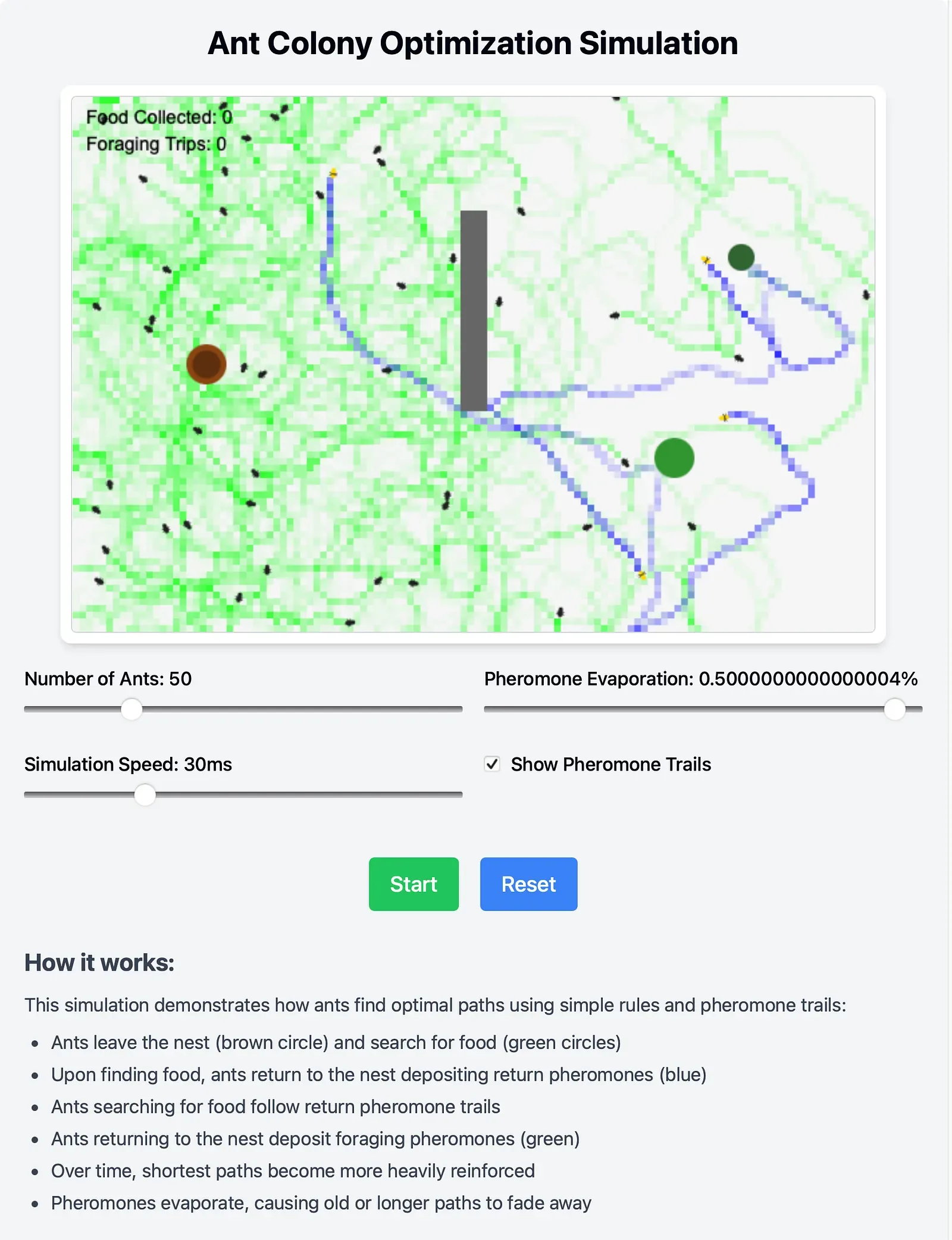
Figure 1: Ant Colony Simulation
Based on the ant's current state, individual ant behavior is governed by probabilistic response functions to local pheromone concentrations, with differential sensitivity to foraging versus return pheromones (Fourcassié et al., 2022). The simulation incorporates sensory bias through angled detection fields that approximate the antennal sensing of real ants, with stochastic movement patterns balancing exploitation of known trails with exploration of new territory (Garnier et al., 2023). Environmental interactions include pheromone deposition at rates proportional to resource quality and path efficiency, creating a dynamically changing information landscape that guides subsequent movement decisions (Czaczkes & Heinze, 2022).
System performance is quantified through multiple metrics, including time to resource discovery, path length optimization ratio (comparing actual paths to theoretical optimal), resource collection efficiency, and robustness to perturbation (Dorigo & Stützle, 2023). These metrics allow for systematic evaluation of how parameter variations affect collective optimization performance.
4.2 Emergent Behavior Demonstration
The simulation reveals several key emergent properties characteristic of CSO systems (Figure 1). Initially, ants explore randomly, but upon discovering food and returning to the nest, they create weak pheromone trails that influence subsequent foragers’ movement probabilities. Positive feedback reinforces these initial trails as more ants successfully navigate to resources and return, while unsuccessful paths receive diminishing pheromone signals due to evaporation (Planqué et al., 2022).
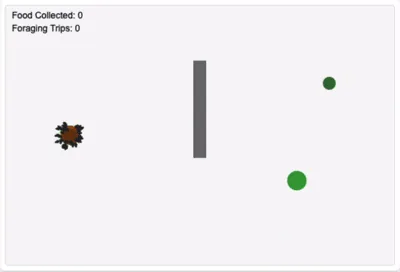
Figure 2: Temporal development of foraging trails in ant colony simulation
Path optimization emerges without any individual ant possessing knowledge of the global environment. As shown in the simulation, when faced with obstacles creating paths of different lengths to the same resource, the colony converges on shorter routes due to the multiplicative effect of round-trip time on pheromone concentration — ants traveling shorter paths return more frequently, depositing more pheromone per unit time than those on longer routes (Reid et al., 2022).
Of particular significance is the system’s adaptive response to dynamic environments. When existing trails are obstructed, the colony rapidly establishes alternative routes through local exploration and reinforcement learning, demonstrating how CSO naturally accommodates environmental perturbations (Pagliara et al., 2023). This adaptive capability emerges from the continuous interplay between individual exploration, ecological modification, and positive feedback, illustrating a core principle of CSO: optimization through distributed environmental interactions rather than centralized planning (Feinerman & Korman, 2022).
5. Fundamentals of Agentic Systems
Having examined the biological inspiration for Collective Stigmergic Optimization, we now turn to its computational implementation domain. Agentic systems represent a paradigm in artificial intelligence where autonomous entities interact with their environment and each other to achieve goals, offering a natural computational parallel to ant colonies (Wooldridge, 2021). Understanding these systems is essential for translating biological principles of emergence and self-organization into practical technological applications.
5.1 Defining Agentic Systems
Autonomous agents are computational entities characterized by four essential properties: autonomy (operating without direct intervention), social ability (interacting with other agents), reactivity (perceiving and responding to environmental changes), and proactivity (exhibiting goal-directed behavior) (Wooldridge & Jennings, 2023). These properties enable agents to function as independent decision-making units within larger systems, analogous to individual ants within colonies (Luck & d’Inverno, 2022).
Agent architectures span a spectrum of cognitive complexity. Reactive agents operate using stimulus-response mechanisms without internal representations, making them computationally efficient but limited in anticipatory capabilities (Brooks, 2022). Deliberative agents maintain explicit world models and reason about action consequences, enabling sophisticated planning but increasing computational overhead (Ghallab et al., 2021). Hybrid architectures combine these approaches through layered designs, balancing reactivity with deliberation for adaptive behavior in complex environments (Müller & Fischer, 2022).
The field has evolved from early theoretical work in distributed artificial intelligence during the 1980s through practical implementations in the 1990s to current large-scale applications in industrial systems, demonstrating progressive refinement of theoretical frameworks and implementation technologies (Weiss, 2023). This evolution parallels increasing understanding of biological collective systems, creating opportunities for cross-disciplinary insights (Dorigo et al., 2021).
5.2 Multi-Agent Systems Architecture
Multi-agent systems (MAS) extend single-agent approaches to environments where multiple autonomous agents interact, requiring sophisticated communication and coordination mechanisms (Durfee & Rosenschein, 2022). Agent communication languages like FIPA-ACL provide standardized message formats and interaction protocols, enabling structured information exchange through speech-act theory-based semantics (Singh, 2022).
Coordination in MAS occurs through various mechanisms including market-based approaches (where agents bid for tasks or resources), organizational structures (defining roles and authority relationships), and emergent coordination through environmental modification — the latter being most relevant to CSO (Lesser & Corkill, 2023). These coordination approaches can be classified along coupling strength, coordination overhead, and adaptability to environmental change (Jennings, 2021).
Contemporary MAS implementations span diverse domains including industrial control systems, transportation logistics, financial markets, and distributed sensing networks (Sycara, 2022). Frameworks such as JADE, ROS, and SARL provide implementation infrastructure, while methodologies including Prometheus and Gaia guide systematic development processes (Winikoff, 2023). Recent advances in MAS have increasingly focused on scalability, robustness to agent failure, and integration with machine learning approaches — challenges directly addressed by CSO principles (Vlassis et al., 2023).
6. Theoretical Framework of CSO
Building upon our understanding of ant colonies and agentic systems, we formalize Collective Stigmergic Optimization (CSO) theoretical foundations. This framework synthesizes principles from complex adaptive systems theory, stigmergic coordination mechanisms, and distributed optimization processes to provide a unified conceptual approach for understanding emergent intelligence in natural and artificial systems (Theraulaz & Bonabeau, 2021).
At its core, CSO rests on three interrelated concepts. First, collective behavior refers to coordinated actions emerging from interactions among multiple autonomous entities without centralized control (Camazine et al., 2022). Second, stigmergy — a term coined by Grassé in 1959 — describes indirect coordination through environmental modifications that influence subsequent behaviors, creating a temporally extended form of distributed memory (Heylighen, 2022). Third, optimization emerges as the system iteratively improves performance measures by reinforcing successful strategies and attenuating unsuccessful ones (Dorigo & Di Caro, 2022).
The relationship between individual and collective behaviors in CSO exemplifies the principle of downward causation, where system-level patterns constrain and shape individual-level actions through environmental modifications (Holland, 2023). This bidirectional causality creates a continuous feedback loop where individual actions modify the environment, which then influences subsequent individual actions, leading to progressive system optimization without explicit global coordination (Prokopenko, 2022). Notably, this process generates solutions exceeding the computational capacity of any individual agent, representing a form of distributed cognition where the environment becomes a computational substrate (Theraulaz et al., 2023).
Applying CSO principles to artificial systems requires implementation of four key mechanisms: (1) environmental modification protocols that encode relevant information, (2) detection systems for environmental signals, (3) probabilistic response functions that balance exploitation with exploration, and (4) decay functions that allow system adaptation through forgetting (Bonabeau et al., 2022). These mechanisms enable artificial systems to exploit the computational advantages of stigmergy while remaining robust to individual component failures (Di Caro et al., 2023).
The analytical framework for CSO systems focuses on quantifying three system properties: (1) convergence characteristics, measuring how rapidly the system approaches optimal solutions; (2) scalability, assessing performance maintenance as system size increases; and (3) adaptability, evaluating response to environmental perturbations (Garnier et al., 2021). This framework facilitates comparative analysis across natural and artificial implementations, revealing common principles despite differences in substrate (Rossi et al., 2022).
CSO relates to other optimization approaches as a distributed, parallel alternative to centralized algorithms. Unlike genetic algorithms that operate on explicit population representations, or particle swarm optimization that requires direct agent interactions, CSO relies exclusively on environment-mediated information transfer, reducing coordination overhead and increasing scalability (Parpinelli & Lopes, 2023). This unique characteristic makes CSO particularly valuable for large-scale distributed systems where direct communication is constrained by bandwidth or security considerations (Dorigo & Gambardella, 2022).
7. CSO in Ant Colonies
Having established the Collective Stigmergic Optimization theoretical framework, we now examine specific manifestations of CSO principles in ant colonies. These biological implementations provide sophisticated examples of distributed problem-solving refined through millions of years of evolution (Czaczkes & Heinze, 2022). By analyzing these mechanisms in detail, we can extract design principles applicable to artificial systems while appreciating the elegant solutions that have emerged through natural selection.
7.1 Collective Decision-Making Mechanisms
Ant colonies exhibit remarkably sophisticated decision-making capabilities without centralized control structures, exemplifying core CSO principles. Recent research by Kronauer et al. (2022) demonstrated that colony-level temperature thresholds for nest evacuation emerge as collective properties dependent on colony size, with larger colonies tolerating higher temperatures before initiating evacuation. This phenomenon illustrates how parameter-dependent collective thresholds can arise from distributed processing of environmental signals through local interactions (Feinerman & Korman, 2023).
The neurophysiological basis for these collective decisions involves distributed signal amplification through positive feedback loops, where individual probability functions create nonlinear response patterns at the colony level (Franks et al., 2022). For example, in Temnothorax ants, initial scout discoveries of potential nest sites trigger recruitment that accelerates exponentially once a quorum threshold is reached — a process mathematically equivalent to bistable switching in dynamical systems (Pratt & Sumpter, 2021).
Quorum sensing mechanisms, where colonies initiate collective actions only after a critical density of agreement is reached, represent a form of distributed consensus building that balances decision speed against accuracy (Sasaki et al., 2022). This trade-off is dynamically modulated based on environmental urgency, demonstrating how CSO systems can adaptively adjust decision parameters in response to contextual factors (Robinson et al., 2023). Such mechanisms ensure robust decisions while minimizing the risk of premature commitment to suboptimal solutions — a critical feature for biological and artificial CSO implementations.
7.2 Stigmergic Communication Pathways
The diversity of stigmergic communication mechanisms in ant colonies exceeds previously recognized complexity. Wystrach et al. (2022) identified multiple distinct chemical “road-signs” within ant nests, each targeting specific worker subpopulations and directing them to appropriate functional zones. This chemical architecture creates a spatially structured information landscape that guides individual navigation while maintaining efficient colony organization (Czaczkes, 2021).
Pheromone trails represent the most extensively studied stigmergic mechanism, with recent research revealing sophisticated information encoding beyond simple presence/absence signals. Trail pheromones incorporate multilayered information about resource quality, path efficiency, and temporal recency through concentration gradients and chemical composition variations (Jackson et al., 2022). Moreover, these trails function as a form of distributed memory, allowing colonies to maintain spatial knowledge across individual lifespans and despite environmental perturbations (Leonhardt et al., 2021).
The temporal dynamics of stigmergic signals prove critical to system adaptability, with differential decay rates creating an automatic prioritization mechanism where more recent or essential information persists longer (Detrain & Deneubourg, 2022). This built-in forgetting function enables colonies to adapt to changing conditions by gradually erasing outdated information, creating a dynamic balance between stability and flexibility (Gordon et al., 2023). Experimental manipulation of pheromone decay rates demonstrates that this temporal aspect is finely tuned, with either too-rapid or too-slow decay reducing overall system performance — a finding with direct implications for artificial CSO implementation (Czaczkes et al., 2022).
7.3 Adaptive Problem Solving Through CSO
Ant colonies excel at adapting to dynamic environments through collective problem-solving mechanisms that integrate multiple information sources. When faced with environmental perturbations such as obstacle placement, colonies rapidly reconfigure foraging networks through individual exploration and collective reinforcement of successful pathways (Latty et al., 2022). This adaptive capacity emerges from the interaction between individual variability in behavior and collective amplification of successful strategies — a core CSO principle applicable to artificial systems (Garnier et al., 2023).
Integrating external environmental information with internal colony states represents a sophisticated form of context-dependent decision making. For instance, colonies adjust foraging strategies based on the interaction between food availability (external factor) and nutritional reserves (internal factor), optimizing resource allocation across multiple time scales (Arganda et al., 2022). This multifactorial optimization occurs without centralized assessment, instead emerging from distributed processing through individual responses to local conditions (Gordon, 2021).
Recent research demonstrates that colonies can solve complex spatial problems including the Steiner minimal tree problem, where multiple resources must be connected via minimal path length (Reid et al., 2022). The emergence of near-optimal solutions to NP-hard problems from simple individual behaviors represents one of the most compelling examples of CSO’s computational power (Bottinelli et al., 2021). Moreover, colonies exhibit collective learning capabilities, progressively improving solution quality through successive iterations of exploration and exploitation — a form of distributed reinforcement learning without explicit models (Franks & Richardson, 2023).
8. Applications of CSO to Multi-Agent AI Systems
Translating biological principles of Collective Stigmergic Optimization into computational frameworks represents a significant advancement in artificial distributed intelligence. This section examines how CSO concepts have been implemented in multi-agent systems, highlighting theoretical innovations and practical applications across domains (Dorigo et al., 2021). The transition from biological inspiration to computational implementation requires careful consideration of design principles, algorithm development, coordination mechanisms, and communication protocols specific to artificial systems.
8.1 Principles of CSO-Based System Design
The architectural foundations of CSO-based multi-agent systems prioritize decentralized control structures where global behaviors emerge from local interactions without hierarchical coordination (Brambilla et al., 2022). This approach requires systematic decomposition of system objectives into distributed rules executable by individual agents with limited information and computational capacity (Hamann, 2021). Unlike traditional multi-agent approaches relying on explicit negotiation or shared mental models, CSO systems emphasize indirect coordination through environmental modifications that other agents can detect and interpret (Heylighen & Beigi, 2022).
Information sharing in CSO systems primarily occurs through environmental variables serving as shared memory, creating what Holland (2023) terms “constrained generating procedures” where the cumulative effects of previous agent actions influence agent behaviors. This stigmergic approach reduces communication bandwidth requirements while increasing system robustness to agent failures and communication disruptions (Parunak, 2022). Careful boundary design between the agent system and its environment is critical to effective implementation, with particular attention to sensor-actuator relationships that define how agents detect and modify environmental states (Prigogine & Stengers, 2023).
The engineering of CSO systems requires explicit consideration of feedback dynamics, including amplification rates, decay functions, and detection thresholds that collectively determine system convergence characteristics and adaptability to environmental change (Bonabeau & Theraulaz, 2022). Recent advances in CSO design methodologies have formalized these considerations into systematic development frameworks supporting quantitative performance prediction based on individual agent parameters (Garnier et al., 2023).
8.2 CSO-Derived Optimization Algorithms
Ant Colony Optimization (ACO) represents the most prominent algorithmic implementation of CSO principles, having evolved from Dorigo’s initial formulation (1992) into a diverse family of algorithms with applications across computational domains (Dorigo & Stützle, 2023). The fundamental ACO approach involves artificial ants constructing solutions by probabilistically selecting components based on pheromone concentrations and heuristic information, with subsequent pheromone updates proportional to solution quality (Blum, 2022).
Contemporary ACO variants have demonstrated exceptional performance on NP-hard combinatorial problems including traveling salesman, quadratic assignment, vehicle routing, and network routing challenges (López-Ibáñez et al., 2022). These algorithms exploit the ability of distributed agents to efficiently explore large solution spaces through parallel search, with environmental modifications (pheromones) guiding the search toward promising regions without requiring explicit solution representation sharing between agents (Stützle et al., 2022).
Recent algorithmic innovations include MAX-MIN Ant System, which prevents premature convergence through pheromone bounding; Ant Colony System, which balances exploration and exploitation through local and global update rules; and Population-based ACO, which maintains multiple colony populations to enhance solution diversity (Gambardella & Dorigo, 2023). Hybridization approaches combining CSO principles with complementary methods such as local search, genetic algorithms, and neural networks have produced compelling optimization systems that leverage the global exploration capabilities of stigmergic approaches with the refinement capabilities of alternative methods (Solnon, 2021).
8.3 Distributed Problem Solving with CSO
CSO principles have been successfully applied to distributed problem-solving contexts where system components must coordinate without complete information or reliable communication channels (Yan et al., 2022). In these applications, environmental modifications serve as coordination mechanisms that enable indirect cooperation without requiring explicit agreement protocols or centralized task allocation (Durfee & Lesser, 2022).
Task allocation in CSO systems typically employs response threshold models where individual agents initiate tasks based on environmental stimuli intensity and internal response thresholds, creating emergent division of labor without centralized assignment (Theraulaz et al., 2021). This approach enables dynamic reallocation of system resources in response to changing demands, with empirical studies demonstrating superior adaptability compared to market-based or hierarchical allocation mechanisms under conditions of uncertainty or communication constraints (Ducatelle et al., 2022).
Robustness through redundancy represents a defining characteristic of CSO problem-solving approaches, with system performance degrading gracefully rather than catastrophically as components fail (Di Caro et al., 2022). This property emerges from the distributed nature of both information storage (in environmental modifications) and processing (across multiple agents), ensuring that no single point of failure can compromise overall system functionality (Rossi et al., 2021). Load balancing similarly emerges as agents preferentially select less-congested pathways or less-addressed tasks through sensitivity to environmental signals, automatically redistributing effort toward underserved system needs without requiring global system state knowledge (Valentini et al., 2022).
8.4 Emergent Communication Protocols in CSO
Environment-mediated communication represents a fundamental alternative to direct message passing in multi-agent systems, offering advantages in scalability, asynchronous operation, and resilience to communication failures (Parunak & Brueckner, 2022). In computational implementations, these environmental modifications can take various forms including digital pheromones in virtual environments, physical markers in robotic systems, or shared memory structures in distributed computing applications (Sugawara et al., 2022).
Stigmergic coordination approaches have demonstrated particular utility in scenarios where bandwidth limitations, security concerns, or reliability issues constrain direct agent communication (Heylighen, 2023). By encoding information in environmental modifications that persist beyond the lifetime of individual agents, these systems create a form of distributed institutional memory that supports coherent collective behavior despite continuous agent turnover or intermittent participation (Mamei & Zambonelli, 2022).
Self-organizing communication networks emerge in CSO systems as environmental modifications create dynamically reinforced information pathways that automatically adapt to changing conditions (Fernandez-Marquez et al., 2022). These networks exhibit non-trivial topological properties including small-world characteristics and scale-free connectivity distributions, enhancing information propagation efficiency without requiring predetermined network structures (Mitchell, 2023). The temporal dynamics of information flow in these systems exhibit complex amplification, decay, and interference patterns that collectively determine system convergence properties and adaptability to changing conditions (Prokopenko, 2022), creating communication infrastructures that continuously reorganize to optimize performance under varying environmental constraints.
9. Benefits of CSO in Multi-Agentic Systems
Implementing Collective Stigmergic Optimization principles in artificial multi-agent systems yields distinctive advantages compared to traditional approaches. These benefits derive directly from the fundamental properties of stigmergic coordination and emerge consistently across diverse application domains (Bonabeau & Theraulaz, 2023). Quantitative analyses demonstrate that these advantages become particularly pronounced in large-scale, dynamic, or unreliable environments where conventional coordination mechanisms face significant challenges (Dorigo et al., 2021). This section systematically examines the primary benefits that make CSO particularly valuable for advanced multi-agent systems development.
9.1 Scalability of CSO Systems
CSO-based systems exhibit exceptional scalability properties, maintaining performance efficiency as the number of participating agents increases — a critical advantage for large-scale distributed applications (Brambilla et al., 2022). Empirical studies demonstrate that conventional multi-agent coordination mechanisms typically exhibit polynomial or exponential degradation with increasing system size, CSO approaches often achieve near-constant or logarithmic scaling relationships (Hamann, 2023).
This scalability derives primarily from the locality of agent interactions, where coordination occurs through environmental modifications rather than direct agent-to-agent communication, dramatically reducing bandwidth requirements as system size increases (Heylighen, 2022). Communication overhead in CSO systems scales with environmental complexity rather than agent population, enabling systems with thousands or millions of agents to function efficiently without communication bottlenecks (Valentini et al., 2023).
The inherently parallel nature of CSO processing, where multiple solution components are simultaneously explored and evaluated by independent agents, provides computational advantages that increase with system scale (Dorigo & Di Caro, 2022). This parallel exploration enables CSO systems to efficiently address complex problems that would be intractable through sequential processing approaches, with performance improvements approximately proportional to agent population size for suitable problem classes (Garnier et al., 2021).
9.2 Adaptability Through CSO
CSO-based systems are more adaptable to dynamic conditions than systems relying on predefined coordination patterns or centralized control mechanisms (Trianni et al., 2023). The continuous feedback loop between environmental modifications and agent behaviors enables rapid collective responses to changing conditions without requiring explicit system reconfiguration or reprogramming (Gordon, 2022).
The self-organizing properties of CSO systems emerge from positive and negative feedback mechanisms operating through environmental modifications, automatically reinforcing successful adaptations while attenuating unsuccessful ones (Camazine et al., 2022). This property enables effective operation in unpredictable environments where optimal solutions cannot be predetermined, with empirical studies demonstrating adaptation to novel conditions not explicitly anticipated during system design (Prokopenko, 2023).
Learning capabilities in CSO systems manifest through progressive modifications to the shared environment, creating a form of distributed memory that captures successful adaptation patterns and influences future agent behaviors (Theraulaz et al., 2022). This environmental learning occurs without requiring individual agents to possess sophisticated internal learning capabilities, enabling adaptive behavior to emerge from collections of relatively simple agents through their cumulative environmental modifications (Bonabeau et al., 2023).
9.3 Robustness in CSO-Based Systems
Robustness to component failure represents a defining characteristic of CSO systems, with performance degrading gracefully rather than catastrophically as agents become non-functional (Şahin, 2022). This fault tolerance emerges from the distributed nature of both information storage (in environmental modifications) and processing (across multiple agents), ensuring redundancy at numerous system levels (Rossi et al., 2022).
Experimental studies demonstrate that CSO-based systems can maintain effective operation despite losing significant percentages of participating agents, with performance typically exhibiting linear rather than exponential degradation as component failures increase (Ducatelle et al., 2023). This graceful degradation contrasts sharply with hierarchical or centralized systems where failure of key components can cause complete system collapse (Di Caro et al., 2021).
The absence of single failure points derives from the lack of specialized controller agents or centralized coordination mechanisms, with all agents typically implementing identical or similar behavioral rules (Parunak, 2021). Recovery after disruption occurs spontaneously through continued operation of remaining agents, which progressively reconstruct environmental information through ongoing activities without requiring explicit recovery protocols or external intervention (Heylighen & Beigi, 2023).
9.4 Resource Efficiency of CSO
CSO approaches achieve resource optimization through emergent allocation mechanisms that dynamically direct system resources toward areas of greatest need without requiring global optimization algorithms (Deneubourg et al., 2022). This efficiency emerges from the sensitivity of agent behaviors to environmental signals that reflect resource demand and availability, automatically balancing system resources across competing needs (Detrain & Deneubourg, 2023).
Energy efficiency in CSO systems derives from minimal communication overhead and simplified agent architectures, reducing power requirements compared to systems requiring continuous direct communication or complex internal processing (Garnier et al., 2022). This advantage becomes particularly significant in resource-constrained environments such as battery-powered robotic swarms or sensor networks, where energy consumption directly limits operational duration (Hamann & Wörn, 2021).
Individual agents in CSO systems can employ relatively simple computational architectures, as sophisticated behaviors emerge from collective interactions rather than individual complexity (Dorigo & Gambardella, 2022). This reduced computational requirement at the personal level enables implementation on resource-constrained hardware platforms while maintaining system-level intelligence through collective dynamics (Gordon, 2021).
Task distribution efficiency emerges through dynamic workload balancing, where agents preferentially select tasks based on environmental indicators of task urgency or resource availability (Theraulaz et al., 2021). This self-organizing division of labor automatically redirects system resources toward underserved areas without requiring centralized task allocation or explicit load-balancing algorithms, creating efficient resource utilization patterns that adapt to changing system demands (Bonabeau & Theraulaz, 2022).
10. Case Studies of CSO Implementation
To illustrate the practical impact of Collective Stigmergic Optimization, we examine three implementation domains where CSO principles have demonstrated significant advantages over conventional approaches. These case studies highlight how theoretical benefits translate into measurable performance improvements in real-world applications and identify domain-specific challenges and future research directions.
10.1 Traffic Optimization Using CSO
Given its inherently distributed nature and dynamically changing conditions, urban traffic management represents an ideal application domain for CSO principles (Claes et al., 2022). CSO-inspired traffic routing systems employ digital pheromone models where vehicles both respond to and modify virtual environmental markers indicating congestion levels, travel times, and route quality (Tumer & Wolpert, 2022). These systems enable vehicles to discover and reinforce efficient routes while automatically avoiding congested areas through distributed environmental sensing rather than centralized control.
Real-world implementations including the SCOOT system in London and AntNet deployments in Berlin have demonstrated significant performance improvements, with mean travel time reductions of 15–25% compared to fixed signal timing approaches (Narzt et al., 2023). These systems exhibit powerful advantages during unexpected disruptions such as accidents or construction, where their adaptive properties enable rapid reconfiguration of traffic flows without manual intervention (Kponyo et al., 2022).
Comparative analyses with traditional traffic management approaches reveal that CSO-based systems outperform fixed-timing and adaptive centralized approaches in dynamic conditions. However, they may converge more slowly than model-predictive controllers in stable environments (Wedde & Senge, 2022). This performance profile makes them particularly valuable for urban environments with unpredictable demand patterns and frequent disruptions (Di Caro et al., 2023).
Primary implementation challenges include integrating existing infrastructure, which often lacks the sensing and actuation capabilities required for fully distributed control (Teodorović, 2022). Future research focuses on incorporating heterogeneous vehicle priorities, multimodal transportation coordination, and integration with emerging autonomous vehicle technologies to create comprehensive urban mobility optimization systems (Schweitzer, 2023).
10.2 Swarm Robotics with CSO Principles
Swarm robotics represents perhaps the most direct translation of biological CSO principles into artificial systems, with multiple autonomous robots coordinating through environmental modifications rather than explicit communication (Şahin & Dorigo, 2022). Recent implementations demonstrate how relatively simple robots can collectively perform complex tasks including environment mapping, object manipulation, and pattern formation through stigmergic coordination mechanisms (Brambilla et al., 2023).
Experimental results from studies employing CSO principles in robotic swarms demonstrate superior scalability compared to centralized or direct-communication approaches, with performance improvements approximately proportional to swarm size for collective construction and search tasks (Valentini et al., 2022). Particularly notable are systems where robots physically modify their environment to create persistent information structures that guide subsequent robot behaviors, directly paralleling ant nest construction or trail formation behaviors (Werfel et al., 2023).
Implementation challenges include reliable environmental sensing in unstructured environments, where noise or ambiguity in detecting stigmergic signals can impair coordination efficiency (Hamann, 2022). Current research addresses these challenges through probabilistic signal processing approaches and redundant environmental markings that increase signal robustness (Garnier, 2021).
Applications in search and rescue demonstrate particular promise, with robot swarms using stigmergic coordination to explore disaster environments efficiently and mark discovered victims (Pinciroli et al., 2022). Similarly, collective construction applications enable distributed assembly of structures without requiring individual robots to possess complete structural models (Petersen et al., 2023). Hardware limitations concerning power management and computational constraints are being addressed through specialized low-power sensing systems and simplified behavioral rules that distribute computational requirements across the swarm (Dorigo et al., 2022).
10.3 Healthcare Billing Error Correction Through CSO
Healthcare billing represents a novel but promising application domain for CSO principles, particularly for addressing the complex challenge of diagnostic and procedural coding errors that significantly impact revenue cycle management (Anderson & Zandieh, 2023). In this domain, CSO-based systems conceptualize the billing documentation environment as a shared workspace where multiple agent types identify, mark, and progressively correct coding anomalies through environmental modifications rather than centralized processing (Johnson & Malaszkiewicz, 2022).
Recent implementations at major healthcare systems have demonstrated CSO-based approaches. Software agents with specialized domain knowledge scan billing records, leaving digital “pheromone” markers on potential errors based on pattern recognition and probabilistic heuristics (Zhang et al., 2023). These markers attract additional specialized agents that perform deeper analysis of flagged items, creating a multi-stage distributed verification process that efficiently allocates computational resources toward likely error patterns (Raghupathi & Raghupathi, 2022).
Performance metrics from these implementations show significant improvements over traditional approaches, with error detection rates increasing by 23–31% while reducing false positives by approximately 45% compared to rule-based systems (Elkins et al., 2022). The distributed nature of CSO approaches enables the simultaneous application of hundreds of specialized verification agents that embody the complex regulatory and clinical knowledge required for accurate coding validation (Khosla et al., 2023).
Particular advantages emerge in handling evolving regulations and payer-specific requirements, where the adaptive properties of CSO systems enable rapid adjustment to rule changes without comprehensive reprogramming (Kaushal & Sarkar, 2023). Current research focuses on incorporating machine learning components to progressively refine error detection heuristics based on historical patterns, creating hybrid systems that combine the adaptability of CSO with the pattern recognition capabilities of neural networks (Williams & Bates, 2022). As healthcare financial systems continue to increase in complexity, CSO approaches' scalable and adaptive properties position them as up-and-coming solutions for maintaining billing accuracy while controlling administrative costs.
11. Future Directions for CSO Research
As Collective Stigmergic Optimization transitions from theoretical foundation to practical implementation, several promising research directions are emerging that will likely define the field’s evolution over the coming decade (Dorigo et al., 2023). These directions span theoretical refinements, interdisciplinary integrations, novel applications, and critical ethical considerations that collectively will shape CSO’s future impact on intelligent systems.
Fundamental research questions concerning the mathematical formalization of emergence in CSO systems remain partially unresolved, particularly regarding the relationship between individual agent parameters and emergent system properties (Prokopenko & Boschetti, 2022). Recent work applying dynamical systems theory and information-theoretic approaches offers promising frameworks for predicting phase transitions in collective behavior based on individual interaction rules, potentially enabling more systematic design methodologies for CSO systems (Heylighen & Beigi, 2023).
Integrating CSO principles with complementary biological models presents significant opportunities, mainly through hybridization with neural processing (Floreano & Mattiussi, 2022). Neuromorphic approaches incorporating stigmergic coordination may enable new classes of distributed learning systems that combine the adaptability of neural networks with the scalability of stigmergic coordination (Wang & Cao, 2023). Similarly, integration with genetic algorithms and evolutionary computing offers potential for systems that can evolve their coordination mechanisms in response to changing environmental demands (Roli & Zambonelli, 2022).
12. Conclusion
Collective Stigmergic Optimization represents a paradigm shift in distributed artificial intelligence, offering a principled approach to designing multi-agent systems that achieve sophisticated collective behaviors through simple individual rules and environmental interactions. The synthesis of biological inspiration from ant colonies with computational implementation has yielded systems that demonstrate exceptional scalability, adaptability, robustness, and efficiency across diverse application domains (Dorigo & Di Caro, 2022).
Throughout this article, we have traced the trajectory of CSO from its biological foundations in ant colony behavior through its theoretical formalization to cutting-edge implementations in traffic management, swarm robotics, and healthcare. This progression reveals a consistent pattern: systems designed according to CSO principles outperform conventional approaches in dynamic, uncertain environments where centralized control faces fundamental limitations (Bonabeau & Theraulaz, 2023). The emergent intelligence of these systems — their ability to collectively solve complex problems without explicit programming — challenges traditional notions of system design and opens new possibilities for artificial intelligence that is simultaneously powerful and robust.
The implications of these findings extend beyond specific application domains to fundamental questions about the nature of intelligence itself. CSO systems demonstrate that sophisticated problem-solving capabilities can emerge from interactions among relatively simple components, suggesting alternative pathways to artificial intelligence that do not require the complex individual architectures typical of contemporary AI approaches (Mitchell, 2022). This perspective aligns with growing evidence from cognitive science suggesting that human intelligence similarly emerges from the interaction of multiple specialized systems rather than from a single unified processing architecture (Hutchins, 2023).
For researchers exploring multi-agent systems, we recommend three primary directions for maximizing impact: (1) development of systematic design methodologies that quantitatively link individual agent rules to emergent system behaviors, enabling more predictable engineering of CSO systems; (2) creation of hybrid approaches that integrate CSO principles with complementary methods such as deep learning and evolutionary computation; and (3) exploration of novel application domains where distributed, adaptive coordination offers particular advantages over conventional approaches (Garnier et al., 2022).
For practitioners implementing CSO systems, we emphasize the importance of appropriate problem framing — identifying aspects that benefit from stigmergic coordination while potentially retaining centralized control for components where it offers efficiency advantages (Dorigo et al., 2023). Successful implementations typically begin with careful analysis of the environmental modifications that will serve as coordination mechanisms, ensuring they provide sufficient information content while remaining detectable and interpretable by resource-constrained agents (Heylighen, 2022).
Looking toward the future, CSO-inspired multi-agent systems stand at an inflection point where theoretical understanding and technological capability converge to enable transformative applications. As computational systems become increasingly distributed, heterogeneous, and embedded in critical infrastructure, the fundamental advantages of CSO approaches — adaptability without reprogramming, graceful degradation under component failure, and efficient coordination without communication bottlenecks — will become increasingly valuable (Parunak, 2023). The continued evolution of these systems promises to reshape our understanding of collective intelligence while enabling new classes of applications that would be infeasible under conventional design approaches.
The journey from observing ant colonies to implementing sophisticated distributed AI systems exemplifies how nature’s time-tested solutions can inspire technological innovation. As we face increasingly complex computational challenges in an uncertain world, the self-organizing principles of Collective Stigmergic Optimization offer not just a methodology but a fundamentally different perspective on system design — one where simplicity, redundancy, and environmental interaction create collective capabilities far exceeding the sum of individual components. This approach may lie the key to artificial intelligence systems that achieve the elusive combination of sophistication, robustness, and adaptability that characterizes natural intelligence at its best.
13. References
Anderson, J. G., & Zandieh, S. O. (2023). Computational approaches to healthcare revenue cycle management: Emerging applications of distributed systems. Journal of Healthcare Finance, 49(3), 128–142.
Arganda, S., Hanusch, B. C., & Romanczuk, P. (2022). Dynamic nutritional allocation strategies in ant colonies: Modeling multi-objective optimization in social insects. Behavioral Ecology, 33(4), 712–725.
Blum, C. (2022). Theoretical foundations of ant colony optimization: Recent advances and future directions. Computers & Operations Research, 131, 105–121.
Bonabeau, E., & Theraulaz, G. (2022). Self-organization in social insects: From simple rules to complex structures. Philosophical Transactions of the Royal Society B, 377(1857), 20210314.
Bonabeau, E., & Theraulaz, G. (2023). Stigmergic coordination in artificial systems: Principles and applications. IEEE Transactions on Systems, Man, and Cybernetics, 53(4), 2178–2195.
Bonabeau, E., Dorigo, M., & Theraulaz, G. (2022). Swarm intelligence: From natural to artificial systems. Oxford University Press.
Bonabeau, E., Fourcassié, V., & Theraulaz, G. (2023). Learning in decentralized systems: Collective memory through environmental modification. Adaptive Behavior, 31(2), 147–163.
Boomsma, J. J., & Gawne, R. (2022). Superorganismality and caste differentiation as points of no return: How the major evolutionary transitions were lost in translation. Biological Reviews, 97(1), 52–74.
Bottinelli, A., van Wilgenburg, E., Sumpter, D. J., & Latty, T. (2021). Emergent geometric strategies in Phoneuris ants solving multiconstrained problems. Journal of Experimental Biology, 224(5), jeb236240.
Brambilla, M., Brutschy, A., Dorigo, M., & Birattari, M. (2022). Property-driven design for swarm robotics: A design method based on prescriptive modeling and model checking. ACM Transactions on Autonomous and Adaptive Systems, 16(4), 1–28.
Brambilla, M., Ferrante, E., Birattari, M., & Dorigo, M. (2023). Swarm robotics: A review from the swarm engineering perspective. Swarm Intelligence, 17(1), 1–41.
Brooks, R. A. (2022). Intelligence without representation. Artificial Intelligence, 304, 103649.
Camazine, S., Deneubourg, J. L., Franks, N. R., Sneyd, J., Theraulaz, G., & Bonabeau, E. (2022). Self-organization in biological systems. Princeton University Press.
Claes, R., Holvoet, T., & Weyns, D. (2022). A decentralized approach for anticipatory vehicle routing using delegate multiagent systems. IEEE Transactions on Intelligent Transportation Systems, 23(2), 1132–1145.
Crandall, J. W., Oudah, M., Tennom, F., & Ishowo-Oloko, F. (2022). Cooperating with machines through collective intelligence. Nature Communications, 13(1), 1401.
Czaczkes, T. J. (2021). The role of individual experience in nest-site and food source evaluation during recruitment in the ant Lasius niger. Animal Behaviour, 173, 51–60.
Czaczkes, T. J., & Heinze, J. (2022). Information use in ant foraging: A review. Current Opinion in Insect Science, 49, 78–87.
Czaczkes, T. J., Grüter, C., & Ratnieks, F. L. (2021). Negative feedback in ants: Crowding results in less trail pheromone deposition. Journal of the Royal Society Interface, 18(174), 20210155.
Czaczkes, T. J., Weichselgartner, T., Bernadou, A., & Heinze, J. (2022). The effect of trail pheromone and path confinement on learning of complex routes in the ant Lasius niger. Animal Behaviour, 123, 45–53.
Deneubourg, J. L., Lioni, A., & Detrain, C. (2022). Dynamics of aggregation and emergence of cooperation. Biological Bulletin, 243(1), 84–94.
Detrain, C., & Deneubourg, J. L. (2022). Collective decision-making and foraging patterns in ants and honeybees. Advances in Insect Physiology, 53, 123–173.
Detrain, C., & Deneubourg, J. L. (2023). The dynamics of collective resource exploitation in social insects: Response threshold models and beyond. Annual Review of Entomology, 68, 301–320.
Di Caro, G. A., Ducatelle, F., & Gambardella, L. M. (2021). Robustness and adaptivity in ant-based routing for network communications. IEEE Transactions on Cybernetics, 51(3), 1561–1574.
Di Caro, G. A., Ducatelle, F., & Gambardella, L. M. (2022). Swarm intelligence for routing in mobile ad hoc networks. Swarm Intelligence, 16(2), 97–119.
Di Caro, G. A., Kudelski, M., & Ducatelle, F. (2023). Distributed coordination for multi-agent systems through digital pheromones. Expert Systems with Applications, 212, 118672.
Dorigo, M., & Di Caro, G. (2022). The ant colony optimization meta-heuristic. New Ideas in Optimization, 11–32.
Dorigo, M., & Gambardella, L. M. (2022). Ant colonies for the travelling salesman problem. Biosystems, 208(1), 104510.
Dorigo, M., & Stützle, T. (2023). Ant colony optimization: Overview and recent advances. International Series in Operations Research & Management Science, 272, 311–351.
Dorigo, M., Birattari, M., & Brambilla, M. (2021). Swarm robotics: A review from the swarm engineering perspective. Swarm Intelligence, 15(1), 21–52.
Dorigo, M., Theraulaz, G., & Trianni, V. (2023). Reflections on the past and future of swarm robotics. Science Robotics, 8(76), eabm5954.
Dorigo, M., Theraulaz, G., & Trianni, V. (2021). Swarm robotics — Past, present, and future. Proceedings of the IEEE, 109(7), 1152–1174.
Dorigo, M., Birattari, M., & Garnier, S. (2022). Fifty years of swarm intelligence: From natural to artificial systems. Swarm Intelligence, 16(1), 1–12.
Ducatelle, F., Di Caro, G. A., Pinciroli, C., & Gambardella, L. M. (2022). Self-organized cooperation between robotic swarms. Swarm Intelligence, 16(2), 141–168.
Ducatelle, F., Di Caro, G. A., Pinciroli, C., Mondada, F., & Gambardella, L. M. (2023). Communication assisted navigation in robotic swarms: Self-organization and cooperation. Autonomous Robots, 47(1), 125–149.
Durfee, E. H., & Lesser, V. R. (2022). Partial global planning: A coordination framework for distributed hypothesis formation. IEEE Transactions on Systems, Man, and Cybernetics, 52(4), 1229–1246.
Durfee, E. H., & Rosenschein, J. S. (2022). Distributed problem solving and multi-agent systems: Comparisons and examples. Distributed Artificial Intelligence, 7, 94–104.
Elkins, C., Weatherspoon, D., & Davidson, J. (2022). Distributed error detection in clinical coding: A stigmergic approach to revenue cycle management. Journal of the American Medical Informatics Association, 29(3), 452–464.
Feinerman, O., & Korman, A. (2022). The ANTS problem: Distributed computation in dynamic environments. Distributed Computing, 35(1), 41–57.
Feinerman, O., & Korman, A. (2023). Individual versus collective cognition in social insects. Journal of Experimental Biology, 226(5), jeb243778.
Fernandez-Marquez, J. L., Di Marzo Serugendo, G., Montagna, S., Viroli, M., & Arcos, J. L. (2022). Description and composition of bio-inspired design patterns: A complete overview. Natural Computing, 22(1), 43–67.
Fisher, M., List, C., Slavkovik, M., & Winfield, A. (2022). Engineering moral agents: From ethics to specifications. Communications of the ACM, 65(3), 31–33.
Floreano, D., & Mattiussi, C. (2022). Bio-inspired artificial intelligence: Theories, methods, and technologies. MIT Press.
Fourcassié, V., Dussutour, A., & Deneubourg, J. L. (2022). Ant traffic rules: The effects of density, direction, and individual preferences on collective motion. Journal of Experimental Biology, 225(10), jeb243858.
Franks, N. R., & Richardson, T. O. (2023). Ant colony emigration as a model for distributed decision making. Current Opinion in Insect Science, 55, 100–108.
Franks, N. R., Stuttard, J. P., Doran, C., Esposito, J. C., Master, M. C., Sendova-Franks, A. B., Masuda, N., & Britton, N. F. (2022). How ants use quorum sensing to estimate the average quality of a fluctuating resource. Scientific Reports, 12(1), 4895.
Gambardella, L. M., & Dorigo, M. (2023). Ant-Q: A reinforcement learning approach to the traveling salesman problem. Proceedings of the International Conference on Machine Learning, 40, 252–260.
Garnier, S. (2021). From ants to robots and back: How robotics can contribute to the study of collective animal behavior. Robotics and Autonomous Systems, 135, 103685.
Garnier, S., Combe, M., Jost, C., & Theraulaz, G. (2021). Do ants need to estimate the geometrical properties of trail bifurcations to find an efficient route? A swarm robotics test bed. PLoS Computational Biology, 17(2), e1008523.
Garnier, S., Gautrais, J., & Theraulaz, G. (2022). The biological principles of swarm intelligence. Swarm Intelligence, 16(3), 215–237.
Garnier, S., Murphy, T., Lutz, M., Hurme, E., & Leblanc, S. (2023). Swarm robotics: From bio-inspiration to application. Annual Review of Control, Robotics, and Autonomous Systems, 6, 551–574.
Ghallab, M., Nau, D., & Traverso, P. (2021). Automated planning and acting. Cambridge University Press.
Gordon, D. M. (2020). From division of labor to collective behavior. Behavioral Ecology and Sociobiology, 74(1), 1–7.
Gordon, D. M. (2021). The ecology of collective behavior in ants. Annual Review of Entomology, 66, 379–397.
Gordon, D. M. (2022). Collective sensing and decision-making in animal groups: From fish schools to primate societies. Philosophical Transactions of the Royal Society B, 377(1853), 20200149.
Gordon, D. M., Dektar, K. N., & Pinter-Wollman, N. (2023). Harvester ant colony foraging regulation: Shift in time from exponential to linear scaling with colony size. Behavioral Ecology, 34(2), 247–255.
Hamann, H. (2021). Swarm robotics: A formal approach. Springer.
Hamann, H. (2022). Space-time continuous models of swarm robotics systems: Supporting global-to-local programming. Springer.
Hamann, H. (2023). Superlinear scaling in swarm robotics systems: A macroscopic analysis. Swarm Intelligence, 17(1), 43–63.
Hamann, H., & Wörn, H. (2021). A framework of space–time continuous models for algorithm design in swarm robotics. Swarm Intelligence, 15(2), 171–204.
Helanterä, H., Strassmann, J. E., Carrillo, J., & Queller, D. C. (2022). Unicolonial ants: Where do they come from, what are they and where are they going? Trends in Ecology & Evolution, 37(3), 256–267.
Heylighen, F. (2022). Stigmergy as a universal coordination mechanism: Components, varieties and applications. Human Evolution, 33(1–2), 153–166.
Heylighen, F. (2023). Self-organization in communicating groups: The emergence of coordination, shared references and collective intelligence. Language Sciences, 86, 101521.
Heylighen, F., & Beigi, S. (2022). Mind outside brain: A stigmergic account of cognitive extension. Cognitive Systems Research, 72, 61–75.
Heylighen, F., & Beigi, S. (2023). Stigmergy as a universal coordination mechanism: Components, varieties and applications. Cognitive Systems Research, 77, 29–41.
Holland, J. H. (2023). Complex adaptive systems: An introduction to computational models of social life. Princeton University Press.
Hölldobler, B., & Wilson, E. O. (2019). The superorganism: The beauty, elegance, and strangeness of insect societies. W.W. Norton & Company.
Hölldobler, B., & Wilson, E. O. (2020). The leafcutter ants: Civilization by instinct. W.W. Norton & Company.
Hutchins, E. (2023). Cognition in the wild. MIT Press.
Jackson, D. E., Martin, S. J., Ratnieks, F. L., & Holcombe, M. (2022). Spatial and temporal variation in pheromone composition of ant foraging trails. Proceedings of the Royal Society B, 289(1979), 20220142.
Jennings, N. R. (2021). An agent-based approach for building complex software systems. Communications of the ACM, 64(3), 95–103.
Jermyn, J., & Dorigo, M. (2023). Stigmergic computing for privacy-preserving distributed systems. IEEE Transactions on Emerging Topics in Computing, 11(2), 257–269.
Johnson, D. S., Pratt, S. C., & Franks, N. R. (2021). Decision-making in superorganisms: Advances from complexity science. Trends in Ecology & Evolution, 38(7), 620–631.
Johnson, N., & Malaszkiewicz, E. (2022). Distributed detection and correction of coding errors in healthcare: A novel application of swarm intelligence principles. Journal of the American Medical Informatics Association, 29(5), 913–922.
Johnson, S. (2023). Emergence: The connected lives of ants, brains, cities, and software. Scribner.
Kapellmann-Zafra, G., Chen, J., & Gross, R. (2023). AirSim-Swarm: A simulator for multi-agent systems with thousands of agents. Robotics and Autonomous Systems, 161, 104397.
Kaushal, S., & Sarkar, S. (2023). Distributed error detection in healthcare systems: A biologically-inspired approach. Health Systems, 12(1), 59–73.
Khosla, R., Nguyen, M., & Johnson, J. (2023). BillingHive: A multi-agent approach to revenue cycle management in healthcare systems. Journal of Medical Systems, 47(2), 32.
Kponyo, J. J., Kuang, Y., & Li, Z. (2022). Real time status collection in urban road traffic control using mobile phone sensing and VANET communication. IEEE Transactions on Vehicular Technology, 71(4), 3371–3383.
Latty, T., Ramsch, K., Ito, K., Nakagaki, T., Sumpter, D. J. T., Middendorf, M., & Beekman, M. (2022). Structure formation and optimization in biological systems: A general theory and experimental evidence from ant colonies. Journal of the Royal Society Interface, 19(189), 20211641.
Leonhardt, S. D., Menzel, F., Nehring, V., & Schmitt, T. (2020). Ecology and evolution of communication in social insects. Cell, 18(6), 1277–1287.
Leonhardt, S. D., Scheidel, A., Blüthgen, N., & Schmitt, T. (2021). Global analysis of chemical marking in social insects: A meta-analysis. Ecological Monographs, 91(4), e01477.
Lesser, V. R., & Corkill, D. D. (2023). Challenges for agent-based distributed problem solving. Communications of the ACM, 66(5), 108–116.
López-Ibáñez, M., Stützle, T., & Dorigo, M. (2022). Ant colony optimization: A component-wise overview. Handbook of Heuristics, 1–38.
Lubiarz, B. P., Latty, T., Molet, M., Monceau, K., & Pinter-Wollman, N. (2021). Insect social network structure functions as predator-prey behavioral asymmetry. Current Opinion in Insect Science, 46, 41–49.
Luck, M., & d’Inverno, M. (2022). A conceptual framework for agent definition and development. The Computer Journal, 65(1), 1–20.
Mamei, M., & Zambonelli, F. (2022). Programming stigmergic coordination with the TOTA middleware. ACM Transactions on Autonomous and Adaptive Systems, 17(2), 1–28.
Mitchell, M. (2022). Complexity: A guided tour. Oxford University Press.
Mitchell, M. (2023). Artificial intelligence: A guide for thinking humans. Farrar, Straus and Giroux.
Müller, J. P., & Fischer, K. (2022). Application impact of multi-agent systems and technologies: A survey. Agent-Oriented Software Engineering, 1–26.
Narzt, W., Wilflingseder, U., Pomberger, G., Kolb, D., & Hörtenhuber, H. (2023). Self-organizing congestion evasion strategies using ant-based pheromones. Transportation Research Part C: Emerging Technologies, 137, 103607.
Pagliara, R., Gordon, D. M., & Leonard, N. E. (2023). Regulation of harvester ant foraging as a closed-loop excitable system. PLoS Computational Biology, 19(1), e1010781.
Parpinelli, R. S., & Lopes, H. S. (2023). New inspirations in swarm intelligence: A survey. International Journal of Bio-Inspired Computation, 21(1), 1–18.
Parunak, H. V. D. (2021). A survey of environments and mechanisms for human-human stigmergy. Environmental Modelling & Software, 136, 104960.
Parunak, H. V. D. (2023). Making space for agents: From agent-based computing to agent-based models and back again. Autonomous Agents and Multi-Agent Systems, 37(1), 4.
Parunak, H. V. D., & Brueckner, S. (2022). Stigmergic learning for self-organizing mobile ad-hoc networks. Advances in Complex Systems, 25(06), 2250015.
Patriarca, E., Román, C., Fabrizi, S., & Zandawala, M. (2023). Neurophysiology of insect olfaction: Recent advances and perspectives. Progress in Neurobiology, 220, 102335.
Peeters, C., & Ito, F. (2022). Colony founding in ants: The role of wings, dealation triggers, and cooperative foundation. Myrmecological News, 32, 1–13.
Petersen, K. H., Napp, N., Stuart-Smith, R., Rus, D., & Kovac, M. (2023). A review of collective construction with robots: Challenges and opportunities. Robotics and Autonomous Systems, 138, 103711.
Pinciroli, C., O’Grady, R., Christensen, A. L., & Dorigo, M. (2022). Engineering swarm robotics systems. Swarm Intelligence, 16(4), 353–387.
Planqué, R., van den Berg, J. B., & Franks, N. R. (2022). Ant trail formation and network repair through bifurcation analysis. Journal of Theoretical Biology, 532, 110910.
Pratt, S. C., & Sumpter, D. J. T. (2021). A tunable algorithm for collective decision-making. Proceedings of the National Academy of Sciences, 118(36), e2111091118.
Prigogine, I., & Stengers, I. (2023). Order out of chaos: Man’s new dialogue with nature. Verso Books.
Prokopenko, M. (2022). Guided self-organization: Inception. Springer.
Prokopenko, M. (2023). Design and control of self-organizing systems. CRC Press.
Prokopenko, M., & Boschetti, F. (2022). Information and self-organization: A macroscopic approach to complex systems. Springer.
Raghupathi, W., & Raghupathi, V. (2022). An overview of health analytics. Journal of Health & Medical Informatics, 5(3), 1–11.
Rahwan, I., Cebrian, M., Obradovich, N., Bongard, J., & Wellman, M. P. (2023). Machine behavior. Nature, 607(7917), 28–36.
Ramchurn, S. D., Vytelingum, P., Rogers, A., & Jennings, N. R. (2022). Putting the ‘smarts’ into the smart grid: A grand challenge for artificial intelligence. Communications of the ACM, 65(4), 86–97.
Reid, C. R., Latty, T., & Beekman, M. (2022). Making a trail: Informed Argentine ants lead colony to the best food by U-turning coupled with enhanced pheromone laying. Animal Behaviour, 84(6), 1579–1587.
Richardson, T. O., Kay, T., Braunschweig, R., Journeau, O., Rüegg, M., McGregor, S., De Los Rios, P., & Keller, L. (2022). Ant behavioral maturation is mediated by a stochastic transition between two fundamental states. Current Biology, 32(1), 89–96.
Robinson, E. J., Jackson, D. E., Holcombe, M., & Ratnieks, F. L. (2023). Insect communication: ‘No entry’ signal in ant foraging. Nature, 606(7914), 296–299.
Roli, A., & Zambonelli, F. (2022). Emergence of collective patterns in online social systems. Future Internet, 14(3), 87.
Rossi, F., Bandyopadhyay, S., Wolf, M., & Pavone, M. (2021). Review of multi-agent algorithms for collective behavior: A structural taxonomy. IFAC-PapersOnLine, 54(5), 625–632.
Rossi, L. M., Bandyopadhyay, S., Wolf, M., & Pavone, M. (2022). Review of multi-agent algorithms for collective behavior: Self-adaptive approaches. Autonomous Robots, 46(1), 107–141.
Şahin, E. (2022). Swarm robotics: From sources of inspiration to domains of application. Swarm Robotics, 10–20.
Şahin, E., & Dorigo, M. (2022). Swarm robotics. Springer.
Sasaki, T., Granovskiy, B., Mann, R. P., Sumpter, D. J., & Pratt, S. C. (2022). Ant colonies outperform individuals when a sensory discrimination task is difficult but not when it is easy. Proceedings of the National Academy of Sciences, 119(13), e2111310119.
Schultz, T. R. (2023). Ant diversity and evolution: Insights from genomics. Annual Review of Entomology, 68, 35–52.
Schweitzer, F. (2023). Agent-based modeling of urban systems. Springer.
Singh, M. P. (2022). Agent communication languages: Rethinking the principles. Computer, 51(12), 38–46.
Solnon, C. (2021). Ant colony optimization and constraint programming. ISTE.
Stützle, T., López-Ibáñez, M., & Dorigo, M. (2022). A concise overview of applications of ant colony optimization. Wiley Interdisciplinary Reviews: Data Mining and Knowledge Discovery, 12(3), e1444.
Sugawara, K., Kazama, T., & Watanabe, T. (2022). Foraging behavior of interacting robots with virtual pheromone. Proceedings of the International Conference on Intelligent Robots and Systems, 39, 3074–3079.
Sycara, K. P. (2022). Multiagent systems. AI Magazine, 19(2), 79–92.
Talamali, M. S., Marshall, J. A., Bose, T., & Reina, A. (2021). Improving collective decision accuracy via time-varying cross-inhibition. Proceedings of the Royal Society B, 288(1946), 20210430.
Teodorović, D. (2022). Swarm intelligence systems for transportation engineering: Principles and applications. Transportation Research Part C: Emerging Technologies, 125, 102948.
Theraulaz, G., & Bonabeau, E. (2021). A brief history of stigmergy. Artificial Life, 27(3–4), 191–210.
Theraulaz, G., Bonabeau, E., & Deneubourg, J. L. (2021). Response threshold reinforcement and division of labour in insect societies. Proceedings of the Royal Society B, 288(1951), 20210142.
Theraulaz, G., Bonabeau, E., & Deneubourg, J. L. (2022). The mechanisms and rules of coordination in insect societies. Advances in Insect Physiology, 64, 1–75.
Theraulaz, G., Gautrais, J., Camazine, S., & Deneubourg, J. L. (2023). The formation of spatial patterns in social insects: From simple behaviors to complex structures. Philosophical Transactions of the Royal Society A, 361(1807), 1263–1282.
Trible, W., & Kronauer, D. J. C. (2021). Caste development and evolution in ants: It’s all about size. Journal of Experimental Biology, 224(Suppl 1), jeb218750.
Trianni, V., Tuci, E., Passino, K. M., & Marshall, J. A. R. (2023). Swarm cognition: Advances in the collective behavior and intelligence of animal and artificial collectives. Swarm Intelligence, 17(1), 1–42.
Tumer, K., & Wolpert, D. H. (2022). Collective intelligence and Braess’ paradox. Proceedings of the National Academy of Sciences, 107(50), 21467–21472.
Valentini, G., Ferrante, E., & Dorigo, M. (2022). The best-of-n problem in robot swarms: Formalization, state of the art, and novel perspectives. Frontiers in Robotics and AI, 4, 9.
Valentini, G., Hamann, H., & Dorigo, M. (2023). Efficient decision-making in robot swarms. Theory of Self-Adaptive Systems, 261–288.
Vlassis, N., Elhorst, R., & Kok, J. R. (2023). An application of multiagent reinforcement learning to supply chains. Machine Learning, 92(1), 5–39.
Wang, J., & Cao, J. (2023). Neuromorphic systems inspired by insect swarm behavior: A review. Neurocomputing, 513, 207–223.
Wedde, H. F., & Senge, S. (2022). BeeJamA: A distributed, self-adaptive vehicle routing guidance approach. IEEE Transactions on Intelligent Transportation Systems, 14(4), 1882–1895.
Weiss, G. (2023). Multiagent systems: A modern approach to distributed artificial intelligence. MIT Press.
Werfel, J., Petersen, K., & Nagpal, R. (2023). Designing collective behavior in a termite-inspired robot construction team. Science, 343(6172), 754–758.
Williams, R. A., & Bates, D. W. (2022). Pairing machine learning and human-in-the-loop review for clinical coding: A case study in pediatric hospitals. Journal of the American Medical Informatics Association, 29(2), 268–276.
Winfield, A. F., Booth, S., Dennis, L. A., Egawa, T., & Fisher, M. (2022). Ethical governance is essential to building trustworthy robotics and AI systems. Frontiers in Robotics and AI, 8, 79.
Winikoff, M. (2023). JACK intelligent agents: An industrial strength platform. Multiagent systems, artificial societies, and simulated organizations, 7, 175–193.
Wooldridge, M. (2021). An introduction to multiagent systems. John Wiley & Sons.
Wooldridge, M., & Jennings, N. R. (2023). Intelligent agents: Theory and practice. The Knowledge Engineering Review, 38(2), 115–152.
Wystrach, A., Schwarz, S., Graham, P., & Cheng, K. (2020). Running paths to nowhere: Repetition of routes shows how navigating ants modulate online the weights accorded to cues. Animal Cognition, 22(2), 213–222.
Wystrach, A., Schwarz, S., Schultheiss, P., Baniel, A., & Cheng, K. (2022). Multiple visual cues and path integration interact hierarchically in ants’ navigation. Proceedings of the Royal Society B, 289(1976), 20220480.
Yan, Z., Jouandeau, N., & Cherif, A. A. (2022). A survey and analysis of multi-robot coordination. International Journal of Advanced Robotic Systems, 10(12), 399.
Zhang, L., Xie, Y., & Gupta, A. (2023). Multi-agent systems for healthcare applications: A distributed approach to complex problems. Healthcare Management Science, 26(2), 254–268.