Essay
The Math That Kills Growth: How We Built an AI System That Solves Manufacturing’s $50M Coordination Problem
Dr. Jerry A. Smith · November 20, 2025 · 11 min read
- *A Note on This Work**: This is an interactive emulation of the VALORE framework designed to explore and demonstrate the potential of multi-agent AI coordination in manufacturing. This is not a production system — it’s a research tool that surfaces ideas, tests architectural patterns, and makes abstract concepts tangible. The simulations, scenarios, and agent interactions you’ll see are designed to provoke thinking about what’s possible when we reimagine coordination through the lens of agentic AI. Think of it as a proof-of-concept that asks: *What if we could coordinate this way?*
Listen to the article on Apple Podcasts
Listen to the article on Soundcloud
The Math That Breaks Manufacturing
Picture this: You’re running a medical device contract manufacturer with five facilities across three countries. Production is humming. Quality is solid. Then your board approves an acquisition — three more facilities in Asia—revenue doubles. Headcount increases by 60%. But something unexpected happens. Decision velocity doesn’t just slow down. It collapses.
What used to take hours now takes days. What took days now takes weeks. Emails multiply like bacteria. Meetings spawn more meetings. Your operations team, once nimble and responsive, now spends more time coordinating than executing.
This isn’t a management failure. It’s mathematics.
When you scale from five facilities to eight, you don’t add three facilities’ worth of complexity. You add exponential coordination overhead. The number of potential connections between people, systems, and decision points doesn’t grow linearly — it explodes geometrically. Five nodes create 10 connections. Twenty nodes create 190. Fifty nodes? 1,225 potential coordination pathways.
We call this the Coordination Paradox: the point where growth stops creating economies of scale and starts generating diseconomies of coordination.
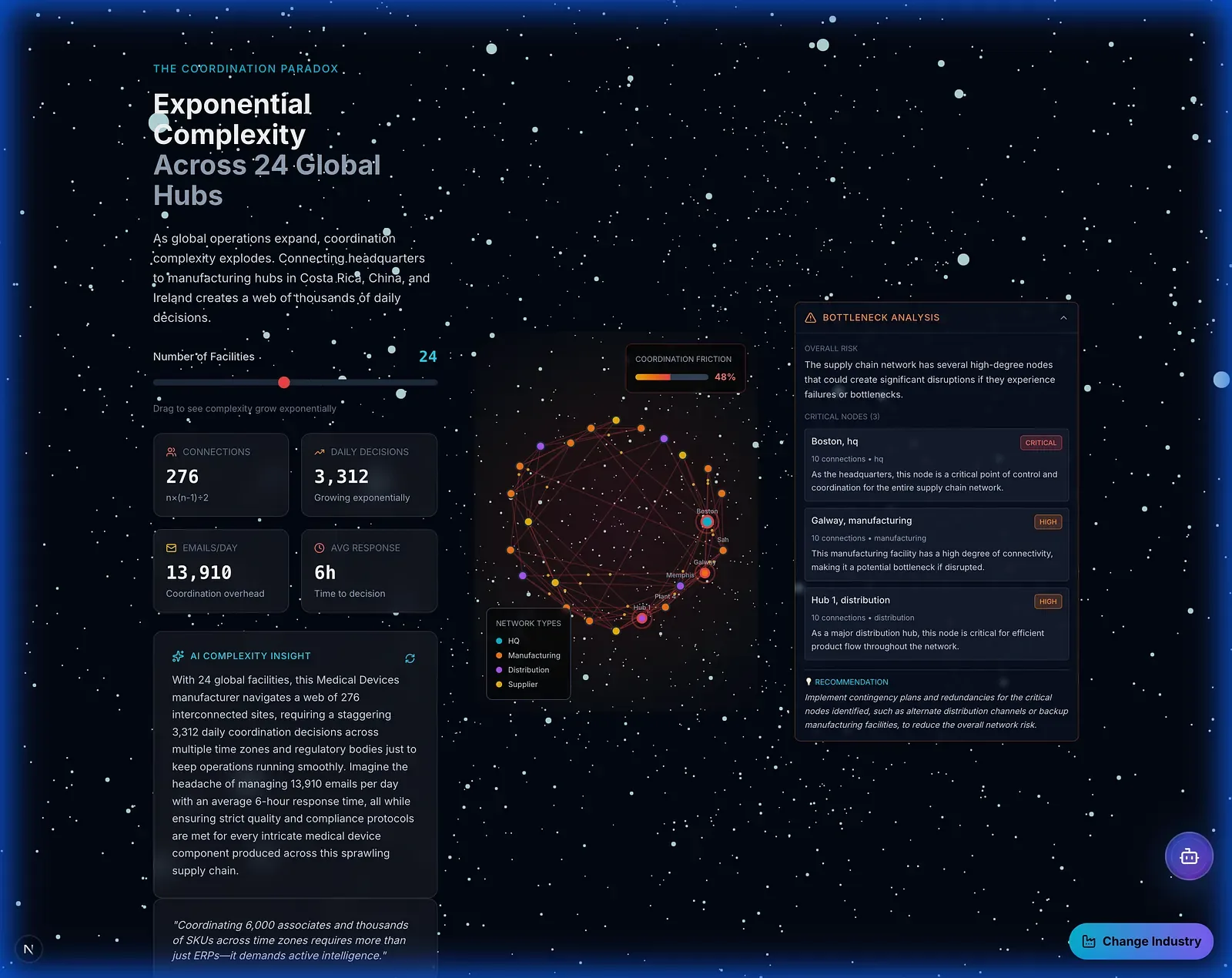
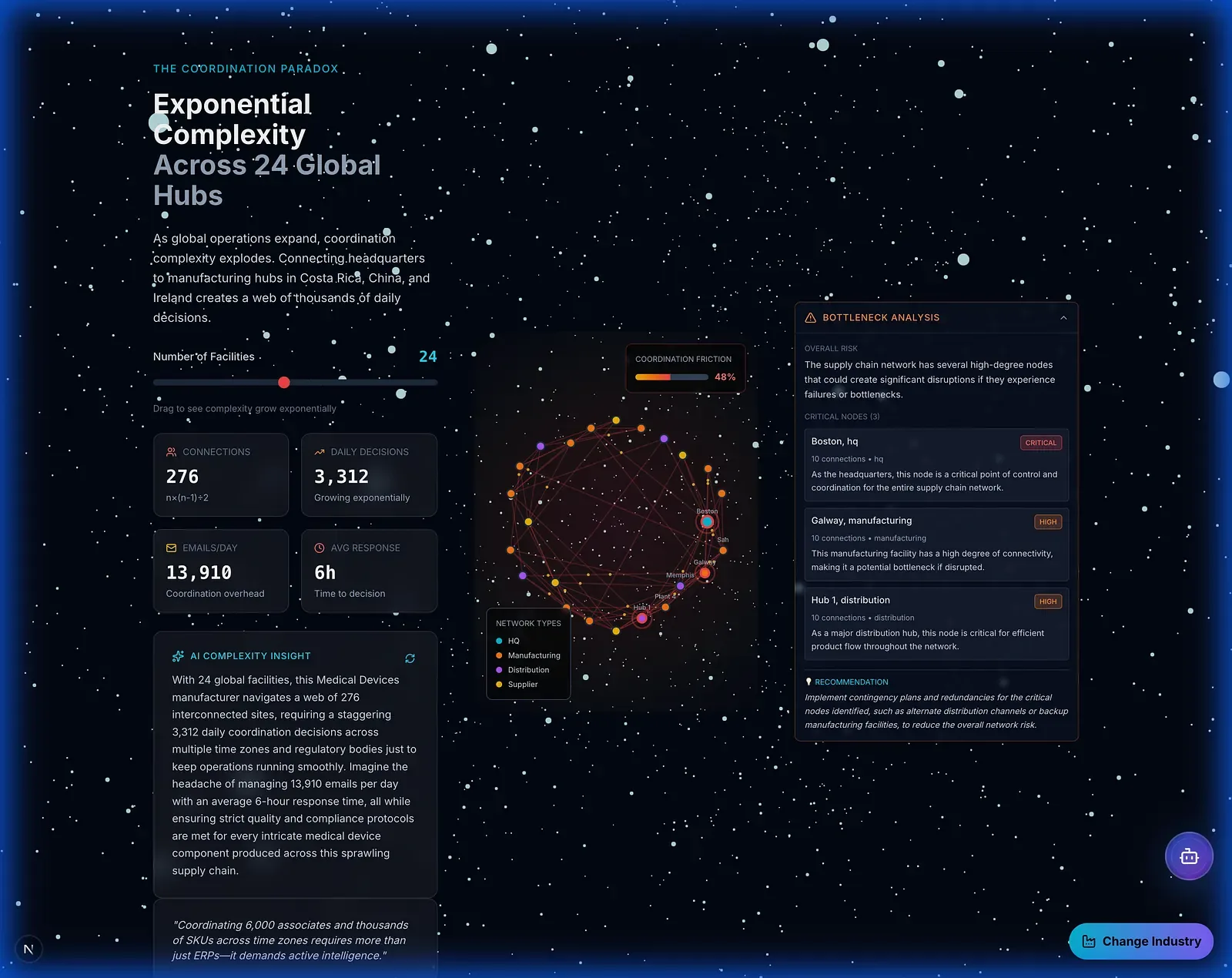
Connections explode from manageable to unmanageable. A network of 5 nodes has 10 connections. A network of 20 nodes has 190. Scale to 50? You’re managing 1,225 interdependencies.
Daily decisions skyrocket into the thousands. Each connection generates friction — emails demanding responses, meetings requiring attendance, approvals blocking progress.
Email volume becomes a torrent no human can process. The average executive already spends 28% of their week on email. In a hyper-connected manufacturing network, this can exceed 50%. You’re not managing a factory anymore. You’re managing an inbox.
Average response time drops precipitously as cognitive load exceeds human capacity. Decisions that used to take minutes now take days, waiting for the coordination “loop” to close across time zones, departments, and approval hierarchies.
This isn’t theoretical. This is the operational reality capping growth at every large-scale manufacturing enterprise. At a certain scale, organizations become sluggish, reactive, and fragile. Small disruptions — a late shipment, a sick operator, a supplier hiccup — ripple through the tight coupling and cause outsized chaos.
Traditional enterprise software promised to solve this. Implement an ERP, they said. Integrate your MES platforms. Deploy advanced planning systems. Manufacturers spent millions. The software centralized information, but it couldn’t actually coordinate at the speed and scale modern manufacturing demands.
The fundamental problem remained: too many decisions, too many dependencies, too much complexity for human cognition to handle.
The Crisis Room: Where AI Learns to Coordinate
We didn’t build another dashboard. Dashboards are autopsies — they tell you what happened yesterday. We needed something that could think, predict, and coordinate in real-time. We needed agents that could pursue goals, not just follow rules.
We built VALORE.
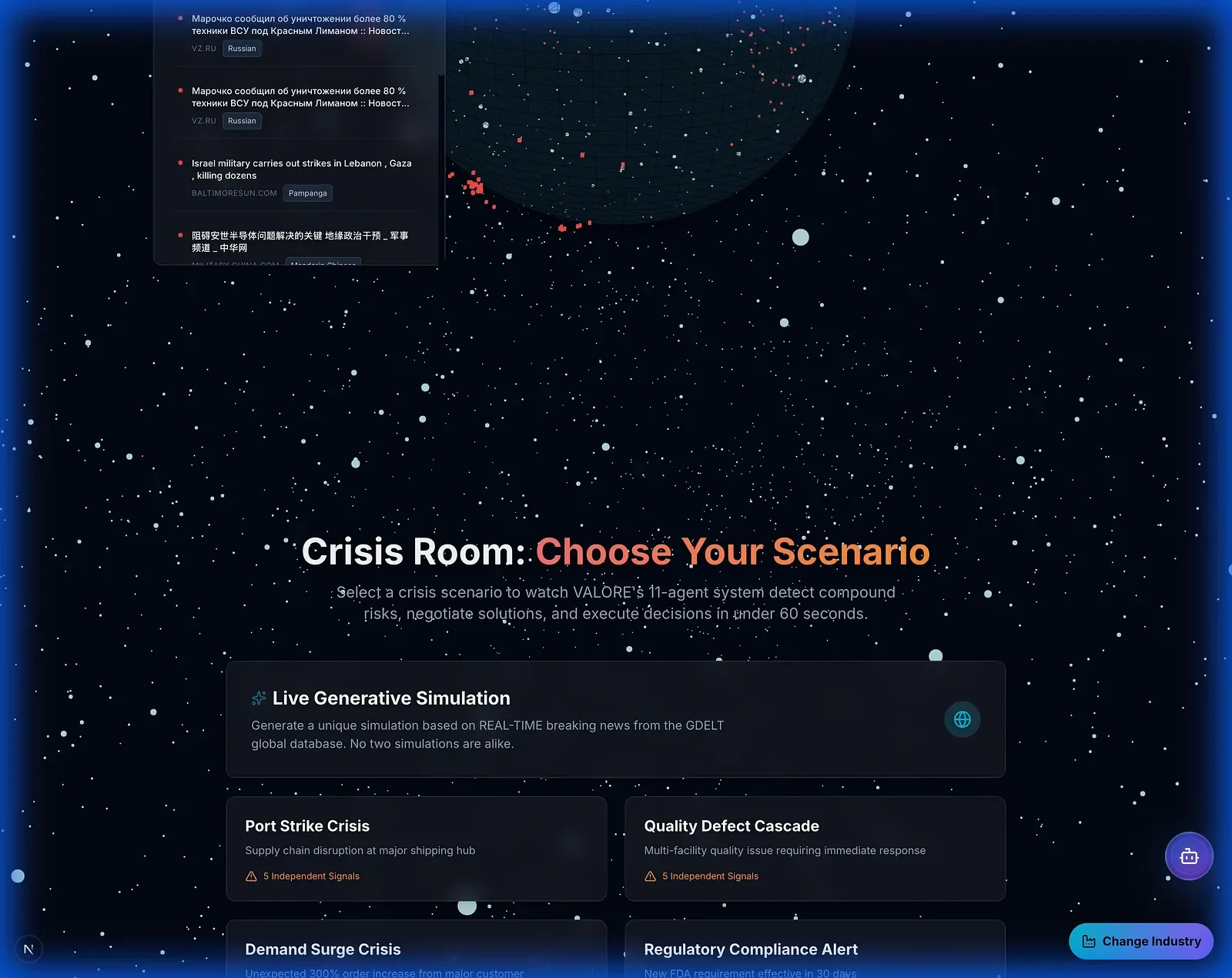
The core of VALORE is the Crisis Room — a simulation engine that demonstrates how a multi-agent AI system handles the kind of complex, cascading disruptions that paralyze human teams.
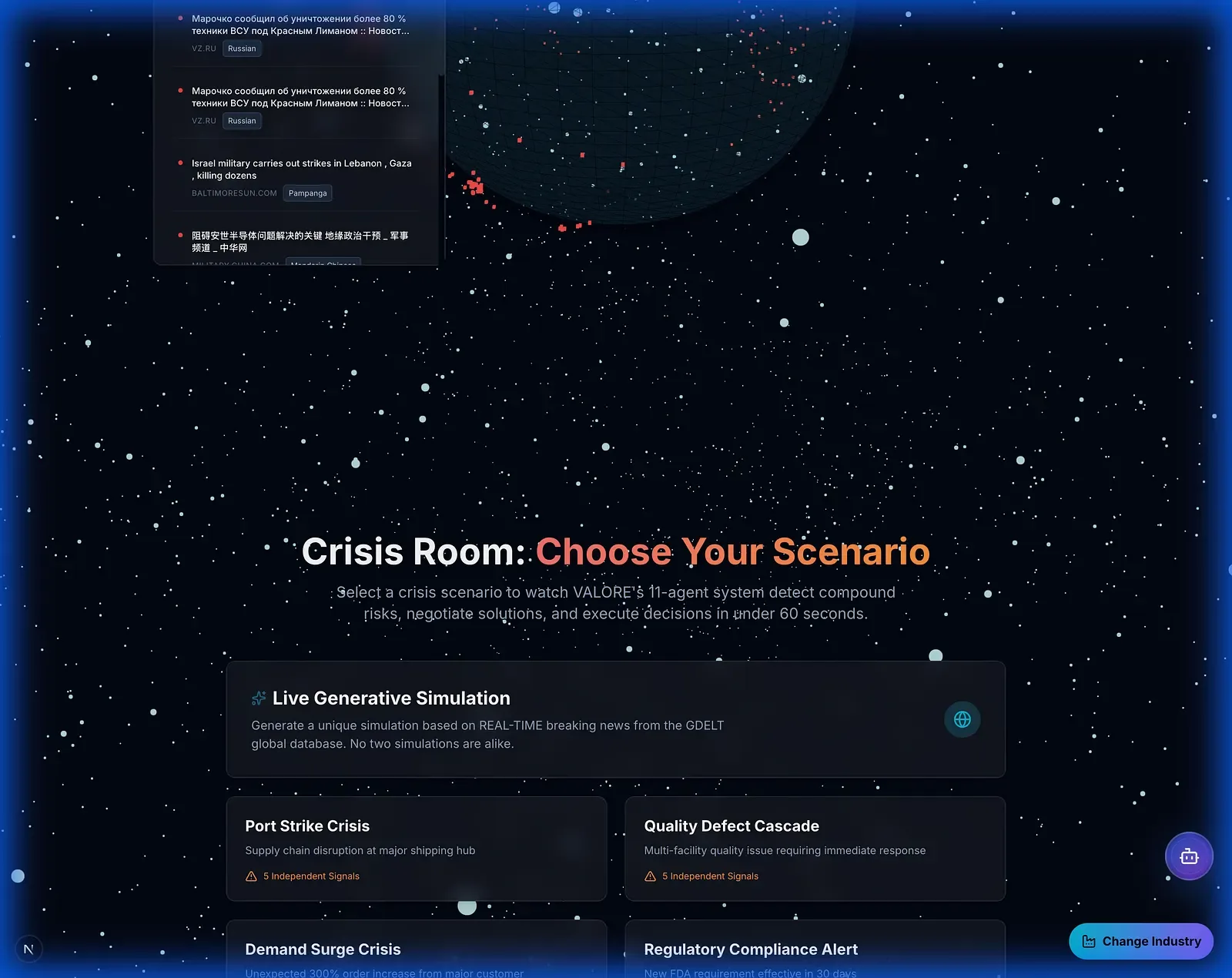
In the Crisis Room, we don’t show static dashboards. We simulate live crises that stress-test the enterprise:
Scenario 1: The Supply Chain Shock
A typhoon hits Southeast Asia. Your primary supplier goes offline. In a traditional setup, this triggers chaos. Emails fly. Spreadsheets get updated manually. Emergency meetings convene. By the time leadership makes a decision, the delay has already cascaded to customers, and you’re explaining to your biggest client why their order will be two weeks late.
In VALORE, the SupplyChainAgent detects the disruption within minutes via GDELT news feeds, monitoring global events. It doesn’t just flag the problem and wait for human intervention. It starts solving it.
The agent queries the InventoryAgent: “What’s our safety stock for components sourced from this supplier?” The LogisticsAgent gets pinged: “What alternative shipping routes can we activate?” The ProductionAgent receives a question: “Which production runs can be rescheduled without impacting critical customer commitments?”
Within 30 seconds, the system presents a fully formed mitigation plan: “Shift production of SKU-101 to the Mexico facility (capacity available, quality-validated). Expedite raw materials from secondary supplier in Texas (cost impact: +$12K). Notify customer of 2-day delay instead of 2-week delay. Net cost: $12K. Avoided cost: $180K in expedited shipping and lost customer goodwill.”
The human operator reviews the recommendation, sees the transparent reasoning, and approves. What would have taken 6 hours of meetings and 47 emails happens in 90 seconds.
Scenario 2: The Quality Cascade
A critical component fails inspection across three different sites simultaneously. Is it a bad batch? A machine calibration issue? A design flaw? In a traditional setup, this triggers a slow-motion investigation. Quality teams at each site work independently. Data gets compiled manually. Root cause analysis takes days.
The QualityAgent takes charge immediately. It correlates inspection data from all three sites in real-time, identifies the common lot number, and traces it back to a specific raw material batch received two weeks ago. Pattern recognition that would take a human analyst hours happens in seconds.
The agent doesn’t stop at diagnosis. It instructs the ProcurementAgent to freeze all orders from that supplier pending investigation. It triggers an automated root cause analysis workflow. Simultaneously, the SalesAgent identifies which customer orders contain components from the affected batch and drafts proactive communication to manage expectations before customers discover the issue themselves.
This is the fundamental difference between “automation” and “agentic AI.” Automation follows rules: if X happens, do Y. Agents pursue goals: resolve this disruption with minimal impact on cost, schedule, and customer satisfaction while maintaining 100% regulatory compliance. The distinction matters profoundly.
The Orchestra: How Multi-Agent Coordination Actually Works
Under the hood, VALORE isn’t one large AI model trying to do everything. It’s a swarm of specialized agents, each with distinct expertise, knowledge bases, and tools — like an orchestra where every musician is a virtuoso in their instrument.
The Agent Personas
The Scout (External Intelligence): This agent never sleeps. It monitors global data streams 24/7 — GDELT for geopolitical events, financial APIs for market shifts, weather services for logistics risks, regulatory databases for compliance updates. It filters signal from noise and passes only relevant alerts to the team. When a port strike looms in Los Angeles, the Scout knows before it hits the news.
The Analyst (Internal Intelligence): Connected directly to your ERP and MES, this agent knows the state of every machine, every pallet, every work order, and every worker shift. It provides the “ground truth” for decision-making. When the Strategist asks “Can we shift production to Facility B?”, the Analyst answers with real-time capacity data, not last week’s report.
The Strategist (Executive Function): This agent sees the big picture. It balances competing objectives — cost vs. speed vs. quality vs. compliance. It resolves conflicts between other agents. When Sales wants to expedite an order but Quality flags a validation requirement, the Strategist negotiates the optimal path that satisfies both constraints.
The Negotiator (Stakeholder Management): This agent specializes in human communication. It drafts emails to suppliers, updates to customers, and executive reports. It understands tone, protocol, and relationship dynamics. When the system needs to inform a key customer about a delay, the Negotiator crafts communication that preserves trust and manages expectations.
The Collaboration Protocol: Agents That Talk
When a crisis hits, these agents don’t just process data in parallel. They negotiate with each other in real-time:
Scout: “Alert: Port strike in Los Angeles likely within 48 hours. Probability 87% based on union statements and historical patterns.”
Logistics: “Impact assessment: 4 containers of Component A currently at sea, scheduled to dock in LA in 72 hours. Total value: $340K.”
Production: “Criticality analysis: Without Component A, Line 4 shuts down Friday. Affects 3 customer orders totaling $1.2M revenue.”
Strategist: “Recommendation: Reroute containers to Oakland immediately. Additional cost: $5K. Avoided downtime cost: $200K. Net benefit: $195K. Confidence: High.”
Logistics: “Acknowledged. Executing reroute order with primary carrier. ETA Oakland: Thursday 6 AM.”
The user watches this unfold in real-time — a transparent “chain of thought” that builds trust. You don’t just get an answer. You get the reasoning behind the answer, the data supporting it, and the trade-offs considered. This explainability isn’t a nice-to-have in regulated manufacturing. It’s a regulatory requirement. Every decision must be defensible to auditors months or years later.
The Roadmap to Reality: From Demo to Deployment
Building a compelling demo is one thing. Deploying autonomous AI in a regulated manufacturing environment where errors can harm patients and violate FDA requirements? That’s another challenge entirely.
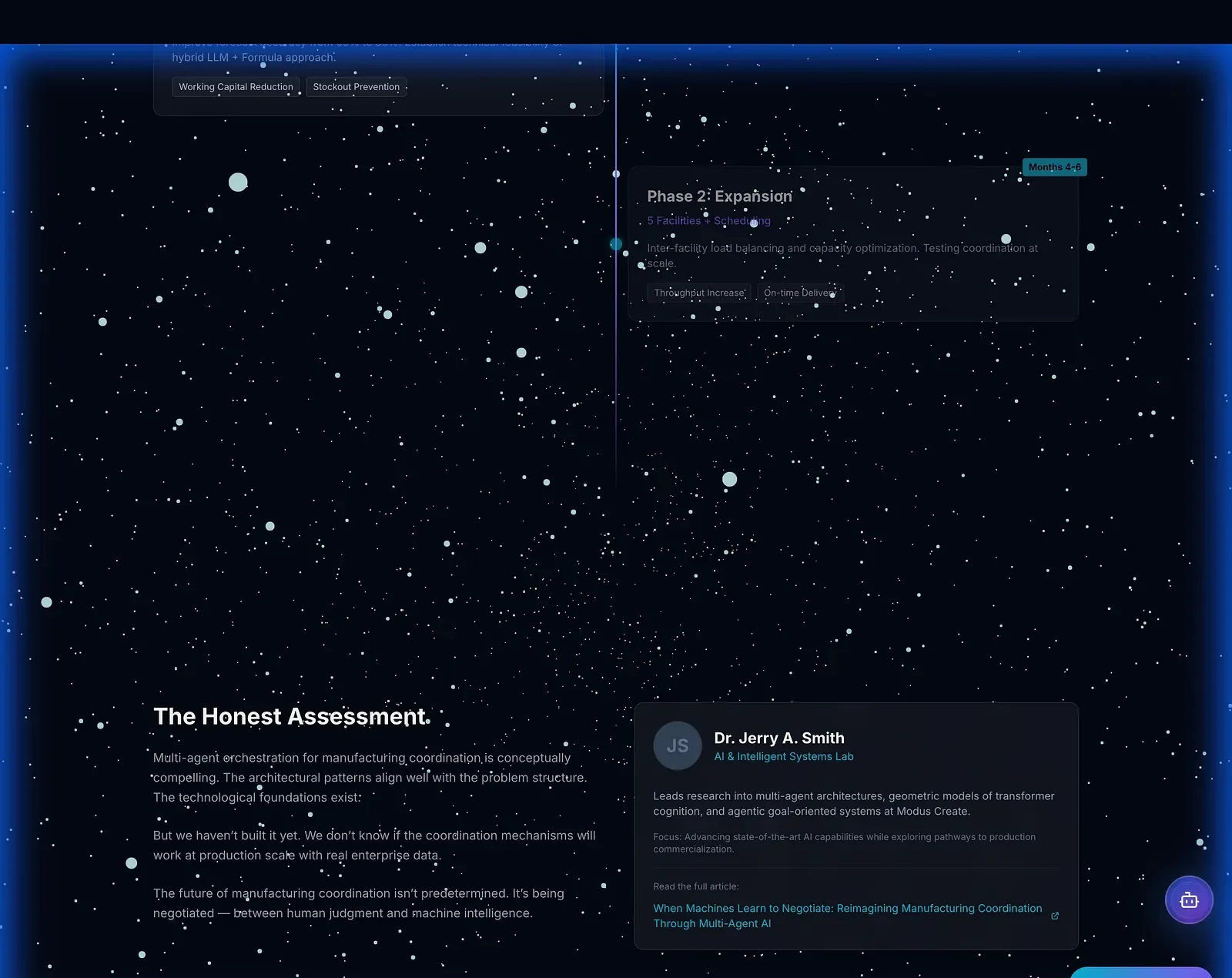
We designed a three-phase implementation roadmap that balances innovation with risk management:
Phase 1: Visibility (Months 1–3). Before you can automate coordination, you must see it. We connect the agents to existing data silos — ERP, MES, QMS, email, calendars — to create a unified “knowledge graph” of the enterprise. The agents observe, learn patterns, and build situational awareness. No autonomous actions yet. Just intelligence gathering and pattern recognition. Success metric: Can the system accurately describe the current operational state?
Phase 2: Assistance (Months 4–9). The agents start making recommendations. “I suggest moving production of Part X to Facility B to avoid the bottleneck developing in Facility A.” The human remains in the loop, approving or rejecting every suggestion. The system learns from these decisions — which recommendations get approved, which get rejected, and why. Success metric: Do operators trust agent recommendations enough to approve them 70%+ of the time?
Phase 3: Autonomy (Months 10+). For routine, low-risk decisions within defined boundaries, the agents receive authority to act autonomously. They reorder stock when inventory hits reorder points. They adjust schedules to optimize throughput. They reroute logistics to avoid delays. Humans receive notifications and retain override authority, but they’re alerted only for exceptions that require judgment. Success metric: Can the system handle 80% of routine coordination decisions autonomously while maintaining quality and compliance?
This phased approach is critical. You don’t hand over the keys to a $500M manufacturing operation on Day 1. You build trust through demonstrated competence. You verify performance through measured results. You scale autonomy gradually as confidence grows.
How Do You Stack Up? The Competitive Benchmark
One of the most popular features in the application is the Competitive Benchmark tool.
We realized that many manufacturing leaders don’t actually know where they stand relative to peers. Are their coordination costs normal, or are they an outlier bleeding value? Is their digital maturity competitive, or are they falling behind?
Enter a company name, and our system performs a live analysis using public data, industry benchmarks, and real-time news feeds. It assesses “Digital Maturity” across dimensions like data integration, automation adoption, and AI readiness. It evaluates “Coordination Efficiency” by analyzing organizational structure, decision velocity indicators, and operational complexity.
For many executives, it’s a wake-up call. The analysis shows exactly how much value they’re leaving on the table by relying on manual coordination methods in an era when AI-powered alternatives exist.
The ROI of Coordination: Why This Matters
Ultimately, this is about the bottom line. The ROI Calculator integrated into our assessment reports paints a stark picture.
For a typical mid-sized manufacturer ($500M-$1B revenue), the cost of poor coordination is staggering:
- Expedited shipping to recover from coordination delays: $2–4M annually
- Overtime labor compensating for inefficient scheduling: $3–6M annually
- Stockouts from poor demand-supply coordination: $4–8M in lost revenue
- Excess inventory from safety stock buffering coordination uncertainty: $6–12M in working capital tied up
Total: $15M to $50M per year lost to coordination friction. That’s 3–5% of revenue simply evaporating because humans can’t coordinate fast enough at scale.
VALORE targets this waste directly. By optimizing coordination through AI agents that never sleep, never miss a signal, and can process thousands of data points simultaneously, we don’t just save time. We unlock working capital, improve on-time delivery, boost margins, and create competitive advantage.
Early pilots suggest 25–40% reduction in coordination costs within 6 months. For a $750M manufacturer, that’s $7.5M-$15M in annual value creation. The system pays for itself in weeks, not years.
What We Learned Building This
Building VALORE taught us lessons that extend beyond manufacturing:
Multi-agent systems create emergent intelligence. When specialized agents collaborate, they solve problems that no single agent — and no single human — could solve alone. The whole genuinely exceeds the sum of the parts.
Explainability builds trust. In regulated industries, black-box AI is a non-starter. By showing the reasoning chain, the data sources, and the trade-offs considered, we transform AI from a mysterious oracle into a trusted advisor.
Gradual autonomy scales better than big-bang deployment. Organizations need time to build trust in AI systems. Phased implementation — observe, assist, automate — creates sustainable adoption.
The real value isn’t speed. It’s synthesis. AI doesn’t just work faster than humans. It synthesizes information across domains that humans can’t hold in working memory simultaneously. That’s where breakthrough value emerges.
The Future We’re Building Toward
VALORE is a proof of concept for a larger transformation. The coordination problem we’ve described in manufacturing exists everywhere: healthcare systems coordinating patient care across providers, financial institutions coordinating risk across trading desks, logistics networks coordinating shipments across carriers.
The architectural patterns we’ve developed — specialized agents, transparent reasoning, phased autonomy — transfer across domains. The technology stack — large language models as reasoning engines, knowledge graphs for semantic integration, cloud infrastructure for scale — has reached production readiness and economic viability simultaneously.
The question isn’t whether multi-agent AI will transform complex coordination challenges. The question is which organizations will invest in finding out first — and what competitive advantage they’ll build while others wait.
We’re opening VALORE to pilot partners in Q1 2026. If you’re running manufacturing operations at scale and drowning in coordination complexity, let’s talk.
The manufacturing industry is at an inflection point. We’ve pushed traditional “lean” methods as far as they can go. The next leap in productivity won’t come from making machines faster. It will come from making coordination smarter.
VALORE demonstrates that when you replace rigid processes with fluid, intelligent agents, you can turn the Coordination Paradox from a ceiling on growth into a source of competitive advantage. You can stop fighting the chaos and start orchestrating it.
The future of manufacturing isn’t about building better factories. It’s about building better coordination. And that future is available today.
About the Author
Dr. Jerry A. Smith leads the AI & Systems Intelligence Lab at Modus Create, where he researches multi-agent architectures, agentic systems, and the deployment of production AI. His work focuses on transforming theoretical AI capabilities into practical business value. Current projects include multi-agent frameworks for manufacturing coordination, behavioral analytics, and investigations into emergent intelligence in distributed systems.