Essay
The Devil’s Advocate Architecture: How Multi-Agent AI Systems Mirror Human Decision-Making Psychology
Dr. Jerry A. Smith · November 21, 2025 · 11 min read
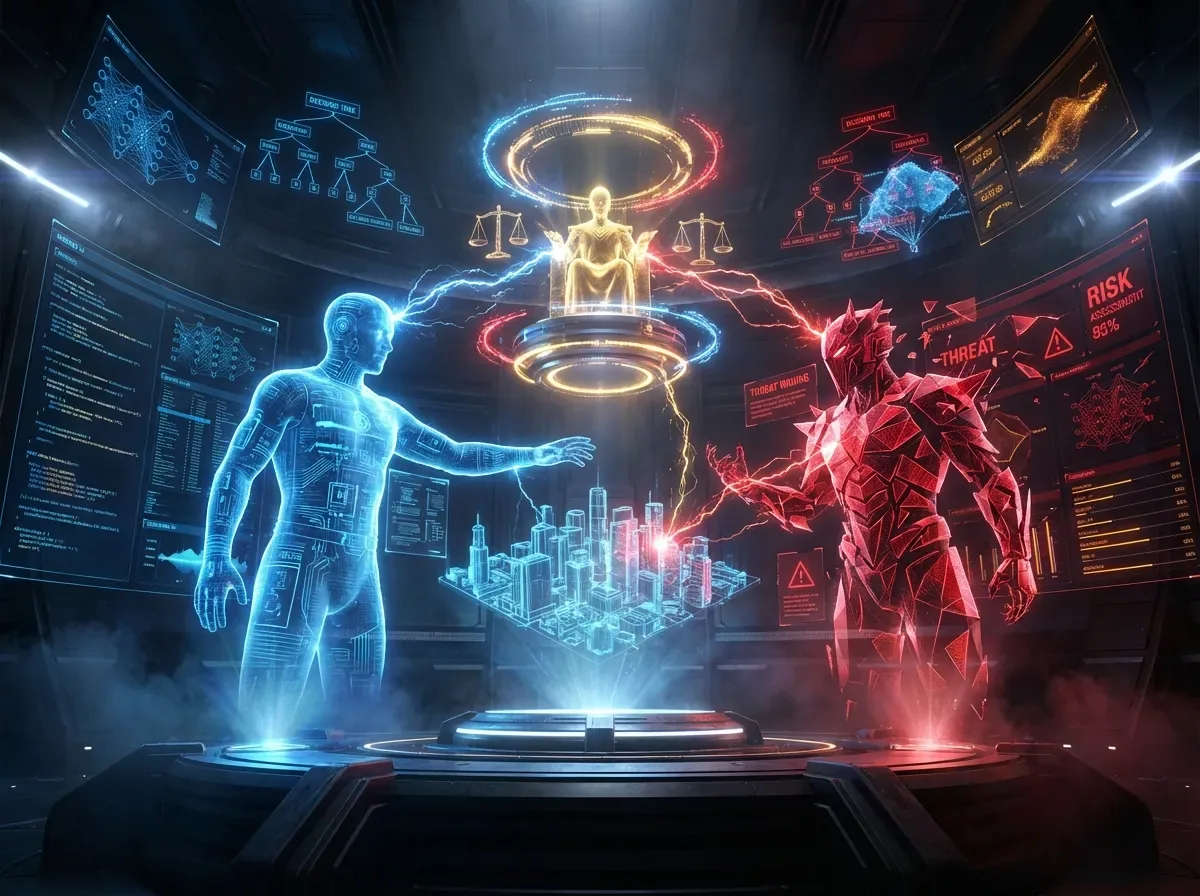
Listen to the article on Apple Podcasts
Listen to the article on Soundcloud
In 2023, a primary healthcare AI system confidently recommended a treatment protocol that overlooked a critical drug interaction — one that a junior resident would have caught in seconds. The AI wasn’t wrong because it lacked information; it was wrong because it lacked doubt. This is the paradox of modern artificial intelligence: our systems are simultaneously too smart and not smart enough. They excel at pattern recognition but fail at the very human skill of knowing when to question themselves.
The best human decisions rarely emerge from individual brilliance. They come from structured debate — from the friction of opposing viewpoints grinding against each other until truth emerges. Corporate boards employ devil’s advocates. The Catholic Church institutionalized the role of the advocatus diaboli in canonization decisions. Military strategists conduct red team exercises. Why? Because disagreement isn’t a bug in human decision-making — it’s a feature that surfaces hidden risks and challenges, dangerous assumptions.
What if we designed AI systems that argue with themselves before making a decision?
The Psychology of Better Decisions
Well-documented cognitive biases plague human decision-making. Kahneman and Tversky’s decades of research revealed how confirmation bias leads us to seek information that supports our existing beliefs while ignoring contradictory evidence. Janis identified groupthink as the phenomenon in which cohesive groups prioritize consensus over critical evaluation, leading to catastrophic failures such as the Bay of Pigs invasion. Tversky and Kahneman also documented the anchoring bias, in which initial information disproportionately influences subsequent judgments.
The devil’s advocate tradition emerged as a deliberate countermeasure to these biases. Originating in the 16th-century Catholic Church, the advocatus diaboli was tasked with arguing against candidates for canonization, ensuring that only the most rigorously vetted individuals achieved sainthood. This wasn’t cynicism — it was epistemic humility institutionalized. Modern organizations have adopted similar practices: Intel’s Andy Grove famously encouraged “constructive confrontation,” while Amazon’s leadership principles explicitly call for leaders to “disagree and commit.”
The underlying mechanism is what Hegel termed the dialectic method: thesis meets antithesis to produce synthesis. When a proposal (thesis) encounters systematic criticism (antithesis), the resulting decision (synthesis) incorporates insights from both perspectives. Nemeth’s research on minority influence demonstrates that even when the devil’s advocate is wrong, their dissent improves decision quality by forcing deeper analysis and consideration of alternatives.
This isn’t just about avoiding bad decisions — it’s about cognitive diversity. Page’s work on collective intelligence shows that diverse problem-solving approaches often outperform individual expertise. The key insight: disagreement forces perspective-taking, and perspective-taking reveals blind spots.
Translating Psychology into Architecture
How do we encode these psychological principles into software? The answer lies in a three-agent architecture in which the roles mirror the dialectical process.
The Worker Agent serves as the thesis — the optimistic problem-solver who proposes solutions based on standard practices and domain knowledge. In our ServiceNow incident management system, the Worker analyzes IT issues and recommends resolutions: “The laptop battery won’t charge? Dispatch a technician for replacement.”
The Devil’s Advocate Agent embodies the antithesis — the systematic skeptic who identifies risks, edge cases, and failure modes. It doesn’t merely disagree; it challenges assumptions: “What if the user is in a remote location? What about the security risks of allowing third-party access? Could this be a motherboard issue, not just the battery?”
The Reviewer Agent performs the synthesis — orchestrating the debate, asking clarifying questions, and ultimately making decisions only when confidence thresholds are met. Critically, the Reviewer doesn’t just pick a winner; it forces both agents to refine their positions through iterative questioning.
The communication protocol is event-driven, not sequential. Agents publish messages to a shared bus, and all agents maintain a complete dialogue history — they “hear” each other’s arguments. This shared context mirrors what Wegner called transactive memory systems in human teams: collective knowledge that exceeds individual understanding.
But the most innovative component is the confidence loop. After agents present final positions, the Reviewer generates a decision with a confidence score (0–100). If confidence falls below 80%, the system doesn’t proceed — it rejects the decision, preserves the debate history, and generates targeted follow-up questions. This cycle repeats until certainty emerges or human escalation is triggered.
Why 80%? Research on calibration in expert judgment (Tetlock) suggests that well-calibrated forecasters express appropriate uncertainty. Our threshold enforces epistemic humility: the system must earn the right to be confident.
When AI Evolves Under Pressure
Here’s where it gets interesting. Most AI systems are fragile — they break when they encounter uncertainty. If a model isn’t confident, it typically fails or asks a human for help. Our system does something different. It evolves.
When the Reviewer’s confidence drops below the threshold, something remarkable happens. Instead of simply asking another clarifying question, the system enters a Genetic Mutation Loop. The Reviewer doesn’t just identify that confidence is low — it diagnoses why. It identifies the specific “stressor” causing the proposal to fail: a safety risk, a regulatory gap, or a user experience friction point.
Then it does something no traditional AI system does: it broadcasts a mutation command. MUTATE: Address Safety Risk - Third-party technician access without proper vetting.
The Worker Agent receives this command, and something profound occurs. It doesn’t patch its existing proposal. It doesn’t just add a safety clause. It fundamentally rewrites its strategic approach while maintaining the original objective. The solution evolves — from “dispatch technician” to “remote-guided self-repair with video verification.” Same goal, different evolutionary path.
This mutation event is broadcast to all agents via the message bus. Everyone knows evolution has occurred and why. The mutated proposal enters the debate pool as a new thesis, and the dialectic cycle begins again — but now with enriched context from the previous iteration.
This is antifragility in action. The system doesn’t just tolerate stress — it uses it as fuel for improvement. The environmental pressure (the Devil’s Advocate’s critique) forces adaptation. The solution that survives this process isn’t just “correct” — it’s battle-hardened. More importantly, the mutation is directed by the specific failure mode, making it far more efficient than random variation or simple retry logic.
In biological evolution, random mutations occasionally confer an advantage. In our system, every mutation is a targeted response to a diagnosed weakness. It’s evolution with intention.
A Case Study: ServiceNow Incident Resolution
Consider a real scenario from our implementation: a user reports that their laptop battery won’t hold a charge, and the device shuts down unexpectedly.
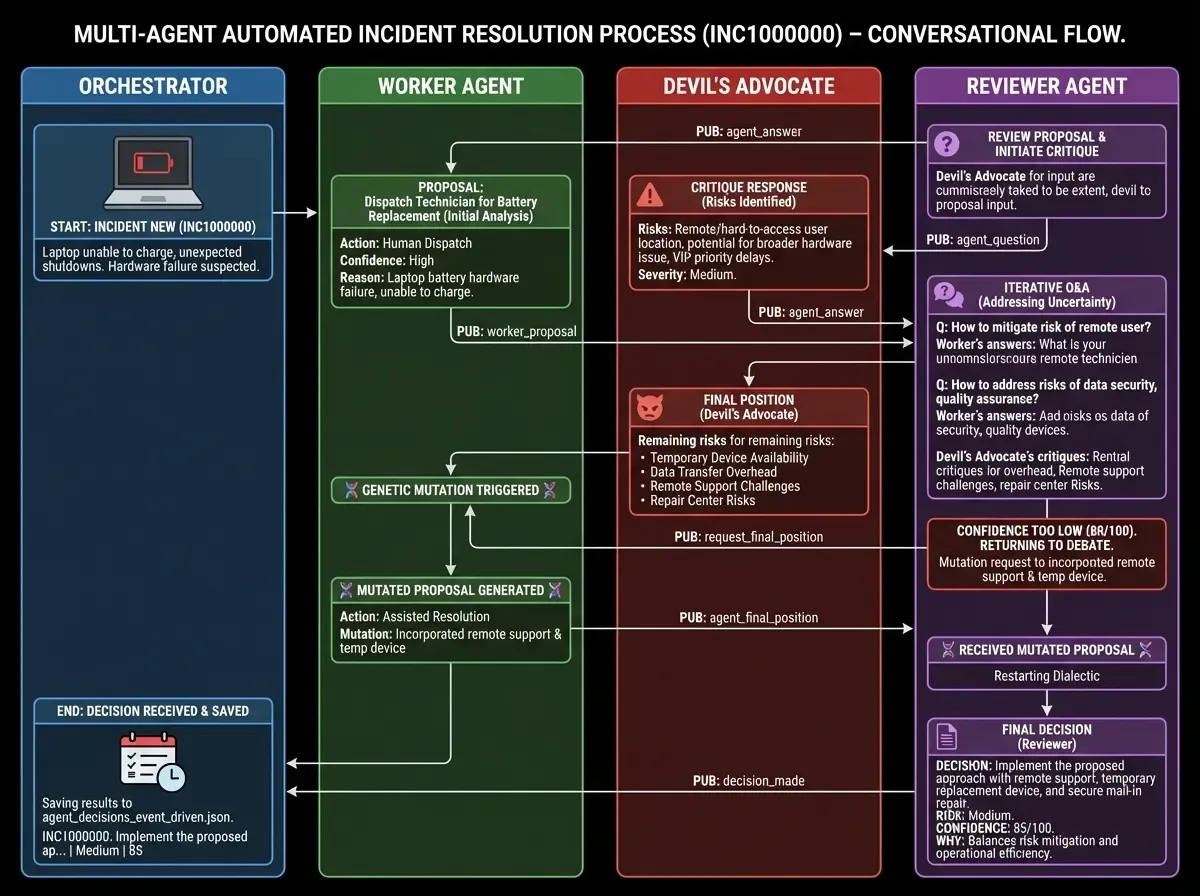
Round 1: Initial Proposal
The Worker Agent analyzes the incident and proposes: “Hardware failure detected. Recommendation: Dispatch a technician for on-site battery replacement. Confidence: High.”
The Devil’s Advocate immediately challenges: “Risks identified: (1) User may be in a remote location with limited technician access, (2) Issue could be motherboard charging circuit, not battery, (3) No information on laptop model — parts availability unknown, (4) Security concerns with third-party technician access.”
The Reviewer probes: “Worker, how do you address the remote user scenario? Do we have location data?”
Round 2: Refinement
The Worker adapts: “Proposal updated: (1) Verify user location, (2) If local: dispatch technician with security protocols, (3) If remote: offer mail-in repair with loaner laptop, (4) Conduct remote diagnostics first to rule out motherboard issues.”
The Advocate pushes back: “Mail-in repair introduces new risks: (1) Lithium battery shipping regulations, (2) Extended downtime during transit, (3) Data security during device transfer, (4) User technical proficiency for backup procedures.”
The Reviewer requests final positions. Both agents synthesize their arguments.
Round 3: Genetic Mutation
The Reviewer evaluates the final positions. Confidence: 75/100.
CONFIDENCE TOO LOW. STRESSOR IDENTIFIED: “User Technical Proficiency Risk”.
The system doesn’t ask another question. It triggers evolution.
The Reviewer broadcasts: MUTATE: Address User Technical Proficiency Risk.
The Worker’s proposal doesn’t just get tweaked — it transforms: “New Strategy: Hybrid Approach. (1) Send ‘Self-Install Kit’ ONLY if the user passes a digital proficiency quiz. (2) Otherwise, auto-schedule on-site tech. (3) Include QR code for AR-guided installation.”
Round 4: Final Decision
The Reviewer accepts the mutated proposal. Confidence: 92/100. “Approve Hybrid Approach. The proficiency quiz mitigates the risk of user error, while the AR guide ensures correct installation.”
The decision isn’t just a choice — it’s a comprehensive plan with contingencies, risk mitigation, and clear reversal conditions. And it only exists because the system was allowed to evolve under pressure.
The Sociology of AI Agent Teams
What we’ve built isn’t just a decision-making algorithm — it’s a computational instantiation of organizational sociology. Weick’s concept of organizational sensemaking describes how teams collectively interpret ambiguous situations. Our agents don’t just process information; they negotiate meaning through dialogue.
The architecture exhibits role differentiation, a principle from organizational theory (Mintzberg). Just as effective human teams assign specialized roles — the builder, the quality assurance tester, the architect — our agents have distinct epistemic responsibilities. This isn’t mere division of labor; it’s cognitive specialization that enables deeper expertise within each role.
The shared dialogue history creates what Hutchins termed distributed cognition — intelligence that exists not in individual agents but in the system’s communication patterns. Each agent’s context includes not just facts about the incident, but the entire argumentative history: what was proposed, what was challenged, what was refined, what mutated and why.
Most importantly, the system demonstrates constructive conflict (De Dreu). Not all disagreement is productive — destructive conflict devolves into personal attacks or rigid position-taking. Constructive conflict focuses on ideas, assumes good faith, and aims for synthesis. Our architecture enforces this through its protocol: agents can’t interrupt, they must respond to direct questions, and the Reviewer prevents circular arguments by tracking conversation history.
The result is emergent intelligence. The final decisions consistently exceed what any individual agent would produce — not because we’ve built a more powerful model, but because we’ve built a better process.
Beyond ServiceNow: Implications for Complex Ecosystems
The architecture is domain-agnostic. Anywhere human experts benefit from structured debate, multi-agent dialectic systems could apply:
Medical Diagnosis: A Diagnostician agent proposes differential diagnoses, a Pharmacology agent challenges drug interactions and contraindications, and a Chief Medical Officer agent synthesizes into treatment plans. The confidence loop prevents premature diagnostic closure — a known cause of medical errors (Graber). The mutation loop allows treatment strategies to evolve when initial approaches face contraindications.
Financial Planning: An Advisor agent optimizes returns, a Risk Manager agent identifies downside scenarios, a Fiduciary agent ensures alignment with client values and regulations. The system wouldn’t just recommend investments — it would stress-test them against adversarial scenarios and evolve strategies when market conditions change.
Policy-Making: A Policy Advocate agent proposes interventions, an Opposition agent identifies unintended consequences and equity concerns, a Mediator agent builds consensus. This could help policymakers anticipate implementation challenges before deployment, with policies evolving as new stakeholder concerns emerge.
Code Review: A Developer agent writes features, a Security Auditor agent identifies vulnerabilities, a Tech Lead agent balances functionality with maintainability. The confidence loop ensures code isn’t merged until security concerns are adequately addressed. The mutation loop allows architectural approaches to evolve when security audits reveal fundamental design flaws.
The implications for AI safety are profound. Current AI alignment research focuses on training models to be helpful, harmless, and honest (Anthropic). But our architecture suggests an alternative approach: instead of trying to build a single perfectly aligned model, build a system of models with competing objectives. The Worker optimizes for task completion; the Advocate optimizes for risk avoidance; the Reviewer optimizes for balanced decisions. Alignment emerges from process, not just training.
Scaling presents interesting challenges. With five agents, do we need pairwise debates? With ten, do we risk cacophony? Research on team size (Hackman) suggests diminishing returns beyond seven members. Future work might explore hierarchical structures — teams of agents with meta-reviewers — or dynamic role assignment based on incident characteristics.
The Future of Thoughtful AI
We stand at an inflection point in artificial intelligence. The race for faster, larger models has delivered impressive capabilities, but speed without wisdom is dangerous. The healthcare AI that confidently recommended the wrong treatment wasn’t malicious — it was overconfident.
The shift we need is from “fast answers” to “earned confidence.” Our multi-agent architecture demonstrates that AI systems can embody epistemic humility — they can know what they don’t know. When confidence falls below the threshold, the system doesn’t guess; it deliberates. And when deliberation isn’t enough, it evolves.
This matters because AI is increasingly deployed in high-stakes domains where errors have consequences: medical diagnosis, financial advice, legal analysis, and infrastructure management. In these contexts, we don’t need AI that’s consistently fast — we need AI that’s reliably thoughtful.
The vision is for AI to think like the best human teams: diverse in perspective, critical in analysis, humble about uncertainty, and adaptive under pressure. Not a single oracle dispensing wisdom, but a community of specialized agents engaged in structured debate, where truth emerges from the friction of ideas and solutions evolve through directed mutation.
The challenge is balancing speed with deliberation. Not every decision warrants extended debate — sometimes “good enough, fast” beats “perfect, slow.” Future research might explore dynamic threshold adjustment based on decision stakes or parallel processing of low-confidence branches.
But the fundamental insight remains: the best decisions aren’t made in isolation — they’re forged in debate and refined under pressure. By encoding this principle into AI architecture, we move closer to systems that don’t just compute answers, but earn the right to be trusted.
As we deploy AI into increasingly complex ecosystems — healthcare, finance, governance, infrastructure — we must ask not just “Can AI solve this problem?” but “Can AI question its own solutions? Can AI evolve when its solutions fail?” The devil’s advocate architecture with genetic mutation suggests the answer is yes: if we design for doubt and adaptation as deliberately as we design for capability.
The future of AI isn’t just more innovative models — it’s wiser systems that grow stronger under stress.
References
Anthropic. (2023). Constitutional AI: Harmlessness from AI feedback. arXiv preprint.
De Dreu, C. K. W. (2006). When too little or too much hurts: Evidence for a curvilinear relationship between task conflict and innovation in teams. Journal of Management, 32(1), 83–107.
Graber, M. L. (2013). The incidence of diagnostic error in medicine. BMJ Quality & Safety, 22(Suppl 2), ii21-ii27.
Hackman, J. R. (2002). Leading teams: Setting the stage for great performances. Harvard Business Press.
Hutchins, E. (1995). Cognition in the wild. MIT Press.
Janis, I. L. (1972). Victims of groupthink. Houghton Mifflin.
Kahneman, D., & Tversky, A. (1979). Prospect theory: An analysis of decision under risk. Econometrica, 47(2), 263–291.
Mintzberg, H. (1979). The structuring of organizations. Prentice-Hall.
Nemeth, C. J. (1986). Differential contributions of majority and minority influence. Psychological Review, 93(1), 23–32.
Page, S. E. (2007). The difference: How the power of diversity creates better groups, firms, schools, and societies. Princeton University Press.
Taleb, N. N. (2012). Antifragile: Things that gain from disorder. Random House.
Tetlock, P. E., & Gardner, D. (2015). Superforecasting: The art and science of prediction. Crown Publishers.
Tversky, A., & Kahneman, D. (1974). Judgment under uncertainty: Heuristics and biases. Science, 185(4157), 1124–1131.
Wegner, D. M. (1987). Transactive memory: A contemporary analysis of the group mind. In B. Mullen & G. R. Goethals (Eds.), Theories of group behavior (pp. 185–208). Springer-Verlag.
Weick, K. E. (1995). Sensemaking in organizations. Sage Publications.