Building Minds
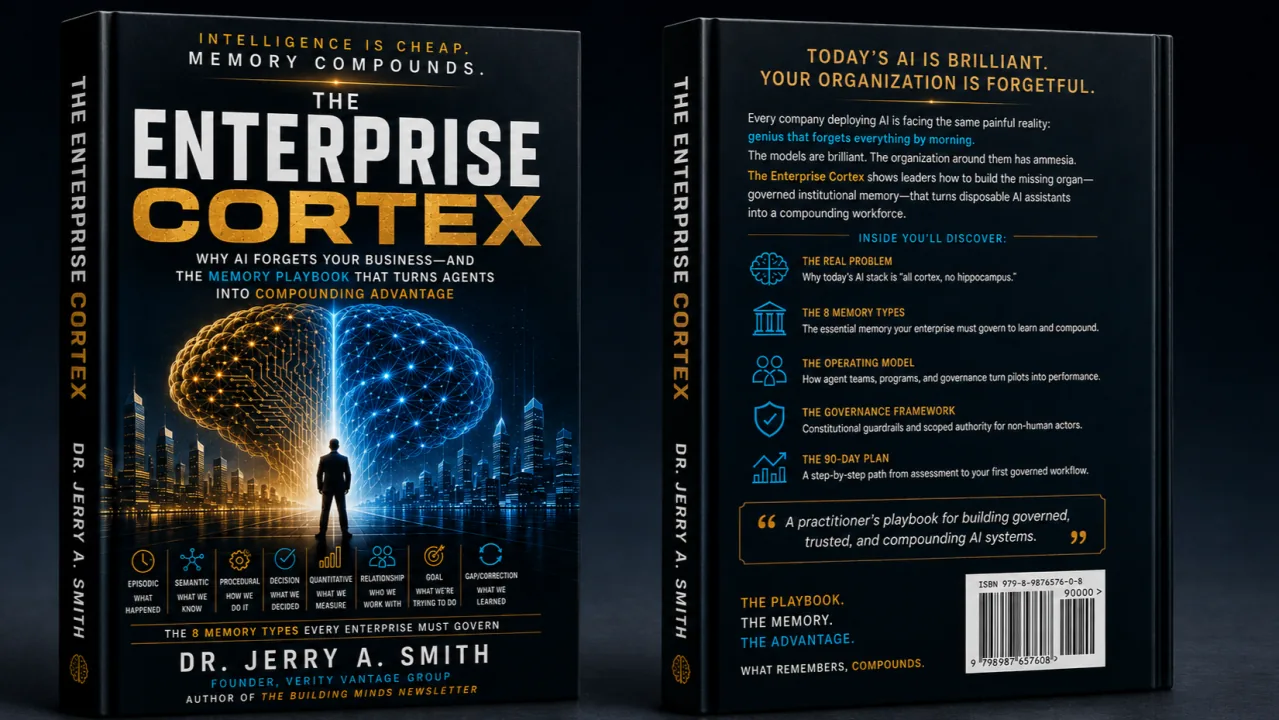
The Book Is Out: The Enterprise Cortex
Dr. Jerry A. Smith · August 27, 2026 · 4 min read
Building Minds — Special Edition
Thursday, 7:40 a.m. A managing director opens her laptop to prepare for a ten o'clock client meeting.
Her firm evaluated this exact opportunity three years ago. She knows this because a colleague mentioned it in the elevator. The document system returns 214 results, four of them titled "Final," two of those contradicting each other. The partner who led the work left in January. The model survives in a spreadsheet with a tab called Scenario_v7_USE_THIS_ONE, and nobody can say whether its numbers are actuals, projections, or the underwriting case a departed vice president built to win an argument.
At ten o'clock she walks into the meeting carrying roughly 60 percent of what her own firm already knew — and pays a second time, in client credibility, for the 40 percent she could not recover.
Nothing in that morning is exotic. That is what makes it worth a book.
So I wrote one.
The Enterprise Cortex is available today
For eighteen months, this newsletter has been circling a single argument from different angles: durable AI advantage is not being built in the models. It is being built in the structures around them — the memory systems, the coordination protocols, the governance layers.
The Enterprise Cortex: Why AI Forgets Your Business — and the Memory Playbook That Turns Agents into Compounding Advantage assembles that argument into one place, in order, with the receipts attached. Fourteen chapters, four parts, and two diagnostic instruments you can score your own firm against before you spend another dollar on models.
The thesis fits in three sentences. Your company is paying for genius and getting amnesia — every AI initiative starts over from zero each morning, because the organization deployed intelligence without deploying memory. The fix is not a bigger model; it is a governed institutional memory layer, an enterprise cortex, built over the systems you already run. Intelligence is becoming a commodity; memory is becoming the moat — because what remembers, compounds.
What is inside
Part I names the disease: the five symptoms of organizational amnesia, the control tax that arrives after the token discounts, and why the modern AI stack is all cortex, no hippocampus — enormous reasoning power attached to no organ of durable memory.
Part II describes the missing organ: why a store is not a memory, the eight kinds of memory a firm actually runs on, and why the training corpus — not the model — is the one product a competitor cannot replicate at any price.
Part III is the build: the sequencing that separates compounding firms from firms that rent intelligence and keep nothing, the agent topology that outperformed a single frontier model by 90.2 percent on the same evaluation, and the operating model for a workforce that is part human and part not.
Part IV is command and control: constitutions for non-human actors, the seven moves that get a transformation past the enterprise immune system, the five-question Mind Audit, and a ninety-day plan for the first governed workflow — with the gates that keep you honest.
Longtime readers will recognize the bones. Several chapters began life as editions of this newsletter, and I have said so in the book rather than pretending otherwise. What the book adds is the connective argument — the case studies threaded across chapters, the instruments in full, and the parts I could never fit in a weekly format.
Who it is for
I wrote it for the people who sit across the table from me: CEOs and boards funding AI initiatives that stall, Chief AI Officers staring down the eighteen-month clock, PE operating partners trying to move a portfolio rather than a pilot, and partners at professional-services firms whose real product was always judgment. If your AI produces impressive demonstrations and unmoved margins, this book is the diagnosis and the treatment plan, in that order.
It is deliberately short — a two-flight read at roughly 150 pages — because the executives it was written for do not need another 400-page survey. They need the argument, the instruments, and the build order.
Where to get it
The Enterprise Cortex is available now in three formats:
If the newsletter has earned its place in your weekly morning reads, the book is the compounded version of everything it has been building toward. And if you read it and it holds up, an honest review on Amazon in the first two weeks is the single most useful thing you can do for it — early reviews decide whether a book gets found or buried.
The soft close, kept honest
One disclosure, because this newsletter runs on receipts: the book is also the front door to the work my firm does. The final chapter ends where an engagement begins, and I have not disguised that. What I can promise is that the book holds nothing back to sell the meeting — the instruments, the design rules, and the ninety-day plan are complete on the page. Plenty of readers will build their cortex without ever calling me. The book was written so they could.
Next week, the regular editions resume. There is a vendor week worth reading closely, and the assurance-fraction ledger has new receipts.
What remembers, compounds. Go build the organ.
— Jerry