Essay
From Grep to Greatness: How GPT-5 Makes Text Pipelines Bulletproof
Dr. Jerry A. Smith · August 9, 2025 · 7 min read
(Follow-on to Unlocking Unprecedented Power: Why grep Is Your LLM’s Secret Weapon)

Listen to the article on Apple Podcasts
Listen to the article on Soundcloud
Introduction: From Sidekick to Safety Net
In my original article, grep wasn’t the star—it was the indispensable sidekick. A terse, battle-hardened Unix tool that doesn’t pretend to “understand” your text, but finds exactly what you ask it to, with brutal speed. The LLM was the headliner, spinning meaning from filtered fragments. The magic came from pairing them: deterministic speed meets probabilistic intelligence.
But the workflow still had a flaw: after the LLM finished, we had to check its work. A second grep pass verified structure, fields, and formatting. It was effective, but it was reactive. Now, with GPT-5 and its new regex-constrained tool calls, we can build pipelines that don’t just catch mistakes—they make them impossible.
Why Grep Still Deserves to Go First
Before getting excited about new model features, it’s worth remembering why grep has been in our toolbox for five decades. Filtering at the very start isn’t just a nice-to-have — it’s the difference between spending pennies and burning dollars.
Grep earns its place because:
- It’s fast — Streaming gigabytes per second is routine.
- It’s accurate — No hallucinations, no misinterpretations.
- It’s memory-lean — Works on files that dwarf system RAM.
Think of it as sweeping the stage before the main act comes on. No matter how brilliant GPT-5 is, you don’t want it tripping over stray cables. That’s why the first move is still:
grep -iE "billing|overcharge|refund" raw_chats.txt > billing_chats.txt
Even in a GPT-5-powered pipeline, removing irrelevant noise early will pay dividends downstream.
The Pain Point in the Old Pipeline
The grep → LLM → grep sequence worked well because each step had a clear job. But the second grep pass — the post-validation — was inherently reactive. We were looking for missing headings, malformed JSON, or any other output drift the LLM introduced.
The problem wasn’t that this check failed; it was that it ran after the expensive part. Every time an output failed validation, we had to pay for a rerun, introduce custom handling, or manually patch the result. It was like discovering a packaging defect after the truck had left the warehouse.
The ideal fix? Put the “don’t ship broken things” rule inside the LLM call itself.
GPT-5’s Game-Changing Constraint Ability
GPT-5 introduces a deceptively transformative but straightforward feature: custom tool calls that accept plain text constrained by a developer-supplied regex or grammar. This means the model’s output has to match your rules — if it doesn’t, the call fails before you even see it.
Why does this matter so much? Because it turns validation from a trailing process into a structural guarantee. You’re no longer asking the model to “please follow this format”; you’re enforcing it mechanically.
In practice, this is the difference between a junior analyst whose reports you always double-check and a system that literally cannot produce an invalid report.
The New Pipeline: Grep → GPT-5 (Regex Tool) → Optional Grep
This isn’t a reinvention; it’s an upgrade. The flow is the same, but the middle step is smarter.
First, we still let grep do the heavy lifting:
grep -iE "billing|overcharge|refund" raw_chats.txt > billing_chats.txt
Then we chunk for context, so the model isn’t chewing through megabytes at once:
from pathlib import Path
DOC = Path("billing_chats.txt").read_text().splitlines()
for i in range(0, len(DOC), 200):
    Path(f"chunks/{i//200:05}.txt").write_text("\n".join(DOC[i:i+200]))
And here’s where GPT-5 changes the game: we invoke it with a regex constraint.
system_msg = "You are a finance QA agent. Output MUST match the regex schema."
regex_pattern = r"(?s)^Resolution: .+\nStatus: (approved|denied|pending)\nNotes: .+$"
resp = openai.ChatCompletion.create(
    model="gpt-5",
    tools=[{
        "type": "custom",
        "name": "finance_summary",
        "input_format": regex_pattern
    }],
    messages=[
        {"role": "system", "content": system_msg},
        {"role": "user", "content": Path("chunks/00000.txt").read_text()}
    ]
)
We can still add a final grep pass if we want, but it’s now an optional spot-check instead of the primary defense.
Why This Changes More Than Just Code
On the surface, it’s a small change — moving validation rules into the model call. But the operational impact is much larger.
With constraints baked in, you no longer waste tokens generating unusable outputs. You don’t have to build brittle parsers to handle format drift. You can plug the model’s responses directly into downstream systems without extra sanitation layers.
This also changes how teams think about AI integration. Instead of treating LLMs as unpredictable black boxes that need cleanup, you can treat them as structured components in a deterministic pipeline.
Numbers Don’t Lie: Cost & Latency Gains
Let’s revisit the math with a real-world corpus: a 1-GB log file filtered and summarized in both the old and new pipelines. The differences stack quickly.
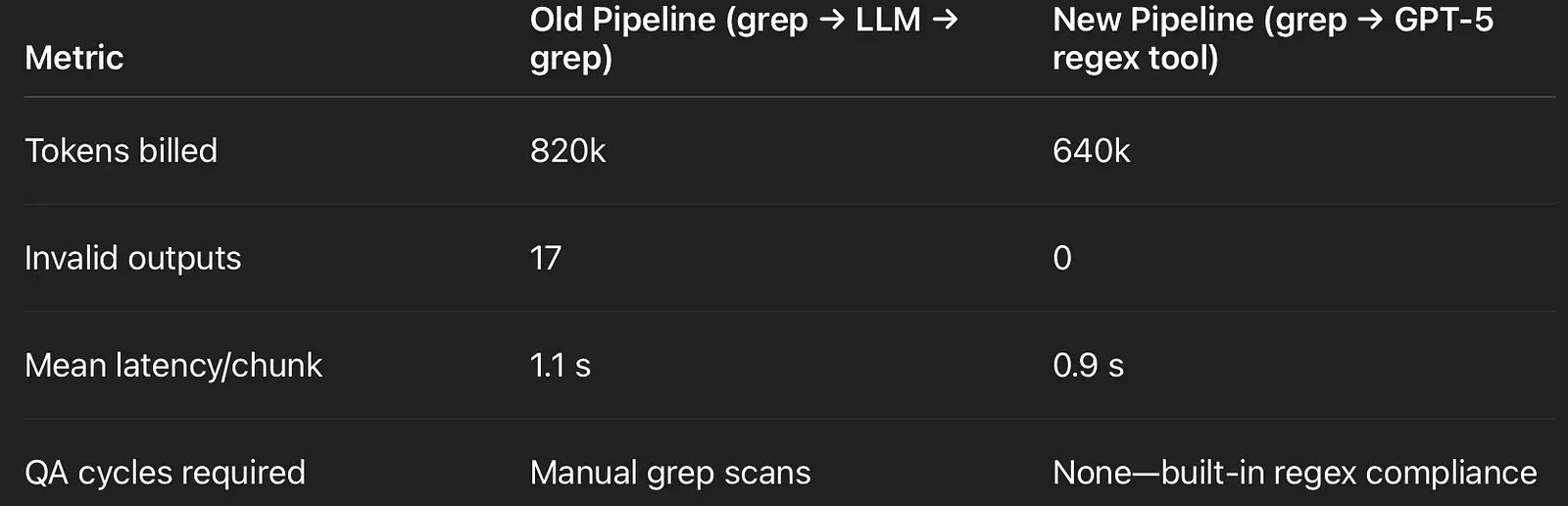
Even small token reductions compound at scale. For a team running millions of calls per month, these savings aren’t theoretical — they show up on the invoice.
Regex Patterns Worth Their Weight in Gold
Constraining GPT-5’s output isn’t just about preventing errors — it’s about encoding your business logic directly into the format. The regex becomes the contract between your AI and your automation.
Incident Reports — For structured documentation of operational problems, such as outages or safety events, where each record must have a unique ID, severity rating, and descriptive text.
IncidentID: [A-Z]{3}-\d{4}
Severity: (low|medium|high|critical)
Description: .+
Bug Tracker Summaries — For logging software issues with a clear title, priority level, and an estimated fix date, ensuring uniform records that can be triaged and scheduled automatically.
Title: .+
Priority: (P1|P2|P3)
FixETA: \d{4}-\d{2}-\d{2}
Customer Service Notes — For recording case resolutions in support systems, capturing the outcome, current status, and any contextual notes for the next agent or audit.
Resolution: .+
Status: (approved|denied|pending)
Notes: .+
The key is balance — lock down the fields that matter while leaving space for the model to write natural language in free-form sections.
Lessons That Still Apply
Technology evolves, but the fundamentals of building robust text-processing pipelines remain stubbornly relevant. GPT-5 changes where we enforce rules, but it doesn’t change the truth that bad inputs and sloppy processes will break even the most innovative models.
Start broad, then refine — The temptation with regex is to write something surgically precise from the start. Resist it. Begin with a wide net to ensure you capture all relevant data, then tighten the pattern through quick iterations. Too-narrow patterns don’t just miss edge cases — they can silently delete valuable context before it ever reaches the model.
Chunk aggressively — Large context windows are seductive, but they’re also expensive and latency-prone. Keep your inputs small and targeted. The goal is to hand the model problems it can solve completely in one go, without carrying the weight of unrelated noise. Chunking also makes it easier to reprocess only the segments that fail downstream checks.
Avoid regex bloat — Regex is a precision tool, not a competition for complexity. If your pattern reads like a cryptic crossword clue, it’s probably too brittle to maintain. Break complex extraction tasks into stages: first, use grep to identify clear anchors, then let GPT-5 handle the fuzzy, semantic parts. Maintainable patterns are an investment in your future.
And here’s the shift with GPT-5: the “QA Inspector” is no longer just stationed at the end of the line. They’re embedded inside the manufacturing process itself, turning quality control from a reaction into a guarantee. The habits above will make that embedded inspector’s job easier — and ensure your pipeline remains as lean and reliable as possible, even as tools continue to change.
Conclusion: From Guardrails to Guarantees
In the early days of AI-assisted workflows, we built guardrails. We filtered the data, validated the outputs, and crossed our fingers that nothing strange would slip through. It was a defensive posture — necessary, but reactive.
The grep + LLM pipeline was already a big step forward. It married the brute certainty of deterministic search with the adaptive intelligence of probabilistic models, delivering speed and savings without sacrificing accuracy. But the weak point was always the same: the real check happened after the expensive work was done.
With GPT-5’s regex and grammar constraints, we’ve moved from guardrails to guarantees. The model’s output isn’t just likely to be right — it can’t be wrong in the ways that break your systems. That shift ripples through every part of the workflow: fewer retries, lower bills, less QA overhead, and the freedom to automate with confidence.
And here’s the more profound truth: this isn’t just about regex or about one model release. It’s about a mindset. When you combine timeless, battle-tested tools like grep with next-generation AI that can respect rigid boundaries, you stop reacting to errors and start engineering them out of existence.
That’s not just efficiency. That’s leverage. And in a world where data velocity, cost control, and trust in automation define the winners, it’s the kind of leverage you can build an edge on — and keep.