Building Minds
Crossing the Chasm as a Firm, Not a Product
Dr. Jerry A. Smith · August 18, 2026 · 10 min read
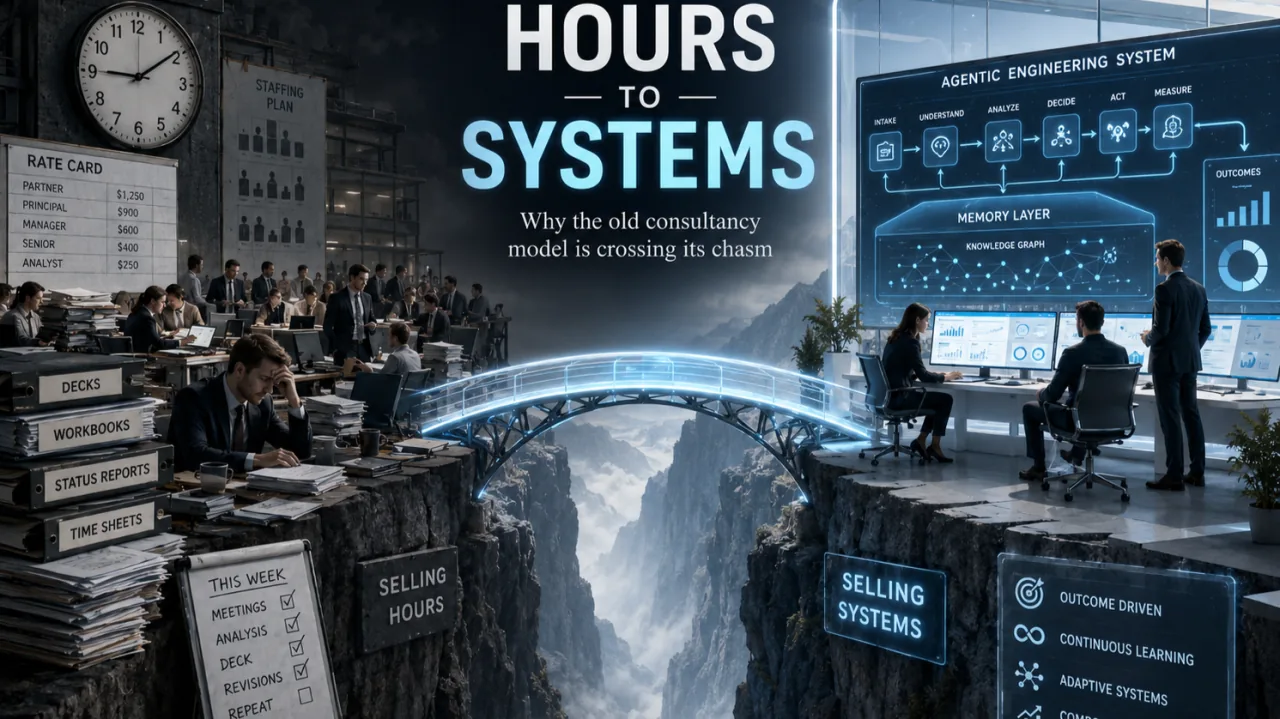
An AI practice will not save an hours consultancy. Seven characteristics have to change before the next SOW is signed — and here is the test.The check did not get smaller. It changed vendors.
By Dr. Jerry A. Smith
The check did not get smaller. It changed vendors
The check did not get smaller. It changed vendors.For fifteen years, a serious company with a serious problem bought a team. A digital-transformation firm showed up with a rate card, a bench, and a deck. The work was real. The product was hours. Scale meant more heads. And when the project ended, the judgment left with the people who had it. That was fine while hours were the only way to buy the work.
That buyer is still in the room. But the firms now competing for that check do not sell a bench. They sell a system that does the work, keeps what was learned, and comes back cheaper the second time. Some of these firms are two years old. Some are four people. By the standards of the old model they should not be winning enterprise work yet. They are winning it anyway, because the buyer is not buying maturity. The buyer is buying the job getting done.
This piece is for the person who runs an hours-based firm, and for the buyer deciding whether the next statement of work is still worth signing. The argument is short: the characteristics that made the hours firm work are now the characteristics that make it invalid, and "adding an AI practice" changes none of them.
Borrowing Moore's chasm, and changing what crosses
Geoffrey Moore's chasm was a product problem. A technology wins the early adopters, then has to cross a gap to reach the pragmatic early majority. The product crosses; the customers stay where they are on the curve.
The chasm in front of the hours consultancy is a firm-model problem, and the roles are reversed. Here the firm is what has to cross, and there is no early majority waiting on the far side. There is only a market that has learned to buy the work another way. On one side sits the firm that rents judgment by the week. On the other sits the firm that leaves a system behind. The emerging agentic-engineering shops started on the far side. The hours firm has to get there from the lagging edge, and it has to do so while those shops invoice its accounts.
So the useful question is not "how do we add an AI practice." It is: which characteristics of this firm have to change, or the firm stops being a valid way to buy the work?
"Invalid" needs a definition, because it does not mean the doors close next quarter. Hours firms can limp for years on retainers, relationships, and the last transformation budget nobody has raided yet. Invalid means the model no longer clears a market that has another way to buy the same outcome. You see it in conversations long before you see it in a filing.
The revenue is already moving
Discretionary project spend is the first thing a company cuts when the cycle turns. Hours businesses learned that in every downturn. What is new is what the money does instead of waiting for the cycle to come back.
The same operating budget that used to fund a six-month staffed build now funds a thinner team and a system: agents on a constrained workflow, a memory of what was decided last time, a loop a small group can run without a room full of billable people. The buyer did not turn against consultants. The buyer turned against renting the same judgment twice.
That is why "we have an AI practice" does not save the old firm. A practice is a slide and a pod; the invoice underneath it is still hours. For the emerging firm, the engineering is the product. A buyer can tell the difference in the first meeting. One conversation opens with who will be on the team. The other opens with which decision will be different on Friday.
Moore would file those emerging shops under innovators and the messy front of the early market. The hours firm keeps waiting for them to grow up, hire properly, and start buying services like a real company. Meanwhile they are taking the work.
Autopsy of a laggard
The pattern is stable enough to write without a name.
A digital-engineering firm is bought or built at the top of a transformation cycle. The thesis sounds durable: global talent, product-engineering depth, enterprise relationships, long-term demand for modernization and AI. The business is project-based. Revenue is discretionary. Utilization is the hidden P&L.
Then the cycle turns. Product-development budgets tighten. AI spend is real but uneven, and every rival has the same slide. The firm starts lagging its own sector before anyone calls it a crisis. Revenue does not just compress on a multiple; the business itself contracts, and margin follows utilization down. If the firm is levered the way an asset-light people business should never be levered, a dip becomes a rescue.
None of this requires a villain. The original thesis was not stupid. It was a peak-cycle bet that hours would remain the way companies buy software work. That is the bet that aged out.
Three things break, and only one of them is about the balance sheet.
Revenue was never durable. Time-and-materials engineering is first out of the budget and first into a price war with offshore majors and a dozen mid-market twins. If the offering is "we will staff your build," there is always someone cheaper.
The product did not change when the language did. AI arrived as a practice, a lab, an assessment. The invoice stayed in hours. The buyer who wanted an outcome kept meeting a firm that wanted a statement of work measured in weeks of people.
Memory left the building. Every engagement trained a team; the team rotated; the next engagement started from zero or from a slide graveyard. The emerging firm's advantage is not a smarter model. It is that the judgment does not walk out. What was believed, what was tried, what broke, what to watch: that decision memory stays in a system the buyer now owns.
A write-down and a restructuring can fix leverage. They cannot fix a product that is still hours. Deleveraging buys time. It does not buy validity.
The honest sentence
You do not get the old multiple back by running the old firm harder.
Recommended by LinkedIn
[ How to Run Pricing Experiments Without Killing Your…
Dr. Adrianne P.
How to Run Pricing Experiments Without Killing Your…
Dr. Adrianne P.
4 months ago](https://www.linkedin.com/pulse/how-run-pricing-experiments-without-killing-your-phillips-dba--jb8xc)
[ A Guide to Business Entities for Irish Businesses
Paul Melrose
A Guide to Business Entities for Irish Businesses
Paul Melrose
2 months ago](https://www.linkedin.com/pulse/guide-business-entities-irish-businesses-paul-melrose-dwlcf)
[ By 2029, You Will Still Have The Work. Someone Else…
Francis Maduakor
By 2029, You Will Still Have The Work. Someone Else…
Francis Maduakor
2 months ago](https://www.linkedin.com/pulse/2029-you-still-have-work-someone-else-margin-francis-maduakor-du7ge)
Owners and operators avoid that sentence because the whole identity of the firm is the old multiple: a services engine that, at the peak, printed a margin that looked like a product company. Utilization programs, a new hunter in sales, a cleaner delivery pyramid: those can stop the bleed. They are survive moves. They are not the crossing.
If the firm is still worth saving, the honest goal is not to restore yesterday's story. It is to become a different firm whose economics a buyer can believe. Capital wants a path back. The operator wants a firm that is still valid. Those two goals meet in exactly one place: the product changes.
If the honest goal is still "protect the old multiple," you will keep staffing the chasm. You will hire for the last cycle, price like the last cycle, and call the emerging shops a fad while they invoice your accounts.
What crossing actually is
Crossing is not a rebrand. It is a change in what is for sale. Three things change, one thing depends on what you already have, and two things that look like crossing are not.
Stop selling hours. Sell a system that does the work. A system has a named outcome, a constraint, and a way to tell whether it ran. It can still include people. It cannot be people billed by the week. Fixed scope, outcome-priced, repeatable: two or three offerings, not a menu of capabilities. If you cannot name the offering without naming a role, you are still selling a bench.
Land on a decision, expand into the system. The one AI motion that is not a slide is a cheap, honest diagnosis of a live operating problem, followed by a build the buyer can run without you in the room. If the diagnosis needs a circus, it is a pitch. If it cannot convert into a system, it is content. The emerging firms are good at the second half; that is why they get to charge for the first.
Scale is agents plus retained judgment, not more heads. Headcount still matters. It is no longer the product. The leverage is a constrained agentic workflow and a memory layer the client keeps. Senior people design the system and own the exceptions. They do not reconstruct last quarter's project from Slack.
Use a captive market only if you actually have one. A portfolio, an installed base, a set of operators who already trust you: that is an unfair advantage if it becomes the first outcome-priced work, not a captive hours dump. If you do not have one, do not invent the story. Verticalize into two or three sectors where you already have scars and let the scars be the wedge. A fake captive market is just a related-party staffing plan.
Two things are not the crossing, however good they feel:
Utilization is the fastest win and the wrong destination. Right-size the bench, lift billable time, strip the overhead that exists to service a model you are leaving. Do it to fund the crossing, not to tell yourself the old firm is back.
Thought leadership is not the crossing either. A point of view helps a buyer find you. It does not replace a product. If the only AI artifact is a podcast and a lab overview, you are still on the lagging side, talking to people who already left.
The characteristics that have to change
Moore's crossing needed a whole product, a beachhead, and a pragmatist who needed the category to feel safe. The firm-model crossing has a shorter list. If these do not flip, the old firm is not late. It is invalid.
Yesterday (laggard) → Has to become
- Sells hours and a bench → Sells a system that does the work
- Scale = more heads → Scale = agents + retained judgment
- Memory leaves with the team → Decision memory stays with the client
- AI is a practice, a slide → AI is the product
- Wins on rate card and logos → Wins on a live outcome the buyer can run
- Rides the transformation cycle → Owns a named wedge in two or three sectors
- Honest goal: protect the old multiple → Honest goal: become a different firm
Read it as a test, not a mural.
Can the firm price a job without a rate card? Can the buyer run the thing next month with a thinner team? Does anyone remember what was believed the last time this decision came up, without calling a person who left? If the answers are no, you are not "early." You are the firm the emerging shop is replacing.
If you are the buyer, your test is even shorter. You are not asking whether the firm can staff Java and a cloud migration. You are asking whether the next decision will be better because they were there, and whether you still need them in the room for the one after that. A laggard answers the first half with logos. An emerging firm answers the second half with a system.
What it looks like from the inside
You will see it in the conversations before you see it in the filing.
The RFP still asks for a team, and the serious buyer has already run a shadow process with a four-person agentic shop. Your best people want to build systems and are being told to protect utilization. Your AI assessment converts into more hours, not a product. Someone asks when revenue inflects; the honest answer is "when we become a different firm," and the slide says "when the market comes back."
The market that is coming back is not coming back for you. It is coming back as a different purchase.
That is the chasm. Not a gap in the adoption curve, but a gap between a firm that rents judgment by the week and a firm that leaves judgment behind. The emerging shops are already on the far side, competing for the same dollar, and they did not wait to be called early adopters.
Hours and a bench was a business. It is now a lagging layer in a market that has learned to buy the work another way. You can decline to cross. You cannot decline the test.
Dr. Jerry A. Smith is the founder of Verity Vantage Group. He spent years building AI practices inside firms that sold hours, and now builds the other kind: production systems with a decision memory the client keeps. VVG works with private equity firms and their portfolio companies. Navy veteran. He rewrites everything he publishes himself.