Building Minds
Your Sales Team Processes 10 RFQs. 8 Produce Zero Revenue. Here's How to Fix That.
Dr. Jerry A. Smith · March 18, 2026 · 10 min read
Building Minds | Dr. Jerry A. Smith
I sat across from an SVP who runs a $100M+ aftermarket parts operation and asked him what his win rate was on inbound RFQs.
"Twenty percent. Maybe."
I asked how many hours his team spent on the 80% that was lost.
He paused. "More than I want to think about."
Then I asked what would happen if an AI agent handled 9 out of every 10 RFQs automatically — ingesting the request, matching it against inventory and pricing, generating a quote, and sending it back — while his team focused on the one that actually needed a human.
His answer: "Call it a couple million. Call it five."
That conversation kicked off a 45-day pilot that I believe represents the highest-ROI AI use case in B2B operations today. Not chatbots. Not dashboards. An AI agent that processes RFQs in production — and learns from every win and loss.
Here's how it works, what it takes to build, and why most companies that need it haven't built it yet.
The Problem Is Bigger Than You Think
Every B2B company with inbound sales requests has a version of this problem. The specifics vary — manufacturing quotes, service estimates, parts pricing, project bids — but the economics are the same:
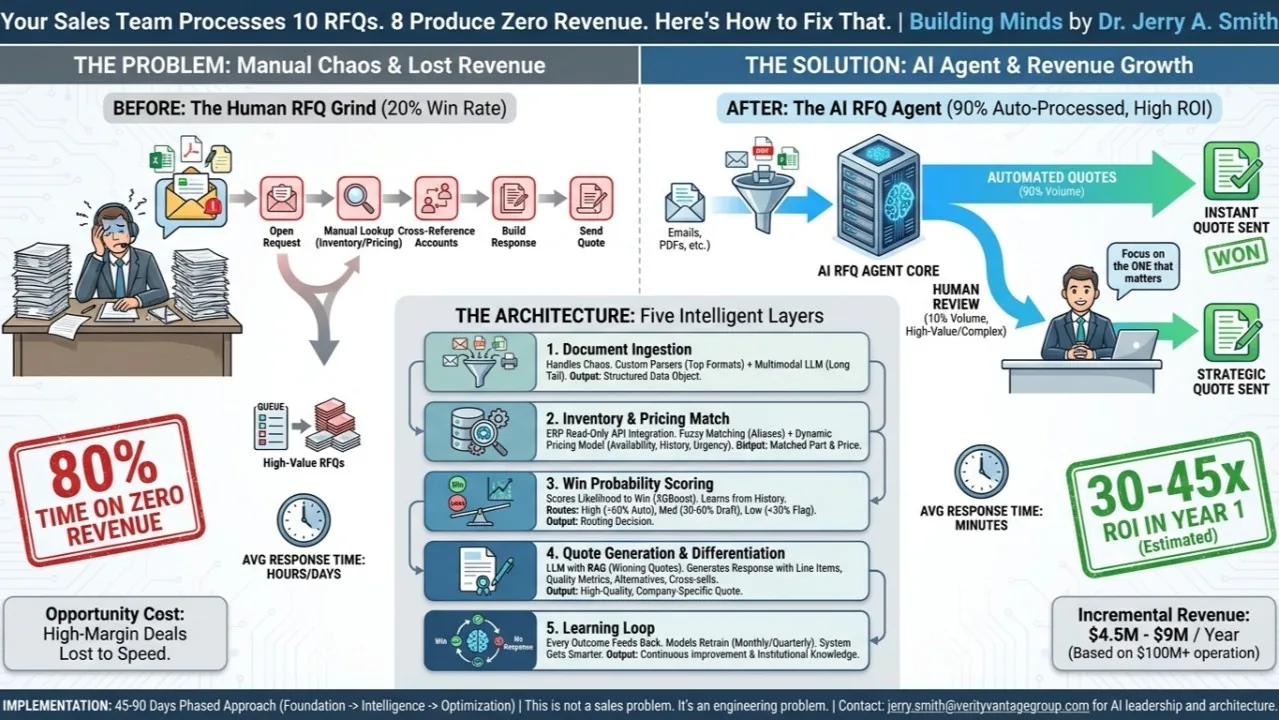
A request comes in. Someone opens it. They look up inventory. They check pricing history. They cross-reference the customer account. They build a response. They send it. And 70-85% of the time, they lose.
The waste isn't just labor cost. It's an opportunity cost. While your best people are grinding through requests they'll lose, the one RFQ that actually matters — the high-margin, high-probability deal — is sitting in a queue. By the time someone gets to it, a competitor has already quoted.
In aftermarket parts, speed is everything. An aircraft-on-ground (AOG) situation means someone needs a part now. The first credible quote wins. Not the cheapest quote. The first one.
This is the problem an AI RFQ agent solves. Not by replacing your sales team. By giving them back the 80% of their time that currently produces zero revenue.
The Architecture: Five Layers
Building an AI RFQ agent isn't a single model. It's a pipeline of five capabilities, each handling a different part of the workflow.
Layer 1: Document Ingestion
RFQs arrive as chaos. Emails with attachments. Excel spreadsheets with inconsistent formatting. PDFs with embedded tables. Phone calls that get transcribed into notes. Faxes — yes, in 2026, some industries still use faxes.
The ingestion layer has to handle all of it. The engineering decision here is whether to build custom parsers for each format or use a general-purpose document understanding model.
The right answer: both. You build format-specific parsers for the 3-4 most common RFQ formats you receive (these handle 70-80% of volume with high accuracy), and you run everything else through a multimodal LLM that extracts structured data from unstructured documents. The LLM handles the long tail — the weird formats, the one-off requests, the customer who sends a photo of a handwritten parts list.
The output of Layer 1 is a structured object: part numbers, quantities, delivery requirements, customer identifier, urgency indicators, and any special conditions. This structured data feeds every downstream layer.
Engineering decision that matters: Don't try to achieve 100% accuracy on document parsing. Aim for 95% automatic, 5% human review. That 5% includes genuinely ambiguous requests that a human would need to interpret anyway. Flag them, route them, and let the agent handle the rest.
Layer 2: Inventory and Pricing Match
Once you have a structured request, the agent queries your ERP for three things: whether you have the part, the current price, and the availability timeline.
This sounds simple. It's not.
Part numbers have aliases. Customers use their internal part numbers, not yours. A single RFQ might reference 15 line items across 3 different naming conventions. The matching engine needs fuzzy matching against your parts catalog — not exact string matching, but semantic matching that understands "P/N 7823-A Rev C" and "Boeing 7823A-C" are the same part.
The pricing logic is where the real intelligence lives. Static pricing is table lookup. Dynamic pricing — which is what you actually want — requires a model that considers: current inventory levels, historical pricing for this customer, competitive pricing intelligence (if available), current capacity utilization, urgency premiums, volume discounts, and the customer's lifetime value.
Most companies start with static pricing in the agent and add dynamic pricing in Phase 2. That's the right sequencing. Get the agent processing RFQs automatically with current-book pricing first. Then layer on the intelligence.
Engineering decision that matters: Build the ERP integration as a read-only API consumer, not a direct database connection. Your ERP is a production system. The RFQ agent should query it through the same API layer that your internal applications use. This keeps IT happy and makes the integration maintainable.
Layer 3: Win Probability Scoring
This is what separates an AI agent from a mailmerge script.
Every RFQ gets scored on the likelihood to win. The model learns from your historical data: which customers tend to convert, which part categories have high win rates, which request patterns indicate serious buying intent versus price shopping, and which competitors you tend to beat (or lose to) on specific product lines.
The scoring model uses gradient-boosted trees (XGBoost or LightGBM) trained on your historical RFQ outcomes. Features include: customer segment, part category, order size, requested lead time, day of week, time since the last order from this customer, and whether this is a repeat request for something previously quoted.
The score determines routing:
- High probability (>60%): Agent generates and sends the quote automatically. Human gets a notification but doesn't need to intervene.
- Medium probability (30-60%): Agent generates a draft quote. Human reviews, potentially adjusts pricing, and sends.
- Low probability (<30%): Agent generates a quote but flags it for strategic review. Is this a price-shopping exercise? A new customer worth investing in? A competitor's existing account worth disrupting?
The key insight: even the low-probability RFQs get quoted. They just get quoted automatically instead of consuming your best people's time. And the system tracks outcomes to continuously improve its scoring.
Engineering decision that matters: Start the win probability model with whatever historical data you have, even if it's messy. A model trained on 1,000 historical RFQs with 60% data quality outperforms no model. You can improve data quality while running the system.
Layer 4: Quote Generation and Competitive Differentiation
The agent doesn't just generate a price. It generates a response.
Recommended by LinkedIn
[ From Close Plans to Mutual Success Plans: Elevating…
Bob Apollo
From Close Plans to Mutual Success Plans: Elevating…
Bob Apollo
11 months ago](https://www.linkedin.com/pulse/from-close-plans-mutual-success-elevating-b2b-sales-outcomes-apollo-ogsie)
[ The Metrics Trap: Why Small B2B Sales Teams Are…
Tim Mata 🎯
The Metrics Trap: Why Small B2B Sales Teams Are…
Tim Mata 🎯
1 year ago](https://www.linkedin.com/pulse/metrics-trap-why-small-b2b-sales-teams-measuring-way-failure-mata--vjgsc)
[ Revision of The G.O.D Sales Rule
Gordon Tai 戴国栋, DBA.
Revision of The G.O.D Sales Rule
Gordon Tai 戴国栋, DBA.
1 year ago](https://www.linkedin.com/pulse/revision-god-sales-rule-gordon-tai-%E6%88%B4%E5%9B%BD%E6%A0%8B-mba-1uxec)
This is where your company's specific knowledge becomes a competitive weapon. The quote response includes:
- Line-item pricing with availability dates
- Relevant certifications and quality metrics (if your defect rate is <1%, that goes in every response)
- Alternative parts suggestions when the exact part is unavailable
- Cross-sell recommendations based on component co-occurrence patterns ("customers who order this part frequently also need these")
- Delivery timeline with confidence interval
The quote is generated by an LLM that has been fine-tuned (or RAG-augmented) on your company's specific quoting language, quality positioning, and competitive differentiators. This is what I call a company-specific Small Language Model (SLM) — not a generic AI, but one that knows YOUR process, YOUR quality story, and YOUR competitive positioning.
When a customer receives an AI-generated quote from this system, it should read like it came from your most experienced sales rep — because it was trained on how your best people communicate.
Engineering decision that matters: Don't try to fine-tune a model from scratch. Use RAG (Retrieval Augmented Generation) over your historical winning quotes. The model retrieves examples of successful quotes for similar requests and uses them as templates. This works immediately with no training time and improves as you add more winning examples.
Layer 5: Learning Loop
Every quote outcome — win, loss, or no response — feeds back into the system. The win probability model re-trains monthly. The pricing model adjusts quarterly. The quote language evolves based on what's converting.
Over time, the system develops institutional knowledge that no individual salesperson has: which product lines are trending, which customers are shifting buying patterns, which competitors are gaining or losing share, and which pricing strategies work in which contexts.
This is the long-term competitive moat. Your competitors can buy the same ERP. They can hire the same salespeople. They can't replicate an AI system trained on YOUR historical data, YOUR customer relationships, and YOUR win/loss patterns.
The Implementation: 45-90 Days
This isn't a 12-month enterprise project. Here's the phased approach:
Phase 1: Weeks 1-3 — Foundation
- Connect to ERP via API (read-only: parts catalog, pricing, inventory, customer records)
- Build document ingestion for top 3 RFQ formats (covers 70-80% of volume)
- Implement exact + fuzzy part number matching
- Static pricing lookup (current book prices)
- Basic quote template generation
At the end of Phase 1, you have an agent that can process a standard RFQ from ingestion to quote draft in under 60 seconds. A human reviews every quote before it is sent.
Phase 2: Weeks 4-6 — Intelligence
- Train the win probability model on historical RFQ data
- Implement routing logic (auto-send / human review / strategic flag)
- Add cross-sell recommendations
- Build company-specific quote language via RAG over historical winning quotes
- Begin tracking outcomes systematically
At the end of Phase 2, 60-70% of standard RFQs are processed automatically with human review only on exceptions. The system is learning from every outcome.
Phase 3: Weeks 7-12 — Optimization
- Dynamic pricing model (capacity-aware, customer-aware, competition-aware)
- LLM-based ingestion for non-standard RFQ formats (the long tail)
- Follow-up automation (nudge on quotes that haven't received a response)
- Competitive intelligence integration (where available)
- Dashboard for sales leadership: conversion rates, response times, revenue attribution
At the end of Phase 3, you have a production AI system that processes 90%+ of inbound RFQs with minimal human intervention, learns continuously from outcomes, and generates measurable revenue lift.
The Math
Let's use real numbers from a company I assessed:
- Current state: 500 RFQs/month, 20% win rate, $15K average deal size
- Current monthly revenue from RFQs: 100 wins × $15K = $1.5M/month = $18M/year
- With AI agent at 30% win rate: 150 wins × $15K = $2.25M/month = $27M/year
- Incremental revenue: $9M/year
- Conservative estimate (25% win rate): $4.5M/year incremental
Against that, the investment:
- Phase 1-3 build: $100-200K
- Ongoing infrastructure: $2-3K/month (cloud compute, API costs)
- Ongoing maintenance: 10-15 hours/month of engineering time
ROI: 20-45x in Year 1. This isn't theoretical. It's arithmetic.
But the revenue lift isn't even the most important number. The speed improvement is. When your average response time drops from 4 hours to 4 minutes, you win the deals that go to the first credible quote. In AOG situations, that's worth more than any pricing optimization.
Why Most Companies Haven't Built This
Three reasons:
First, they think RFQ processing is a "sales problem," not an "engineering problem." They hire more salespeople or buy a CRM. They don't think of it as a systems engineering challenge where AI can fundamentally change the economics.
Second, they're waiting for their ERP vendor to add AI. SAP, Oracle, and Infor are all adding AI features. They'll ship something in 2027 that does 30% of what a custom agent does today. By then, the companies that built their own will have 18 months of learning data that the late movers can't replicate.
Third, they don't have someone who can build it. This isn't a strategy problem. It's a build problem. You need an engineer who understands both the AI architecture and the business process — who can sit with the sales team, understand why they lose 80% of their quotes, and build a system that changes that ratio. That person is rare. Most AI consultants deliver recommendations. Very few deliver production systems.
The Bigger Picture
The AI RFQ agent is a specific instantiation of a broader pattern: agentic AI in B2B operations.
Every B2B company has workflows in which humans process inbound requests, look up information across multiple systems, apply judgment, generate a response, and track outcomes. RFQs, customer service tickets, insurance claims, loan applications, vendor evaluations, regulatory submissions — the structure is the same.
The companies that build AI agents for their highest-volume, highest-value workflows will operate at a fundamentally different efficiency level than the ones that don't. And the advantage compounds: the agent gets smarter with every transaction, while the manual process stays exactly as slow as it was yesterday.
The question isn't whether AI agents will process your RFQs. It's whether you build the one that learns from YOUR data and reflects YOUR competitive positioning — or whether you wait for a generic tool that treats your company like every other company.
I know which one I'd build.
Dr. Jerry Smith has spent 20+ years deploying production AI systems across industrial companies and PE portfolio companies. He holds a PhD in Computer Science and is a Navy veteran. He writes Building Minds weekly on AI leadership and architecture.
If your company processes high volumes of inbound requests and you want to explore what an AI agent could do, reach out: jerry@drjerryasmith.com