Essay
Your AI Isn’t Intelligent — It’s Just Really Good at Pretending
Dr. Jerry A. Smith · November 17, 2025 · 6 min read
Listen to the article on Apple Podcasts
Listen to the article on Soundcloud
When ChatGPT forgets the details of your earlier conversation or an autonomous vehicle fails spectacularly in a scenario it has never encountered, you’re witnessing the fundamental limitations of today’s artificial intelligence. These aren’t bugs to be fixed with the following software update. They’re architectural constraints baked into the very foundation of how we build intelligent systems. And they point to why we need something entirely different: Synthetic Intelligence.
The Current AI Landscape
The past three years have brought an extraordinary revolution in artificial intelligence. Large Language Models like GPT-4 and Claude write essays, generate code, and engage in sophisticated conversations. Image generators create photorealistic artwork from text descriptions. These generative AI systems have attracted hundreds of billions of dollars in investment and transformed various industries, including software development and creative production. Their capabilities in pattern matching and synthesis are genuinely impressive, often surpassing human performance on specific tasks.
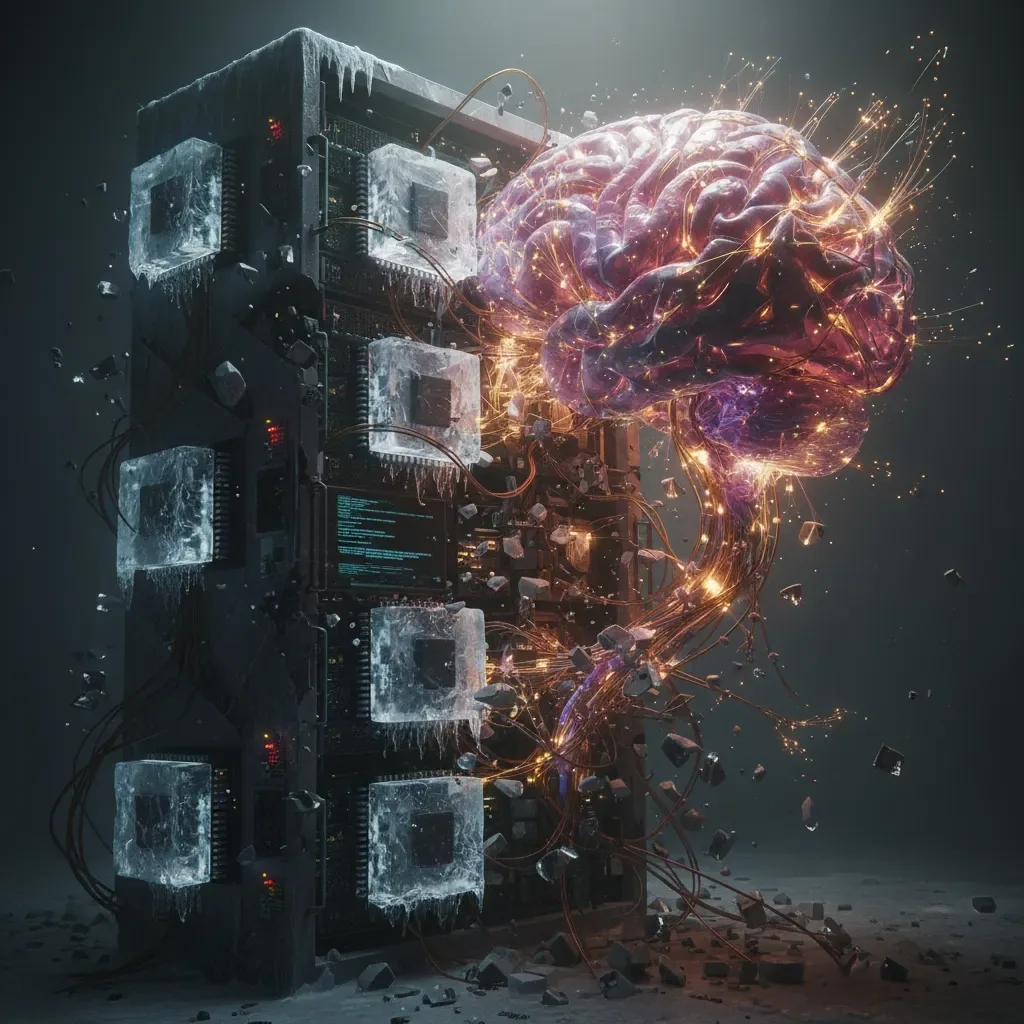
Yet beneath these remarkable achievements lies a computational architecture that hasn’t fundamentally changed since the 1940s. Today’s AI systems run on von Neumann architectures that strictly separate memory from processing. They’re trained on massive datasets, then frozen into static models deployed to production. When they generate text or images, they’re executing sophisticated pattern matching based on probabilistic correlations learned during training. They simulate intelligence through imitation, analyzing billions of examples to mimic human-like responses. This simulation approach has taken us remarkably far, but we’re now hitting its hard limits.
The Fundamental Limitations
The most critical flaw in current AI is catastrophic forgetting. When an AI model learns something new, it tends to overwrite what it previously learned. Imagine if every time you learned a new person’s name, you forgot someone else’s. This is why Large Language Models are “frozen” after their initial training phase. They cannot learn continuously the way humans do throughout our lives. Instead, they rely on static knowledge that becomes outdated the moment training ends, supplemented only by temporary context windows that vanish when the conversation ends.
Consider a medical AI system trained on research available in 2023. When groundbreaking studies emerge in 2024, AI cannot incorporate the new knowledge without expensive retraining, which risks degrading its performance on everything it previously knew. It cannot adapt to the specific cases it encounters in a particular hospital or learn from the unique patient populations it serves. The training-deployment divide means these systems are perpetually living in the past, their knowledge frozen at a point in time.
This limitation extends beyond simple knowledge updates. Current AI systems reason through correlation rather than causation. They identify patterns in their training data without understanding the underlying cause-and-effect relationships. This correlation-based approach works remarkably well for common scenarios represented in training data, but it becomes dangerously brittle when encountering novel situations. An AI might “understand” thousands of recipes well enough to generate new ones, but fail when asked to substitute ingredients based on their chemical properties and cooking behaviors. It has learned associations without comprehending the causal mechanisms that make cooking work.
The system mimics understanding without possessing genuine cognition. It simulates reasoning by pattern matching against its training corpus, meaning its intelligence is fundamentally imitative rather than generative in an absolute sense. This isn’t simply a philosophical distinction. It has profound practical implications for reliability, adaptability, and autonomous operation.
Why This Matters Now
These architectural limitations create immediate business consequences. Organizations face costly retraining cycles every time their domain knowledge evolves or their operational context changes. They cannot deploy truly autonomous systems that learn and adapt in production environments. As competitive needs evolve, AI systems become progressively less relevant unless completely retrained. Personalization remains superficial because models cannot genuinely learn from individual users over time. The promise of AI, which grows more capable through experience, remains unfulfilled.
The safety implications are even more pressing. In autonomous vehicles, medical diagnosis, and critical infrastructure management, we need systems that can reason causally about novel situations, rather than just pattern-matching against training data. Current AI’s unpredictable failures in edge cases create significant liability exposure. When a system cannot explain its reasoning based on a genuine understanding of cause and effect, stakeholders cannot trust it with decisions that have high stakes. The lack of genuine causal comprehension means we’re building systems that work most of the time but fail catastrophically when it matters most.
We’re also approaching a scaling wall. Diminishing returns from ever-larger models suggest that simply adding more parameters and training data won’t solve these fundamental problems. The energy consumption of training massive models has become economically and environmentally concerning. High-quality training data is increasingly scarce as we exhaust readily available datasets. The path forward requires architectural innovation, not just incremental scaling of existing approaches. We need a different paradigm entirely.
Synthetic Intelligence as the Solution
Synthetic Intelligence represents a fundamental reimagining of how we create intelligent systems. Rather than simulating human thought through pattern matching on massive datasets, SI aims to create genuine, non-imitative cognition. The term “synthetic” doesn’t mean “fake” but rather “manufactured” — human-made intelligence that functions as a genuinely cognitive system rather than an imitation of one.
SI rests on three foundational pillars. First, it embraces physical embodiment through Material-Based Intelligence, where computation is integrated directly into the physical substrate rather than separated into distinct hardware and software layers. In this approach, the material’s dynamics and interactions embody the program itself, with memory and processing unified rather than artificially separated. This includes neuromorphic hardware that mimics neural and synaptic structures, as well as Synthetic Biological Intelligence, which combines living neural tissue with engineered hardware for computation through biological-digital interactions.
Second, SI solves catastrophic forgetting through Nested Learning architectures. Instead of frozen monolithic models, these systems implement multi-timescale updates that allow them to learn one new thing at a time and remember it forever. A System-LLM acts as a high-level planner and reasoner, orchestrating specialized sub-modules for logic, memory, and action. This modular, self-modifying architecture enables meta-learning — the system learns how to learn more effectively, optimizing its own future learning strategy. It’s intelligence that grows genuinely more capable through experience.
Third, SI integrates causal reasoning at its core. Rather than relying on correlation, these systems use structural causal models to understand cause-and-effect relationships. This makes them robust to distribution shifts and novel scenarios because they reason from first principles rather than pattern matching. When an SI system encounters a situation unlike anything in its training, it can reason about the causal mechanisms at play rather than simply failing or producing nonsensical outputs.
This represents a paradigm integration. Suppose Generative AI is a talented artist who can copy any painting by studying billions of examples, and Thinking AI provides the specialized tools, like understanding perspective and physics. In that case, Synthetic Intelligence is the creation of a living, evolving artist who synthesizes these capabilities, learns continuously from every experience, and spontaneously invents entirely new artistic styles the world has never seen. SI doesn’t just use neuromorphic computing and causal inference as techniques — it integrates them into a genuinely autonomous, continuously adaptive, and physically embodied form of cognition.
The Path Forward
The near-term applications are already emerging. Personalized learning systems that genuinely adapt to individual students over time, rather than serving static content. Adaptive robotics that learn from experience in specific environments rather than requiring complete reprogramming. Domain-specific autonomous agents in healthcare that incorporate new research automatically, in manufacturing that optimize themselves based on actual production experience, and in autonomous systems that improve their decision-making through real-world operation.
For organizations navigating the AI landscape, this represents both a challenge and an opportunity. The research priorities are clear: developing Nested Learning architectures that overcome catastrophic forgetting, advancing Material-Based Intelligence approaches that integrate computation with physical substrates, and building causal reasoning capabilities into learning systems. The investment thesis centers on the reality that simulation-based AI has natural limits, while genuine cognition offers exponential improvements in adaptability, reliability, and autonomous operation.
We stand at an inflection point. The question isn’t whether to continue scaling today’s AI approaches, but whether to begin the transition from simulation to synthesis — from imitation to genuine intelligence. Synthetic Intelligence isn’t just the next generation of AI. It’s a fundamentally different paradigm for creating systems that think, learn, and adapt in ways that current architectures simply cannot. The future of intelligence isn’t bigger models trained on more data. It’s systems that genuinely understand, continuously learn, and autonomously improve. That future is Synthetic Intelligence.