Essay
Why Your AI Agents Keep Failing — And What Synthetic Intelligence Can Do About It
Dr. Jerry A. Smith · October 7, 2025 · 9 min read
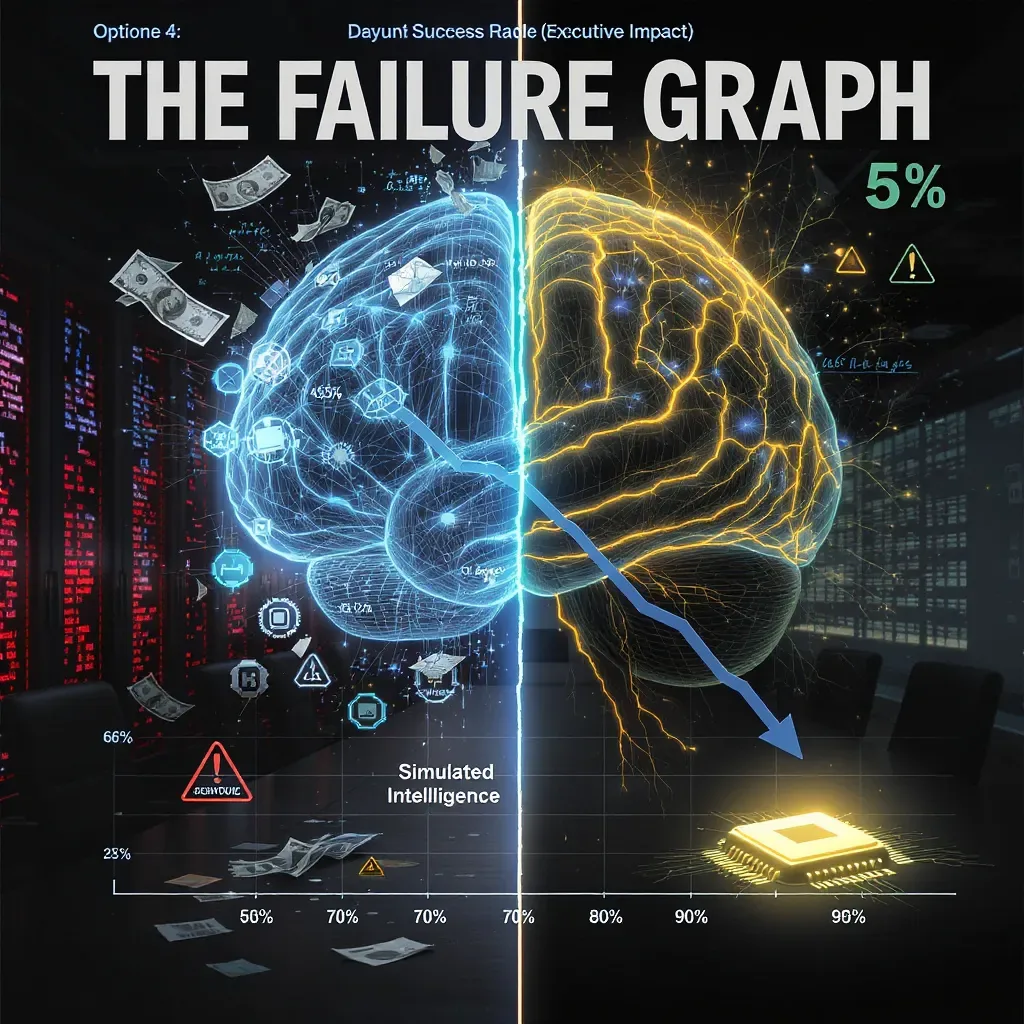
Listen to the article on Apple Podcasts
Listen to the article on Soundcloud
The AI ROI Crisis
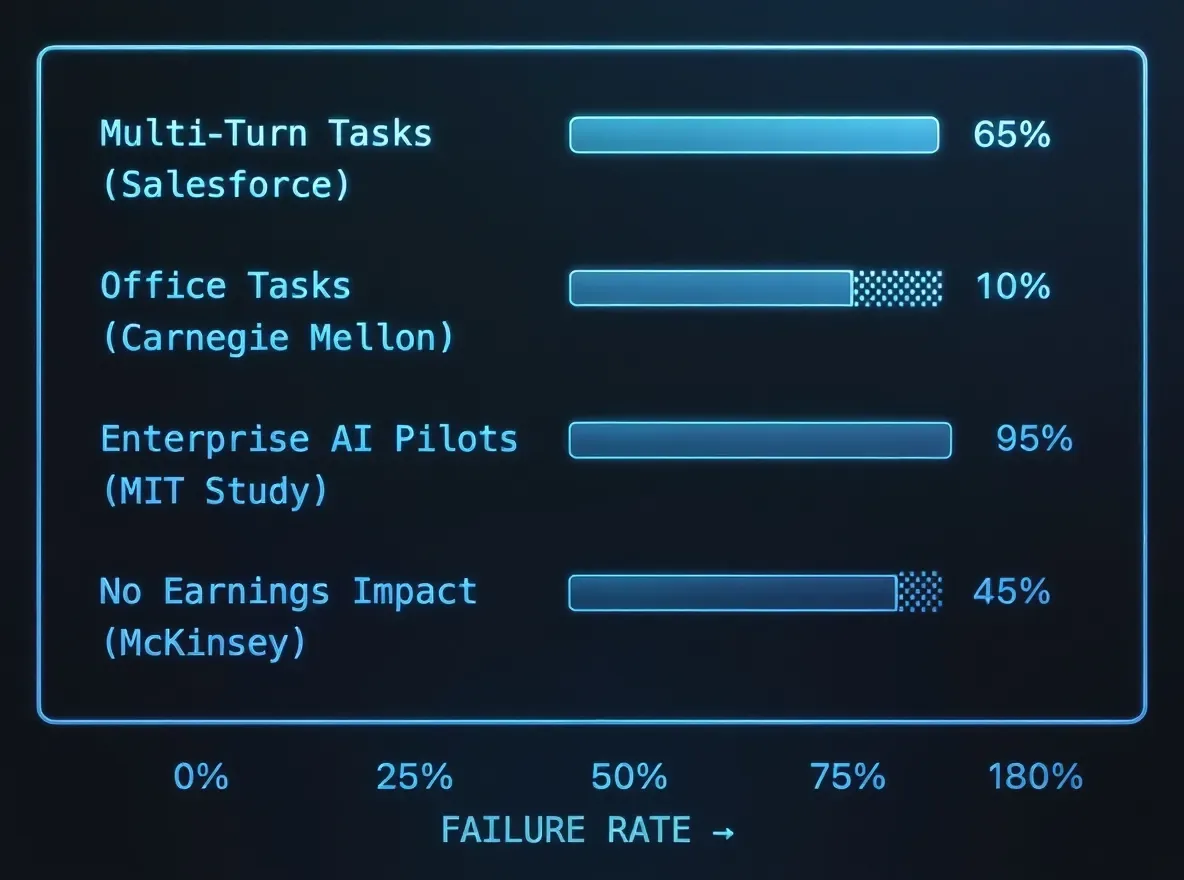
Ninety-five percent of enterprise AI pilots are failing. If you’re an executive who’s invested millions in AI agents only to watch them stumble, you’re not alone. According to MIT research, only 5% of custom enterprise AI tools reach production. More troubling: 80% of executives report no material impact on earnings from their AI initiatives, and only 1 in 4 AI projects delivers their expected return on investment.
The data reveals an uncomfortable truth — companies are now rehiring humans to do work where AI agents have failed. After a year of aggressive AI deployment, enterprises are retrenching, returning to human workers who can reliably complete tasks that seemed perfect for automation.
The problem isn’t AI itself. The problem is that we’re using the wrong kind of intelligence for tasks that require genuine autonomy, adaptation, and decision-making. Today’s transformer-based systems can simulate intelligent responses, but they cannot think, prioritize, or care about outcomes. And that fundamental limitation is costing businesses billions in failed deployments and missed opportunities.
The Real Problem: Today’s AI Can’t Think, It Can Only Respond
Three failure modes dominate executive AI initiatives today. First, Salesforce research shows that enterprise AI agents fail 65% of multi-turn tasks — conversations requiring more than simple question-and-answer exchanges. Analysis reveals agents struggle fundamentally with information gathering, with 45% of failures attributed to incomplete context acquisition.
Second, Carnegie Mellon University found that AI agents fail at office tasks nearly 70% of the time. These aren’t edge cases — agents routinely struggle to navigate basic digital interfaces, misunderstand straightforward instructions, and lack common sense judgment. Tasks humans complete in minutes can take agents hours or end in complete failure.
Third, integration nightmares plague deployment. Nearly 60% of enterprise leaders cite legacy system integration as their primary barrier to AI adoption. AI solutions often fail to scale due to fragmented data pipelines, siloed information, and inadequate operational alignment. Without unified data governance, agents hallucinate, misfire, and require constant human intervention.
Why do current AI agents fail so consistently? The answer lies in their fundamental architecture. Large language models are reactive systems — they respond to prompts but maintain no genuine continuity between interactions. As one AI researcher put it, “Every prompt exists in a vacuum.” Models lack actual memory, cannot retain meaningful context across sessions, and must be explicitly programmed with goals rather than generating their own purposes.
More fundamentally, transformer-based AI processes information but doesn’t experience it. Your customer service AI can answer questions but doesn’t care about customer satisfaction. Your automation agent follows scripts but cannot prioritize when business objectives conflict. These systems execute instructions brilliantly but cannot ask the critical question every intelligent being asks: “What should I care about?”
This isn’t a training problem or a prompt engineering challenge. It’s an architectural limitation. Systems built on transformers — no matter how sophisticated — lack the capacity for genuine autonomy, intrinsic motivation, and adaptive learning that real-world business problems demand.
Figure 1: AI Agent Failure Rates Across Enterprise Use Cases
The Hidden Cost Crisis: Energy Economics at Scale
While executives focus on deployment failures, an even more serious crisis lurks in the infrastructure costs. A single ChatGPT query consumes approximately 0.3 kilowatt-hours of electricity — roughly 1,000 times more energy than a traditional Google search at 0.0003 kWh. This isn’t a trivial difference. It’s a fundamental economic constraint that makes large-scale AI deployment financially unsustainable.
The energy math gets worse. Meta disclosed that 70% of their AI infrastructure power consumption goes to inference, not training. While training is a one-time cost, inference runs continuously every time a user interacts with the system. At scale, these costs compound exponentially. Current small models cost approximately $10,000 per year in compute alone. Multiply that by hundreds or thousands of concurrent agents in enterprise deployment, and operational costs balloon into millions.
For companies deploying AI at scale, the implications are stark: energy costs for AI operations will soon exceed employee salaries for equivalent functions. This creates an impossible business case. You cannot achieve positive ROI when your automated systems cost more to operate than the humans they replace.
The problem becomes even more acute for edge computing applications. Autonomous robots require onboard intelligence but are subject to strict power constraints. High GPU power consumption degrades vehicle range, reduces flight time for drones, and makes battery-powered systems impractical. Mobile autonomous systems — from warehouse robots to delivery vehicles — cannot run current AI architectures on battery power for meaningful operational periods.
Meanwhile, a competitive threat emerges. The neuromorphic computing market is growing at 89.7% CAGR, expanding from $28.5 million in 2024 to a projected $1.32 billion by 2030 — a 45-fold increase in just six years. Companies like Intel, IBM, and BrainChip are already deploying brain-inspired computing in autonomous vehicles, robotics, and edge computing devices. These early adopters are gaining orders-of-magnitude efficiency advantages while competitors remain locked into unsustainable transformer architectures.
Figure 2: Energy Consumption Comparison
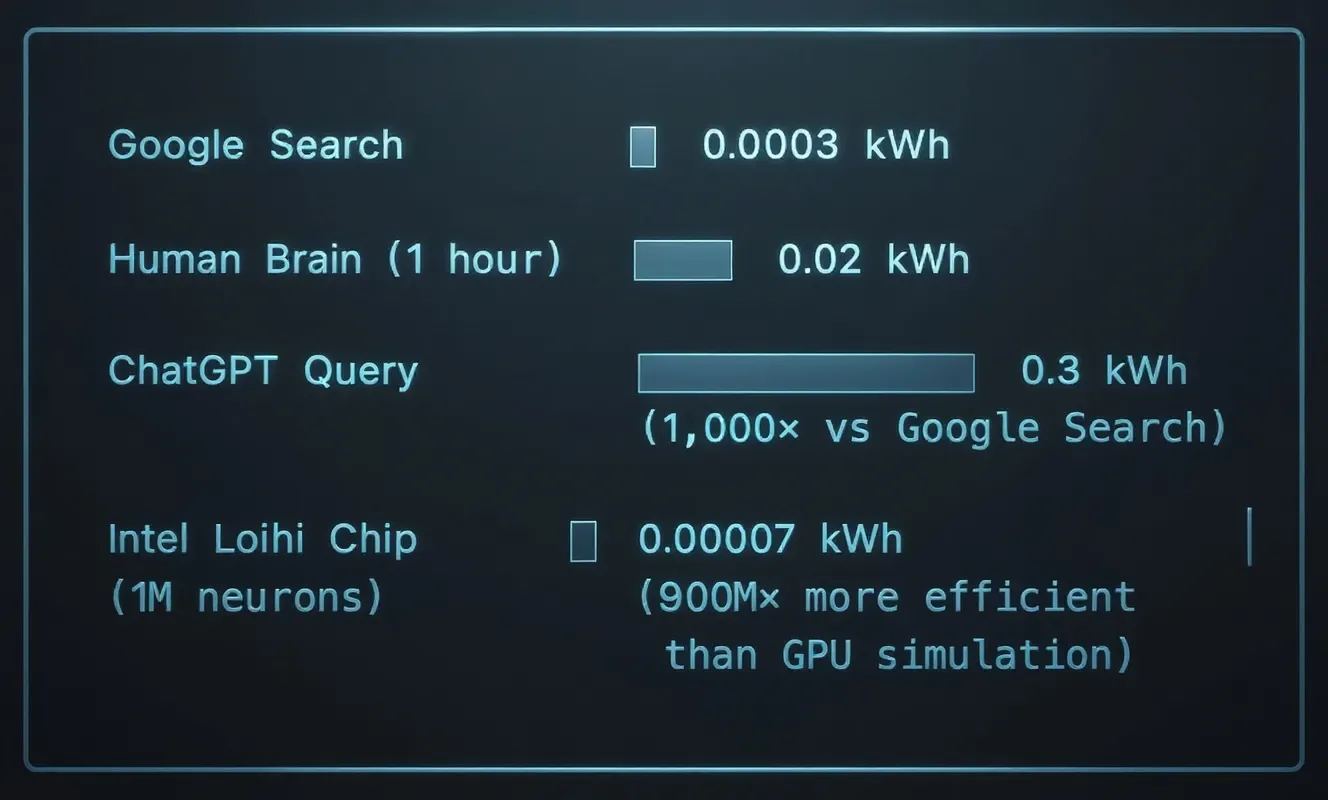
Key Insight: 70% of AI infrastructure power goes to inference, not training. At scale, energy costs become unsustainable with current architectures.
Introducing Synthetic Intelligence: The Brain-Inspired Alternative
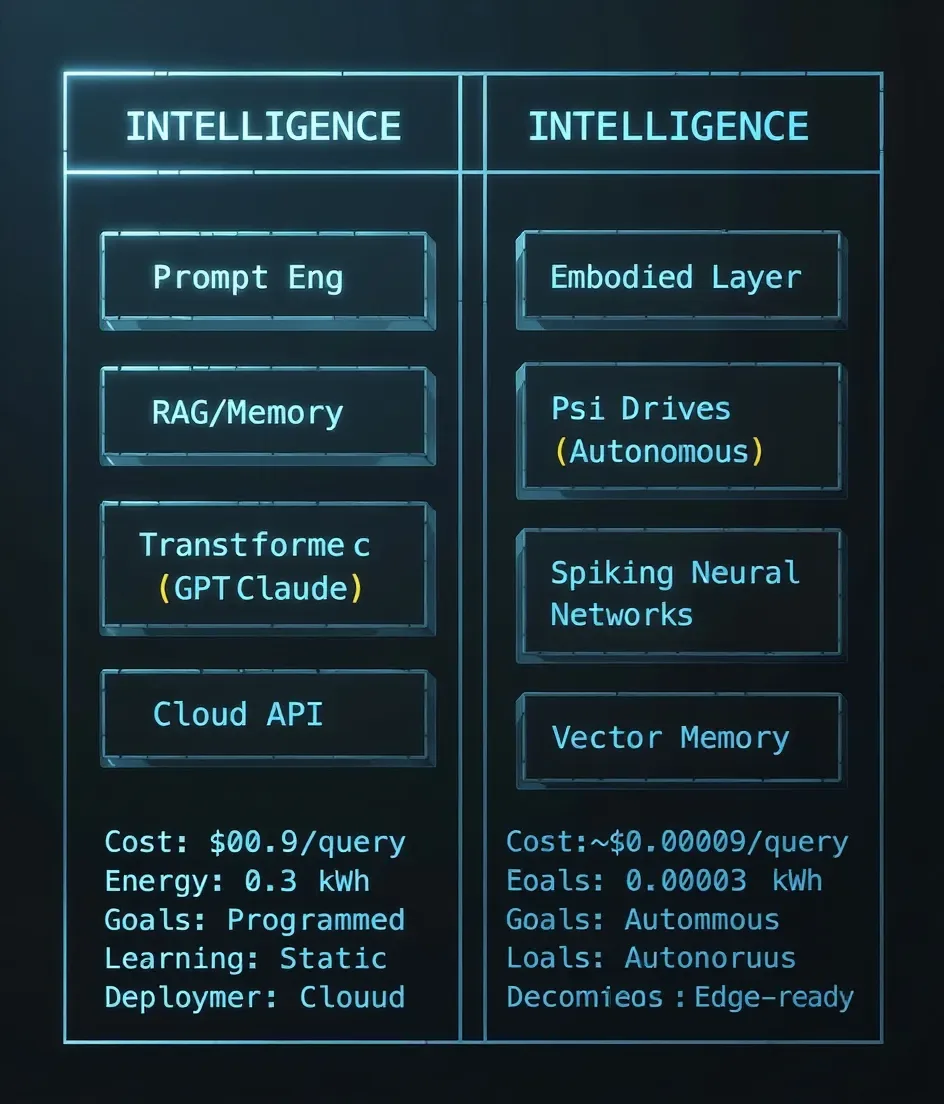
Synthetic Intelligence represents a fundamental paradigm shift. Rather than simulating intelligent behavior through massive computational brute force, SI creates genuine non-biological intelligence by replicating how biological brains actually work: spiking neurons, temporal dynamics, and biological learning mechanisms.
The architecture is composed of three integrated layers. First, neuromorphic processing using Spiking Neural Networks provides the computational foundation. Unlike transformers that process information in parallel with artificial time encodings, SNNs handle temporal dynamics the way biological neurons do — through discrete electrical spikes that encode information in their timing and patterns. The energy advantage is staggering: human brains process information using just 20 watts, with approximately 100 billion neurons. Intel’s Loihi neuromorphic chip processes 1 million neurons using 70 milliwatts. This isn’t incremental improvement — it’s 900 million times more energy efficient than simulating brain-level computation on traditional hardware.
Second, Psi-Theory cognitive architecture provides autonomous motivation. Developed by cognitive scientist Dietrich Dörner, Psi-Theory models intelligence as a homeostatic system driven by four fundamental drives: Competence (mastering skills), Affiliation (social connection), Certainty (understanding and prediction), and Existence (survival and resources). Unlike programmed objectives, these drives create autonomous goal formation. When drives go unsatisfied, the system automatically generates goals to address deficits — not because programmers told it what to want, but because internal needs create intrinsic motivation.
This distinction is critical. Your LLM-based customer service agent follows scripts. A Psi-based SI system develops genuine affiliation drive — it’s actually motivated to help customers because satisfying that drive creates internal reward signals. Your current automation agent optimizes metrics you specify. An SI research assistant pursues competence and certainty drives — it genuinely wants to master skills and understand problems.
Third, vector memory systems utilizing technologies like FAISS and ChromaDB offer semantic and episodic memory capabilities. SI systems maintain genuine continuity across interactions, storing experiences as high-dimensional vectors and retrieving similar patterns for reasoning. Every interaction strengthens the system’s understanding without requiring expensive retraining.
The result: systems that don’t just process information but experience their internal states. Systems that ask “What should I care about?” and “Why does this matter?” before deciding how to act. This is the difference between sophisticated automation and genuine intelligence.
Figure 3: Architectural Comparison — LLM Agents vs Synthetic Intelligence Real-World Business Applications
Synthetic Intelligence solves problems that transformer-based systems cannot address. In autonomous robotics, manufacturing systems must adapt to novel situations without requiring reprogramming. SI-based robots learn from embodied interaction, developing skills autonomously through competence-driven satisfaction. Warehouse optimization systems self-improve not because humans specify new objectives but because internal drives motivate capability development. And critically, these systems run on battery power for full operational shifts — impossible with current GPU-based AI.
Edge AI applications transform when power constraints disappear. Autonomous vehicles gain genuine environmental awareness and adaptive decision-making while running on vehicle electrical systems. IoT devices deploy sophisticated onboard intelligence without requiring cloud connectivity. Medical monitoring devices adapt to individual patient patterns in real-time, learning continuously from biosensor data without bandwidth-intensive cloud processing.
Enterprise systems gain capabilities that today’s automation cannot provide. Customer service systems genuinely motivated by affiliation drives provide contextual support that feels authentic rather than scripted. Quality control systems driven by competence motivation actively seek process improvements. Security systems with existence drives exhibit genuine vigilance — not just pattern matching but adaptive threat response motivated by self-preservation.
The cost economics are transformative. At scale, businesses can deploy 1,000 synthetic intelligence agents for the operational cost of a single LLM-based agent — a 1,000 to 10,000-fold cost reduction on inference workloads. This enables sustainable scaling to millions of concurrent autonomous systems, opening up market opportunities that are impossible under current AI economics.
The Strategic Choice: Lead or Follow
Market dynamics are shifting rapidly. The neuromorphic computing sector is transitioning from research curiosity to commercial deployment. Major enterprises — particularly in robotics, autonomous vehicles, and defense — are making long-term commitments to brain-inspired architectures. Meanwhile, Gartner predicts that over 40% of current agentic AI projects will be canceled by the end of 2027 due to escalating costs, unclear business value, and inadequate risk controls.
This creates a strategic opportunity. Companies investing in synthetic intelligence now gain a 3–5 year competitive advantage before the technology reaches mainstream adoption. Early movers build expertise, capture patents, and establish market leadership positions while competitors struggle with failing LLM deployments and unsustainable operational costs.
The recommended approach is hybrid. Continue using LLMs for current needs, such as content generation, question answering, and simple automation, where reactive systems are sufficient. Simultaneously launch synthetic intelligence initiatives for next-generation autonomous systems requiring genuine adaptation, intrinsic motivation, and sustainable economics. Position your organization as dual-capability: providing today’s automation while leading tomorrow’s autonomy revolution.
Three strategic questions should guide your decision. First, can your business scale AI profitably at current energy costs, or will operational expenses eventually exceed the value AI provides? Second, do your most valuable applications need genuine autonomy and adaptive learning, or can they function with sophisticated automation? Third, will you lead the neuromorphic revolution or follow competitors who capture first-mover advantages?
The bottom line is simple. Large language models simulate intelligence through computational brute force. Synthetic intelligence creates genuine non-biological intelligence through biological principles. The question facing executives isn’t whether to adopt SI — it’s whether your organization will be among the leaders who define the next generation of autonomous systems, or among the followers who struggle to catch up when transformer economics finally collapse.
The AI agents you deployed last year are failing because they were never brilliant. The synthetic intelligence systems you deploy next year will succeed because, for the first time, they genuinely are.
What Comes Next
The evidence is clear: transformer-based AI agents are failing at rates ranging from 65% to 95% across various enterprise use cases. Energy costs are unsustainable at scale. The fundamental architecture cannot deliver genuine autonomy; it can only provide sophisticated automation.
Synthetic intelligence, built on neuromorphic computing, biological learning principles, and autonomous motivation systems, offers a path forward. Not as a replacement for every AI application, but as the foundation for systems that genuinely need to think, adapt, and operate independently.
The neuromorphic computing market is growing at a rate of 89.7% annually, from $28.5 million in 2024 to a projected $1.32 billion by 2030. Intel, IBM, and BrainChip are deploying brain-inspired chips in autonomous vehicles, robotics, and edge computing. This isn’t speculative technology — it’s entering production now.
For organizations facing the strategic question of where to invest AI resources, the answer increasingly points toward a hybrid approach: continue using LLMs where reactive systems suffice, while building capabilities in synthetic intelligence for applications requiring genuine autonomy and sustainable economics.
The companies that understand this distinction — between simulating intelligence and creating it — will build the next generation of autonomous systems. Those that don’t will find themselves competing solely on cost in an increasingly commoditized LLM market, while their operational expenses compound and their AI initiatives continue to fail.
Intelligence cannot be simulated indefinitely. Eventually, it must be created.