Essay
Why Current NIL Valuations Fail — and How Multi-Agent AI Fixes Them
Dr. Jerry A. Smith · October 2, 2025 · 12 min read
Listen to the article on Apple Podcasts
Listen to the article on Soundcloud
The 53% Problem: What Traditional NIL Valuations Miss
Abstract
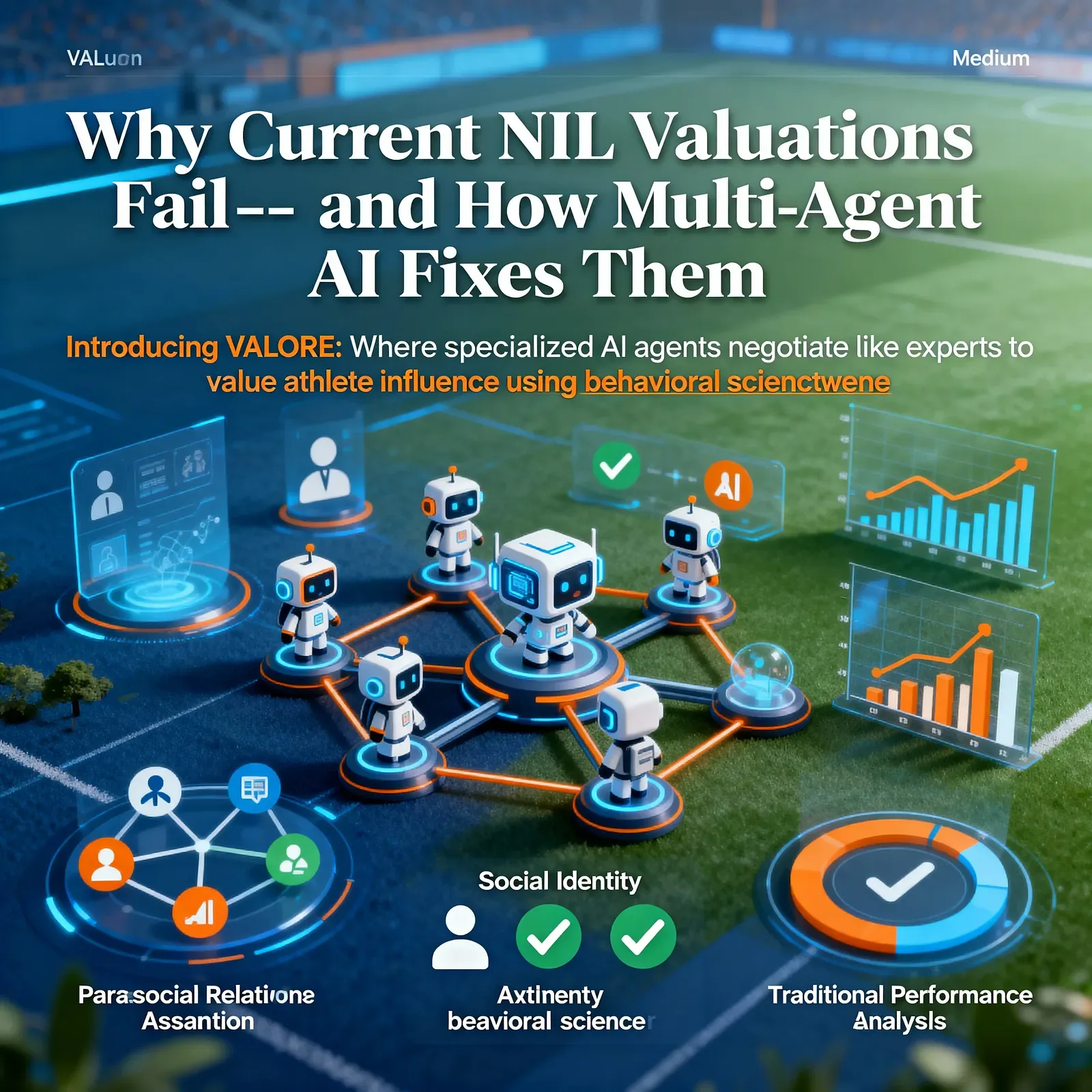
The Name, Image, and Likeness (NIL) market in collegiate athletics presents complex valuation challenges that require the integration of psychological, sociological, and economic factors. Current approaches achieve limited accuracy due to their reliance on surface-level metrics, which overlook behavioral science factors that drive actual engagement and value creation. We present VALORE (Valuation Agent-Led Operations for Recruitment Economics), a novel multi-agentic system employing seven specialized thinking transformer models coordinated through goal-oriented consensus mechanisms.
The system integrates parasocial relationship theory, social identity theory, and authenticity assessment frameworks with traditional performance analytics. Each agent utilizes multiheaded attention mechanisms optimized for domain-specific analysis, with coordination achieved through evidence-based negotiation protocols. The architecture enables specialized expertise while maintaining transparency and regulatory compliance.
Preliminary validation frameworks aim to achieve significant improvements in prediction accuracy, processing efficiency, and stakeholder value creation. This represents the first systematic integration of behavioral science with multi-agent AI for sports marketing valuation, establishing new paradigms for human influence measurement in digital economies.
Introduction
The emergence of NIL rights in collegiate athletics has created unprecedented challenges in quantifying the value of human influence. Unlike traditional metrics that can be objectively measured, NIL valuation requires understanding complex psychological relationships, sociological dynamics, and economic factors that determine actual marketing effectiveness. This complexity demands sophisticated analytical approaches that can integrate diverse expertise domains while maintaining transparency and accountability in high-stakes financial decision-making.
Current methodologies demonstrate fundamental limitations, focusing on easily quantifiable metrics — such as follower counts, engagement rates, and performance statistics — while overlooking deeper behavioral factors. Research consistently shows these surface metrics correlate poorly with actual purchasing behavior and partnership success. The psychological foundations of sports marketing effectiveness lie in parasocial relationships — one-sided emotional connections fans develop with athletes. These relationships, combined with social identity benefits fans derive from athlete association, create measurable value that current systems fail to capture.
The challenge extends beyond simple measurement inadequacy. Monolithic AI systems attempting to handle multiple analytical domains face inherent optimization conflicts that prevent them from achieving expert-level performance in any specific area. Social media analysis requires temporal pattern recognition and sentiment evolution tracking, while athletic performance demands statistical modeling and trajectory prediction. Market intelligence requires economic reasoning and timing optimization, while psychological profiling necessitates understanding personality patterns and analyzing behavioral consistency. When single models attempt to optimize simultaneously across these conflicting requirements, they inevitably reach compromise solutions that achieve mediocre performance rather than excellence in any domain.
The Multi-Agentic Paradigm
Multi-agentic systems represent a fundamental departure from traditional AI architectures by deploying multiple specialized agents that maintain individual expertise while coordinating toward shared objectives. This approach addresses the critical limitations of monolithic systems through three key mechanisms: specialized optimization, emergent intelligence, and transparent coordination.
Specialized optimization enables each agent to focus exclusively on its domain without compromise from conflicting requirements. Unlike ensemble methods that aggregate multiple model outputs, true multi-agentic systems enable communication, negotiation, and collaborative reasoning between specialized components. Each agent develops deep expertise through dedicated training, specialized attention mechanisms, and domain-specific optimization objectives that would conflict if combined within a single model.
Emergent intelligence arises when specialized agents interact through structured communication protocols. This interaction often yields insights and solutions that are not apparent to individual agents working in isolation. For example, the Social Media Analysis Agent might identify unusual engagement patterns that appear positive from a digital influence perspective. At the same time, the Psychological Profile Agent recognizes these patterns as indicators of manufactured rather than genuine fan connection. This type of cross-domain insight emerges through agent interaction rather than being predetermined by system designers.
Transparent coordination maintains accountability through documented reasoning chains and evidence-based decision-making. Unlike black-box systems that provide outputs without explanation, multi-agentic architectures naturally support explainability by enabling each agent to provide detailed reasoning from its specialized perspective while documenting how different viewpoints are integrated into final decisions.
System Architecture and Methodology
The VALORE system represents a sophisticated integration of multiple AI technologies, behavioral science frameworks, and coordination mechanisms designed to address the inherent complexity of NIL valuation. Unlike traditional approaches that attempt to force all analytical requirements into a single model or rely on simple aggregation of independent analyses, our architecture leverages the principle of specialized expertise coordination — similar to how expert human teams collaborate on complex problems. Each component maintains deep domain expertise while contributing to a unified valuation framework through structured communication and consensus protocols.
The architecture’s foundation rests on three critical design principles. First, domain specialization enables each agent to achieve expert-level performance without compromise from conflicting optimization requirements. Second, transparent coordination ensures that specialized insights are integrated through documented reasoning chains rather than opaque aggregation methods. Third, behavioral science integration transforms theoretical psychological and sociological constructs into quantifiable metrics that capture the human factors driving actual marketing value. These principles guide every architectural decision, from the design of individual agents to system-wide coordination mechanisms.
Specialized Agent Design
VALORE implements seven specialized agents, each optimized for specific analytical domains while maintaining communication capabilities for system-wide coordination. This specialization approach enables expert-level performance without the optimization conflicts that plague monolithic systems.
Social Media Analysis Agent (SMAA-001) employs a 7B-parameter thinking transformer with five specialized attention heads. The Engagement Analysis head (30% weight) focuses on temporal pattern recognition to distinguish sustained authentic engagement from temporary viral spikes. The Sentiment Analysis head (25%) performs sophisticated emotional analysis, going beyond simple positive-negative classification, to understand emotional intensity and evolution over time. The Virality Prediction head (20%) models content spread patterns through network topology analysis. The Platform Optimization head (15%) specializes in platform-specific algorithms across Instagram, TikTok, Twitter, and emerging platforms. The Authenticity Detection head (10%) identifies genuine versus manufactured engagement through sophisticated pattern recognition.
The Athletic Performance Agent (APA-002) utilizes enhanced numerical reasoning capabilities, incorporating specialized statistical analysis modules—the Statistical Performance Analysis head (35%) processes game statistics within a competitive context. The Competitive Context Assessment head (25%) evaluates performance relative to competition level and situational factors. The Injury Risk head (15%) analyzes durability indicators and recovery patterns. The Professional Potential head (15%) models development trajectories through skill progression analysis. The Leadership Assessment (10%) evaluates intangible factors that affect both athletic success and marketing appeal.
Market Intelligence Agent (MIA-003) employs a 13B-parameter transformer with economic reasoning capabilities. The Comparable Deal Analysis head (30%) maintains comprehensive databases while employing similarity matching algorithms. The Market Timing head (25%) models seasonal patterns and optimal opportunity windows. The Brand Demand head (20%) analyzes sponsor preferences and partnership landscapes. The Economic Context head (15%) integrates macroeconomic trends affecting valuations. The Competitive Positioning head (10%) evaluates market dynamics and strategic opportunities.
Brand Alignment Agent (BAA-004) focuses on psychological compatibility between athletes and potential partners. Psychological Profile Agent (PPA-005) models behavioral patterns through fan psychology and influence mechanisms. Risk Assessment & Compliance Agent (RACA-006) ensures regulatory adherence through proactive analysis. Ethics Oversight Agent (EOA-007) maintains continuous bias detection and fairness optimization throughout the system.
Behavioral Science Integration
The system operationalizes psychological theories through sophisticated quantitative frameworks that maintain theoretical fidelity while enabling predictive modeling. This integration represents a novel contribution to both AI development and applied behavioral science.
Parasocial Relationship Modeling quantifies emotional connections through multiple measurement approaches:
Where EI represents Emotional Intensity measured through sentiment analysis, IF represents Interaction Frequency across temporal scales, CR represents Content Resonance with athlete messaging, LI represents Loyalty Indicators during controversies, and TC represents Temporal Consistency of engagement. Coefficients are learned through supervised learning on validated relationship datasets.
Authenticity Assessment evaluates genuineness through consistency analysis:
Where C represents cross-platform Consistency, VA represents Value Alignment between statements and actions, BC represents Behavioral Congruence, CS represents Communication Style naturalness, and TS represents Temporal Stability. This framework distinguishes between enhanced authentic personality and manufactured personas.
Social Identity Integration measures the psychological benefits that fans derive from associating with athletes, including enhanced self-esteem, facilitated social connection, and aspirational motivation. These measurements predict behavioral outcomes, including sustained engagement, financial support, and advocacy activities.
Goal-Oriented Coordination Mechanisms
Coordination transcends simple voting or averaging through sophisticated consensus-building protocols that maintain specialized expertise while achieving system-wide optimization. This approach represents a significant advancement in the design of multi-agent systems.
The consensus process begins with independent analysis by all agents, each providing assessments with confidence scores and supporting evidence. When disagreements exceed acceptable thresholds, structured negotiation rounds enable evidence sharing and collaborative reasoning. During negotiations, agents must justify their positions in terms of system-wide objectives rather than domain-specific preferences, thereby creating accountability and transparency.
Dynamic weight adjustment considers multiple factors when integrating agent assessments:
Where Wi represents the final weight for agent i, with factors for Data Quality (DQ), Confidence ©, Historical Performance (HP), and Domain Relevance (DR), the σ parameters control the relative importance of each factor, adapting to specific contexts and requirements.
The Ethics Oversight Agent maintains veto authority when bias detection algorithms identify potential unfairness or discrimination. This ensures accuracy optimization never overrides ethical considerations, with comprehensive documentation of interventions and remediation approaches.
Validation Framework and Expected Results
Performance Projections
The multi-agentic architecture, integrating behavioral science, targets substantial improvements across multiple performance dimensions, addressing fundamental limitations in current approaches while creating new possibilities for stakeholder value creation.
Improvements in prediction accuracy derive from the coordination of specialized expertise and the integration of behavioral factors. By addressing the psychological and sociological factors that drive actual marketing effectiveness, rather than relying on surface-level metrics, the system aims to significantly improve valuation accuracy. Processing efficiency targets a sub-5-second comprehensive evaluation through parallel agent processing, compared to the hours required for manual analysis. This efficiency enables practical deployment across large athlete populations while maintaining analytical sophistication.
Regulatory compliance enhancement focuses on proactive violation prevention through the specialized Risk Assessment Agent that maintains comprehensive regulatory knowledge and identifies potential issues before they occur. This proactive approach contrasts with current reactive checking that often identifies violations only after deals are submitted, creating legal risks and administrative burden.
Stakeholder Value Optimization
The system design prioritizes value creation across all stakeholder groups rather than optimizing narrow technical metrics. This approach ensures that technological advancements serve human welfare and enhance opportunities.
Athletes benefit through enhanced decision support that identifies optimal partnership opportunities and negotiation strategies. The transparency and explainability features enable athletes to understand valuation factors and make informed decisions about their careers. Improved accuracy in valuation can lead to better compensation and more suitable partnership matches that create sustained value rather than short-term transactions.
Brands receive superior partner identification through psychological compatibility assessment and authenticity verification. The integration of behavioral science enables the prediction of which partnerships will resonate with target audiences and create genuine emotional connections, rather than superficial awareness. This improvement in partnership quality can enhance campaign effectiveness and return on investment.
Universities gain operational efficiency through automated compliance verification and strategic intelligence. The system reduces administrative burden while enhancing competitive positioning through superior analytics and informed decision-making support. Proactive compliance analysis can significantly reduce the risks of violations and associated legal costs.
Validation Methodology
Comprehensive validation employs multiple approaches to demonstrate the system's effectiveness across diverse contexts and stakeholder perspectives. Technical validation measures prediction accuracy against actual market outcomes, processing efficiency benchmarks, and scalability testing under high-load conditions.
Bias and fairness testing examines outcomes across demographic groups to ensure equitable treatment and opportunity distribution. Statistical parity metrics, individual fairness measures, and third-party auditing provide a comprehensive assessment of system fairness. Continuous monitoring enables identification and correction of any emergent biases.
Stakeholder value measurement tracks actual outcomes, including improvements in athlete earnings, performance of brand campaigns, and gains in university efficiency. Long-term studies will assess the sustained value creation and any unintended consequences that may require system adjustments.
Discussion and Implications
The development and validation of the VALORE system shed light on fundamental questions about the intersection of artificial intelligence, behavioral science, and human value assessment. Our findings extend beyond the immediate application of NIL valuation to address broader challenges in AI system design, human behavioral modeling, and the ethical deployment of technology. The successful integration of multi-agentic architectures with psychological and sociological frameworks demonstrates possibilities for AI systems that can understand and optimize complex human phenomena while maintaining transparency, fairness, and stakeholder value alignment.
The implications of this research extend across multiple domains — from immediate practical applications in sports marketing to fundamental theoretical advances in AI coordination and the operationalization of behavioral science. By demonstrating how specialized AI agents can maintain domain expertise while achieving system-wide optimization through goal-oriented coordination, we provide frameworks applicable to any complex decision-making context that requires integrating diverse analytical perspectives. Similarly, our approach to operationalizing psychological theories within computational systems offers methodologies for translating human behavioral understanding into predictive models that maintain both theoretical fidelity and practical utility.
Perhaps most significantly, this research addresses the critical challenge of developing AI systems that serve human welfare rather than simply optimizing technical metrics. Through comprehensive bias detection, transparent decision-making processes, and explicit consideration of stakeholder value creation, we demonstrate how sophisticated AI capabilities can be aligned with ethical principles and social responsibility. These contributions become increasingly important as AI systems assume larger roles in decisions affecting human opportunities, relationships, and life outcomes.
Theoretical Contributions
The research makes significant contributions across multiple domains. In artificial intelligence, the goal-oriented multi-agent coordination framework advances understanding of how specialized systems can maintain expertise while achieving system-wide optimization. The dynamic weight adjustment and evidence-based negotiation mechanisms offer new approaches to addressing disagreement and uncertainty in complex decision-making contexts.
For behavioral science, the systematic operationalization of psychological theories within AI systems provides empirical validation while demonstrating practical applications. The integration frameworks for parasocial relationships, social identity, and authenticity assessment show how complex theoretical constructs can be quantified for predictive modeling while maintaining theoretical fidelity.
In ethical AI development, comprehensive bias detection and mitigation mechanisms integrated into the core architecture, rather than added as afterthoughts, demonstrate practical approaches to responsible AI that maintain high performance while ensuring fairness and transparency.
Practical Applications and Market Impact
Beyond immediate NIL applications, the multi-agentic behavioral intelligence approach has implications for professional sports marketing, entertainment industry evaluation, influencer marketing optimization, and any context where understanding human behavioral factors creates value.
Market efficiency improvements address systematic inefficiencies that currently result in suboptimal resource allocation and unfair distribution of opportunities. By focusing on actual value creation potential rather than surface metrics that may reflect historical biases, the system promotes more equitable and efficient markets.
The transformation from reactive to proactive compliance represents a fundamental shift in regulatory approach, creating collaborative rather than adversarial relationships between stakeholders and oversight bodies, while reducing the risks of violations and associated costs.
Limitations and Future Directions
Several limitations require acknowledgment and future research attention. Data dependency remains fundamental — sophisticated analysis cannot overcome poor-quality or limited input data. Future research should develop methods for practical analysis with incomplete information and the quantification of uncertainty.
Cultural and contextual variation presents ongoing challenges, as behavioral patterns vary significantly across geographic regions, demographic groups, and temporal periods. Cross-cultural validation studies and adaptation mechanisms require continued development.
The balance between optimization and authenticity presents philosophical and practical challenges. As systems become more sophisticated at predicting value, athletes may optimize their behavior for system metrics, potentially at the expense of genuine personality expression. Research into maintaining authenticity while enabling optimization remains critical.
Long-term social impact requires ongoing monitoring to understand how systematic evaluation affects athlete behavior, fan relationships, and the broader sports ecosystem. Unintended consequences may arise that necessitate adjustments to the system or the implementation of additional safeguards.
Conclusion
This research demonstrates how artificial intelligence can be developed to understand and optimize complex human behavioral patterns while maintaining ethical standards, promoting fairness, and creating value for diverse stakeholders. The multi-agentic behavioral intelligence approach addresses fundamental limitations in current AI systems while establishing frameworks for responsible development that prioritize human welfare alongside technical performance.
The significance extends beyond immediate NIL applications to fundamental questions about the role of AI in society. By integrating behavioral science, ethical considerations, and stakeholder value creation, the research provides practical examples of AI development that align with social values and human flourishing objectives.
As artificial intelligence becomes increasingly prominent in decisions affecting human opportunities and welfare, this research provides both theoretical frameworks and practical methodologies for ensuring that technological advancement serves broader human goals. The multi-agentic behavioral intelligence approach represents a pathway toward AI systems that enhance rather than replace human judgment while promoting fairness, transparency, and stakeholder welfare across diverse applications and contexts.
The transformative potential lies not merely in improved prediction accuracy or operational efficiency, but in demonstrating how sophisticated AI systems can be designed to understand the full complexity of human behavior — including psychological, social, and cultural dimensions — while maintaining accountability and serving the interests of all stakeholders in an increasingly digital economy.