Building Minds
The Shape of the Work Comes from the Schedule
Dr. Jerry A. Smith · October 2, 2026 · 11 min read
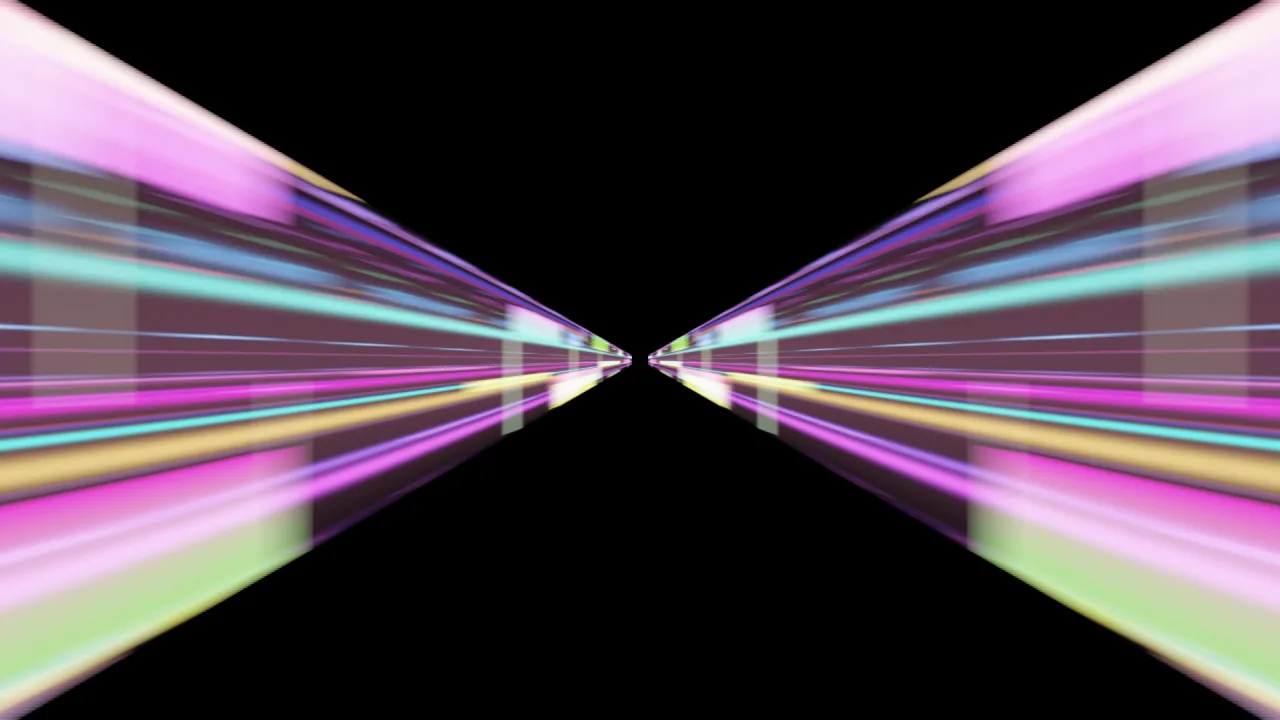
I modeled the slit-scan rig behind the 2001 Star Gate sequence in code. With every component held fixed, the schedule alone determined what landed on the film. Agentic systems share that structure, and the reflex is still to shop for a better slit.
Each frame of the Star Gate sequence in 2001: A Space Odyssey took about a minute to expose.
Not a minute of preparation. A minute with the shutter open. Douglas Trumbull, writing in American Cinematographer in June 1968, described what he called the Slit-Scan machine: a standard 65mm camera holding focus from fifteen feet down to an inch and a half, with "exposures of approximately one minute per frame." In his longer October 1969 account, he documented the choreography. During one frame, the camera dolly traversed roughly 12 feet of track in front of a glass plane carrying a very narrow slit. Behind the slit, backlit artwork slid about 10 inches on a second pane. A sequencer then closed the shutter, advanced the film, displaced the artwork by a small increment, reversed the motor, and reopened the shutter.
There is no photograph in that description. There is a schedule.
That is the claim of this edition, stated narrowly: the shape of the work comes from the schedule. This week I built a physically modeled version of that rig in Python and ran it until I trusted the measurements. With the camera, the slit, and the artwork held constant, changing only how the camera moved through time was the difference between a wall eighty times brighter at one end than the other and a wall with uniform exposure. Agentic systems have the same architecture — a fixed set of components, and a schedule that determines what they produce — and much of the attention still goes to the components.
The reflex is to upgrade the slit
The default question in agentic AI is which model. Which vendor, which capability tier, which benchmark. When an agent system produces uneven work, the reflex is to replace the model, rewrite the prompt, or purchase a larger context window. Every one of those is a change to the slit.
The schedule rarely receives comparable scrutiny. By schedule I mean the parts of an agent system that have nothing to do with intelligence and everything to do with time: how many steps an execution receives, how budget is distributed across those steps, when verification happens, when the system is permitted to stop, and what carries forward from one iteration to the next. In earlier editions I argued that the orchestrator is not a performance knob — it is a safety mechanism. The rig revealed something else it does. It determines the shape of the output.
Not the quality of any individual step. The shape of the whole.
I modeled the rig in code
The simulation is not an image filter that imitates the appearance. It models the mechanics and the optics. A pinhole camera dollies toward an opaque mask with a narrow slit. Backlit artwork slides laterally behind the slit. The shutter stays open for the entire movement, so each frame is one continuous exposure, and light accumulates in a floating-point film buffer, slice by slice. Nothing is ever overwritten. Between frames the artwork advances slightly, and the walls appear to flow.
The receipts, from the October 2 run log:
- Output: 1920×1080, 24 frames per second, 8 seconds, 192 frames, with two exposure passes per frame for the two walls.
- Integration: 480 time steps per exposure, within 0.28% (relative L1 error) of a 2,400-step reference.
- Validation: with uniform white artwork, the simulated exposure along the wall reproduces the analytic exposure law for both dolly profiles.
- Artwork: original and procedurally generated. No film footage or film artwork is used or imitated.
- Cost: about 28 seconds to render the 8-second corridor on a laptop.
That last line deserves one sentence of reflection. At Trumbull's reported pace, 192 frames represent more than three hours of open shutter for a single wall. The physics did not change. The cost of executing the schedule did.
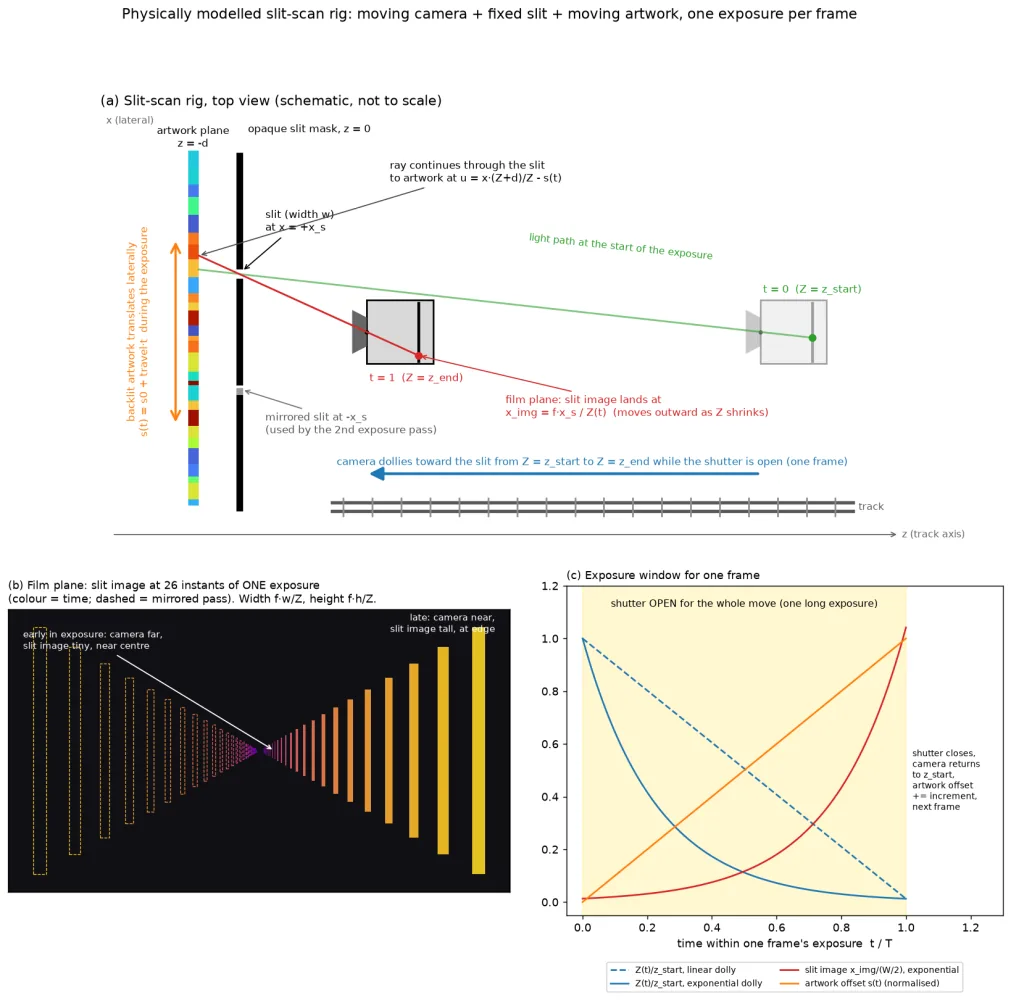
Overhead view of track, camera, slit mask, and moving artwork; slit image on the film plane at 26 instants of one exposure; exposure window over time
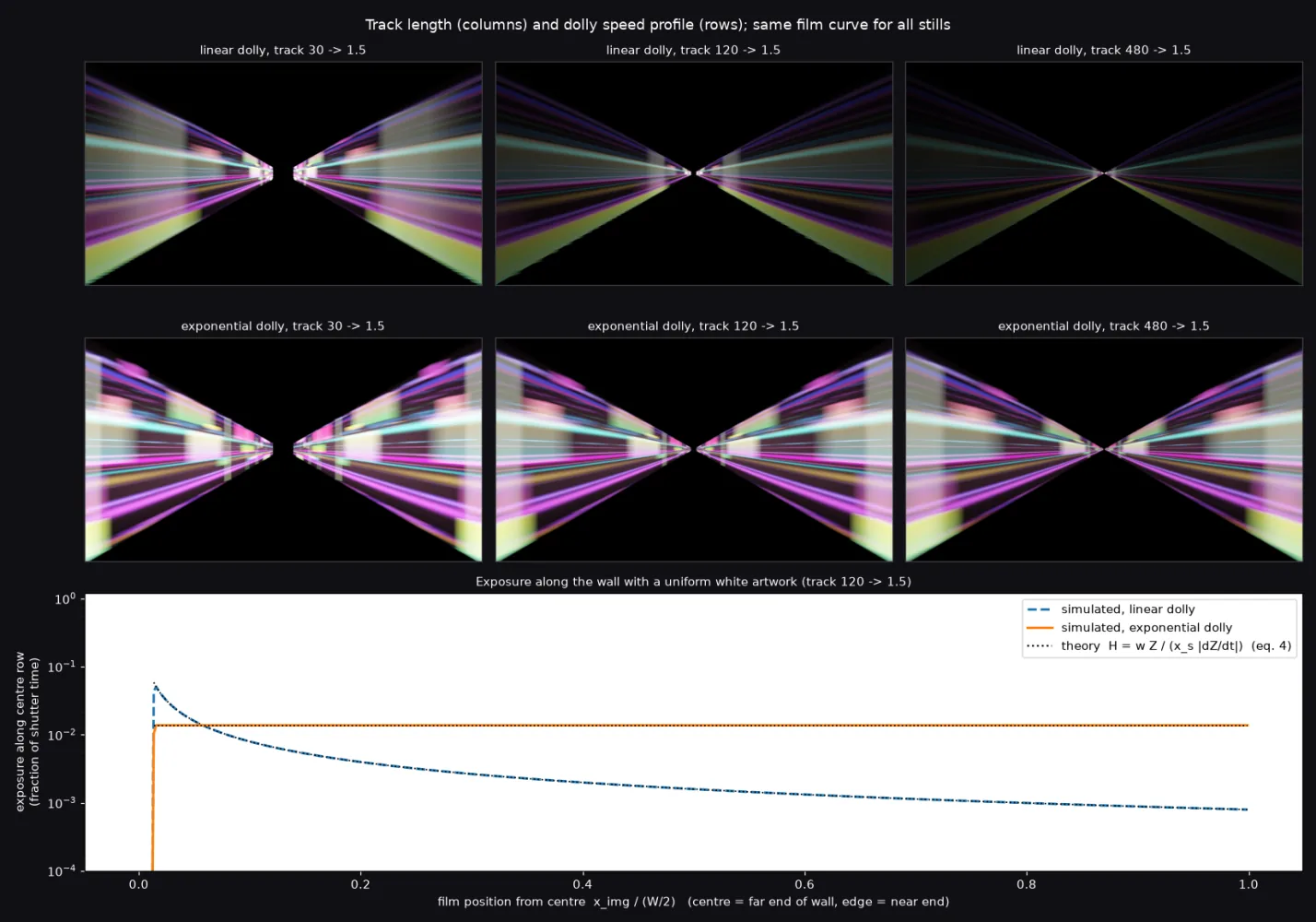
Linear versus exponential dolly profiles, with measured exposure along the wall compared against theory
A constant-speed dolly delivered eighty times more light to one end of the wall
The first surprise was the dolly.
The intuitive choice is to drive the camera down the track at constant speed. It's simple, it's repeatable, and it's wrong. Because of perspective, the slit's image creeps across the film while the camera is distant and races across it when the camera is close. Where the image moves slowly, it dwells, and dwelling is exposure. On my 120-to-1.5 track, the far end of the wall — the vanishing point — received about eighty times more light than the near end at the frame edge. The measurement matches the analytic prediction: the ratio is simply the starting distance divided by the ending distance.
The correction wasn't a better slit. It wasn't brighter artwork or faster film. It was a different schedule: move the camera at a speed proportional to its distance from the slit. With that single change, exposure along the entire wall became uniform.
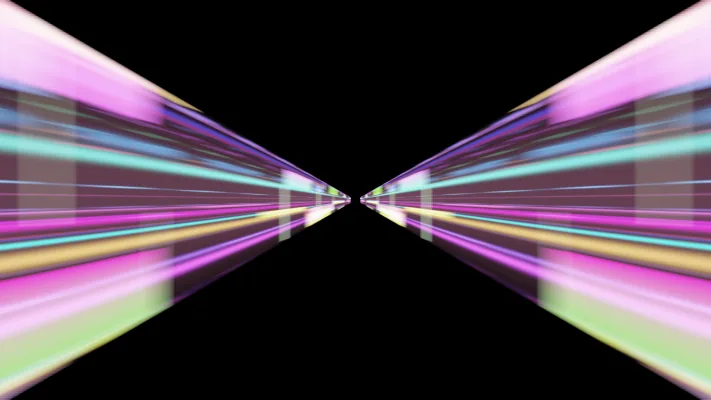
Still from the 8-second, 1080p24 two-wall corridor rendered from the simulation (video in my feed post.)
Trumbull's own account emphasizes the same sensitivity. "For consistency and evenness of exposure," he wrote, "all movements must be smooth and repeatable," and he enumerated the hardware that delivered it: precision bearing tracks, anti-backlash gearing, synchronous motor drives, and selsyn links, with synchronous sequencers and timers controlling the overall system. Evenness was engineered into the motion, not into the optics.
Here is the mechanism that transfers. Constant speed is a uniform schedule imposed on work that isn't uniform. The rig's mapping from elapsed time to frame position is nonlinear, so equal time does not purchase equal coverage. Agent executions share that property whenever the value of individual steps is uneven — when the final steps, integration and verification against acceptance criteria, matter more than the early ones. A schedule that allocates every step identical budget and an identical review cadence is a constant-speed dolly. It overexposes some stages and starves others, and a better model is unlikely to fix it, because the unevenness lives in the schedule.
Equal time is not equal coverage.
A wider slit purchases brightness and sacrifices detail
The second variable was slit width. Wall brightness scaled exactly with width: widths of 0.02, 0.06, and 0.2 produced relative brightness of 1, 3.0, and 10.0. Depth detail moved in the opposite direction. Across that tenfold widening, the depth-detail contrast metric declined by 40% to 70%, depending on how far the artwork traveled during the exposure. Streak contrast declined as well.
That is a throughput-versus-fidelity tradeoff, and the rig makes it impossible to ignore. More light passes per unit of time. Less of it carries information.
The agent equivalent is the granularity of the work assigned to a single step. Hand an agent a large, loosely bounded assignment and more gets accomplished per call. Hand it a narrow, well-specified slice and each call accomplishes less, but the result is legible: you can verify it, attribute it, and reverse it. Neither choice is free. The mistake is pretending the aperture carries no penalty on the detail side because the brightness side looks so impressive in a demonstration.
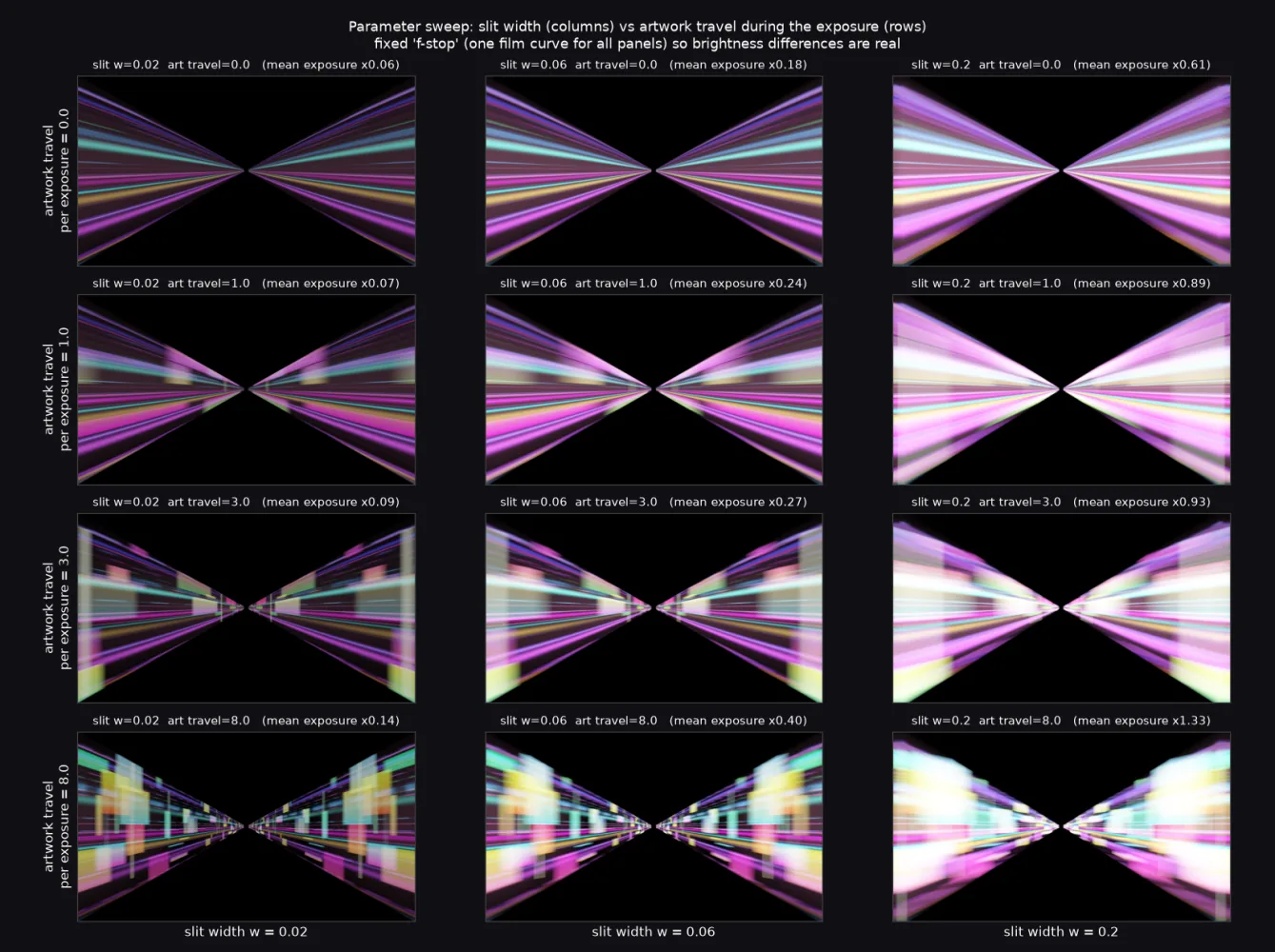
Slit width (0.02 / 0.06 / 0.2) by artwork travel per exposure (0 / 1 / 3 / 8), all at one fixed aperture setting
The frame paints itself at the end
The third finding is the most consequential.
The frame does not fill evenly across the exposure. It paints from the vanishing point outward, and very unevenly in time. With the proportional-speed track, the first half of the exposure covers only the central 12% of the half-frame. Three quarters of the way through, the image has reached 35%. The final 10% of the exposure paints the outer third. With a constant-speed track, the skew is even more extreme.
Inspect the frame at the halfway mark and you'd see a small bright core and very little else. A reasonable observer would conclude the exposure was failing. It wasn't. It was on schedule.
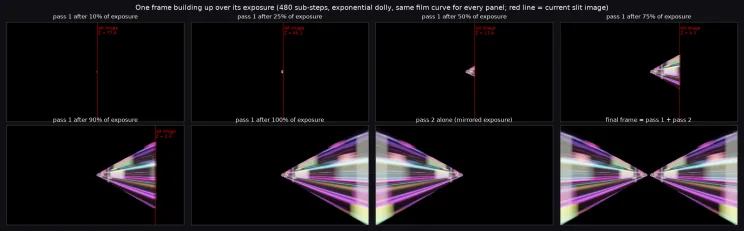
One frame at 10 / 25 / 50 / 75 / 90 / 100% of pass 1, then the mirrored second pass, then the combined result, all on the same film curve
Trumbull documented the operator's version of this in 1969. Because the technique deals with an accumulated exposure, "only a fraction of which exists at any single point in time, light meter readings are relatively useless," and the correct exposure "can only be obtained by a trial and error process." His sequencer was designed accordingly. An operator could halt the shoot at any moment, but the camera completed its current exposure first; the machine then stopped between frames, with the shutter closed, so the crew could inspect the camera and the artwork under a safelight.
That is a checkpoint policy, and a sound one. Inspect at boundaries. Never meter mid-exposure.
Some long agent executions accumulate their value the same way — research that only resolves at synthesis, code that only functions once the final module lands, a plan that reads as noise until the last step integrates it. A monitor that grades the first half of such an execution can terminate good work, and a human who intervenes mid-flight will often be correcting something that was fine. The discipline is the one the sequencer enforced: define where the frame boundaries are, inspect there, and evaluate the frame against what it was supposed to become.
A partial exposure is not a partial result.
Travel determines the texture; the increment determines the motion
Two smaller findings complete the picture.
How far the artwork traveled during the exposure determined the texture. With the artwork stationary while the shutter was open, the walls emerged as pure converging streaks. Moving it during the exposure distributed the artwork along the depth of the wall as panels and bars, and greater travel packed more of it into each frame. Same artwork. Same slit. Different motion, different surface.
The motion between frames came from tiny adjustments. Advancing the artwork by 0.04 units per frame — 1.3% of its in-exposure travel — made the wall's features stream toward the camera, expanding about 6% per frame. The model predicted 6.0%; I measured 5.8% to 6.7%. Trumbull described the same lever in plain mechanical language: the incremental change between frames "is usually a small fraction of the total" movement, with "the size of the increment determining the speed of cinematic movement."
For agents, the closest analog is what moves within a step versus what carries between steps. Within a step, how widely the agent ranges across its material determines the texture of the output — narrow and streaky or broad and layered. Between steps, the increment of state carried forward determines the motion: too large and the execution lurches; too small and it stalls. Both are scheduling decisions. Neither appears on a model card.
What this demonstrates, and what it doesn't
This is precisely where an analogy can quietly become a claim it hasn't earned, so here is the ceiling.
One simulation of an optical rig proves nothing about agent orchestration. It does not demonstrate that schedules dominate models in your system. What it demonstrates is narrower and, I think, more useful: with the components held constant, a schedule alone can dominate the result, by a measurable factor, through a mechanism you can write down. Whether your agent system has a nonlinear time-to-value mapping like the rig's is an empirical question about your system. I haven't measured it, and I'm not offering a number for it.
The simulation is also idealized, and I would rather disclose that than have someone discover it:
- Idealized optics: a pinhole camera with no depth of field, no lens distortion, no vignetting, and no flare, halation, or diffraction at the slit edges.
- Perfect motion control: no jitter, no backlash, no frame-to-frame registration error, and a mirrored pass that registers perfectly.
- No film grain, no reciprocity failure, and no color-layer crosstalk — and genuine long exposures do suffer reciprocity failure.
- The eighty-fold figure is a property of my track geometry. A shorter track produces a smaller ratio. The mechanism holds; the number moves.
Three historical limits matter as well. I don't know which speed profile Trumbull's rig used, and the passages I read specify distances but not the profile, so I won't claim one. My simulation returns the camera to its starting position every frame; his sequencer reversed the motor and ran the next exposure in the opposite direction, which eliminated recycling time. And Trumbull himself said the hardest part was not the machine. "Our main problem," he wrote, "had nothing to do with the machine we built, because that worked just fine; it had to do with the actual artwork." One early texture experiment looked, in Kubrick's words, "too much like carpets going by." They discarded it.
That is the honest counterweight. The schedule shapes the work; it does not supply the judgment about whether the work is any good. A perfect dolly profile on poor artwork still produces poor artwork. A well-paced agent loop running a weak model, or attacking the wrong problem, is still wrong.
I have written before that the gap between performing in a simulation and performing under real-world conditions is where everything that actually matters gets decided. That applies to this edition too. Treat the rig as a lens on a mechanism, not as evidence about your agents.
Five questions to ask of your schedule
If the mechanism holds in your system, it will surface in places that model evaluations don't examine. Five questions to start with:
- Where does value accumulate during an execution? If it concentrates at the end, a uniform budget per step is a constant-speed dolly.
- What is your aperture? How large is the unit of work assigned to a single step, and what are you surrendering on the detail side to purchase the throughput?
- Where are your frame boundaries? Name the points where an execution can be inspected without ruining the exposure, and stop inspecting in between.
- What do your monitors measure mid-execution, and do they understand that a partial exposure is not a partial result?
- What carries between iterations, and is the increment calibrated for the motion you want?
None of these questions mentions a model. That is the point. The model is an input. The architecture is the asset — and the schedule is the part of the architecture that determines what the inputs become.
The shape of the work comes from the schedule.
If you have measured a case where changing only the pacing of an agent system altered the output more than replacing the model did — or a case where it didn't — reply and tell me. I want the miss column as much as the hits.
— Jerry
Dr. Jerry A. Smith — AI executive and engineer. Built AI practices from zero inside six global firms. PhD in Computer Science. Navy veteran — nuclear engineer, then carrier-based jet pilot. Still writes production code.
Verity Vantage Group | Production AI That Moves EBITDA | verityvantagegroup.com