Building Minds
The Portfolio Problem: Why Private Equity Can't AI Its Way Out One Company at a Time
Dr. Jerry A. Smith · March 5, 2026 · 9 min read
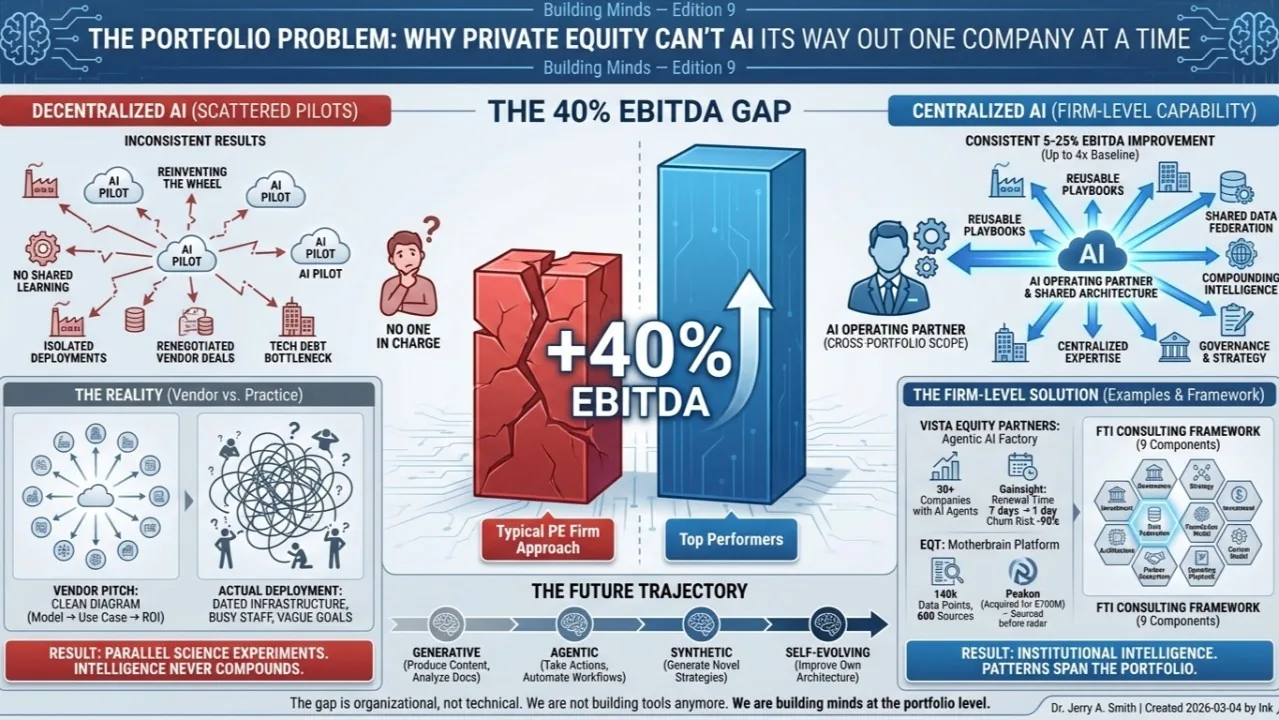
There is a number that should bother anyone who works in private equity. The number is forty percent.
That is the EBITDA gap — measured, documented, consistent across multiple surveys — between PE firms that have centralized their AI operations at the firm level and those that have left AI adoption to each portfolio company individually. The firms in the first category see five to twenty-five percent EBITDA improvement across their portfolios, with top performers reaching four times the baseline. The firms in the second category see what they have always seen: scattered pilots, inconsistent results, and a growing conviction that AI is somehow both inevitable and impossible to implement.
Eighty-eight percent of PE firms have now integrated generative AI into their M&A workflows, outpacing corporate acquirers at seventy-seven percent. Over a third plan to exceed $100 million in AI spend by 2026. The capital is flowing. The question that separates the firms that will see returns from the ones that will write off the investment is not whether they are spending on AI. It is whether anyone is in charge.
I deploy AI across a private equity portfolio. Not at one company — across multiple portfolio companies simultaneously, each at a different stage of maturity, each with different technical debt, different leadership, different degrees of enthusiasm for what I am there to do. The work looks nothing like the vendor presentations suggest.
The vendor presentations show a clean diagram. There is a foundation model at the center. Arrows radiate outward to different business functions. Each function has a use case, and each use case has a projected ROI. The implication is that AI deployment is about connecting the right model to the right workflow and measuring the results.
What actually happens is this. You arrive at a portfolio company. Their data infrastructure was built for a different era, when the priority was transaction processing rather than analysis. Their best people — the ones who carry the institutional knowledge that would make AI genuinely useful — are the ones with the least time to help you, because they are the ones running the business. Their leadership has been told by the PE firm that AI is a priority, but no one has explained what that means in terms they can act on. They have a vague expectation that someone will install something, and then costs will go down.
The first thing you learn, repeatedly, across every portfolio company, is that the deployment challenge is not technical. The models work. The APIs connect. The infrastructure, while often dated, can be brought to a functional state. The challenge is that every company you walk into is solving the problem from scratch. The mistakes made at portfolio company number one are repeated at portfolio company number two. The playbooks developed through painful trial at company number three never reach company number four. The vendor relationships negotiated at a discount for one engagement are renegotiated at full price for the next.
This is what decentralized AI operations look like from the inside. It is not a strategy. It is the absence of one.
The firms that have figured this out are not difficult to identify.
Vista Equity Partners launched what they call the Agentic AI Factory — a proprietary framework for deploying agentic AI across their entire enterprise software portfolio. More than thirty of their portfolio companies have launched AI agents in production. More than half are actively monetizing AI products. One of their companies, Gainsight, automated the customer renewal cycle: renewal time dropped from seven days to one day, and churn risk fell by ninety percent. Vista projects five to ten AI agents per user across their portfolio — potentially four to eight billion agents across their full portfolio footprint.
EQT built Motherbrain, a deal sourcing platform that aggregates one hundred and forty thousand data points across six hundred data sources. It has directly secured over 200 million euros in investments. Three of EQT Ventures' top five investments from its 2016 fund came through Motherbrain. The most notable: Peakon, a human resources platform that appeared on no banker's radar before it was acquired by Workday in 2021 for $700 million. The return on that single AI-sourced deal exceeded the entire cost of building and running the platform.
These are not experiments. These are firm-level capabilities that produce firm-level results. The difference between what Vista and EQT do and what most PE firms do is not a difference in the models they use. The same foundation models are available to everyone. The difference is organizational. Vista and EQT made AI a firm-level function — with governance, shared architecture, reusable playbooks, and centralized expertise that deploys across the full portfolio. Most firms — roughly forty percent, according to FTI Consulting's survey — leave it to each portfolio company to figure out on its own.
The forty percent EBITDA gap is not a technology gap. It is an organizational design gap.
There is a framework that helps explain what this organizational design should include. FTI Consulting identified nine components of a centralized PE AI operating model: governance, strategy alignment, investment prioritization, data federation, foundation-model application, custom-model evaluation, architecture optimization, partner-ecosystem management, and operating-playbook deployment.
The list is instructive not because any of these components are surprising, but because most firms attempting AI deployment address perhaps two of the nine. They choose a model. They identify a use case. They skip governance, skip data federation, and skip the playbook that would let them replicate what they learn at one company across the rest of the portfolio. They solve a specific problem at a specific company and then start over at the next one.
The component I have come to believe matters most is data federation — the shared data architecture that enables intelligence to flow across portfolio companies without violating confidentiality boundaries. When you build an AI capability for one manufacturing company in a portfolio, the patterns you learn about demand forecasting should be transferable to another manufacturing company in the same portfolio. When you develop an approach to customer churn prediction at one software company, the methodology — not the data, but the methodology — should travel to the next software company you assess.
Recommended by LinkedIn
[ Pausing modernisation to fund AI isn't a saving. It's…
Daniel J. Jacobs
Pausing modernisation to fund AI isn't a saving. It's…
Daniel J. Jacobs
3 days ago](https://www.linkedin.com/pulse/pausing-modernisation-fund-ai-isnt-saving-its-loan-against-jacobs-vntsc)
[ The AI Reckoning in Private Equity
Scott Kosch
The AI Reckoning in Private Equity
Scott Kosch
11 months ago](https://www.linkedin.com/pulse/ai-reckoning-private-equity-scott-kosch-3vnnc)
[ Building the Equity Story: How Should Anthropic Be…
Anna Valcheva
Building the Equity Story: How Should Anthropic Be…
Anna Valcheva
2 months ago](https://www.linkedin.com/pulse/building-equity-story-how-should-anthropic-positioned-anna-valcheva-vh8pf)
Without data federation, every deployment is isolated. The intelligence never compounds. You are not building a portfolio-wide AI capability. You are running parallel science experiments that happen to share an investor.
The talent question is worth addressing directly because it is where the conversation usually stalls.
Sixty percent of PE firms lack a dedicated data science team. This is not a criticism — it reflects a rational allocation of resources for firms whose core competency is deal-making and portfolio management, not technology development. But it means that most PE firms approaching AI are doing so without the internal expertise to evaluate what they are buying, what they are building, or whether the results they are seeing are what good looks like.
The emerging solution is a role that did not exist five years ago: the AI Operating Partner. Cross-portfolio scope. Not embedded in one company but serving the entire portfolio. Reports to managing partners, not CTOs. The compensation reflects the scarcity — north of a million dollars annually, according to Heidrick & Struggles. Roughly 250 such roles exist at scale in PE today.
The economics of this role are compelling when you do the math. A PE firm with a dozen portfolio companies can either hire twelve separate AI leads — one per company, each operating independently, each making different technology choices, each repeating the same mistakes — or it can hire one senior person who builds the playbook once and deploys it everywhere. The centralized model is not just more effective. It is dramatically cheaper. The cost of one operating partner is a fraction of the cost of twelve independent efforts, each producing inconsistent results.
This is the job I do. I say that not to credential the argument but to explain where the observations in this newsletter come from. The patterns I describe — the repeated mistakes, the isolated deployments, the intelligence that never compounds — are not things I read about. They are things I see every week, across different companies, industries, and stages of AI maturity, all owned by the same firm.
There is something else happening in this space that I think matters more than the efficiency gains, and it is harder to quantify.
When you deploy AI across a portfolio — not at one company, but across several — you begin to see patterns that no individual company could see on its own. The signals that predict customer churn in one industry echo, in a different register, in an adjacent industry. The operational bottlenecks that constrain one company map structurally to bottlenecks at another. The portfolio itself becomes a dataset, and the AI operating layer becomes the instrument that reads it.
This is not knowledge management. It is not document retrieval, chatbot deployment, or any of the use cases that populate the vendor presentations. It is something closer to institutional intelligence — the ability of an organization to learn from its own experience at a speed and scale that no human network, however talented, can match. The AI is not replacing the operating partners' judgment. It is giving them access to patterns they could not have seen without it, because the patterns span companies, span industries, span the full breadth of the portfolio's operational history.
We are in the early stages of this. The firms building it are doing so quietly because the capability itself is a competitive advantage. But the trajectory is clear. The AI tools we deploy today are generative — they produce content, they analyze documents, they surface information faster than humans can find it. The next generation will be agentic — systems that take actions, not just produce outputs. Beyond that, the systems become synthetic — they generate novel strategies and approaches that were not in their training data. And eventually, they become self-evolving systems that improve their own architecture without human intervention.
We are not building tools anymore. We are building minds. And the firms that build them at the portfolio level, rather than the company level, will have built something that their competitors cannot replicate by buying the same software.
The cautionary voice in this space is worth hearing. Orlando Bravo of Thoma Bravo warned publicly in December 2025 about AI FOMO driving private market mistakes — overvalued deals driven by hype without short-term delivery. He is not wrong. The history of technology adoption in PE is littered with investments that paid for the future and received the present.
But the caution applies to investments made without structure, without measurement, without the organizational architecture to convert spending into results. The firms seeing the 40% EBITDA gap on the positive side are not spending more recklessly than those on the negative side. They are spending more deliberately. They have centralized the function. They have built the playbooks. They have the expertise in-house — not distributed across a dozen companies, each reinventing the approach, but concentrated in a role whose sole purpose is to compound the intelligence.
The number that should bother anyone in private equity is not the amount being spent on AI. It is the amount being spent on AI without anyone in charge of making sure it works. That is the gap. It has always been the gap. The technology simply makes it measurable now.
Dr. Jerry A. Smith builds AI organizations within large enterprises. Connect on LinkedIn or reach out at jerry@drjerryasmith.com.