Building Minds
The Page Is Not the Product
Dr. Jerry A. Smith · September 18, 2026 · 11 min read
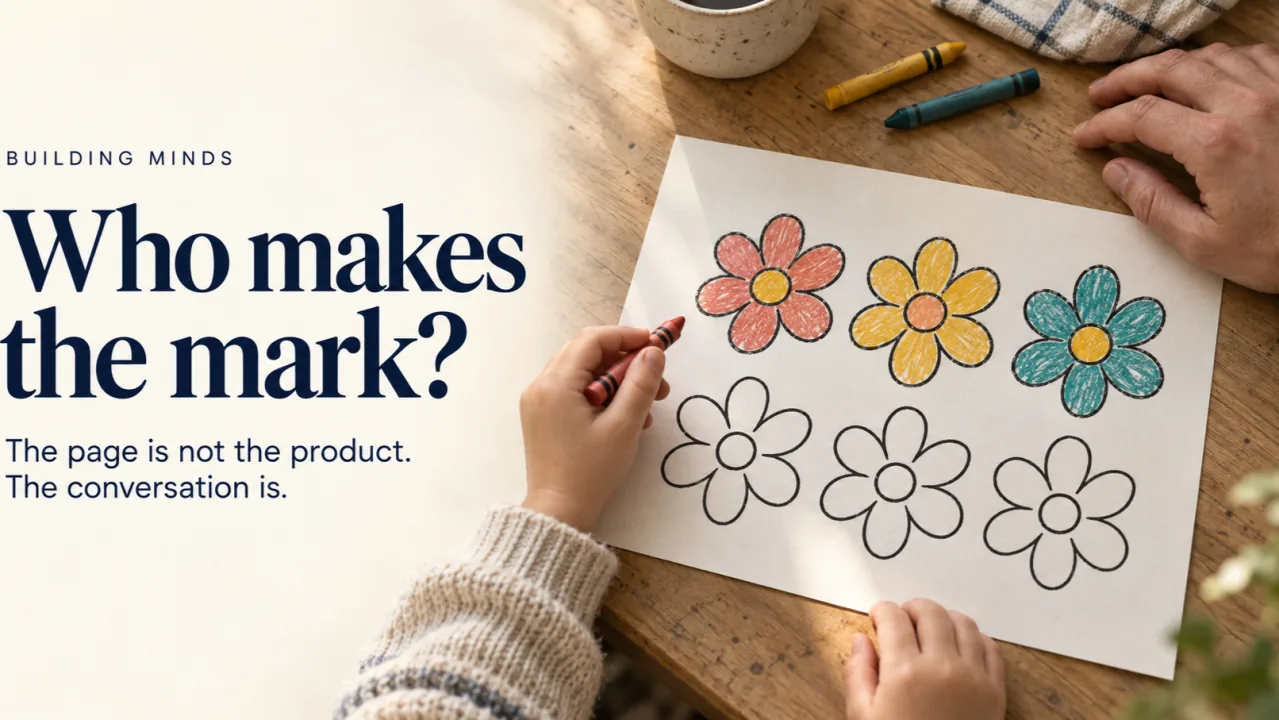
What a coloring page can ask of a four-to-eight-year-old, and why that matters more now that answers are free.
Picture a six-year-old looking at six flowers. The instruction says to color three of them. She colors one, then a second, then a third, and then her hand, which wants very badly to keep going, stops.
That stop is the most interesting thing on the page.
Most editions of this newsletter concern the architecture of judgment in machines. This one concerns how judgment gets constructed in people. This month I wrote and produced a series of children's coloring books — Color Me Curious, for ages four to eight — and the design questions turned out to be the ones I ask about any learning system, artificial or otherwise. What does the learner have to do alone? What can the environment carry? Where does the structure live?
If you work with AI and have a small child in your life, you've probably felt the question underneath this one. Answers are instant for her now. Which of the slow, low-tech activities still build anything, and which are only content with a theme?
The conventional view treats a coloring book as the second kind: quiet time with a subject. Add facts, and it becomes educational quiet time, an occupation with a vocabulary list attached. That's a category error. A coloring page works better as a scaffold than as content, and the thing it holds up is not on the paper.
The page is not the product. The conversation is.
Answers got cheap. Effort did not.
A child who is five today will not remember a world in which a question went unanswered for more than a few seconds. Ask why the sky is blue and something, somewhere, will say why, fluently and at once.
This isn't an argument against screens, and the books don't make one. It is an argument about who performs the work. My premise, and it is a premise rather than a finding, is that when the answer arrives instantly, information stops being the scarce resource. The scarce resource is the child's own production: the mark made, the sentence said, the guess risked before the answer shows up.
Ages four to eight are when that matters most, because four developmental systems are under simultaneous construction, each depending on the others and none of them finished: the hand, the brake, the conversation, and the self. Each has a receipt. Each has a page.
The hand: fine motor control is a leading indicator, not a craft skill
In 2010, David Grissmer and colleagues at the University of Virginia worked through six longitudinal data sets searching for the capabilities that, measured at kindergarten entry, predict academic achievement years later. Early math and reading scores did. No surprise. The surprise was everything else on the list. Attention, fine motor skills, and general knowledge of the world were together much stronger predictors of later math, reading, and science than early math and reading scores alone.
Two years later Claire Cameron's team looked closer, assessing 213 three- and four-year-olds at home before kindergarten and then following them through the year, and found that fine motor skill and executive function each predicted achievement at kindergarten entry as well as improvement from fall to spring. The component carrying the weight was design copy — examining a shape and reproducing it.
Copying a design, in other words, more than coloring neatly. Eye to plan to hand.
Page 11 of the Outer Space book shows a launch tower built from three large triangular braces. The instruction reads: "Find a triangle in the tower. Draw another triangle beside it." That is close to a design-copy task, dressed as a rocket. The outlines are bold and the regions are generous for the same reason. A four-year-old's grip is an instrument still under construction, and a page of intricate detail defeats it.
There's an honest complication here, and it shaped the books. In 2012 Karin James and Laura Engelhardt had 15 preliterate five-year-olds print, trace, or type letters, then scanned them while they looked at those letters. A previously documented reading circuit was recruited only after printing — not after typing, and not after tracing. The study concerned letters, and I am extending it to arrows and triangles, which is a stretch worth naming. But the direction is hard to ignore. Staying inside someone else's lines, it appears, isn't sufficient.
So no page in the series is merely a picture to fill. Every activity asks the child to produce something that wasn't there before — an arrow for the rocket's exhaust, a second parachute, two more rockets in the ideas box, a sentence said out loud.
Filling in is practice. Making the mark is the lesson.
The brake: you cannot describe control into a child
Adele Diamond's 2013 review of executive function names three core components: inhibition, working memory, and cognitive flexibility. All three develop rapidly across early childhood and keep developing through adolescence. Early differences predict a great deal.
Terrie Moffitt's team followed 1,000 children in Dunedin, New Zealand, from birth to age 32. One cohort. Three decades. Childhood self-control predicted adult physical health, substance dependence, personal finances, and criminal offending, along a gradient, and the effect could be separated from intelligence and social class. In a second cohort of 500 sibling pairs, the sibling with lower self-control had the poorer outcomes by age twelve, despite the shared home.
Now go back to the six flowers. "Count the six flowers. Color three of them." Then the follow-up: "How many flowers are still uncolored?" The arithmetic is trivial, and the inhibition is where the effort goes. A child who loves coloring has to interrupt a hand that is already moving, against every preference she has, which is a small instance of the capability. Some children will color all six. That is information, not failure.
The remaining two components get their own pages. Mission Control asks the child to say three steps in order — check, count down, launch — which is a working-memory exercise with a countdown attached. Same Stars, New Rows shows eight stars in two rows of four, then asks for eight dots in a different arrangement. The quantity holds. The layout changes. Piaget called it conservation of number. It is a cousin of cognitive flexibility: one fact, a different shape.
There's a loose analogy to the systems I build professionally, and it is only an analogy. In an agent architecture, generation is the cheap part. The stop condition is not. A prefrontal cortex is not a guardrail, but the design lesson transfers: you don't get control by describing it. You get it from tasks that require it.
The conversation: turns, not words
This receipt reorganized the series.
Recommended by LinkedIn
[ GMAT RC Keywords: Mastering the Cause-Effect Connection
Payal Tandon
GMAT RC Keywords: Mastering the Cause-Effect Connection
Payal Tandon
1 year ago](https://www.linkedin.com/pulse/gmat-rc-keywords-mastering-cause-effect-connection-payal-tandon-szl9c)
[ Don't Make Me Think: the book my thesis supervisor…
Shirin Sadeghi
Don't Make Me Think: the book my thesis supervisor…
Shirin Sadeghi
1 month ago](https://www.linkedin.com/pulse/dont-make-me-think-book-my-thesis-supervisor-gave-why-shirin-sadeghi-qpxye)
[ Collect Books.
Sophy M. L.
Collect Books.
Sophy M. L.
2 months ago](https://www.linkedin.com/pulse/collect-books-sophy-m-laughing-ph-d-mba-mzkfc)
In 2018 Rachel Romeo and colleagues at MIT and Harvard put recorders in the homes of 36 children aged four to six, then scanned the children while they listened to stories. The number of words a child heard wasn't the variable that tracked the brain measure. Conversational turns were. Children who had experienced more back-and-forth exchanges with adults — independent of socioeconomic status, IQ, and the sheer volume of adult speech — showed greater activation in Broca's area during story listening, and that activation statistically explained the relationship between language exposure and verbal skill.
A turn is not a fact delivered. It is a fact returned.
A related finding, about content rather than turns, comes from early mathematics. Susan Levine's group followed 44 children and found that the amount of number talk parents produced between 14 and 30 months predicted the child's grasp of what number words mean at 46 months, with socioeconomic status controlled. Elizabeth Gunderson and Levine then asked which number talk counted. The answer was narrow — counting or labeling present, visible objects, especially sets of four to ten.
Read the first page of Math Adventures against that finding. "Touch and count the five rockets. Color each one." Present. Visible. Countable. Five. The pages that follow run six flowers, eight stars, a ten-frame. The quantities sit inside the range the study identified, and the objects are physically present under the child's finger. The study was of toddlers and of parent speech, not of print. I am borrowing the shape of the finding.
The science pages accomplish the same thing with prediction instead of counting. Safe Landing asks: "Would a tiny or a wide parachute catch more air?" Suit Up, Nova asks the child to design a mission patch and then "tell someone what your symbol means." Each one invites a conversational turn. And for the younger half of the age band the adult is structurally part of the activity, because a four-year-old cannot read the prompt. The grown-up's guide says as much: "Read prompts aloud and let your child answer by pointing or talking." Then it lowers the bar on purpose: "One page, one question, or a few minutes is enough."
This is where the sociology enters, and here I am offering an observation, not a citation. Coloring is a side-by-side activity, not a face-to-face one. It is undemanding, unhurried, and interruptible, and the adult can be partially occupied with something else. In my experience that is a productive setting for conversation, which is why the line in our design standards reads: the picture is the beginning; the conversation is the point.
The self: who counts as brilliant starts being shaped early
In 2017, Lin Bian, Sarah-Jane Leslie, and Andrei Cimpian reported in Science that stereotypes about brilliance are endorsed by children as young as six. Six-year-old girls were less likely than boys to believe that members of their own gender are "really, really smart," and at the same age they began to avoid activities described as being for children who are.
The longer view comes from David Miller's meta-analysis of five decades of U.S. Draw-A-Scientist studies: 78 studies, 20,860 children. Later decades produced more drawings of female scientists. Older children produced fewer. Better, and not fixed: the culture is improving, and children still acquire the older association as they age.
The four-to-eight window brackets the age at which these studies first detect it.
The design response is straightforward. In Math Adventures, every one of the 45 activity illustrations pairs a boy and a girl, both doing the work—questioning, building, testing, explaining—and the recurring cast includes braids, curls, glasses, and a child using a wheelchair. Inside the outlines, skin, hair, and clothing are left white.
That last choice is the one I would defend longest. A printed picture book decides who the scientist is. A coloring book can hand part of that decision to the child. Draw-A-Scientist has spent fifty years measuring what children put on a blank page. This invites them to put something different there, deliberately.
The model draws the children. It does not draw the five rockets.
One build note, because this is still Building Minds. The character illustrations are AI-generated, and disclosed as such. The countable objects are not. Generative image models don't count reliably, and a page that says five rockets above a drawing of six teaches the wrong thing with great confidence. So the mathematical diagrams are drawn programmatically and verified, and the instructions name the objects to count so that stray shapes on a character's shirt cannot confuse the task.
Generation where variation is welcome. Determinism where correctness is the lesson.
The honest ceiling
Nobody has run a trial on these books. Nothing here has been measured on a single reader, and our own standards forbid promising a learning outcome. This edition does not promise one either.
Most of the evidence is correlational, and some of it is small: 15 children, 36 children, 44 children. The number-talk studies followed toddlers, below our age band. The Dunedin study measured self-control across childhood; it did not measure coloring. I am reasoning from mechanism to design, which is a legitimate way to build and an inadequate way to prove.
Direct evidence on coloring itself is thin and sits outside the age band. The cleanest study I found, by Dana Carsley, Nancy Heath, and Sophia Fajnerova in 2015, had 52 children with an average age near eleven color a structured mandala or color freely before a spelling test. Anxiety fell in both groups. Older children showed a different outcome, and no comparison group didn't color.
There's also a classic finding that runs counter to one of our own features. In 1973, Mark Lepper, David Greene, and Richard Nisbett took 51 preschoolers who already liked drawing with markers and promised some of them a Good Player award for doing it. A week or two later, those children spent roughly half as much free time drawing as children who got nothing, or who got the award as a surprise. Each of our books ends with a certificate. An end-of-book certificate is closer to the surprise than to the contract, but only if the adults keep it that way. "Finish three pages and you get a treat" rebuilds the 1973 experiment at the kitchen table.
Children differ, and the series tries not to pretend otherwise — no developmental timetable, no implied benchmark. Each math page has a starting task and an optional challenge, and the parent guide counts pointing, talking, drawing, or asking an adult to write as equally good responses. No page says what a five-year-old should be able to do.
Six questions for anything that claims to teach a young child
- Who makes the mark? If the child only selects or fills, the production is happening somewhere else.
- Where is the stop? Look for a task that requires holding back, holding in mind, or switching.
- Does it create a turn? Something the child says that an adult then has to answer.
- Are the quantities real? Present, visible, countable, and correct.
- Who decides who the child on the page is?
- Has anyone measured it? For these books, not yet. Use the list against mine first.
These questions apply to an application as readily as to paper. They also work, with very little translation, on an enterprise AI rollout. My working hypothesis, not a finding, is that a firm in which the model performs all the generation drifts toward fluent recognition and thin production. Who makes the mark is the first question I ask about any copilot deployment.
If you have a four-to-eight-year-old in your life, try one page this week—any page, from any book—and count the turns. I would like to hear what you find.
If you want real pages to try this with, there is a free nine-page sampler at colormecuriousbooks.com: six activity pages to print, no email needed.
Dr. Jerry A. Smith builds production AI systems at Verity Vantage Group and writes Building Minds on the architecture of judgment in machines and, this week, in first graders. Color Me Curious is at colormecuriousbooks.com.