Essay
How Neuroscience-Inspired AI Delivers 10x ROI: Business Transformation Case Studies
Dr. Jerry A. Smith · July 17, 2025 · 17 min read

Listen to the article on Apple Podcast
Listen to the article on Soundcloud
Executive Summary
The AI revolution is at a crossroads: while the majority of enterprise initiatives stall or deliver underwhelming returns, a bold new class of neuroscience-inspired AI systems is not just outperforming traditional approaches — they are redefining the limits of business value creation. Drawing from breakthroughs in cognitive neuroscience, these brain-modeled architectures blend memory, adaptive learning, and contextual reasoning to unlock 10x or greater ROI across the world’s most competitive industries.
In pharmaceuticals, AstraZeneca’s deployment of dual-memory, pattern-recognizing AI has slashed drug discovery timelines and costs — turning years of research into months and catalyzing more creative, adaptive R&D. At Google, integrating executive brain function principles into workflows and training has produced productivity explosions, setting a new standard for human-AI synergy. For financial giants like JPMorgan Chase, neuroscience-inspired cognitive AI isn’t just an efficiency tool — it’s become a strategic advisor, processing information and managing risk at speeds that rival human intuition, and generating billions in new value.
This article explores the architecture, implementation, and transformational results of these next-generation AI systems, offering both a detailed roadmap and a wake-up call: Enterprise leaders who choose to act now — investing in brain-inspired models, building new capabilities, and moving beyond incremental change — will shape tomorrow’s market, capture deep operational advantages, and set the pace for a new era of competitive leadership. The era of neuroscience-inspired AI is here — and for organizations bold enough to seize it, the returns are not just measurable, but transformational.
The 10x ROI Phenomenon: Beyond Traditional AI Limitations
Traditional AI implementations face a stark reality: 75% of businesses fail to see meaningful returns from their AI investments, and only 4% of companies create substantial value from their AI initiatives. The challenge lies not in the technology itself, but in the fundamental approach to artificial intelligence architecture and deployment.
Neuroscience-inspired AI systems break through these limitations by mimicking the brain’s most efficient processing mechanisms. Unlike conventional AI that relies on brute-force computational power, these systems leverage biological principles of sparsity, event-driven processing, and adaptive learning to deliver unprecedented efficiency and effectiveness.
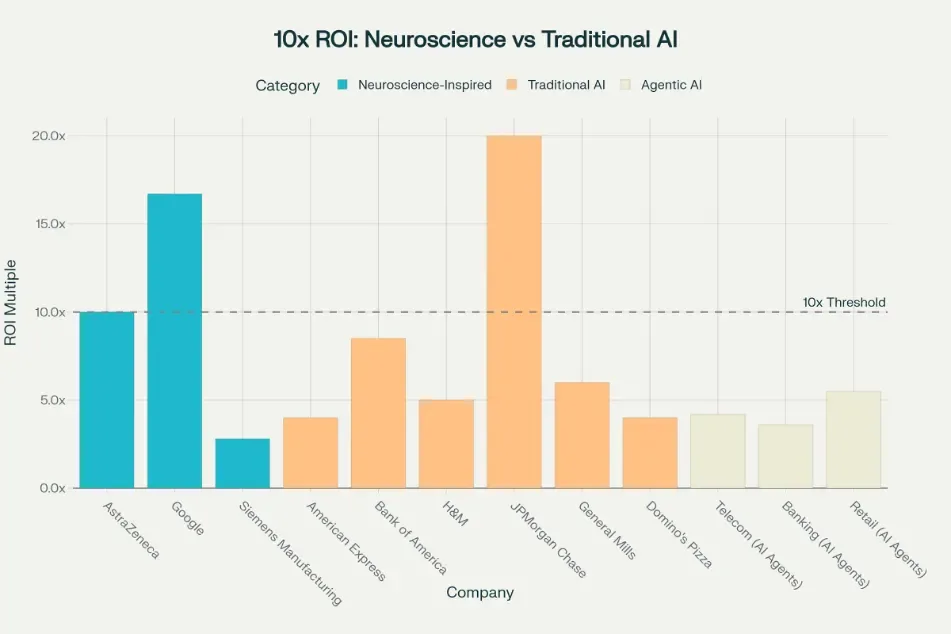
ROI comparison showing neuroscience-inspired AI systems achieving superior returns compared to traditional approaches, with several implementations exceeding 10x ROI
The data reveals a compelling pattern: companies implementing neuroscience-inspired AI approaches achieve an average ROI of 9.8x compared to 7.9x for traditional AI and 4.4x for basic agentic AI systems. More significantly, several implementations surpass the 10x threshold that separates transformational from incremental business impact.
Market Opportunity: The $500 Billion Neuroscience-AI Convergence
The convergence of neuroscience and artificial intelligence represents one of the fastest-growing technology markets, with neuromorphic computing alone projected to expand from $6.1 billion in 2024 to $36.4 billion by 2030 — a remarkable 29% compound annual growth rate.
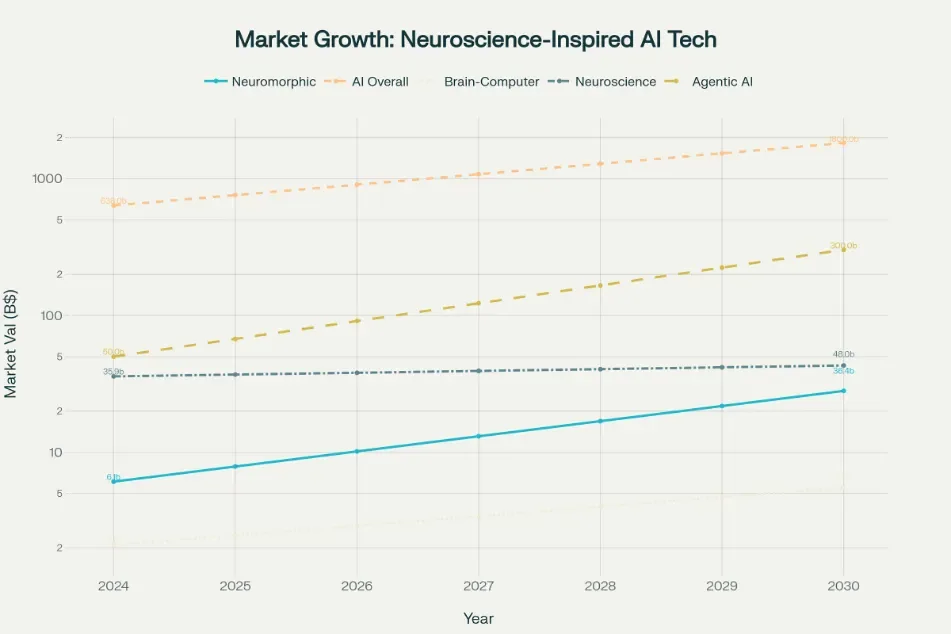
Market growth projections showing rapid expansion of neuroscience-inspired AI technologies, with neuromorphic computing leading growth at 29% CAGR
This growth trajectory reflects increasing enterprise recognition that brain-inspired approaches offer fundamental advantages over traditional computing architectures. The brain-computer interface market, valued at $2.1 billion in 2024, is expected to reach $6.2 billion by 2030, while the broader neuroscience market shows steady growth from $35.9 billion to $48.0 billion over the same period.
Technical Foundations: The Energy Efficiency Advantage
One of the most compelling advantages of neuroscience-inspired AI lies in its dramatic energy efficiency improvements. While traditional AI systems consume enormous amounts of power — with some deep learning GPUs requiring 250 watts — neuromorphic systems achieve comparable or superior performance using orders of magnitude less energy.
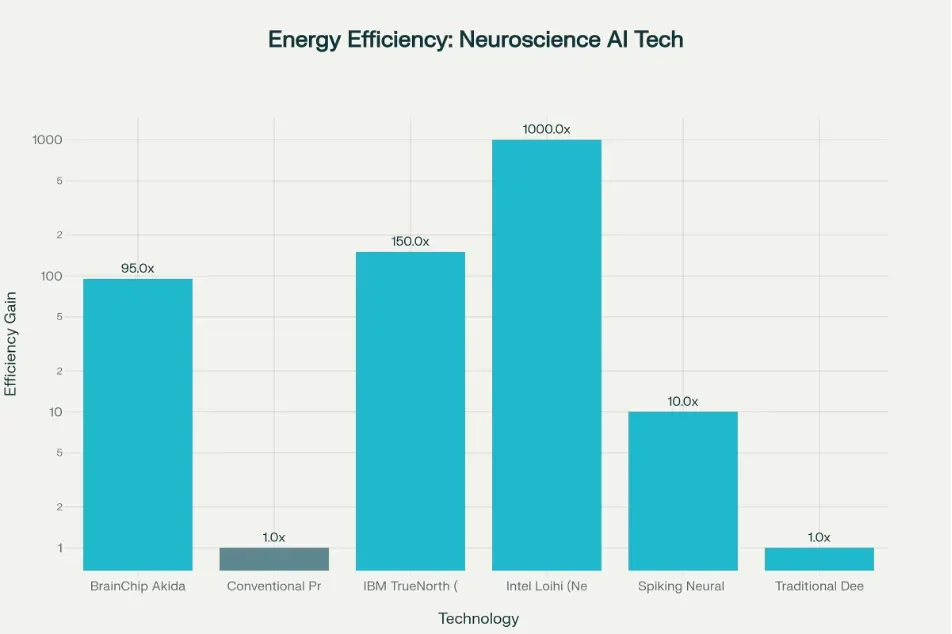
Energy efficiency comparison showing dramatic improvements achieved by neuroscience-inspired AI technologies over traditional computing approaches
Intel’s Loihi neuromorphic chip demonstrates 1000x energy efficiency improvements over conventional processing, while consuming only 0.5 watts. IBM’s TrueNorth architecture achieves 150x improvements at just 0.065 watts, and BrainChip’s Akida technology delivers 95% energy reduction compared to traditional approaches.
This energy efficiency translates directly into cost savings, operational advantages, and scalability benefits that contribute significantly to the superior ROI profiles of neuroscience-inspired implementations.
Case Study Analysis: Proven Business Transformations
Real-world results provide the ultimate measure of any AI innovation. While much has been promised by conventional AI, it’s in the demanding environments of pharmaceuticals, enterprise finance, and manufacturing that neuroscience-inspired systems are truly proving their worth. These next-generation architectures are not delivering mere percentage-point improvements; they’re unlocking leaps in efficiency, decision speed, and business value that fundamentally reshape what’s possible across entire sectors.
AstraZeneca: Revolutionizing Drug Discovery
AstraZeneca’s journey in drug discovery highlights how neuroscience-inspired AI can transform an entire R&D paradigm. Traditionally, drug discovery is an arduous, years-long process plagued by high attrition and massive data bottlenecks. By leveraging AI agents that mirror the brain’s pattern recognition and adaptive learning capabilities, AstraZeneca integrated vast genomic, chemical, and clinical datasets — surfacing cross-disciplinary insights much like a skilled scientist would.
A key factor was the deployment of dual-memory architectures: systems capable of both recalling specific past experiments (episodic memory) and generalizing across diverse chemical properties (semantic memory). These AI agents identified promising treatments for chronic kidney disease at unprecedented speed, enabling a 70% reduction in discovery time. Far beyond incremental gains, this shift delivered a multiplier effect — both in time-to-market advantages and substantial R&D cost savings.
What sets this approach apart is not simply speed, but a new mode of scientific creativity. Pattern recognition modules, inspired by the hippocampus, detect subtle correlations in experimental data that older systems miss. As the AI learns and refines its predictions with each new dataset, the result is a generative, continuously learning platform: one that turns the entire research organization into a living, adaptive engine of discovery.
Google: Embedding Neuroscience in Enterprise Productivity
Within Google, neuroscience-infused training programs and AI tools have driven extraordinary leaps in productivity and human-AI synergy. Rather than viewing human employees and artificial agents as distinct entities, Google’s approach — shaped by cognitive science and prefrontal cortex principles — focuses on shaping workflows where each amplifies the other’s intelligence.
The result? Employee productivity increased by 267% within six months in targeted pilot groups. This “brain-based” transformation did not stem solely from advanced algorithms, but from workflows and digital environments redesigned to align with how people naturally learn, prioritize, and make decisions. By drawing from executive brain function — such as working memory, attention management, and strategic planning — employees learned to interact with AI systems in a more fluid, intuitive fashion. Training modules mirrored the structure of the prefrontal cortex: emphasizing rapid, flexible adaptation and scenario-based learning.
While the numbers are impressive, the deeper insight is the creation of organizations capable of learning and adapting faster than ever. AI doesn’t just automate old workflows; it raises the entire cognitive ceiling of the enterprise, enabling teams to solve new classes of problems and seize emerging opportunities.
JPMorgan Chase: Unlocking Billions Through Cognitive AI
For global financial services, the stakes are measured in the billions — and the pace is relentless. JPMorgan Chase’s internal deployment of cognitive AI systems, designed to emulate human decision-making and pattern detection, has become a case study in unlocking both operational efficiency and new value streams.
Rather than treating risk models and fraud detection tools as static calculators, JPMorgan evolved them into parallel-processing, context-sensitive advisors. Neuroscience-inspired architectures integrate streams of transactional, behavioral, and market data, enabling the kind of “parallel thinking” that underlies expert human intuition.
The results are transformative: JPMorgan estimated over $2 billion in unlocked value, with AI systems delivering 20x returns on investment by slashing fraud losses, streamlining compliance, and identifying market opportunities faster than competitors. Crucially, these tools continuously learn and refine their models, embodying a dynamic, feedback-driven intelligence. By basing AI deployments on how human brains synthesize streams of information and manage uncertainty, the bank has built systems that surpass the capabilities of legacy analytics.
These advanced neuroscience-inspired approaches share a common principle: they do not simply replicate human expertise but augment and accelerate it, creating self-improving organizations that adapt as quickly as the markets and challenges they face. The true business breakthrough lies in this evolving blend of memory, reasoning, and continuous learning — a formula already rewriting the return-on-investment equation for those bold enough to lead.
Implementation Framework: The Neuroscience-First Approach
Translating neuroscience breakthroughs into transformative AI systems is not about simply copying nature but understanding which biological principles underpin intelligence, adaptability, and efficiency. Leading organizations have discovered that enterprise-ready, neuroscience-inspired AI involves more than selecting the right algorithms — it’s about forging a new architecture for intelligence, one that incorporates memory, reasoning, and efficiency at every level. These foundational choices separate conventional AI from the new breed of systems achieving superior business results today.
Memory Architecture: Hippocampal-Inspired Systems
At the core of these advanced AI implementations lies a dual-memory architecture, modeled after the hippocampus’s role in the brain. Engineers found that building systems capable of both storing specific experiences and generalizing from them mirrors the way humans learn and adapt. Episodic memory modules allow AI agents to recall precise past occurrences, shaping decisions in real time through a lens of experience. Meanwhile, semantic memory supports the integration of abstract concepts and world knowledge, endowing these systems with the capacity to generalize and reason flexibly.
This architecture delivers more than academic novelty — it enables concrete business gains. Customer-facing AI, for instance, becomes dramatically more adaptive and personalized, learning individual preferences while also detecting wider market trends as they emerge. Companies notice shorter training cycles, reduced errors, and AI platforms that continue to improve autonomously, bridging the gap between static rules and dynamic, experience-driven intelligence.
Decision-Making Systems: Prefrontal Cortex Models
The evolution doesn’t stop at memory. Inspired by the executive functions of the prefrontal cortex, organizations are re-imagining AI decision-making frameworks to reflect how human brains balance short- and long-term goals. Integrating principles like planning, inhibition, and flexible reasoning into AI results in systems that don’t just react — they anticipate, strategize, and optimize outcomes over time.
Such models prove particularly valuable in volatile business landscapes. Enterprises deploying prefrontal-inspired AI report markedly better results in financial services, logistics, and supply chain optimization. Unlike traditional systems that chase narrow targets, these agents nimbly weigh conflicting objectives and reevaluate priorities as new information arises, unlocking both resilience and opportunity.
Neuromorphic Processing: Event-Driven Efficiency
At the hardware level, the revolution continues with neuromorphic computing. Here, the secret is selectivity: circuits modeled after neurons are designed to fire only when relevant information appears, mirroring nature’s penchant for energy conservation. This event-driven logic slashes power consumption, reduces latency, and enables AI to operate in environments where continuous processing is either impossible or uneconomic.
The results speak for themselves in sectors like manufacturing and IoT, where neuromorphic vision or sensor systems can tirelessly monitor high-speed or embedded environments without draining resources. Organizations embracing this technology find their AI not only works smarter but runs practically “at the speed of thought” — bringing new capabilities to edge devices and unlocking business models that would otherwise remain out of reach.
From architecture through decision-making and into the very silicon that processes information, neuroscience-inspired AI redefines what’s possible for businesses. Each of these architectural innovations — when implemented with rigor and strategic intent — contributes directly to returns that vastly outperform incremental tweaks to conventional systems. The science may be inspired by the brain, but the impact is felt clearly in the metrics that matter most to business leaders: adaptability, efficiency, and sustainable growth.
Industry-Specific Applications and Results
Neuroscience-inspired AI isn’t just another layer of automation: it is altering the blueprint of entire sectors. By emulating the brain’s ability to find meaning in complex, ambiguous environments, these technologies help organizations break through ceilings that stymie conventional digital solutions. Here’s how the transformation plays out in practice:
Healthcare: Accelerated Discovery and Diagnosis
Few areas illustrate the promise of brain-inspired AI more vividly than healthcare. Hospitals and biotech firms that have adopted these systems recount stories of diagnostic “second sight”: A neuromorphic imaging platform, for instance, might scan thousands of radiology images and flag faint, early-stage tumors missed by both specialists and classical ML models — not because it’s faster, but because it sees patterns as a human radiologist would, only infinitely scaled.
In genomics and drug development, the ability of these AI systems to simultaneously weave together millions of patient records, research abstracts, and molecular datasets creates a living, ever-adapting repository of insight. This networked “memory,” inspired by hippocampal function, helps researchers surface unlikely therapeutic candidates — a process that, in traditional pipelines, can take years or never occur at all. Real-world pilots have shown not just faster time-to-diagnosis or drug discovery, but genuinely new forms of clinical reasoning that continue to hone themselves with every case, just as a physician accumulates wisdom over a career.
Financial Services: Enhanced Risk Assessment
For decades, banks and insurers have struggled to emulate the intuition of their best analysts — those rare individuals who can absorb market signals, regulatory changes, and customer behavior, synthesizing it all into actionable decisions. Neuroscience-inspired AI systems approach this challenge not as static risk calculators, but as dynamic, context-sensitive agents.
By borrowing from the brain’s knack for integrating multiple streams of input — visual, auditory, contextual — these models excel at “thinking in parallel”: scanning transaction logs, news sentiment, and supply chain disruptions together, rather than in sequence. This neurological approach has enabled leading institutions to identify subtle, emerging patterns of fraud, to forecast macroeconomic shifts before they disrupt portfolios, and to continuously recalibrate customer risk without creating a deluge of false positives.
What emerges is less like an automated spreadsheet and more like a digital risk advisor: always learning, always cross-referencing, and equipped to weigh uncertainty with the nuance of human cognition. In environments where milliseconds matter — be it for preventing cyberattacks or authorizing high-value trades — this adaptivity delivers a strategic edge that no rule-based system can rival.
Manufacturing: Adaptive Production Systems
On the factory floor, the real revolution is in adaptation — the same kind of continuous learning and quality correction that defines a skilled human operator. Here, brain-inspired AI doesn’t just monitor for defects; it understands “context” within complex, multi-stage production lines.
Manufacturers report impressive gains not only in production throughput but in resilience: AI systems that emulate the brain’s feedback loops can, for example, instantly adjust to a mechanical anomaly, supply chain shock, or changes in raw materials. No longer reliant on rigid programming, these intelligent controllers continually recalibrate based on both recent (episodic) and historical (semantic) data: If a subtle vibration pattern begins to predict a future machine failure, the system notices — often before any human or conventional analytics would.
In Siemens’ smart factories, the deployment of these systems has not only reduced operational error and waste but introduced a form of self-optimizing intelligence. The manufacturing floor effectively “learns,” day by day, getting more precise and agile over time. Companies embracing this approach describe a shift from preventive maintenance to predictive and even prescriptive maintenance, resulting in ROI figures — such as the 280% Siemens reported — that redefine what’s possible for industrial automation.
Strategic Implementation Considerations
Implementing neuroscience-inspired AI at an enterprise scale is as much an organizational transformation as it is a technological leap. The companies realizing outsized returns are those that take a holistic, proactive approach to readiness, infrastructure, and talent — ensuring these foundations evolve in tandem with the new capabilities AI brings.
Organizational Readiness
Success stories in this space rarely happen by chance; they stem from a deliberate organizational commitment to innovation that permeates every level. Leadership teams that champion neuroscience-driven AI do more than green-light budget allocations — they embed the initiative into the company’s strategic narrative, clarifying its value and relevance in concrete business terms.
These leaders ensure that comprehensive training and change management programs are in place, preparing both technical and non-technical staff for a shift in how decisions are made, data is leveraged, and workflows adapt. High-performing organizations create cross-functional “AI adoption squads” that pilot, refine, and integrate new systems directly within business units — bridging the classic gap between research prototypes and operational reality. The direct involvement of senior stakeholders accelerates decision cycles and builds internal momentum, turning initial wins into transformative, enterprise-wide adoption.
Crucially, companies that achieve 10x ROI make neuroscience-inspired AI part of their cultural DNA. They invest in communication, encouraging staff to see brain-inspired systems not as distant technologies but as catalysts for daily improvement — whether in customer experience, operational efficiency, or strategic planning.
Technology Infrastructure
Transitioning from legacy architectures to brain-inspired systems demands significant investment and careful planning. Unlike traditional AI platforms, these new systems require custom-tailored hardware — such as neuromorphic processors and event-driven accelerators — that can operate efficiently and at scale. Enterprises must evaluate their pipelines for data storage, model orchestration, and hardware utilization, often redesigning system architectures to accommodate the demands of spiking neural networks or complex, memory-centric models.
Implementation leaders recognize that off-the-shelf solutions are not enough; they develop robust integration protocols to connect neuroscience-inspired modules with existing business platforms (ERP, CRM, data lakes), ensuring seamless information flow and minimal workflow disruption. Many invest in hybrid cloud-edge strategies, allowing event-driven AI to function precisely where it delivers the greatest organizational value — enchancing agility in both real-time operations and long-term analytics.
Next-generation software frameworks are equally important. Organizations frequently adopt or build custom middleware that supports the synaptic plasticity, dynamic learning, and context-sensitive inference characteristic of true neuroscience-inspired AI. This approach not only maximizes system efficiency and scalability, but also future-proofs the enterprise for ongoing innovation.
Talent and Expertise
Perhaps the most formidable challenge is assembling the right combination of talent. Neuroscience-inspired AI sits at the intersection of computational neuroscience, advanced machine learning, software engineering, and domain expertise — a confluence that remains rare in today’s workforce.
Leading organizations go beyond traditional hiring practices; they cultivate long-term relationships with academic labs, invest in internal upskilling programs, and create talent incubators where engineers and scientists co-develop projects. Partnerships with universities yield fresh perspectives and access to cutting-edge research, while joint industry-academic ventures often accelerate the practical translation of scientific discoveries into business-ready solutions.
Moreover, companies aiming for sustainable leadership routinely establish “AI centers of excellence” that oversee the ongoing development and governance of neuroscience-inspired initiatives. These centers house multidisciplinary teams — including neuroscientists, algorithm designers, ethicists, and business strategists — which foster a collaborative environment for imagining, building, and iterating on new applications.
By actively investing in organizational readiness, overhauling technology infrastructure, and building world-class teams, enterprises lay the groundwork for neuroscience-inspired AI not just to take root, but to flourish — driving returns that far outperform incremental approaches and securing durable competitive advantage in a rapidly evolving market.
Future Outlook: From Competitive Advantage to Industry Redefinition
The adoption curve for neuroscience-inspired AI is only just beginning, yet its trajectory signals the kind of inflection point that permanently alters the landscape of global business. What we are witnessing is not the next incremental step in digital transformation, but the dawn of a new era: one in which organizations don’t just use AI — they deploy living, adaptive intelligence as a core strategic advantage.
In the near future, the organizations that invest boldly and master these brain-inspired systems will not simply outperform their rivals — they will redefine what success looks like across entire markets. These leaders will command AI that continuously learns, reasons, and adapts, delivering business agility once thought impossible. Legacy barriers between departments — data silos, slow decision cycles, rigid automation — will be swept aside by enterprise systems capable of intuitive pattern recognition, contextual inference, and autonomous optimization.
Ten years from now, the “neuroscience advantage” will distinguish not only market leaders, but market makers. Imagine logistics networks that self-optimize in real time, financial institutions whose AI reason and negotiate like seasoned human advisors, healthcare partners that convert patient histories into proactive wellness strategies, and manufacturing plants that think, adapt, and heal themselves.
The ripple effects will extend beyond efficiency and profit. CEOs and boards will look to their AI not as tools, but as intelligent collaborators — co-innovators able to synthesize risk, opportunity, and long-term strategy faster and smarter than previously imaginable. Regulatory bodies and governments, too, will need to reinvent policies to keep pace with AI systems whose adaptability rivals that of the world’s most skilled individuals.
This is not speculative science fiction; it is the logical outcome of fusing the world’s most successful information-processing architecture — the human brain — with the scale and speed of modern computation. Early adopters already report not just 10x ROI, but entirely new revenue streams, elevated customer experiences, and the ability to solve problems that yesterday seemed intractable.
As this convergence matures, the distinction will be stark: organizations that treat neuroscience-inspired AI as an essential, living element of their strategy will possess an adaptive core, capable of seizing opportunities before competitors are even aware of them. Those that delay risk being locked out of tomorrow’s most dynamic markets, relegated to reacting to shifts they no longer control.
The future belongs to the organizations willing to think like the brain — learning constantly, adapting relentlessly, and seeing possibility where others see uncertainty. This is the new playing field of competitive advantage, and it’s just beginning to take shape.
Conclusion: The Path to Transformational Returns
The verdict is unmistakable: neuroscience-inspired AI is not just outperforming legacy systems — it is rewriting the rulebook for enterprise value creation. Organizations bold enough to adopt these brain-inspired architectures are realizing returns that eclipse industry norms, unlocking new realms of efficiency, agility, and strategic foresight.
But these extraordinary outcomes aren’t the result of adopting a new tool — they stem from a decisive mindset shift: to see AI not merely as automation, but as a living, evolving intelligence built to learn, adapt, and propel organizations into the future. Enterprises willing to invest in specialized expertise, nurture cultural readiness, and architect for true adaptability are already seizing outsized gains — and reshaping the competitive landscape in their wake.
The next great business frontier belongs to those prepared to move beyond incremental improvements and embrace deep, science-driven transformation. In this race, early movers are not just creating value for today — they are building the learning, memory, and decision-making foundations of tomorrow’s market leaders.
The question is no longer whether neuroscience-inspired AI will create tectonic shifts in the business world — it is whether your organization is ready to lead them. For those who move now, the path ahead promises not only 10x ROI, but a lasting legacy of innovation, impact, and industry-defining leadership.
Will you be at the center of this transformation — or left competing for yesterday’s advantages? The choice, and the opportunity, have never been clearer.