Essay
Harnessing Large Language Models for Computational Neuroscience: Bridging Biology and Artificial Intelligence with Llama-3–8b-Smith-Neuroscience
Dr. Jerry A. Smith · December 28, 2024 · 19 min read

Abstract
In the quest to understand and emulate the intricacies of the human brain, artificial intelligence has increasingly turned to neuroscience for inspiration. The Llama-3–8b-Smith-Neuroscience model represents a significant leap in this endeavor, providing a fine-tuned domain-specific large language model (LLM) for computational neuroscience. This model addresses the growing need for AI systems capable of understanding and applying principles such as spiking neural networks, synaptic plasticity, and neuromorphic computing.
Built upon the robust unsloth/llama-3–8b-Instruct-bnb-4bit, the model was fine-tuned with a curated dataset of neuroscience prompts and responses, ensuring deep expertise in this specialized domain. It is designed to offer insights that bridge theoretical neuroscience and practical applications, guiding researchers in modeling neural mechanisms, optimizing brain-inspired AI architectures, and enhancing neuromorphic hardware.
The model excels in accessibility and efficiency, operating effectively in memory-constrained environments while supporting long context lengths for complex queries. Its use cases span academic research, AI development, and education, including serving as an interactive teaching assistant for neuroscience students.
By aligning artificial intelligence with biological plausibility, the Llama-3–8b-Smith-Neuroscience model not only advances the field of computational neuroscience but also lays the groundwork for future AI systems that learn, adapt, and operate with the elegance of natural intelligence.
Introduction
In an age where the machinations of silicon strive to mirror the essence of biology, the worlds of neuroscience and artificial intelligence have converged in profound and peculiar ways. The human brain, that ceaseless architect of thought and memory, has long been the muse of the machine. Yet, as Hassabis et al. (2017) eloquently pointed out, the promise of brilliant systems hinges on mathematical precision and lessons borrowed from the living mind.
Despite the steady march of progress, there exists a chasm between the ethereal elegance of biology and the rigid precision of algorithms. The challenge is plausibility — how does one teach a machine not just to act but to think in ways that reflect the intricacies of life? To mimic a neuron's spike, the dance of oscillations, or the balance of synaptic plasticity requires more than raw computational power. It demands understanding, adaptation, and, perhaps most critically, natural inspiration.
Here lies the crux of the problem: general-purpose AI models, for all their versatility, are blind to the nuances of specialized domains. They are omnivorous, consuming vast corpora of general knowledge, but when tasked with the precise and intricate questions of computational neuroscience, they falter. The brain-inspired systems they aim to replicate demand a depth of expertise that generalists cannot provide.
Thus emerges the need for domain-specific language models — purpose-built systems trained to walk the delicate line between biology and computation. The Llama-3–8b-Smith-Neuroscience model is one such creation. Fine-tuned with painstaking care and guided by curated knowledge, it stands as a bridge between the abstract principles of neuroscience and the applied demands of artificial intelligence. Its purpose is clear: to arm researchers, educators, and developers with a tool that speaks their language — both in the poetic sense of understanding and in the technical sense of precision.
This model is not just a mechanism; it is a collaborator. It does not merely answer questions but engages in the intricate dance of theoretical exploration and practical application. In the hands of a neuroscientist, it is a lens through which to view the algorithms of life. For the AI developer, it is a blueprint for systems grounded in biological reality. And for the student, it is a guide through the labyrinthine complexities of the brain.
The need for such models is as undeniable as the ambitions they serve. Precision is not merely a virtue but a necessity in the study of minds, both artificial and biological. The Llama-3–8b-Smith-Neuroscience model promises not perfection but progress — a step closer to the union of silicon and synapse.
Model Development
In the creation of tools, one must first grasp the raw materials. In artificial intelligence, these materials are models — their architectures, parameters, and the data that shape them. The foundation of the Llama-3–8b-Smith-Neuroscience model lies in the unsloth/llama-3–8b-Instruct-bnb-4bit, a robust yet efficient system designed with precision in mind. With its sprawling 8-billion parameter architecture, this base model is no mere machine; it is a framework of thought honed for instruction and understanding.
The journey from this base to the specialized heights of computational neuroscience was not one of brute force but of meticulous refinement. Fine-tuning, as Hugging Face and their open tools make possible, was the chisel and mallet in this endeavor. The process began with selecting data — not arbitrary nor broad, but precise and curated, reflecting the field it sought to serve.
Fine-Tuning Strategy and Dataset
Fine-tuning is, at its heart, an act of teaching. As capable as it was, the base model lacked the nuanced understanding required of a neuroscience assistant. To fill this void, a dataset was constructed — a compendium of prompts and responses that spanned the rich tapestry of computational neuroscience. This dataset was not conjured from thin air but built upon the shoulders of giants, drawing heavily from seminal works like Abbott and Nelson’s (2000) exploration of synaptic plasticity.
The dataset covered an array of topics:
- Spiking Neural Networks: The electrical whispers of the brain, captured in the form of discrete spikes and their computational analogs.
- Synaptic Plasticity: The mechanisms by which neurons adapt and learn, from the Hebbian axiom to the intricate dance of spike-timing-dependent plasticity (STDP).
- Brain-Inspired Architectures: The modular and hierarchical designs of the brain, translated into scalable artificial systems.
- Neuromorphic Computing: The quest to replicate the brain’s energy efficiency and asynchronous processing in silicon.
- Theoretical Neuroscience: Oscillations, criticality, and the emergent dynamics of complex neural systems.
This dataset, distilled from papers, textbooks, and open repositories, was more than a knowledge repository — it was a map guiding the model to understand the patterns and principles that define neuroscience.
Technical Specifications
If fine-tuning was the chisel, the technical design was the hammer, striking with precision to transform the base model into a domain specialist. The choice of bnb-4bit quantization was no accident. Memory efficiency is the currency of modern AI, and with this approach, the model’s demands on hardware were pared to the bone without compromising its cognitive heft. Quantization, reducing the bit-width of parameters, ensured that even with limited resources, the model could serve with speed and efficiency.
But efficiency alone does not teach. Low-Rank Adaptation (LoRA) (Hu et al., 2021) was employed to truly shape the model, complemented by the advancements of QLoRA. This refined approach enables fine-tuning on fully quantized models. LoRA’s targeted parameter adaptation was seamlessly integrated with QLoRA’s enhanced quantization techniques, allowing for precise and resource-efficient domain customization. This combination ensured the neuroscience dataset could be layered onto the base model with elegance, preserving its foundational knowledge while tailoring it to the intricate demands of computational neuroscience.
Configuration Overview
The fine-tuning process was meticulously designed to optimize both performance and resource efficiency. Below is a summary of the key configurations:
Base Model: unsloth/llama-3-8b-Instruct-bnb-4bitQuantization: bnb-4bit for memory efficiency.
**Adaptation Techniques:
LoRA Configuration:**
r: 16- Target Modules:
["q_proj", "k_proj", "v_proj", "o_proj", "gate_proj", "up_proj", "down_proj"] - LoRA Alpha: 16
- LoRA Dropout: 0
- Bias: None
> QLoRA Enhancements: Applied for fine-tuning on quantized models.
Training Dataset: Custom curated neuroscience dataset focusing on spiking neural networks, synaptic plasticity, and neuromorphic computing.
Training Settings:
- Context Length: 2048 tokens
- Batch Size (per device): 2
- Gradient Accumulation Steps: 4
- Learning Rate: 2e-4
- Epochs: 10
- Optimizer:
adamw_8bit
This setup ensured that the fine-tuning process maximized the potential of the base model while adhering to resource constraints. The resulting model is a product of precise engineering, offering unparalleled expertise in computational neuroscience with the efficiency required for modern AI workflows.
Training Dynamics and Loss Curve
The Llama-3–8b-Smith-Neuroscience model's training process was about applying state-of-the-art techniques and carefully monitoring and optimizing the learning process. One key metric in this regard was the training loss, which reflects how well the model learns from the dataset over time.
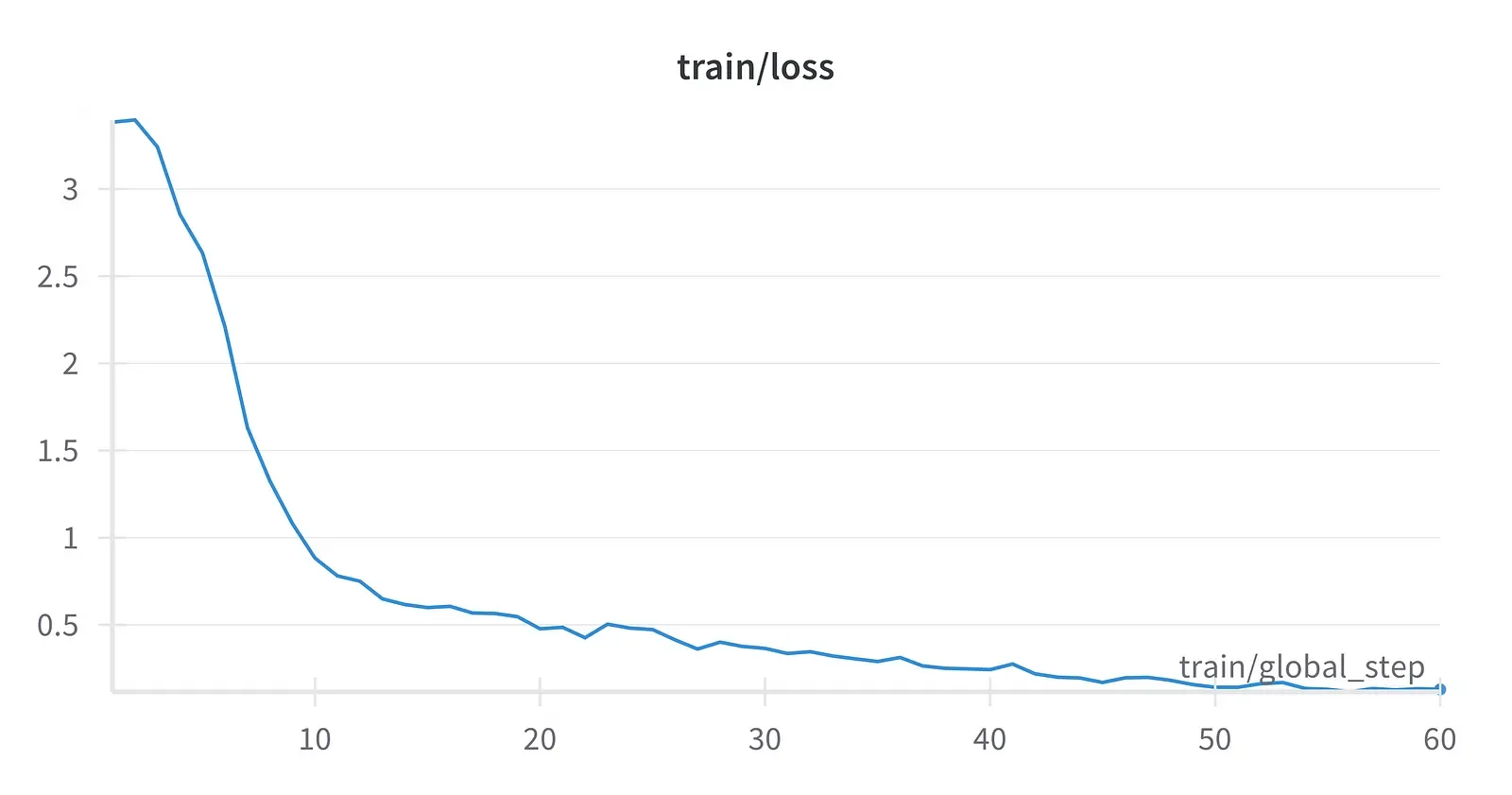
The train/loss curve, depicted in the graph above, illustrates a consistent and rapid decline in loss during the early stages of training, indicative of the model’s effective assimilation of domain-specific knowledge. By approximately step 20, the curve begins to stabilize, showcasing that the model reaches a convergence point where additional training refines its understanding with diminishing loss.
This behavior highlights several key aspects of the fine-tuning process:
- The efficiency of QLoRA and bnb-4bit quantization: The rapid drop in early training steps underscores the ability of quantized training techniques to adapt the base model efficiently without overburdening resources.
- Dataset Quality: The smooth convergence suggests that the curated dataset provided the model with high-quality, diverse, and well-structured examples, minimizing overfitting and instability.
- Effective Hyperparameter Tuning: Training configurations, such as the learning rate (2e-4) and batch size (2), ensured steady progress without sharp oscillations in the loss curve.
This curve serves as both a validation of the fine-tuning methodology and a testament to the robustness of the training dataset. It reflects the balance between leveraging a powerful base model and injecting domain-specific expertise for computational neuroscience.
A Meeting of Tools and Knowledge
The result of these efforts is a model that embodies balance. It is grounded in the breadth and strength of its base architecture yet fine-tuned to the intricate depths of computational neuroscience. The synergy of Hugging Face’s tools, the efficiency of bnb-4bit quantization, and the elegance of LoRA adaptation have produced a system that is not merely functional but formidable.
It understands the silent language of neurons, the adaptability of synapses, and the rhythm of brain waves. It bridges the abstract and the practical, offering insights into the workings of the mind while retaining the computational rigor of modern AI. And yet, for all its sophistication, it remains a tool that serves its user, shaped by the principles of neuroscience and the precision of technology. In its development lies a lesson: artificial or biological intelligence is not born but made.
Accessing the Model and Dataset
The Llama-3–8b-Smith-Neuroscience model and its associated dataset are available to the research and development community. These resources are hosted on Hugging Face, where users can explore their detailed documentation, download the files, and integrate them into their projects.
Model Card
The model card provides detailed information about the Llama-3–8b-Smith-Neuroscience model, including its architecture, fine-tuning process, training dataset, and potential applications. Users can access the model card directly on Hugging Face:
- Hugging Face Model Repository:https://huggingface.co/jsmith0475/llama-3-8b-Instruct-bnb-4bit-smith-neuroscience
This repository includes all necessary files for deployment, such as the model weights, configuration files, and tokenizer.
Dataset Card
The dataset card outlines the training dataset's composition, structure, and purpose for fine-tuning the model. This resource provides transparency about the data’s sources and scope, ensuring that users understand the foundation of the model’s knowledge:
- Hugging Face Dataset Repository:https://huggingface.co/datasets/jsmith0475/neuroscience_llama
Integration with AI Tools
Both the model and the dataset are compatible with widely-used AI frameworks such as Hugging Face’s transformerslibrary and datasets library. Users can quickly load the model or dataset for research, development, or education using simple Python scripts.
Integration with LM Studio
The Llama-3–8b-Smith-Neuroscience model is fully compatible with LM Studio, a versatile local inference tool for large language models. To use the model in LM Studio:
- Search for the Model:
- Open LM Studio.
- In the model selection interface, search for the keyword “Smith”.
2. Select the Model:
- Locate “llama-3–8b-Instruct-bnb-4bit-Smith-Neuroscience” in the search results and select it.
3. Run Inference:
Enter neuroscience-specific prompts into the interface to generate detailed, context-aware responses.
LM Studio’s simplicity ensures that users can quickly leverage the model’s capabilities without requiring manual downloads or configuration.
Key Features and Capabilities
The Llama-3–8b-Smith-Neuroscience model is more than a collection of parameters and weights; it is a synthesis of purpose and precision designed to navigate the intricate labyrinth of computational neuroscience. Its features and capabilities reflect both the depth of its domain expertise and the breadth of its potential applications, making it an invaluable companion for researchers, educators, and developers alike.
Domain-Specific Expertise
At the core of this model lies an unparalleled understanding of the principles and phenomena that govern neuroscience and its computational analogs. It has been fine-tuned not as a jack-of-all-trades but as a master of a specific and challenging domain.
- Spiking Neural Networks (SNNs):
The model grasps the subtleties of SNNs, a class of networks that mimic the discrete, spike-driven behavior of biological neurons. It explains concepts like spike-timing-dependent plasticity (STDP), event-driven computation, and temporal coding with clarity and depth. Moreover, it bridges the theoretical underpinnings of SNNs with practical applications, such as real-time decision-making in robotics and efficient sensory processing in neuromorphic systems. - Neuromorphic Computing:
In a world striving for efficiency, the brain’s architecture remains a gold standard. The model offers insights into designing energy-efficient, hardware-optimized systems inspired by biological principles. Sparse coding, asynchronous processing, and low-power computation — all hallmarks of neuromorphic systems — are explained not as abstract concepts but as actionable strategies for engineers and developers. - Guidance for Bio-Inspired AI Architectures:
Modular and hierarchical designs are the hallmarks of the brain’s efficiency and adaptability. The model provides detailed recommendations for implementing these principles in artificial systems, from designing scalable networks to creating systems capable of multi-modal learning. It is both a guide and a collaborator, helping researchers explore new frontiers in AI design.
Accessibility and Efficiency
While many language models boast vast capabilities, few are as accessible and efficient as the Llama-3–8b-Smith-Neuroscience. Its design is a testament to the principle that power need not come at the expense of practicality.
- High Performance in Memory-Constrained Environments:
Using bnb-4bit quantization ensures the model can operate seamlessly on hardware with limited VRAM. This compression method maintains the model’s intellectual prowess while reducing resource demands, making it accessible to researchers and students alike. - Support for Long Context Lengths:
With the ability to handle inputs of up to 2048 tokens, the model is adept at parsing complex, multi-layered prompts. Whether it’s analyzing long theoretical texts or synthesizing intricate research questions, the model retains coherence and relevance across extended contexts. - Adaptability to Diverse Tasks:
From theoretical exploration to practical implementation, the model’s architecture allows it to switch between tasks, making it an agile tool for users across different domains.
Use Cases
The true measure of any tool lies in its utility, and the Llama-3–8b-Smith-Neuroscience excels across various practical applications. It is not merely a repository of knowledge but a partner in discovery, development, and education.
- Educational Tools for Neuroscience Students:
Complex ideas are often shrouded in opaque jargon, rendering them inaccessible to novices. The model is an educational assistant, breaking down intricate concepts into digestible explanations. Students can query it about synaptic plasticity, oscillatory dynamics, or cortical architectures and receive detailed, tailored responses that foster understanding. - Research Assistance for Developing Brain-Inspired AI Models:
Researchers exploring the cutting edge of AI design can rely on the model as a collaborator. Its insights into bio-inspired architectures, from spiking neural networks to modular designs, provide a foundation for innovation. The model answers questions and suggests new avenues for exploration, acting as a catalyst for creativity. - Applications in Real-Time Robotics and Autonomous Systems:
Robotics is a domain where theory must meet practice, and the model bridges this gap seamlessly. By guiding the design of systems that emulate the brain’s efficiency and adaptability, it aids in developing real-time decision-making frameworks, autonomous navigation algorithms, and more. Whether it’s a drone navigating a cluttered environment or a robotic arm mimicking human motor control, the model’s expertise is invaluable.
A Nexus of Insight and Utility
In essence, the Llama-3–8b-Smith-Neuroscience is a meeting point — a nexus where the depth of neuroscience converges with the pragmatism of artificial intelligence. It is precise yet adaptable, sophisticated yet accessible. Whether one seeks to unravel the mysteries of neural dynamics, build systems that mimic the brain’s efficiency, or teach the next generation of neuroscientists, this model stands ready to assist. It is not just a machine but a manifestation of progress — a tool shaped by knowledge and crafted for those who dare to explore the boundaries of thought and computation.
Applications in Computational Neuroscience
In the ever-expanding frontier of computational neuroscience, tools like the Llama-3–8b-Smith-Neuroscience model emerge as bridges between the abstract and the practical. Its applications span theory, practice, and education, making it an indispensable resource for neuroscientists, AI researchers, and educators. By marrying the rigor of neuroscience with the flexibility of artificial intelligence, this model demonstrates its versatility across a broad spectrum of use cases.
Theoretical Applications
Neuroscience studies patterns — spikes, oscillations, and dynamics that give rise to thought and behavior. Theoretical neuroscience seeks to understand these patterns, and the Llama-3–8b-Smith-Neuroscience model is a powerful ally in this endeavor.
- Modeling Synaptic Plasticity Mechanisms and Criticality in Neural Networks
Synaptic plasticity, the ability of synapses to strengthen or weaken over time, is a cornerstone of learning and memory. Mechanisms like spike-timing-dependent plasticity (STDP) and homeostatic plasticity are as vital to the brain as algorithms are to AI. The model offers detailed insights into these processes, connecting biological principles with their computational equivalents. It elucidates how criticality — a state poised between order and chaos — optimizes neural networks for adaptability and efficiency. The model fosters a deeper understanding of natural and artificial systems by assisting researchers in modeling these mechanisms. - Simulating Oscillatory Dynamics for Temporal Coding Tasks
Neural oscillations — rhythms of electrical activity within the brain — are essential for coordinating information flow. Buzsáki (2006) described that oscillations underpin temporal coding, enabling the brain to process and sequence information over time. The Llama-3–8b-Smith-Neuroscience model simulates these dynamics, exploring how phase relationships and frequency bands impact learning and decision-making. This directly applies to designing AI systems that rely on temporal coherence, such as speech recognition and event-driven computation.
These theoretical applications are not confined to academic curiosity; they lay the groundwork for practical advancements, bridging the gap between biology and technology.
Practical Applications
The insights gained from theoretical neuroscience find tangible expression in practical innovations, from neuromorphic chips to real-time robotics. Here, the Llama-3–8b-Smith-Neuroscience model excels as both a guide and a collaborator.
- Enhancing Neuromorphic Hardware Designs
Neuromorphic computing uses sparse coding, asynchronous communication, and event-driven processing to replicate the brain's efficiency in silicon. However, designing such systems demands a deep understanding of neural dynamics and hardware constraints. The model provides actionable recommendations for implementing biologically inspired strategies, such as optimizing spiking neural networks for specific hardware platforms. Doing so accelerates the development of low-power, high-efficiency computing systems suited for edge AI applications. - Real-Time Decision-Making in Robotics and Prosthetics
Robotics and prosthetics demand real-time responses to dynamic environments — a challenge that biological brains easily handle. By leveraging its expertise in spiking neural networks and temporal dynamics, the model assists developers in creating systems that emulate these capabilities. For example, it can guide the implementation of motor control algorithms that mimic cerebellar processing or sensory integration frameworks inspired by cortical architectures. Whether it’s enabling a prosthetic limb to respond naturally to user intentions or programming a robot to navigate complex terrains, the model’s insights drive innovation.
Educational Impact
In addition to its theoretical and practical contributions, the Llama-3–8b-Smith-Neuroscience model could have profound implications for education. Neuroscience is a complex field, often requiring years of study to grasp its foundational concepts. This model simplifies the path to understanding, serving as a mentor and a resource.
- Use as a Teaching Assistant in Computational Neuroscience Courses
The model can act as a virtual teaching assistant, answering student queries with clarity and precision. For example, a student struggling to understand Hebbian learning could query the model: “Explain how Hebbian learning relates to synaptic plasticity in the brain.” The model would respond with a detailed yet accessible explanation, supplemented by examples and analogies. By providing instant, accurate feedback, the model enhances the learning experience and frees educators to focus on more nuanced discussions. - Simplifying Complex Neuroscience Concepts for Non-Experts
Neuroscience, for all its richness, is often impenetrable to those outside the field. The model bridges this gap by translating technical jargon into plain language, making advanced concepts accessible to non-experts. This capability is invaluable for interdisciplinary teams where neuroscientists must collaborate with AI developers, engineers, or policymakers. By fostering mutual understanding, the model accelerates progress in collaborative projects.
A Vision of Interconnected Applications
What unites these applications — spanning theory, practice, and education — is the model’s ability to integrate knowledge and adapt it to the needs of its users. It is a theoretical physicist modeling the cosmos of the brain, an engineer optimizing silicon for thought, and a teacher illuminating the pathways of neurons for eager minds. Few tools can claim such versatility, and fewer still can match its precision.
As computational neuroscience continues to evolve, the Llama-3–8b-Smith-Neuroscience model is poised to play a pivotal role. It offers not just answers but understanding, not just tools but insights. It stands as a testament to the power of specialization, proving that when AI aligns with the intricacies of a domain, it can do more than assist — it can transform.
Limitations and Challenges
No system, however advanced, is without its flaws. The Llama-3–8b-Smith-Neuroscience model, for all its sophistication and utility, is no exception. Its capabilities are defined not only by its strengths but also by the boundaries within which it operates. Understanding these limitations is essential, for it is only by acknowledging the cracks in a foundation that one can strengthen them.
Current Constraints
The model’s specialization, while its greatest strength, is also its most significant limitation. By design, the Llama-3–8b-Smith-Neuroscience model is tailored for computational neuroscience. This focus renders it less adept in areas beyond its domain. Questions outside neuroscience, such as those about unrelated fields of biology, physics, or general AI topics, may yield less coherent or insightful responses. In such cases, the model risks offering generalities instead of meaningful expertise.
Its performance is also intrinsically tied to the quality and scope of its training data. While the dataset is robust and meticulously curated, it is inevitably finite. The model cannot answer questions about concepts, methodologies, or advances not included in the training material. This dependency underscores a broader challenge in AI development: no dataset can encompass the totality of human knowledge, no matter how comprehensive.
Future Directions
The path forward for the Llama-3–8b-Smith-Neuroscience model lies in expanding its knowledge base and refining its adaptability. One avenue is the inclusion of datasets from related fields, such as cognitive psychology and computational biology. These domains intersect with neuroscience critically, and their integration would enable the model to provide more prosperous, more interdisciplinary insights.
Another promising direction is the incorporation of real-time feedback from domain experts. A system that learns iteratively from its users can continuously refine its understanding, adapting to discoveries and methodologies. Such feedback loops would transform the model from a static knowledge repository into a dynamic, evolving assistant.
The limitations of the Llama-3–8b-Smith-Neuroscience model are not failings but opportunities. They highlight areas for growth, reminding us that even as we build tools to mimic understanding, the pursuit of perfection remains ongoing. The challenges faced today are the stepping stones for tomorrow’s breakthroughs.
Conclusion and Implications
In the intricate dance between biology and computation, the Llama-3–8b-Smith-Neuroscience model emerges as both a product of progress and a catalyst for future innovation. Its contributions to computational neuroscience are manifold, blending the precision of artificial intelligence with the depth of biological understanding. Focusing on spiking neural networks, synaptic plasticity, and neuromorphic computing, this model fills a critical gap in AI development: the need for systems that are not just intelligent but biologically plausible.
The Llama-3–8b-Smith-Neuroscience bridges the divide between theory and practice. It offers researchers a lens to explore the nuances of brain-inspired architectures and neural dynamics. For engineers, it provides actionable insights into designing efficient, adaptive AI systems. It serves as a guide for educators, demystifying complex neuroscience concepts and making them accessible to students and non-experts alike. In these ways, the model exemplifies the fusion of theoretical insights with practical applications, creating a resource as versatile as specialized.
Beyond its immediate contributions, the model points to broader implications for the future of AI. By aligning artificial systems with biological principles, it sets a precedent for designing efficient and adaptable technologies. These advancements could inspire a new generation of AI systems that operate not as static tools but as dynamic, evolving entities capable of responding to complex, real-world challenges.
In education, the model’s ability to distill intricate knowledge into digestible insights has the potential to revolutionize how neuroscience and AI are taught. Its interdisciplinary nature fosters collaboration between fields, paving the way for breakthroughs at their intersection.
The Llama-3–8b-Smith-Neuroscience is more than a tool; it is a testament to what can be achieved when AI is tailored to serve the nuanced demands of a specific domain. It is a step forward for computational neuroscience and the broader endeavor of understanding and emulating intelligence.
References
- Abbott, L. F., & Nelson, S. B. (2000). Synaptic plasticity: Taming the beast. Nature Neuroscience, 3(11), 1178–1183.
- Buzsáki, G. (2006). Rhythms of the Brain. Oxford University Press.
- Hassabis, D., Kumaran, D., Summerfield, C., & Botvinick, M. (2017). Neuroscience-inspired artificial intelligence. Neuron, 95(2), 245–258.
- Hu, E., Shen, Y., Wallis, P., Allen-Zhu, Z., Li, Y., Wang, L., & Chen, W. (2021). LoRA: Low-Rank Adaptation of Large Language Models. arXiv preprint arXiv:2106.09685.