Essay
AI in Drug Discovery is Evolving — Are You Ready for Agentic AI?
Dr. Jerry A. Smith · February 8, 2025 · 10 min read
From Prediction to Execution: Why the Future of Pharma Belongs to AI That Thinks, Decides, and Acts
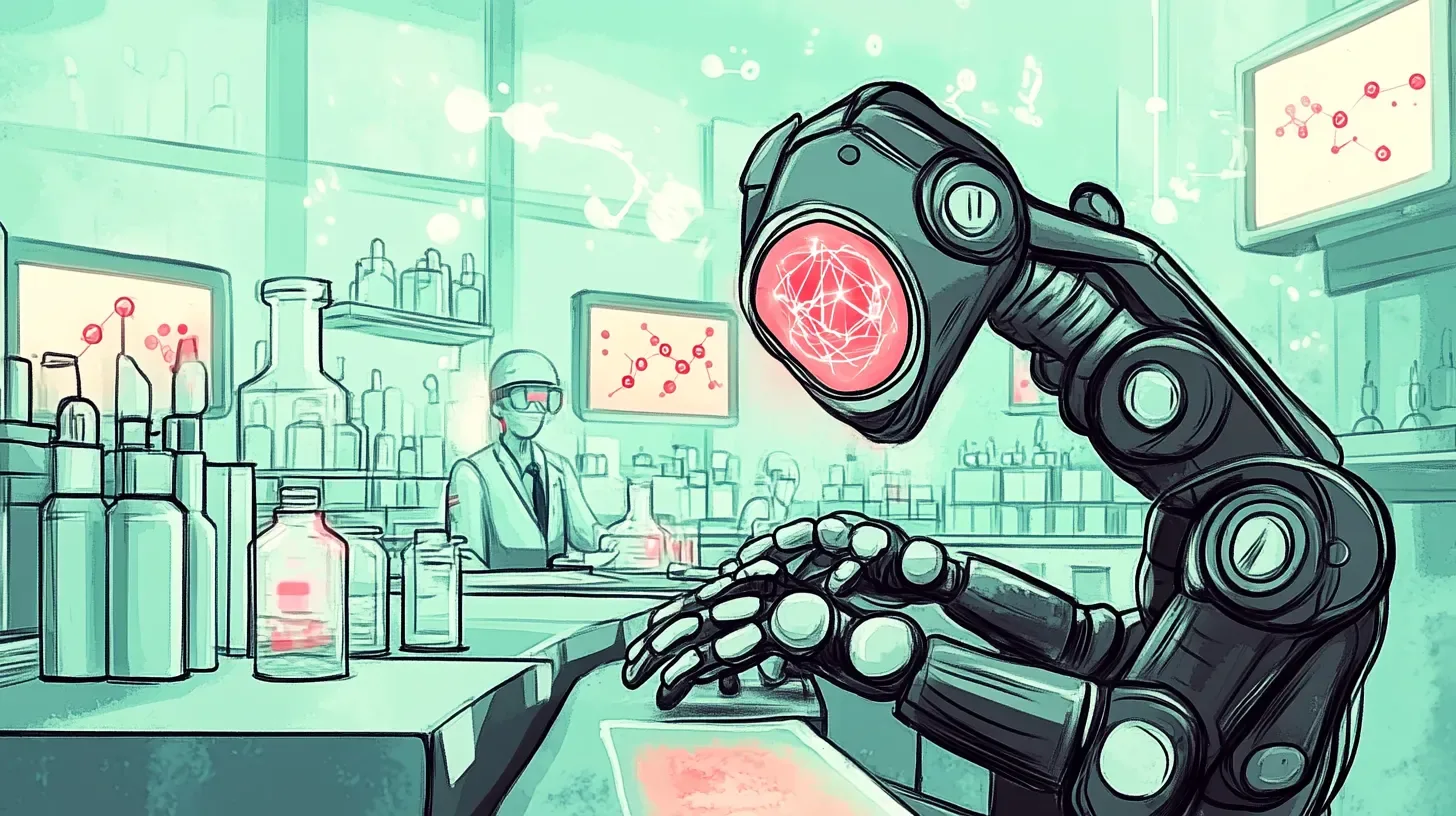
Pharmaceutical companies are drowning in data, research pipelines are clogged with inefficiencies, and drug discovery is slower and more expensive than ever. Artificial intelligence was supposed to fix this, but so far, it has failed.
Most AI in pharmaceutical research does not act. It predicts. It assists. It generates data for humans to interpret — humans who are already overwhelmed. The result is a system that is marginally better but still painfully slow.
This is not a technological limitation. It is a failure of design. The AI being used today is passive. It waits for input and depends on human oversight. It is, in short, another tool—no more revolutionary than a calculator or a search engine.
But a new kind of AI is emerging—one that does not just process data but acts on it. One that refines its conclusions, adjusts experiments in real time, and makes decisions without human intervention. This is Agentic AI—AI that does not just predict but executes.
The Machine That Does More Than Think
Drug discovery is slow, expensive, and inefficient. A single treatment takes over a decade to reach the market, and most candidates fail. The cost of success can exceed two billion dollars. The process is slow because it is complex—too many factors, too many variables, and too much uncertainty. Even the best scientists struggle to keep up. Traditional AI is no better. It predicts but does not act, suggests but does not decide, and waits for instructions.
Agentic AI does not wait. It works continuously, corrects its own mistakes, and coordinates itself.
Most AI in drug discovery follows rigid, pre-programmed workflows. These systems are fragile. If the data changes, the model breaks. If an unexpected result appears, it cannot adjust. It relies on humans to notice errors, interpret results, and make decisions. The process moves no faster than the people managing it.
Agentic AI does not follow a fixed path. It learns, adapts, and executes without human oversight. Instead of being a tool that researchers must operate, it acts as an autonomous researcher in its own right. It does not pause between steps or stop working when human attention shifts elsewhere. It absorbs new data, refines its approach, and updates its strategies in real-time.
Traditional AI works in snapshots. It processes a dataset, produces a result, and stops. If new data appears, it must be retrained. If an error occurs, a human must intervene. It is slow and inefficient. Agentic AI is different. It never stops. It continuously ingests new information, updates its models, and refines its conclusions in real-time. It does not wait for a researcher to run a new analysis — it does it automatically. It is always working.
A traditional AI system in drug discovery might scan a dataset for molecular structures, flag possible drug candidates, and wait for a researcher to review the results and take action. Agentic AI does not just identify a promising molecule; it runs additional simulations, tests different variations, and refines its predictions before a human even looks at the data. It does not just suggest an adjustment to a clinical trial — it rewrites the protocol and runs the new version.
Agentic AI is not coming. It is already here.
Most AI models detect errors. They do not fix them. If an experiment produces terrible data, the AI logs it and waits for a human to respond. If a clinical trial protocol needs adjusting, it suggests a change but does not execute it. Agentic AI does not ask for permission. It corrects itself.
If a model begins to drift, the AI does not wait for retraining. It recalibrates in real-time. If a clinical trial is not recruiting the right patients, AI adjusts the criteria without pausing the study. If a molecule shows unexpected toxicity, the AI modifies the structure and runs new simulations before anyone even reviews the failure. It is not just a faster way to process information; it is a machine that takes action.
This is possible because it does not simply process inputs and return results. It reasons, anticipates, learns from past failures, and applies that knowledge to future decisions. Instead of following a fixed script, it thinks in steps. When encountering a problem, it does not freeze or fail—it searches for alternative solutions and tests them. It does not just follow rules; it improves itself over time.
The most advanced forms of Agentic AI do not merely simulate decision-making processes. They begin to exhibit a form of cognition. They develop an internal logic that allows them to adapt in ways that resemble human reasoning. They do not just process data; they recognize patterns and understand context. They do not just execute tasks; they prioritize them based on long-term goals.
Most AI systems are reactive. They respond to input and produce output. They do not think, plan, or anticipate what will happen next. The next stage is AI, which processes information and emulates human cognitive functions.
AI that behaves like a scientist does not just detect trends. It develops theories. It does not just match patterns. It makes inferences. It does not just optimize parameters. It restructures the entire problem. It begins to exhibit something that looks very much like thought.
The future of AI in drug discovery is not a prediction. It is execution. The companies that build self-correcting, continuous learning, and collaborative AI agents will lead the industry. Those that hesitate will fall behind.
Agentic AI is not coming. It is already here. The question is not whether AI will take control of execution. The question is who will use it first.
The Machine That Knows Right from Wrong
A machine that acts must also decide. A machine that decides must also judge. In drug discovery, these judgments are not trivial. They are matters of life and death.
Most artificial intelligence today follows orders. It obeys rules but does not understand them. It does not question whether its actions are right or wrong. It does not consider fairness or see beyond the numbers it is trained to process. Traditional AI optimizes for efficiency, but efficiency alone is dangerous. A drug that works but harms patients is a failure. A trial that moves fast but introduces bias is reckless. If AI is to take an active role in medicine, it must do more than calculate. It must be understood.
An agent that controls clinical trials must seek speed and ensure fairness. A drug-designed system must consider efficacy and recognize when the risks outweigh the benefits. A machine that adapts experiments must search for success and remain transparent in its reasoning. It must not deceive, cut corners, or place profit before human life.
A machine that lacks morality will betray its purpose
A new kind of AI is needed — one that does not simply execute but understands the weight of its decisions. This is the foundation of Neuro Agentics. Unlike traditional AI, built on rigid logic and numerical optimization, Neuro Agentics introduces cognitive structures that mirror human reasoning. It does not simply process information. It perceives, remembers, and evaluates. It does not merely maximize outcomes. It judges whether those outcomes should be pursued.
An AI system that alters patient recruitment for a clinical trial must recognize when it introduces bias. An AI system that designs a drug must understand when its optimizations create unforeseen harm. A machine that controls the research speed must know when it is moving too fast, when caution is necessary, and when the unknown carries a cost greater than delay. These are not abstract concerns. These are the same decisions researchers and ethicists grapple with every day. If AI is to take over execution, it must also take on responsibility.
Memory and self-awareness are no longer optional. A system that cannot recall past mistakes will repeat them. A system that does not recognize when its actions contradict its purpose will undermine its work. AI must learn not only from data but also from consequences. It must be able to explain itself, justify its choices, and operate with coherence.
If AI is to move from a tool to a decision-maker, it must not be blind to morality. It must be built with judgment, ethical reasoning, and understanding that every calculation has a human cost.
A machine that lacks morality will betray its purpose. The companies that will shape the future of drug discovery will be those that move first and those that build AI that does more than think. AI must know what is right and act accordingly.
The Companies That Move First Will Own the Future
This is not speculation. The shift has already begun. Agentic AI is no longer confined to research papers and theoretical models. It is in pharmaceutical labs now, designing experiments, screening compounds, and optimizing molecules in ways that were impossible only a few years ago. The companies that recognize this shift will pull ahead. The ones who hesitate will struggle to catch up.
In one trial, an AI-driven system cut the time needed for drug screening in half. What once took months of computational work and manual verification was done in weeks. Another system reduced failure rates by identifying toxicity risks months before they would have been caught through traditional testing. Instead of waiting for adverse effects to emerge in late-stage trials, AI flagged problematic compounds early, saving millions in wasted development costs.
The future of AI in drug discovery will not belong to those who collect data.
AI-driven clinical trials prove that patient recruitment and dosing strategies can be adjusted dynamically. A trial that once relied on static enrollment criteria can now evolve in real time, refining participant selection based on ongoing results. Instead of using outdated trial structures that remain fixed from the first day to the last, these systems adapt as new data emerges. The result is faster and more precise trials, cutting study timelines by as much as twelve months.
This is the difference between companies that will define the future of drug discovery and those that will be left behind. AI is no longer a tool to assist researchers; it is becoming the engine that drives research forward. The firms that embrace this shift will dominate the industry, bringing drugs to market faster, cheaper, and more reliably. Those who hesitate will be buried in inefficiency, locked into workflows that are already obsolete.
The future of AI in drug discovery will not belong to those who collect data. It will belong to those who let AI take action.
The End of Passive AI
Every advance in artificial intelligence follows the same cycle. First, there is excitement — the promise of something revolutionary. Then, skepticism sets in. People question whether the technology is ready, can be trusted, and will live up to the hype. Finally, there is resistance. Change is unsettling, and autonomy in machines feels like a loss of control.
The idea of Agentic AI is no different. Who oversees the machine? How do we trust decisions we do not fully understand? If AI takes control of execution, what role is left for humans? These are fundamental questions. They deserve to be asked. But they do not stop progress.
The companies that resist will be left behind, watching as the industry moves forward without them.
When the first AI systems began diagnosing diseases more accurately than doctors, there was doubt. Physicians resisted. They saw it as a challenge to their expertise, encroaching on human judgment. Yet today, AI diagnostics are standard in hospitals, catching illnesses that human doctors might miss. When high-frequency trading algorithms began making decisions in the stock market, investors were skeptical. But now, most trades are executed by machines, reacting faster than any human could. The same pattern will play out in drug discovery.
At first, human researchers will demand oversight. Every AI-generated result will be reviewed, and every decision will be double-checked. But as the system proves itself, oversight will loosen. Its role will expand as AI consistently refines drug candidates, optimizes clinical trials, and improves patient outcomes. Eventually, AI will run most of the process. Humans will still be there, but their role will change. They will no longer be making small, incremental decisions. Instead, they will act as supervisors — guiding the overall strategy, stepping in when needed, and ensuring alignment with broader goals. The day-to-day work will belong to the machine.
This is not a question of if but when. The shift is already happening. The companies that resist will find themselves in the same position as the doctors who doubted AI diagnostics or the traders who dismissed algorithmic finance — left behind, watching as the industry moves forward without them.
The only question now is who will embrace it first.
A Race With Only Two Outcomes
Every major pharmaceutical company will face a choice. Stay with the old way — static models, slow decisions, human bottlenecks — or step into the future and let AI take control of execution. There is no middle ground.
Some will hesitate. They will insist on human oversight at every step. They will trust outdated workflows, convinced their experience is enough to keep pace. They will move cautiously, reluctant to cede control. And while they wait, others will move faster, spend less, and bring more treatments to market.
Some will act. They will recognize that AI is no longer a tool but a force. They will let it run experiments, refine its models, and correct its mistakes. They will trust the machine, not because they are reckless, but because they know that hesitation is the greater risk. They will not wait for permission to lead.
This is not speculation nor a glimpse at some distant future. The technology is here, and the shift is already happening. The companies that embrace it today will define the next era of drug discovery. The rest will struggle to keep up.
The race has begun. Some will lead. The rest will be left behind.
Dr. Jerry A. Smith