Building Minds
Agentic Engineering Is the New Operating Model
Dr. Jerry A. Smith · May 9, 2026 · 9 min read
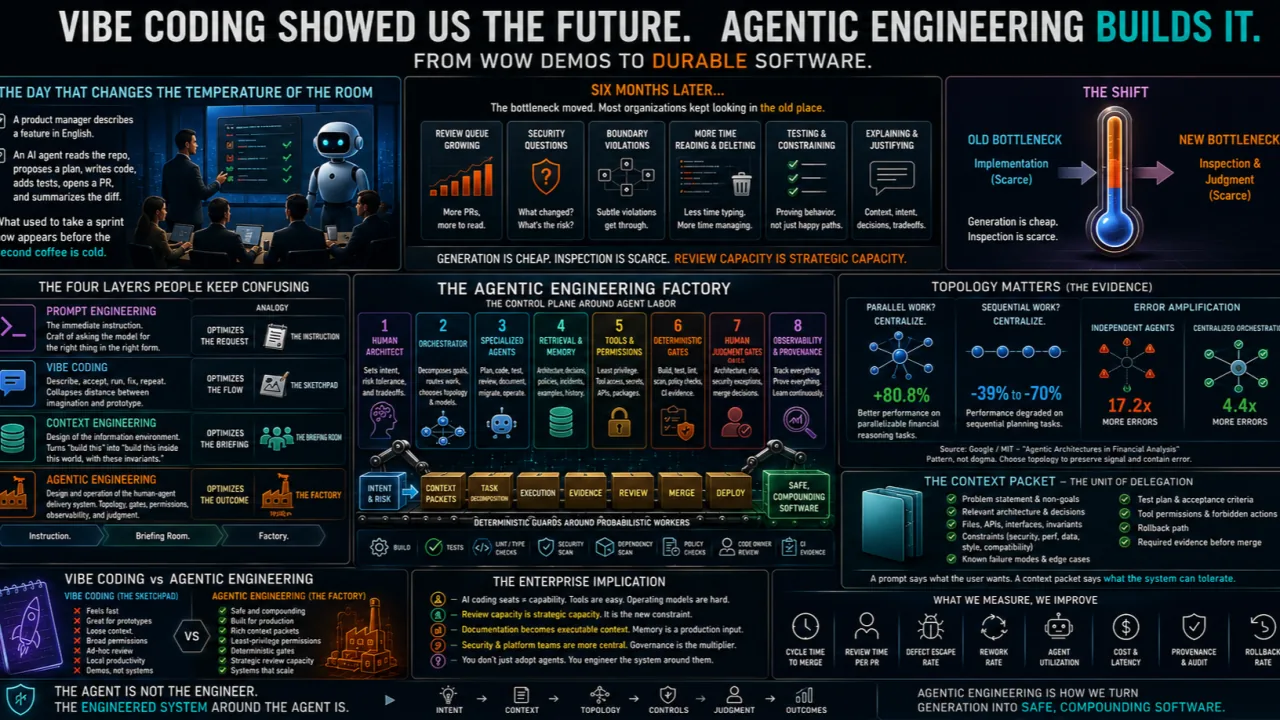
A CTO walks into the board meeting with a demo that changes the temperature of the room.
A product manager describes a feature in English. An AI agent reads the repository, proposes an implementation plan, writes the code, adds tests, opens a pull request, and summarizes the diff. What used to take a sprint now appears before the second coffee is cold. The board sees the obvious future: software described instead of typed, roadmaps compressed, expensive backlogs evaporating into an agentic blur.
Six months later, production velocity has barely moved.
The prototypes are real. The excitement was not fake. The agents did write code. But the organization could not safely absorb code at the speed at which the agents could produce it. Review queues grew. Security teams asked what had changed. Architects found subtle violations of system boundaries. Engineers spent less time typing and more time reading, deleting, testing, constraining, and explaining agent-generated work.
The bottleneck moved.
Most organizations kept looking in the old place.
This is the transition from vibe coding to agentic engineering. Vibe coding made the new interface visible: describe intent, iterate with a model, watch software appear. It is powerful, especially for prototypes and exploratory work. But production software is not a transcript of intent. It is a governed system of architecture, constraints, tests, ownership, security, and institutional memory.
A prompt produces code. An operating model produces software.
That operating model is agentic engineering.
The four layers people keep confusing
The language around AI coding is still immature, which is why teams often argue about different layers as if they were the same thing.
Prompt engineering is the immediate instruction. It is the craft of asking the model for the right thing in the right form. It matters, but it is local. It optimizes the request.
Vibe coding is the broader interaction pattern: describe the application, accept generated code, run it, fix it, and keep going by feel. It collapses the distance between imagination and prototype. It is a magnificent sketchpad. It is also fragile when the sketch becomes infrastructure.
Context engineering is the design of the information environment around the model: repository state, architecture history, constraints, prior decisions, interfaces, examples, tests, policies, known failure modes, and memory. Context engineering turns “build this” into “build this inside this world, with these invariants, under these conditions, with this evidence required before merge.”
Agentic engineering is the next layer up. It is the design and operation of the human-agent software delivery system: context packets, task decomposition, topology, model routing, tool permissions, deterministic gates, observability, provenance, security review, and human judgment at the right choke points.
Prompt engineering is the instruction.
Context engineering is the briefing room.
Agentic engineering is the factory.
The mistake is to treat the factory as merely a better prompt. That is how organizations end up with convincing demos and disappointing production results. The agent may be capable, but capability without structure becomes unreviewed change.
Generation is cheap. Inspection is scarce.
Software teams used to treat implementation throughput as a scarce resource. Could we write the code? Could we staff the tickets? Could we finish the migration? Coding agents change that assumption. They do not eliminate implementation work, but they make implementation much less obviously scarce.
The scarce capacity migrates downstream.
Someone has to read the diff. Someone has to know whether the generated code violates a boundary that was never written down. Someone has to decide whether the test is proving the behavior or merely confirming the happy path the agent imagined. Someone has to notice that the agent installed a dependency for convenience, widened a permission for expedience, or reproduced a vulnerability pattern with great syntactic confidence.
GitHub's own guidance on AI-generated code points in this direction: reviewing AI-generated code is becoming an essential part of the modern developer workflow, with automated tests, static analysis, human oversight, and deeper review especially important for large or legacy changes. That is not an anti-agent position. It is the production position.
The security evidence makes the point sharper. Current research on AI code review, including the Copilot Code Review security analysis cited in the research base for this piece, cautions against treating AI review as a substitute for security review. The reported failure modes include familiar categories such as SQL injection, cross-site scripting, and insecure deserialization. The lesson is not that AI should be kept away from code. The lesson is that probabilistic workers need deterministic and human judgment systems around them.
If agents can create 100 pull requests, the architecture must specify how 100 pull requests are bounded, prioritized, tested, reviewed, merged, reverted, and audited.
Review capacity is no longer a back-office concern. It is a strategic capacity.
The context packet is the unit of delegation
The atomic unit of agentic work is not the prompt. It is the context packet.
A prompt says what the user wants. A context packet says what the system can tolerate.
A strong context packet contains the problem statement and the non-goals. It names the relevant architecture history and prior decisions. It points to the files, APIs, interfaces, and invariants that matter. It lists the security, performance, style, data, and backward-compatibility constraints. It describes known failure modes and edge cases. It specifies the test plan and acceptance criteria. It defines tool permissions and forbidden actions. It names the rollback path. It says what evidence must appear in the final handoff.
This is where context engineering becomes operational rather than decorative. “Context is the new code” is directionally right, but incomplete. In agentic engineering, context is also a schema, a control surface, a memory, and a safety boundary.
A poorly briefed agent behaves like an intern with partial instructions and root access. A well-briefed agent behaves more like a bounded worker inside a production system. The difference is not in politeness or promptness. The difference is whether the organization has encoded enough of its architecture into the work environment for the agent to operate safely.
That encoding is hard because much of software engineering lives outside the codebase. It lives in decisions, scars, naming conventions, incident history, compliance expectations, customer promises, and architectural taboos. Human engineers carry these as memory. Agents need them as context.
Recommended by LinkedIn
[ Harness engineering
Filip Hric
Harness engineering
Filip Hric
6 months ago](https://www.linkedin.com/pulse/harness-engineering-filip-hric-8dwge)
[ AI will force us to redesign the engineering…
Sascha Perkowski
AI will force us to redesign the engineering…
Sascha Perkowski
6 months ago](https://www.linkedin.com/pulse/ai-force-us-redesign-engineering-organisation-sascha-perkowski-myd0f)
[ Engineering with the New AI: Copilots, Agents, and the…
Navveen Balani
Engineering with the New AI: Copilots, Agents, and the…
Navveen Balani
1 year ago](https://www.linkedin.com/pulse/engineering-new-ai-copilots-agents-human-navveen-balani-h22mf)
Agentic engineering, therefore, turns documentation from a passive artifact into an active production input. Architecture records, runbooks, tests, policies, examples, and postmortems stop being “nice to have.” They become the material from which agent labor is constrained.
Topology is not decoration
The next mistake is to assume that agentic engineering means adding more agents.
It does not.
Agentic engineering means choosing the topology that fits the work.
Building Minds Edition 12 - The Exponential Stack framed this as anatomy: models are organs; topology is the anatomy around them. The Google/MIT topology research adds the cautionary evidence. In the vault synthesis of that paper, centralized hub-and-spoke systems improved the parallelizability of financial reasoning by 80.8% over a single-agent baseline. The same research found that multi-agent variants degraded sequential planning tasks by 39–70%. Independent agents amplified errors 17.2x, while centralized orchestration reduced error amplification to 4.4x.
The numbers should not be universalized beyond their task setup. But the pattern is durable enough to matter.
Parallel, decomposable work can benefit from specialized agents. A planner can break down the task. A coder can implement a bounded slice. A tester can construct a validation. A reviewer can look for security and architecture drift. An orchestrator can synthesize evidence and decide what is ready for a human.
Sequential, tightly coupled work can get worse when split across agents. Handoffs lose state. Coordination consumes the cognitive budget. Errors propagate through interfaces. The team becomes a committee where one coherent reasoner would have been better.
That distinction is why the mature question is not “How many agents can we spawn?”
The mature question is: which topology preserves the signal while containing error?
For many production coding workflows, the safest default is not a peer-to-peer swarm. It is a hub-and-spoke control plane. A human architect or product owner sets intent and risk tolerance. An orchestrator decomposes the work and routes bounded tasks. Specialized agents execute inside narrow permissions. Deterministic gates test the result. Human judgment gates approve architecture, handle ambiguity, and make security exceptions, and merge decisions.
The orchestrator is not merely a productivity feature. It is a safety mechanism.
The control plane around the agent labor
A production agentic engineering system has several layers.
First, the human architect decides what matters. This is not romantic human exceptionalism. It is risk allocation. Someone has to resolve ambiguity, make trade-offs, and decide which errors the organization can accept.
Second, an orchestrator decomposes goals into bounded work units. It prevents agent sprawl. It decides which work should be single-agent, which should be parallelized, which model should be used, and what evidence must come back.
Third, specialized agents do narrow work: planning, coding, testing, reviewing, documenting, migrating, and operating. Specialization matters because generalist context windows bloat quickly. A small, relevant context beats a giant, confused one.
Fourth, a retrieval and memory layer supplies the organization’s accumulated knowledge: architecture decisions, style rules, incidents, policies, examples, interfaces, and prior attempts. Without this layer, each agent begins as a talented stranger.
Fifth, a tool-and-permission boundary controls what agents can touch. Repository access, package managers, CI, secrets, deployment systems, data stores, and external APIs cannot be treated as a single undifferentiated tool belt. Permissions are architecture.
Sixth, deterministic gates wrap probabilistic workers: build, tests, lint, type checks, dependency scanning, security scanning, policy checks, code-owner review, and CI evidence. The more autonomous the agents become, the more important these gates become.
Seventh, human judgment gates remain deliberately placed. Humans should not review every keystroke. They should review architecture, risk acceptance, ambiguous requirements, security exceptions, and the evidence trail around meaningful change.
Finally, observability becomes agent ops. The system should track model routes, tool calls, costs, latencies, failures, rework, defect escapes, review times, provenance, and rollbacks. If the organization cannot say which agent made a change, in what context, with what tools, under which tests, and by whom it was accepted, it has not built an agentic engineering system. It has built a faster mystery.
The enterprise implication
AI coding seats do not equal agentic engineering capability.
A company can buy every developer a coding assistant and still preserve the old operating model. Engineers may type less. Tickets may move faster. Demos may improve. But unless the organization redesigns review, architecture, context, governance, measurement, and talent development, the gains leak into local productivity rather than compounding in software delivery.
This is the same conversion problem Building Minds has already traced for enterprise agents generally. A pilot proves the agent can perform a task. Production proves the organization can change around it.
For software teams, that change is uncomfortable because it touches identity. Developers do not disappear; the center of gravity moves. The valuable work shifts toward architecture, decomposition, constraint-setting, debugging, test design, review, and operating the system around agent labor. Junior pipelines have to be redesigned to read, test, instrument, and repair agent output, not merely write boilerplate from scratch. Security and platform teams become more central, not less. Documentation becomes an executable context.
Procurement changes, too. AI coding systems become part of the software supply chain. The question is no longer only whether the tool improves developer productivity. It is whether the tool preserves provenance, respects permissions, produces auditable evidence, integrates with controls, and can be governed when it is wrong.
The winning firms will not merely adopt coding agents. They will build agentic delivery systems.
That is the durable advantage. Vibe coding made the new interface visible. Agentic engineering makes the system around it durable. The frontier is not whether agents can generate code. They can. The frontier is whether organizations can engineer the context, topology, review capacity, permissioning, observability, and human judgment that make agent-generated change safe and compounding.
The agent is not the engineer.
The engineered system around the agent is.